

Podcasts
Our podcast: What should we expect from journalism in 2026?


A special edition of French satirical newspaper Charlie Hebdo lies amid wreaths and pencils left in front of its former offices during commemorations marking 10 years since an Islamist attack on the magazine. LUDOVIC MARIN/Pool via REUTERS
Journalism is, by design, perishable. A piece is valued for its immediacy – at best it circulates for a few weeks – and then disappears into the archives. This archive might serve as an internal database for journalists, maybe the occasional article resurfaces via search for a reader, but mostly, it remains (either literally or digitally) in dusty boxes in a back room.
But as news organisations look for ways to tackle news fatigue and bring in new audiences, some newsrooms are experimenting with how these can be repurposed.
I spoke with journalists at The Economist, Charlie Hebdo, RetroNews, and Archivi.ng about how they are using their archives as a source for new stories, a way to pass on their editorial identity, and as a service to both their readers and their journalists.
The most basic way to use your archive is to simply republish.
Fraser McIlwraith, Foreign Correspondent at The Economist, told me how the team occasionally resurfaces old gems, pairing, for example, their original 1848 review of Wuthering Heights (“interesting, it certainly is, but the interest is not a pleasing one”) with a review of its 2026 film adaptation, or revisiting their 1981 article on the attempted assassination of Ronald Reagan in the wake of the attempted assassination of Donald Trump in 2024.
“It’s a way of breaking from the news cycle and giving readers something that offers a different perspective on contemporary events,” he said. “It also just has some really great writing in it.”
But straight-forward reprints have their limits.
“Many of those pieces [from the archive] can be quite impenetrable to modern readers. You often need to guide people through them, explain who the various figures are, and introduce people who might otherwise be mentioned without any context.”
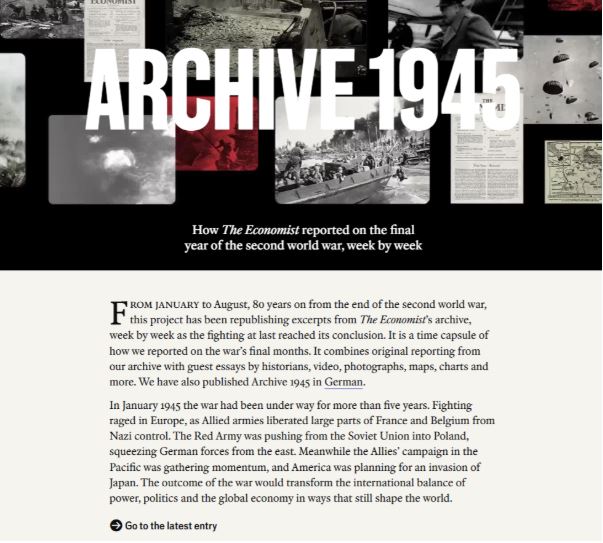
Recently, the team has been experimenting with repurposing their archives into entirely new editorial products. They started with a weekly Dateline quiz, a game that challenges readers to guess the year specific excerpts from its archive were written.
That proved popular with subscribers, so larger experiments followed, like the Archive 1945 project. Using original reporting from The Economist’s archive, McIlwraith and his colleagues created an interactive timeline that revisited the events of 1945 week by week, along with guest essays by historians, videos, photos, and maps to add context. The idea was to create the feeling of reliving those events in real time across 2025.
“It was a way of bringing what is essentially a static historical archive to life by giving it a weekly rhythm,” said McIlwraith.
Readers liked that one too, so they launched America at 250, another timeline project which is currently using the magazine’s archive to track the history of the United States over seven monthly chapters.
“That project is much more consciously in dialogue with the present than Archive 1945 was,” explained McIlwraith. “When you read our coverage of the United States from the 1840s, you see that we were asking many of the same questions that we are still asking today: whether trade will remain open, whether democracy will remain free and fair, and so on. There are a lot of continuities there, and analytically that’s quite helpful.”
It also serves to complement daily news coverage of the country by giving perspective on the present.
“[The project] allows you to step back and see that the United States has gone through very divided and turbulent periods before and has managed to come through them. It can even make you a little more hopeful about the present than you might otherwise be.”
A similar emphasis on using archives to reflect on the present is found at RetroNews, the press archive site of the Bibliothèque nationale de France (BnF). Its editorial team of three uses the vast collection of BnF digital press archives to write pieces connecting the past to contemporary news.
“Press archives capture a moment in time – specifically, the perspective of a newspaper at that moment – and that’s extremely valuable,” said Marie Le Roch, Head of Editorial at RetroNews.
She told me how press archives allow for a more nuanced view of current affairs - and even a degree of novelty to topics that might otherwise be glazed over by audiences saturated with daily news.
“For example, I recently worked on a series about how France reshaped its agricultural landscape after World War II through land consolidation programs linked to the Marshall Plan. That history helps explain current debates about agriculture in France today. These debates didn’t appear out of nowhere – they are the result of historical processes, and press archives from the period help you understand that.”
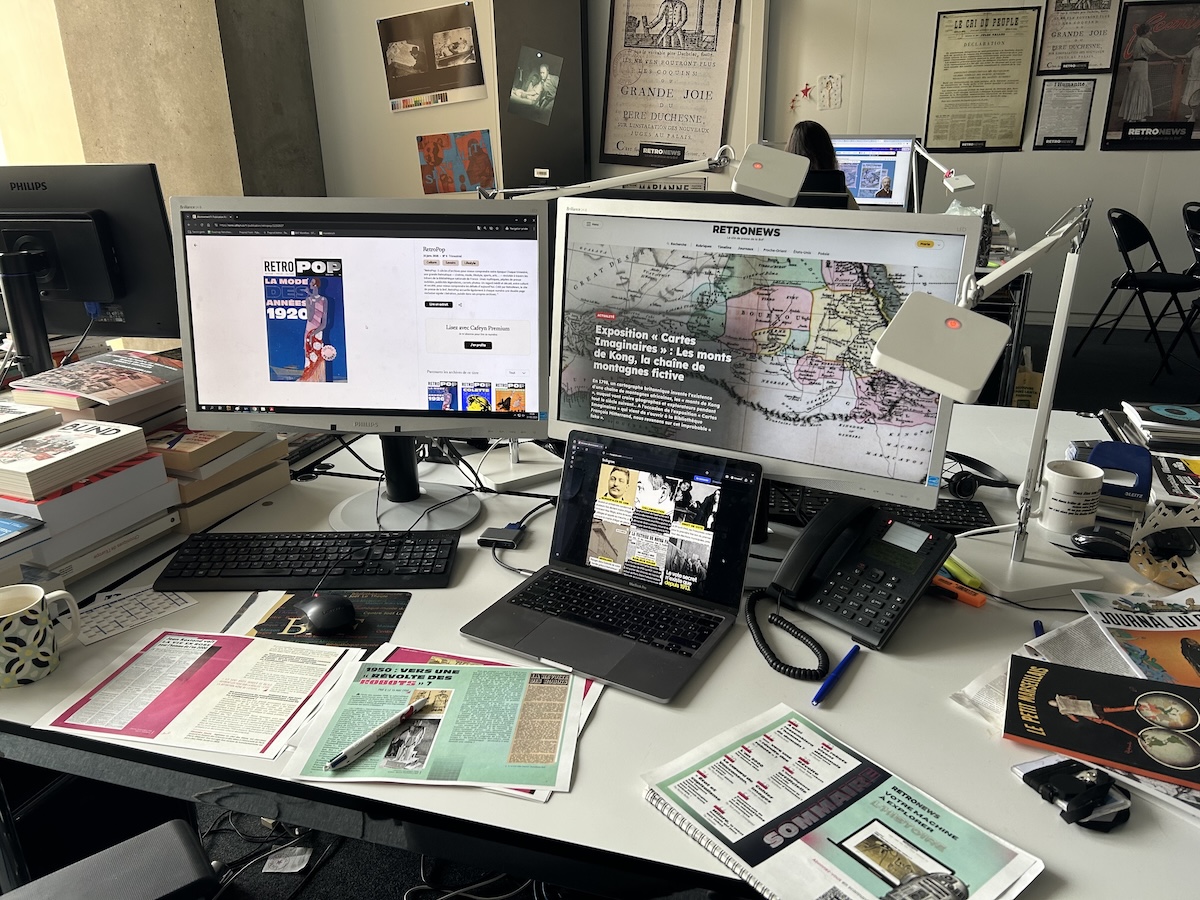
While RetroNews’s basic archive collection is free to browse, the editorial content sits behind subscriptions, most of which are purchased by universities and libraries. The site also relies on partnerships with mainstream news organisations as a way to bring its reporting to wider audiences.
This includes RetroSport, a series done with the national paper Libération during the 2024 Paris Olympics, which resurfaced its coverage of the 1924 Paris Olympics – highlighting, for instance, how the Parisians of 100 years ago had many of the same complaints about hosting the games as those of 2024, like overcrowding, transport delays, and costs.
They have done similar partnerships with Radio France, producing a podcast that looks at how the French press has covered crime news across history, and with Géo magazine on the 80th anniversary of the trials of Philippe Pétain.
“Generally, these collaborations are easier in summer series or special anniversary features rather than in daily news coverage. But we’re trying to encourage more use of archives in relation to current events.” They recently launched a newsletter specifically for newsrooms, highlighting archive material that can be linked to current events.
Like McIlwraith, Le Roch told me how working with archives can change your perspective on current affairs – though she cautioned against using press archives to make too many assumptions about the present.
“Sometimes people compare today’s politics with the 1930s, for example,” she said. “But we prefer to involve historians so we don’t draw misleading parallels. Our goal is really to provide context, not forced comparisons.”
Archivi.ng is taking on a similar challenge in Nigeria. The project, which launched in 2020, has digitalised thousands of Nigerian newspapers to make them accessible to journalists and the public. Like RetroNews, their aim is to connect these archives to the present and add context and nuance to current public debates.
In addition to compiling a database of press archives, the team develops original editorial products out of the material they archive - like this interactive game which helps readers grasp the scale of corruption by Gen. Sani Abacha, the Nigerian Head of State found guilty of stealing $3.65 billion of state funds from 1993 to 1998.
“When we started the project, we thought that the raw materials, the ‘cocoa pods’ of information, were the most valuable part of the process,” Fu’ad Lawal, Chief Archivist at Archivi.ng told me. “But actually, what people want are the ‘chocolates’: clear answers and insights derived from those raw materials.”
In other words, access to archival documents alone generally isn’t enough to get people's interest.
“That realisation has refined our approach. We now treat digitisation as an upstream effort, focused first on extracting and preserving material so it isn’t lost. But our focus is then on expanding its usefulness. In a newsroom context, that means enabling reporters to quickly find the answers they need and make history relevant in real time.”
They are currently developing a tool that uses archival data to track recurring incidents of ballot box snatching across Nigerian elections.
Once the press materials are digitalised, many of these projects are developed with relatively limited tech and resources.
The Economist’s archive projects, for instance, have been fairly low-tech. “Most of the work was manual, going through digital scans of old articles, with careful judgment to select what seemed interesting,” McIlwraith said.
In contrast to other publications like The Atlantic, which last year appointed its first in-house archivist, The Economist’s approach has also not been hugely resource intensive: “The work is picked up by people who have other day jobs and do it in their spare time. People definitely work hard and have committed a lot of time, but we haven’t felt the need for a dedicated archives editor to oversee these projects.”
Increasingly accessible AI tools have also opened up the potential for archives to be repurposed with relatively little resources.
Chris Moran, Editorial Lead on Generative AI at The Guardian, recently spoke about how his team used AI tools to build an internal chatbot that lets journalists query the archive, as well as an initial experiment with tag pages that pulls from the paper’s archives to create AI-generated summaries of past events. Similarly, L’Eco di Bergamo, a local newspaper in Italy, has used AI to repurpose more than 70 years of obituaries from its archives to create a database for readers to explore their local and family history.
“The first thing newsrooms can start by doing is making it ridiculously easy for their own journalists to discover their internal archives,” Lawal said. “It’s important for the archives not to feel far off and locked away.”
Once a user-friendly internal database is in place in a newsroom, he says, journalists can be encouraged to develop new products and stories from the material.
Beyond editorial products, some newsrooms are also using their archives to tell the story of the newspaper itself.
Le Roch points me to an example from the French Catholic newspaper La Croix, which a few years ago published a dossier in which they used their archives to address the paper’s antisemetic past.
“I find that very interesting – a newspaper acknowledging and explaining its own history via its archives,” Le Roch said. “Not every newspaper is comfortable doing that. But a paper’s history inevitably shapes the editorial line today. When you write as a journalist, it’s your own voice, but you are also writing under the name of a newspaper with a long history.”
She suggested I speak with the team at Charlie Hebdo about this, and how they use their archives to help onboard new journalists in particular – which seemed like a good idea, because if there is any newspaper that has consequential, complicated history in French media and society, it's Charlie Hebdo. The satirical weekly paper has long been associated with a combative, irreverent strain of French republicanism, and many people will remember it was the target of a terrorist attack in 2015 that killed 12 people.
Each of the journalists I spoke to there had a lot to say about the role of their archives in shaping their journalism.
Jean-Loup Adénor, the magazine’s Deputy Editor-in-Chief, told me about how new team members are encouraged to spend time in the archive room, reading past issues and books about the paper’s history.
“This allows them to do two things,” says Adénor. “First, to better understand the ideological positioning of the paper and the causes Charlie has defended; and second, to draw inspiration from the tone and the freedom we have in writing here.”
“I’ve worked in more traditional media like France Info and Ouest-France, and there, it’s easy to imagine yourself in a rigid framework,” he explained. “But it’s much harder to project yourself into a free one. That’s what’s both reassuring and intimidating about the freedom here.”
“When I started at Charlie, I wanted to understand exactly what the paper was, so I spent a lot of time in the archives reading old issues,” said Yovan Simovic, a journalist who started at the paper in September 2023. “The Editor-in-Chief often tells us: you are completely free in your writing here. But that freedom is a bit frightening, and you don’t immediately understand what it means. So going to read the old issues, understanding how they spoke, how they described the world, how they wrote - all of that helped me to understand what he meant. Of course, we don’t want to copy [previous journalists], but it helps to see how free we are by seeing what they were able to write.”
Each of them had a favourite piece from the archive they could point to – for Simovic, it's a piece of embedded reporting done in Afghanistan by journalist Agathe André, for Adénor it’s the survivors issue published the week after the 2015 attacks – and told me how they’d pinned articles or cartoons from past editions to the walls of the newsroom for inspiration.
Adénor suspects that understanding your newspaper’s history is particularly important at Charlie Hebdo.
“Maybe the emotional attachment to the paper is different at Charlie than at other newsrooms. I’m trying not to be too grandiloquent in what I say, but the fact is, for secular, left-wing, republican-left journalists, working at Charlie Hebdo is not trivial,” Adénor says, referring to the price many of journalists have paid (and continue to pay) to work there.
“I feel a responsibility to do my job as well as possible, and that requires knowing the paper’s history. I’m not a historian, and I don’t aim to become an expert, but I do need to understand the major milestones.”
He feels he owes it to the audience as well.
“Many of our readers have followed the paper for decades. They often know the paper better than we do. So when we receive criticism, it helps to understand where it’s coming from, historically.”
“You feel a kind of responsibility to respect that memory by understanding it,” agreed Etienne Le Page, an intern who started last autumn. “You can’t just write without context. You need to know what happened at the paper in the past, and how the paper functions and continues. That’s something you learn to do by reading past editions of the paper.”
In every email we send you'll find original reporting, evidence-based insights, online seminars and readings curated from 100s of sources - all in 5 minutes.