




News
This journalist built a database tracking thousands of cases of AI adoption in news organisations. Here’s what she’s learnt

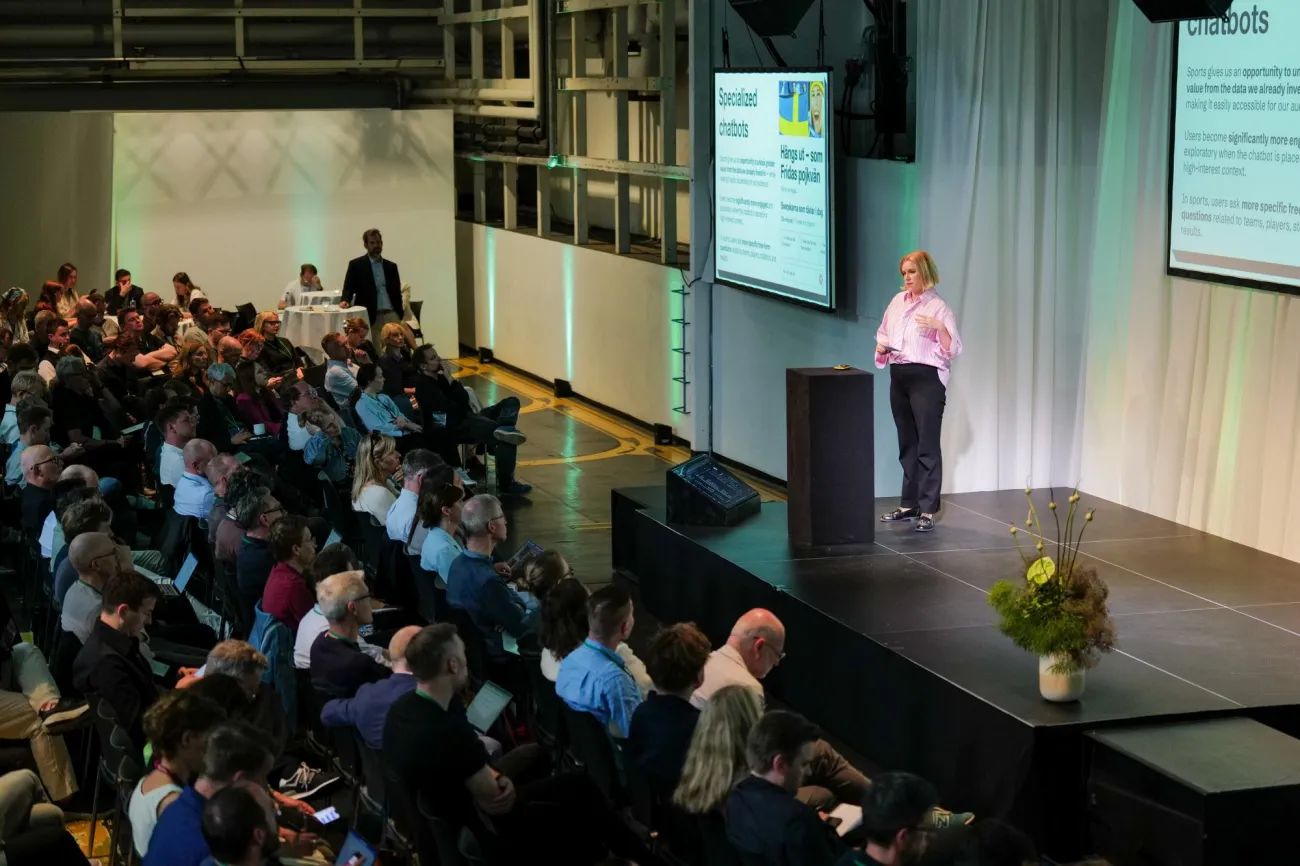
Image courtesy of the Nordic AI in Media Summit
After another year of fast-paced innovation, media managers, experts and academics posed a few tough questions at this year’s Nordic AI in Media Summit (NAMS), hosted at the JP/Politikens former printing press. Both the ink-stained walls and the lyrics of Video Killed the Radio Star served as reminders that the news industry has survived previous rounds of technological changes. But Canadian AI expert Nikita Roy warned the audiences that survival is not a given: “Awareness is not immunity.”
The fourth edition of the summit, hosted in Copenhagen by the Nordic AI Journalism Network, shifted the focus from tools and experiments to some of the more fundamental issues AI is surfacing for the news industry. What will the news economy look like? What (and who) will be automated? What will journalism mean in the age of AI? Speakers and attendees agreed the jury is out for all of these questions. Or at least, no one has definitive answers for them yet.
NAMS is led by Olle Zachrison, head of news AI for BBC News, Kasper Lindskow and Sara Inkeri Vardar from JP/Politikens Media Group, and Agnes Stenbom Swedling from Schibsted, who until recently was a visiting fellow at the Reuters Institute.
The summit included keynote lectures by experts such as Ezra Eeman from NPO, Nikita Roy from Newsroom Robots and our senior research associate Rasmus Kleis Nielsen, now at the University of Copenhagen. There were also presentations of AI projects and tools from many organisations, and breakout sessions targeting specific issues, with most of the latter held under Chatham House rules.
If you couldn’t be in Copenhagen this week, here are five key takeaways from the summit, ranging from broad questions on how AI will change the future of journalism to more practical takeaways from newsrooms navigating these changes. You will soon be able to catch up with the conference programme in full here.
The impact of AI will bring a fundamental restructuring of both the supply and demand side of the news economy, said Shuwei Fang, a Shorenstein Fellow at the Harvard Kennedy School. As she explained in this powerful essay we published in March, she predicts four paradigm shifts: scarcity to abundance, a human audience to a machine audience, attention to intention, and artefacts to liquid content.
She believes these shifts will result in significant changes for the news ecosystem. For example, news production could shift from a “stock model,” where a news product is first produced and subsequently consumed by users, to a “flow model” where content is crafted at the moment of consumption specifically for a particular user.
Another shift could be news going from a B2C product to B2A2C (business to agent to consumer). Here, the “A” layer includes multiple agents with different needs in their own right, depending on their purpose.
The ecosystem emerging can produce answers to extremely niche, detailed questions addressing individuals’ needs, Fang said. While this presents opportunities, the distance that AI creates between audiences and news organisations could alienate publishers from important information about what audiences need from them.
Fang also predicted that the market for news could start to bifurcate between luxury and commodity, with extremes at either end and a hollowed-out middle. The luxury end would be defined by intangible qualities like brand identity and trust, with offerings like member communities and shared live experiences. The commodity end will be defined by infrastructure and integration.
There would be AI and human presence across both ends of the spectrum. The middle, where most news organisations sit today, would be dangerous ground, Fang said.
Despite the risks inherent to the scenarios she painted, Fang is not a pessimist. “The market for knowledge could get much bigger,” she said, with possible expansion both on the supply and demand side. Opportunities include lower production costs and the possibility to use AI to reach underserved audiences.
However, the value brought by AI may not be evenly distributed, and power could concentrate in a handful of players. For news organisations thinking about how to position themselves for the future, Fang heeded a warning: “Be suspicious of solutions that require the least amount of change.”
If the news industry is to reorient itself in light of AI, it will need to redefine itself. “People don’t want news, as in facts, but they might want sensemaking,” said Florent Daudens, CEO and co-founder of Mizal AI, a startup offering production agents for media companies. This is why Substack is growing even as other forms of media struggle, he said.
Facts might not be a great bet in a news ecosystem increasingly mediated by AI either, Daudens said, as tech companies could get them by striking a deal with a single newswire.
This thought was echoed by Fang: there’s so much free information online such as research and press releases that AI companies could draw from, and that, for some, may be indistinguishable from journalism by news organisations.
Nikita Roy suggested we are at a turning point that, if missed, could spell disaster for the news industry. “We are in our Nokia and Kodak moment, where we are looking at a new product but thinking with the metrics of an old product,” she warned. Instead of worrying about how to recover lost web traffic and otherwise defend the status quo, we need to leave behind old assumptions.
AI is disrupting something more fundamental, Roy said: how information moves, how value is captured, what it means to be a media company.
This is a bigger shift than the one from print to digital, as then the role of the publisher remained largely the same. To Roy, publishers may be approaching this from a loss perspective, feeling their losses but not considering what they could gain.
Echoing Fang, she also asked those present to consider the people they could reach that it had not been possible to serve before. “We mistake the container for journalism,” she said, referring to an article, a podcast episode or a newsletter issue. And then she asked a fundamental question: “If you knew nothing about websites, but you knew people still needed verified information to navigate their lives, what would you build?”
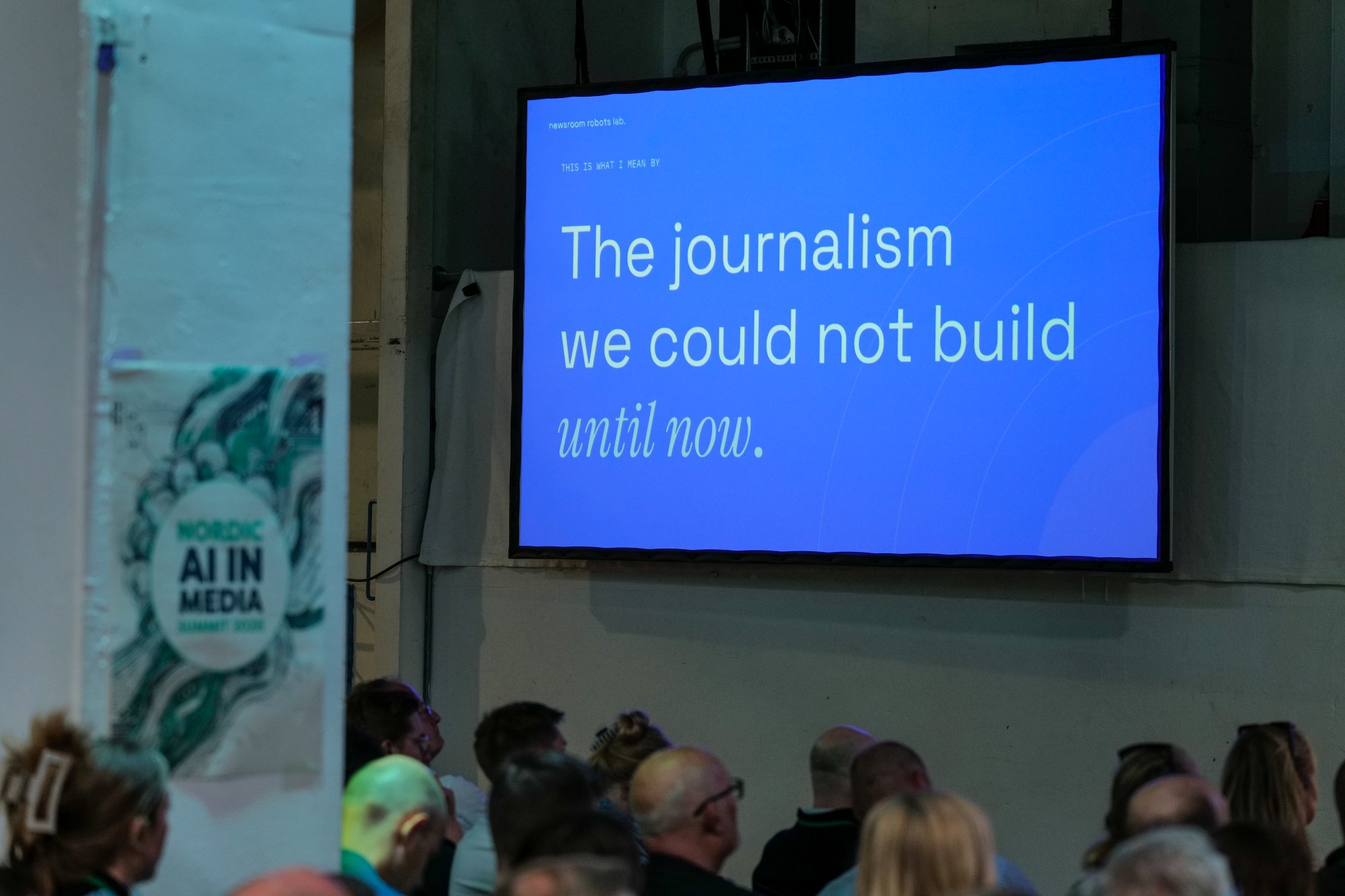
Agents took centre stage at this year’s summit. In a future when many people navigate the web with their own personal agent, as David Caswell outlined in an essay we published last year, publishers’ relationships with audiences would be mediated through this middle layer.
Florent Daudens described how agents would surf the web on behalf of the humans they serve, visiting websites, extracting and repackaging information according to their person’s wants and needs. They may even be authorised to pay for news, in a sort of micropayment system as suggested by OpenAI CEO Sam Altman in a recent conversation with the Atlantic CEO Nicholas Thompson.
For news publishers, this would mean learning how to embed instructions for agents on their websites, instructing them on how to use their content, and working out how to serve information to agents in a way that would preserve the organisation’s tone and identity.
Key to this is keeping your data in order, which isn’t something many news organisations have prioritised until now. “Very few news organisations structure their data properly, and that’s a huge problem,” said consultant Madhav Chinnappa, until recently a visiting fellow at the Reuters Institute.
Roy described how this kind of future might work. In this new world, “you no longer need to be found, you need to be worth monitoring,” she said. Publishers would find themselves creating for two audiences: humans and agents. The latter wouldn’t only be the personal agents Daudens suggested, but also platform agents, newsroom agents, and even adversarial agents.
“By the time agents are reliable enough, it will be too late. We can’t wait and see. We need to experiment now, as much as we can,” Roy warned.
This might still seem far-fetched to some, but agents have already improved substantially over the last year, with the biggest impact on coding.
Agents also began playing a role in newsroom AI tools. Norwegian local media network Polaris Media Vest uses agentic as well as vibe coding for a range of journalistic tools and widgets, some of which non-coding reporters built, said Kaja Distad, head of editorial development.
In Schibsted, video experts taught an agent to work like them to develop a tool now used to convert any content from its subsidiary VG into a social-ready video. Football World Cup-focused chatbots developed by Swedish tabloid rivals Aftonbladet and Expressen both use agentic workflows. Danish publisher Bonnier’s new internal tool Flows allows journalists to set up their own agentic systems, combining research, extraction and planning, decision and writing. This tool is used, for example, to monitor, summarise and notify them of a story they may want to cover. In some ways, agents are already here.
Characterised both as speedboats sailing ahead of a large ship and as light drones compared to heavy tanks, legacy newsrooms shared how they are using relatively small and fast-moving AI experiments to test out new ideas while protecting their core brand.
The military analogy was shared by Amalie Kestler, editor-in-chief of Politiken, the Danish newspaper in whose former printing press the meeting was held. Newsrooms can be run like tanks, heavy and slow with a centralised hierarchy, she explained. Or they can be run like drones, light and quick. The tank model has its place, but in some cases newsrooms should opt for the drone approach.
For Politiken, AI experimentation has expanded beyond data journalism and its multiuse tool Magna into the quick-paced vibe coding, leading to interactive widgets to encourage audiences to engage with news stories.
An eye-catching example was the “death machine”, which asks users to input information about their lifestyle and uses statistics to predict when they will die. At the same time, Politiken is also highlighting the human aspects to its journalism with video podcasts and live debates.
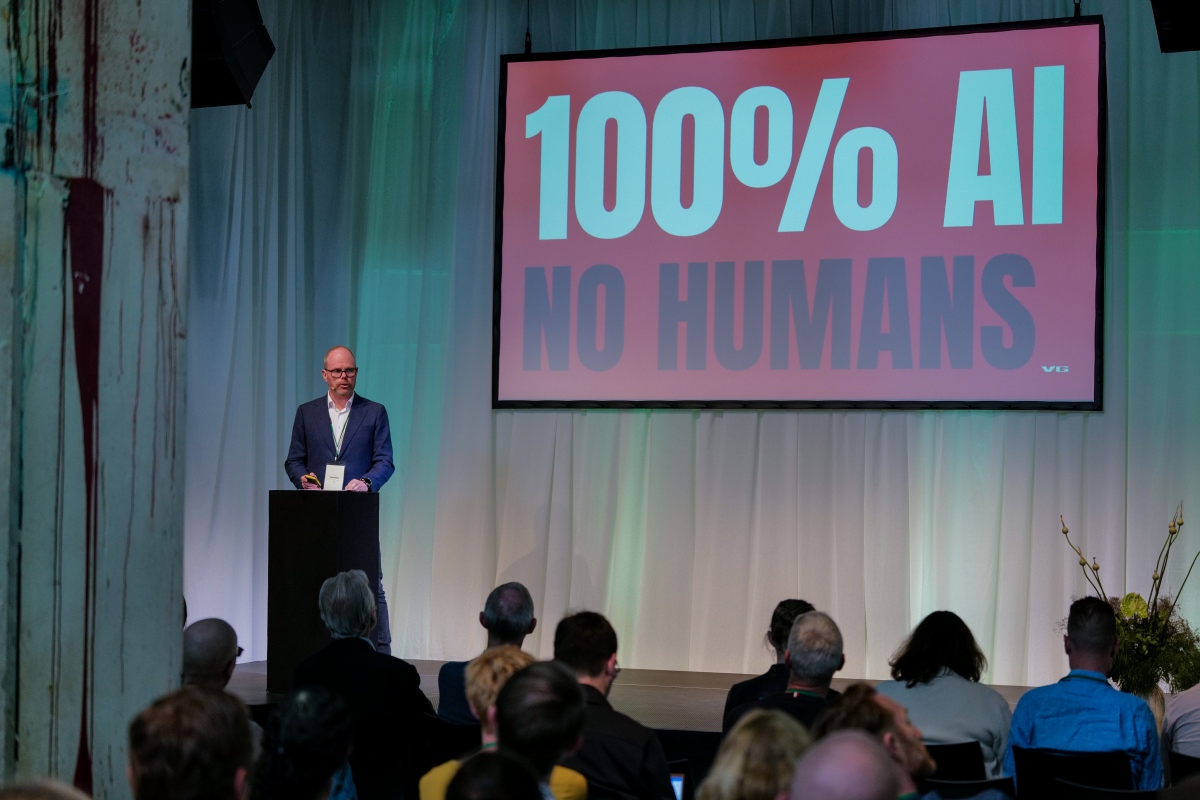
Gard Steiro, editor-in-chief and CEO of Norwegian newspaper Verdens Gang (VG), built upon past NAMS presentations to make the case for moving on from experimentation to scaling. For him, this also means doubling down on the human touch that AI cannot replace in journalism. “There are people out there who need to be met at eye level and tell their stories, and rest assured that Sam Altman doesn't give a damn about them,” he said.
Steiro also sees a great need for change to make the most of the opportunities afforded by AI. “If we don't make an effort to change, the untapped potential will be so great that any startup will overtake us,” he said.
Legacy newsrooms are slow like large ships, so VG is sending out speedboats to test the waters. These include VG X, a new app-based news service that replaces articles with summarised information updated around the clock and managed almost entirely by AI, using a clustering algorithm to group together VG articles and videos into stories. As there is no CMS, editors can request changes directly in the product, akin to talking to it.
Another of these speedboats is VG Lab, an internal tool to quickly test ideas and get an assessment of whether VG could execute it, whether there’s a market for it, how much it would cost, and what similar offerings exist around the world. This is led by two people and a team of agents, and led to the creation of Norway’s fastest growing app last autumn, Steiro said.
An underlying motif pervaded the summit: the idea that AI could be used by publishers to get a better idea of what their audiences want and need through a new ability to ask direct questions.
Daudens mentioned this as an advantage of personal agents: by looking at what agents are seeking out from websites, publishers may figure out areas that require further reporting. Also by analysing how audiences use AI chatbots and the kinds of questions they ask, news organisations can know what kinds of stories they want more of.
In a panel discussion moderated by our researcher Felix Simon, the conversation turned to the importance of building relationships with the audience. “We can create as much journalism as we want, but if people don’t want to be sources, or don’t want to read us, there’s no point,” said Stine Thorsgaard Kjær, head of innovation and development at TV2 Østjylland.
There is a potential problem for journalists who use AI. In a closing keynote, Rasmus Kleis Nielsen asked a key question posed by the Reuters Institute’s survey data: audiences tend to be sceptical of AI in journalism.
It could be that journalists who want to use AI and be explicit about their use aren’t making a good case for this to the public, he suggested. If we want to both use AI and foster trust, there are many factors that contribute to trust that have very little if anything to do with technology. As our Trust in News Project found, it’s about brand, presentation, language, bias, factual accuracy.
“It remains really important that you, as a professional community of practice, continue to judge your own work by your own standards” when it comes to AI use, Nielsen said. But that’s only one leg of value and trust, and probably not the most important one. The second, he added, is a public test: the need to convince members of the public, “what is in it for us?”
In every email we send you'll find original reporting, evidence-based insights, online seminars and readings curated from 100s of sources - all in 5 minutes.