

Carlos Dada
Editor of El Faro


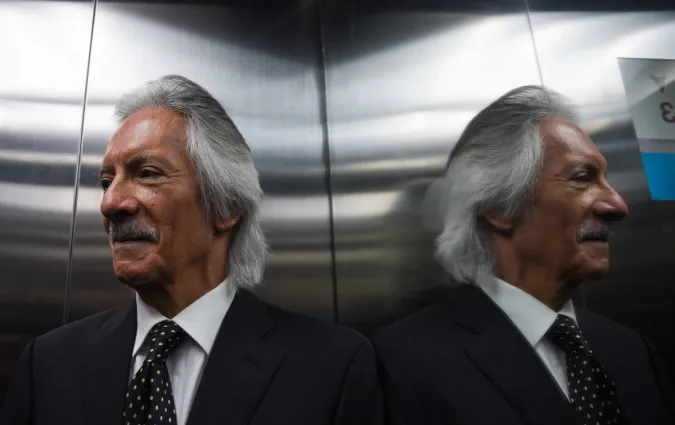
Carlos Dada delivering the 2026 Reuters Memorial Lecture. | John Cairns
A few days ago, in a series of media interviews in Madrid, the vice president of El Salvador, Félix Ulloa, said that his government has never negotiated or made any pacts with criminal organisations. He was lying.
He said the decree of a state of emergency, called the Exception Regime, only applies to gang members; that human rights are not being violated in El Salvador’s prisons. No one, he assured, has been tortured or died for lack of medical attention. He was lying.
He said that El Salvador is a perfect model of democracy. He was lying.
But lies are very powerful.
Today is 9 March 2026. These are some of today’s headlines around the world:
That’s just for today.
The world is now in turmoil. We are witnessing the end of an era, and humanity is steadily sliding back to times when brute economic and military power determined the destiny of human beings.
So much is at stake, and yet here I am, talking about what the vice president of El Salvador said, as if it had any importance among these big events shaking the world.
Good afternoon, everyone. I am very honoured to be here.
To the Reuters Institute, to Mitali Mukherjee, to Eduardo Suárez, to Cheris Leung, to the Advisory Board of the Institute, thank you for having me here.
I have been guessing why you invited me to deliver this lecture, and my conversation with Eduardo gave me a few clues. While it is up to you to come up with an answer to that, I imagine you invited me because of the conditions under which Salvadoran journalists are operating these days, at the onset of a dictatorship whose construction started in 2019, with the democratic electoral triumph of a young politician named Nayib Bukele.
And perhaps you also think that El Faro’s experience may be useful precisely now, when we are all at this new crossroads of history and feel the wind blowing against us.
A far-right, populist, autocratic wave is taking the world by storm and breaking all the rules, and journalists, as in every authoritarian regime or dictatorship, no matter its ideological foundations, are labelled as enemies.
Journalism is being criminalised, and our colleagues are being imprisoned or killed. According to the Committee to Protect Journalists, 2025 broke a record of 129 journalists and members of the press killed. Israel is responsible for two-thirds of those deaths.
Discourses that remained hidden or on the margins for decades have now become mainstream, encouraged and embraced by political leaders. The language sounds somewhat familiar. The hate speech, the calls to nationalism, the construction of the other, the racist language, the tribal language, the populist language. It’s always language. All of this has intoxicated public discourse.
Some responses also sound familiar. Last month, a United States Federal judge cited George Orwell’s 1984 to explain her decision to order the Trump administration to restore displays of ownership of enslaved people at a historical landmark.
In January, during the World Economic Forum in Davos, Canadian Prime Minister Mark Carney used The Power of the Powerless, Vaclav Havel’s famous anti-totalitarian essay, as the backbone of his speech. This was revealing to me, because I was precisely re-reading Havel while mulling over the matters of truth and lies.
If you think about it, it is a sign of the times that people as different as the Prime Minister of Canada and a journalist from El Salvador both thought that a book written half a century ago has something to say about the days we are living in. Particularly because Havel warns that his essay – and therefore any lessons derived from it – is only pertinent to what he calls a post-totalitarian state, namely the Soviet Union and the countries inside its sphere, among them Havel’s Czechoslovakia.
We are not there, of course. But this change of paradigms has just started, and we don’t know where it is heading.
In 1990, a few months after the fall of the Berlin Wall, Mexican poet Octavio Paz wrote: “Los cambios que nos asombran son parte de un proceso que comenzó hace mucho y que no sabemos cuándo ni cómo terminará.” In English: “The changes that have us in awe are part of a process that started long ago, and we don’t know when or how it will end.”
I don’t think it ever ends. Motion is constant in our universe. But what we are seeing now is the result of subterranean forces that we were reluctant to see, growing tired of the corruption and inefficiency of those who kept promising that democracy was the solution but seldom delivered, and the wide, unbearable distance between representatives and those they represent.
In too many places, my country included, politicians’ main goal has not frequently been to solve people’s most urgent problems, but to win battles against political opponents. So here are the consequences: populism, concentration of power, and the erosion of democracy.
So where do we stand as journalists? I hear it every day: We have lost credibility, and we have lost the public. Most people prefer to be reinforced in their prejudices rather than being challenged, so the algorithm is not putting our stories at the top of their timelines.
All of that is true. But there is, it seems to me, also a conflict present in more and more parts of the world, between the media and journalism. Between the industry and the craft. Experience shows that, under autocratic regimes and dictatorships, the industry and the craft are more and more incompatible.
Most of these regimes are built on half-truths or lies, so any discipline or institution dedicated to searching for the truth – academia, journalism, science, the humanities – is an obstacle to be overcome and silenced. Sooner rather than later, media managers and journalists will face a choice: sacrifice the business, or sacrifice the journalism. In other words, sacrifice private interests or sacrifice the public interest. Compromise or pay an existential price.
Under autocratic regimes and dictatorships, the industry and the craft are more and more incompatible.

So we should talk about truth and lies.
Truth understood not as that big word that lives in the Platonic world of ideas and that has obsessed philosophers forever, but rather as a much simpler thing: truth as the opposite of lies.
In journalism, truth is understood as the result of information verified through an editorial process, therefore asserting facts. Truth, then, understood as a statement of fact. Lies, on the other hand, understood as the deliberate act of misleading, of deceit.
Since we are at Oxford, let me use the Oxford English Dictionary definition of a lie: “To make a false statement with the intention to deceive”. So you may pronounce falsehoods and yet not lie. You may just be wrong. Lying requires the intention to deceive.
Sooner rather than later, media managers and journalists will face a choice: sacrifice the business, or sacrifice the journalism. In other words, sacrifice private interests or sacrifice the public interest. Compromise or pay an existential price.

That’s why I was talking about the vice president of El Salvador. Let’s go back to his recent assertions:
Here’s the truth:
During the past six years, we at El Faro have been documenting and publishing Bukele’s deals with the gangs. We have published official prison logs and security camera images; gang member testimonies; recordings of phone calls between government officials and gang bosses; we have published photographs, witness stories, police intelligence information; we’ve confirmed every piece of information on these conversations with government officials, with US task force members chasing gang bosses that were illegally and secretly freed by Bukele.
We have interviewed, on camera, gang bosses who were supposed to be in prison and who were free and living abroad.
When the vice president says there has never been any pact with the gangs, he is lying because he is well aware of the evidence.
We, as well as other news outlets and human rights organisations, have gathered evidence of systematic torture inside El Salvador’s prisons. We are now entering our fifth year living under a state of exception, which means the police can arrest any person for mere suspicion of working for the gangs.
Since the beginning of the state of exception, around 100,000 Salvadorans have been imprisoned, without any accusation, and subject to secret, mass trials if they are lucky. Today, El Salvador holds the dubious distinction of having the world’s highest incarceration rate. Up to 2% of the population is now in prison. Among them are minors, human rights or environmental defenders, political opponents, victims of neighbours’ false accusations or simply people who crossed paths with a police officer having a bad day or who had not yet hit the arrest quota demanded by commissioners.
According to reports from Amnesty International, Human Rights Watch and human rights defenders in El Salvador, the majority of people detained are not related to gangs in any way. More than a hundred of those imprisoned are political prisoners.
Trials are conducted by anonymous judges who determine the guilt or innocence of sometimes 900 individuals in a single hearing.
About 10,000 people among those detained under the state of exception have been freed. We spoke to dozens of them, and they all told the same stories of torture. Some have shown us the scars.
We have identified the prison guards in charge of that torture in several of the 22 prisons around the country. We have talked to mothers who have recovered the bodies of their sons, thin to the bones, with hematomas or brain damage. The coroner’s office has concluded in every single case that the victim died of pulmonary oedema, which is something akin to saying that a person died because she stopped breathing.
So, again, the vice president was lying.
Almost a decade ago, Nayib Bukele, then mayor of San Salvador, broke up with his party, the leftist FMLN, and launched his bid for the presidency as an independent.
Young and inexperienced, very few people believed he had any chance. The political landscape was absolutely controlled by two parties: The FMLN, which sucked up all the oxygen for political projects from the centre to the extreme left, and the National Republican Alliance, ARENA, from the centre to the extreme right. Without their brand and their organisation, Bukele’s aims seemed impossible.
But he and his team had spent years understanding social media and building what we call troll farms; they had an organic communication with new generations of voters who could not care less for the obsolete ideological battles of the main parties.
Bukele’s propagandists knew how to use technology in their favour and deliver the message directly to those new voters. That was their edge.
He ran his campaign mostly on Twitter, Facebook and TikTok, promising to do away with our corrupt political establishment. In a poor country, politicians campaign in markets and public squares. Bukele did none of that. A presidential campaign carried out entirely on the internet sounded preposterous, except for a peculiar fact that traditional politicians missed: in my poor country, smartphones outnumbered people, and their owners were eager for change. The bigger the better.
Bukele won by a landslide, and that was the end of the two-party system that dominated our political landscape for a quarter century.
As soon as he got into office, he started eroding the institutions that held our democracy. He staged a coup d’etat against the Supreme Court, made the army and the police his instruments, seized control of the attorney general’s office and restricted access to public information. He launched a witch hunt against the opposition, which was received with cheers from most of the population.
Bukele engaged in what scholars call “accountability sabotage,” which means the closure of access to public information, the suppression of political opposition and critical voices and the undermining of democratic institutions.
You’ve heard this story about different countries, over and over again: anti-democratic leaders being democratically elected.
On his first visit to the United Nations General Assembly, Bukele took the stage and snapped a selfie. He then told the room that his selfie would be seen many more times than any of the world leaders’ speeches. It may have been a trivial, superficial speech to give at the world’s main forum. But he was right. His selfie and the message went viral.
“O brave new world that has such people in it”
Bukele’s own Supreme Court approved his reelection, against half a dozen articles of our Constitution, and he is already in his second term, with arguably the highest rate of popular support among all Western leaders.
And us? Like most independent media and human rights organisations, we are in exile. Not only El Faro’s newsroom, but its administrative side as well.
But let me tell you a bit about us.
El Salvador began its democratic life in 1992, when the then revolutionary guerrillas, the FMLN, signed a peace agreement with the country’s government to end our long civil war.
It is no coincidence that our war, arguably the last battlefront of the Cold War, ended in the immediate aftermath of the fall of the Berlin Wall. After more than six decades of military regimes, we finally started to live in a democratic country. Repressive security forces were disbanded, and army officers left the government buildings and returned to their barracks. And even more shocking: human rights, two words completely absent from our public life, were put at the centre of every public policy and political discourse.
Enter El Faro.
When the peace agreements were signed, my parents decided it was time to go back to our country. We had lived in exile during most of the war.
I left El Salvador as a child and returned as an adult to a completely different place. Together with Jorge Simán, another returned exile, I founded El Faro in 1998 based on the conviction that a new country needed new journalism. We were determined to contribute.
El Faro could only come to exist in a democratic environment. So we grew and found our own voice over the course of a quarter of a century. Freedom of expression, freedom of the press, this was music to our ears, and we danced to it as much as we could.
Journalism promised to fulfil our curiosity and, as Alma Guillermoprieto said, allowed us to witness the human experience from the front row. Democracy allowed us to be independent, and independence allowed us to look to constantly expand our journalistic frontiers.
Our democratic interregnum ended with the arrival of Nayib Bukele.
Just nine months into office, he entered Congress surrounded by soldiers dressed for combat and threatened to dissolve it. Our editorial called him a dictator in the making, and he declared us an enemy of the people. He launched a smear campaign against us. His troll farms called us everything imaginable: drug addicts, gang members, sex abusers, paid agents at the service of the old system…
The president tweeted against one of our advertisers, or, more precisely, against one of the ads on our site. In a matter of hours, most of our advertisers pulled their ads from our newspaper.
During the COVID-19 emergency, Bukele imposed harsh measures on the population and declared an emergency, allowing his government to avoid public contracting laws, and he cut off access to public information.
We exposed big corruption cases and broke the story on the government’s deals with gangs as the real reason behind the dramatic descent in murder rates. The government accused us of making everything up and of working with terrorist organisations.
In a televised national address, the president showed my photo and accused me of money laundering. Tax authority investigations followed immediately. We were accused of tax evasion. We moved El Faro’s legal residence to Costa Rica, so he could not seize it and use it to disseminate propaganda.
Meanwhile, we noticed strange people standing outside our houses and following us in the streets. Drones visited our houses. Inside sources showed us photos of ourselves. Threats arrived by the dozens.
By the end of 2021, we learned that our phones had been hacked with the Israeli spyware Pegasus. We, as a collective. Twenty-two out of El Faro’s 30-plus employees had been hacked during a year and a half. Other journalists were also hacked.
When we made it public, we lost most of our sources, essential to practice journalism, but especially so under autocratic and opaque regimes. It changed a lot of things in our newsroom. It was the definitive proof that the price for practising journalism had significantly risen.
As recent research from the Barcelona Autonomous University concluded: “El Salvador represents one of the most restrictive environments for press freedom in Latin America, where the concentration of political power and the convergence between technology and propaganda configure a model of techno-populist authoritarianism.”
The Citizen Lab from the University of Toronto gave us logs of the days and times of every Pegasus activity in each of our phones. We cross-checked the timelines with our publications: most of the hacking to most of the people happened immediately before, during and after the publication of our stories on corruption and Bukele’s deals with the gangs. It also lined up uncannily with government attacks against the newsroom.
Autocratic regimes and dictatorships need to impose a monologue, to control the narrative. You have probably seen some of Bukele’s viral tweets or videos: The cinematographic shots of head-shaved gang members, their naked torsos, full of tattoos, sitting on the floor of an enormous prison square, each with his head on the back of the gang member in front of him, whose head is in turn on the back of the gang member in front, surrounded by imposing policemen in black, in absolute control of those criminals, inside one of the world’s most notorious prisons.
You have probably seen or heard about Bukele’s X account, where he calls himself World’s Coolest Dictator, or Dictator of El Salvador, or Philosopher King. A provocateur, his tweets threaten opponents, bark out orders to his cabinet, and insult the press, other presidents, and anyone who does not belong to this new club of extreme right populists and autocrats.
A master of distraction, he gets everybody’s attention, whether it is people enraged or emboldened by his provocations. It’s visceral and viral. “We have to talk about that.”
While Bukele held everyone’s attention, his regime moved steadily. A recent study done by the Jesuit-run Central American University found that, between 2019 and 2024, Bukele’s regime enacted at least 335 executive or legislative decrees that increased his concentration of power.
Meanwhile, we were talking about his tweets.
Now, there are some half-truths that keep his popularity high. In March 2022, for reasons we are still trying to understand, the deal with the gangs was broken. On a bloody weekend, the MS-13 gang killed 87 people and strewed their bodies all around the country. The state of exception was declared, and the police and the army began a campaign of mass incarceration.
There was scant resistance from the gangs that had controlled many areas of the country for a couple of decades. For the first time in a generation, many of these communities were living free from the rule of gangs. Perhaps the most important change in their lives. The price to pay, though, is a long-term one. The loss of our rights, the consolidation of a dictatorship, the exercise of power without checks or balances. Our destinies are in the hands of a person or a small group of people.
But that is easier to say, or to see, by someone who has not been living in one of those communities or held hostage at gunpoint by those gangs. It is not up to them to come forward in defence of democracy or human rights. It is up to us.
The repression against critical voices intensified last May. A Foreign Agents Law was passed, making it almost impossible to receive funding from abroad without authorisation from the regime. Universities, NGOs and independent news organisations were the most affected. The police paid visits to journalists and human rights defenders; environmentalists and two prominent lawyers were arrested. Since then, at least 53 independent journalists and dozens of human rights defenders have left the country to avoid incarceration.
A recent poll showed that half the population is afraid of publicly expressing their opinion or criticising the government.
Like other independent media outlets, we are now a newsroom in exile, facing the biggest challenge in the life of El Faro: how to report on a country where we can no longer live. In other words, how to avoid becoming an outlet of exiles for exiles, a news site that talks about a country that no longer exists.
We know that there is an easy way to stop the harassment and the threats and the drones and the hacking and even exile: we need only quit.
Like other independent media outlets, we are now a newsroom in exile, facing the biggest challenge in the life of El Faro: how to report on a country where we can no longer live. In other words, how to avoid becoming an outlet of exiles for exiles, a news site that talks about a country that no longer exists.

I don’t think anyone could blame us if we did that. Some of our reporters have already done so. But we also know something else: if we decide to stay, we must do our job. For as long as we can do it, we will continue searching for the journalistic truth. We won’t be an echo chamber for a dictatorship. We won’t compromise or remain paralysed.
With the support of the Knight First Amendment Institute at Columbia University, we sued NSO Group, the Israeli company that makes and sells Pegasus, in a US Federal Court. The case is still ongoing.
In November 2023, almost three years ago, we declared ourselves a newsroom in resistance. We said:
“We are called to be an obstacle for those who seek to perpetuate themselves in power through absolutist projects that necessarily cancel citizens’ rights and fundamental freedoms. We are called to resist the suppression of a plurality of voices needed in a healthy society. To resist the attacks of those who cannot tolerate a narrative other than the official one. We are journalists in resistance.
In resistance to the violation of our rights, the shuttering of public information… resistance to limitless power. We practised journalism in democracy for a quarter century. That era is gone. Today, we are a newsroom in resistance.”
That is the only way we can conceive our work today.
If we decide to stay, we must do our job. For as long as we can do it, we will continue searching for the journalistic truth. We won’t be an echo chamber for a dictatorship. We won’t compromise or remain paralysed.

Dictators like Bukele need lies to survive. We all know the handbook. What makes Bukele different is his capacity to turn those lies into a successful narrative that instantly becomes viral on social media platforms.
In a recent poll in Chile, people were asked to mention a politician they admire. Half of them answered Nayib Bukele. More than 5,500 kilometres separate San Salvador from Santiago de Chile. Whatever happens in El Salvador is of very little consequence in the lives of Chileans. So how do you explain that a construction worker on the outskirts of Santiago has Bukele at the top of his mind?
Because Bukele’s propaganda appears every day on his phone. The carefully produced videos of the gangs, the president lecturing soldiers and policemen, are perfectly portrayed with studio illumination, the export of the idea of an efficient leader willing to break the rules to bring security to his country. Exactly what most Latin Americans, whose lives are more and more determined by criminal organisations, wish they had: an efficient leader with enough courage to solve their main security problems.
He is so good at it that he is now more popular in each Latin American country than the president of that country, with the exception of Mexico.
And now, after Donald Trump returned to the White House, Bukele has become a shooting star in the MAGA movement. A few weeks ago, the Guardian called him Trump’s protégé. He just spent this past weekend at Mar-a-Lago, with a few other Latin American conservatives, discussing strategies to advance the so-called 'Donroe Doctrine'.
Without political opposition, and with such strong popular support and the erosion of civil society, Bukele’s monologue is a marching band.
If it weren’t for journalism and human rights organisations, Bukele's propaganda would remain undisputed. We are the ones left to resist. In a country that experienced civil war only three decades ago, it’s striking that the search for truth has become again a subversive activity. It is more difficult, but more urgent, to question those in power. Information is dissent. Truth is dissent. And the rigorous production of information is considered dangerous. Journalism is resistance.
And last, but not least: an essential part of populist strategy is to create enemies and dehumanise them. This doesn’t require too much explanation in Europe. In some places, it is the immigrants. In other places, it is the Jews. Or the Muslims. Or the Venezuelans. Or the Palestinians. A government’s priority in human rights – Bukele said – must be honest people. Since then, more than 3,000 children have been incarcerated in El Salvador.
Information is dissent. Truth is dissent. And the rigorous production of information is considered dangerous. Journalism is resistance.

I consider it an essential part of our job to understand why most people are cheering the installation of a dictatorship, and I have a very good idea. But another important part is to defend the humanity of the victims of this language. Journalism must be, in my view, a humanist discipline.
Let’s bring Havel back, and I quote:
“We do not know the way out of the marasmus of the world, and it would be an expression of unforgivable pride were we to see the little we do as a fundamental solution, or were we to present ourselves, our community and our solutions to vital problems as the only thing worth doing.”
Of course. I would just add: nevertheless, what we do is still worth doing. If nothing else, we will leave testimony for future generations to better understand what the hell happened in our times. So the lies won’t linger.
In every email we send you'll find original reporting, evidence-based insights, online seminars and readings curated from 100s of sources - all in 5 minutes.