


News
A French dispatch: How newsrooms are defying platform reliance and taking back control


Tayzer Awng, founder of ethnic online news magazine Arakha Times, at his food stall. | Credit: Phothar
MAE SOT, Thailand. – Mae Sot is a dusty trading town on the border between Thailand and Myanmar. Lately, it has also become a precarious sanctuary for hundreds of Myanmar journalists and media workers in exile. Close enough to hear the artillery fire they report on, they remain legally, mentally and financially insecure in a foreign land.
In the “newsroom-house” where journalists from the CJ Platform live and work, Min Thu Win Htut, the outlet's founder, often finds it impossible to sleep. “Around 23:00, when I stop working, it feels like the future goes dark,” Min Thu said. “It’s like I’ve arrived at a future where I don’t know what to do next. This happens almost every night.”
Min Thu is not alone in his struggle. These anxieties reflect the worsening structural crisis confronting Myanmar’s exiled media five years into the civil war which is ripping the country apart.
After the 2021 Myanmar coup wiped out their revenue models, Myanmar independent news organisations became heavily dependent on international support. More recently, US funding cuts in 2025 and the reduction of European funders such as Sweden in 2026 leave them in a state of crisis.
Myanmar exiled media currently comprises around 60 news outlets, with over 200 journalists based in Thailand, according to figures from Reporters Without Borders (RSF). “The Myanmar exiled media were in a very severe situation, even before the funding cuts,” said Arthur Rochereau, a representative of RSF’s Asia-Pacific Bureau.
Exiled independent outlets face mounting challenges as geopolitical priorities shift, foreign funding declines, and reliance on volatile social media algorithms increases. The resulting financial strain is forcing newsrooms to shrink, pushing journalists into second jobs and scrambling to find ways to survive, while raising concerns that the quality and survival of independent reporting on Myanmar’s civil war is at risk.
Established after the 2021 military coup, CJ Platform was designed as a digital hub to provide basic journalism training to hundreds of Citizen Journalists and distribute their reports from the frontlines and on the ground. However, with severe US funding cuts in 2025, the organisation’s survival was immediately threatened.
Min Thu said salaries were initially slashed by 50%. Within a month, the cuts reached 70% and the group could no longer afford to maintain safe houses. At the time of this writing, the organisation has forced the remaining staff to move into the office to live together.
Eventually, staff reductions became inevitable. An organisation which previously operated with 17 members, CJ Platform now runs with only six.
Every morning, Min Thu’s first routine check is viewing performance reports on Facebook and YouTube.
“The moment I open my eyes, I run to check: Which post is hitting monetisation? Which one is having problems? Which one has lost its audience? Instead of news quality, we find ourselves thinking first about what the audience likes,” he said. “Clickbait and tabloid journalism,” he adds, are what most people on platforms like, and that’s what gets the most engagement.
On one occasion, he said, his outlet shared a video posted on Facebook by a pro-military commentator during the junta’s election period that received a million views. By contrast, they spent three months working on a report which monitored election coverage which got minimal interest.
And yet even pursuing a clickbait strategy brings minimal returns. For example, one million views generated less than $50, an amount far below other markets. Even with such paltry returns, however, this monetisation income pays for electricity, accommodation and food.
“We are in fear that this income will decrease,” said Min Thu.
This means that for the sake of survival, cash-strapped journalists and outlets in exile often have to focus on increasing reach and catering to audience preferences in order to generate online revenue. This reality creates a sense of discomfort. “We are journalists, after all,” Min Thu said. “We feel a certain sense of shame about it.”
Over a dozen Myanmar journalists and media founders I interviewed for this piece expressed similar concerns, adding that the journalistic quality inevitably suffers. Most of the interviewees expressed their frustration at seeing this growing trend.
Min Thu said that sometimes they use the office car as a taxi service when there are calls for transport within the city. “If someone calls for a ride, I leave the office and can earn about 1,000 baht (around $31),” he said.
A similar pattern is emerging across the sector. By day, Tayzar Awng, founder of ethnic online news magazine Arakha Times, edits and coordinates stories with journalists on the ground in Rakhine State, bordering Bangladesh. By night, he runs a food stall in a Mae Sot night market.
Part of the income he earns from the stall goes toward paying writing fees for local journalists in Rakhine, mainly to fund and continue his online newsroom.
Following the US aid cuts in 2025, many small online outlets have been forced to operate on zero budgets.
Su Myat, a media advisor to the Than Lwin Khet, confirmed that journalists are no longer being paid regularly. Five interviewees who are running other small online media outlets related a similar story.
Among those interviewed, another five founders of small online media outlets and four reporters said they are working second jobs, including running food stalls, part-time accounting, commercial video editing, voice-over services for commercial podcasts and baking, to make ends meet or to pay journalists. All interviewees stated that it has become a norm for exiled journalists to do side jobs.
Kyaw Kyaw Min, a senior journalist who runs Democratic Press, an online Facebook outlet, said they have received no money for a year. “I’m doing a side job as an accountant at night time,” he said.
Maw Jay, a senior journalist and single mum who has now become a baker, told me that “reporting is now a hobby” for her. She continues to do in-depth reporting for Mandaing, a Myanmar pro bono news outlet where all journalists and editors are experienced and yet report for free.
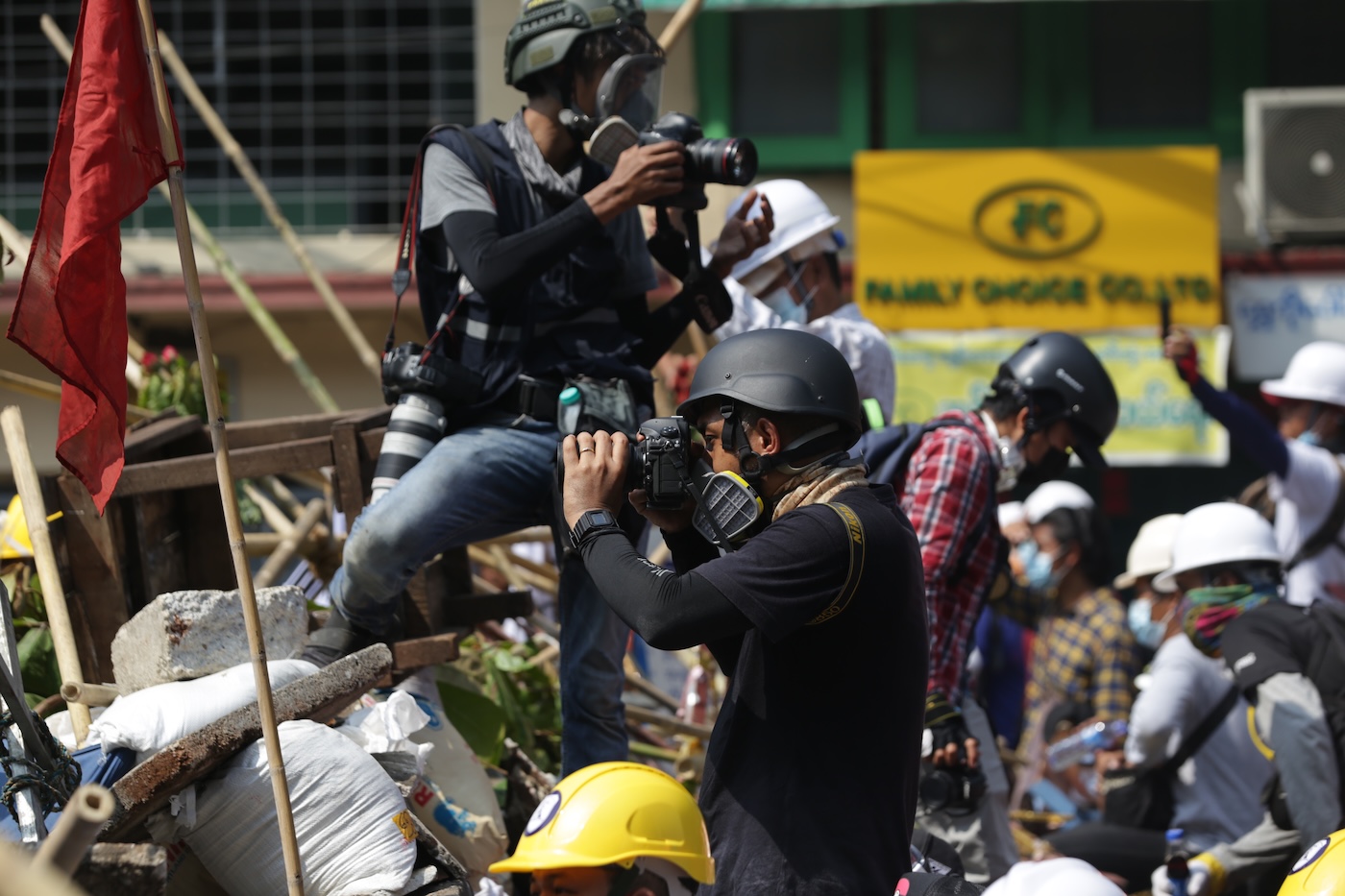
“The 2021 coup has effectively wiped out Myanmar’s once-flourishing media in the Southeast Asian country, while recent foreign aid cuts severely impacted exiled Myanmar media,” Beh Lih Yi, Asia-Pacific Director of the Committee to Protect Journalists (CPJ) told me in an email.
Before the coup, a decade of democratic transition saw a golden era for Myanmar independent media, following five decades of military dictatorship from 1962.
From 2011 to 2021, a new and passionate generation of journalists emerged and media outlets were able to generate sustainable revenue streams. Since the coup, the country has plunged into a brutal and intractable civil war and independent journalism has been effectively outlawed.
Myanmar’s junta is now one of the world’s worst oppressors of the press, and the country has the second highest number of journalists in prison globally, according to CPJ’s latest annual prison census. Over 200 hundred journalists have been arrested, with some tortured, raped and killed in prison, according to the International Centre For Not-For-Profit Law. Myanmar now ranks 169 out of 180 countries in RSF’s World Press Freedom Index.
With independent journalism effectively outlawed, news organisations have continued to report from exile in Thailand, in rebel-held areas in the jungle, or under-cover in areas controlled by the junta. At the same time, according to a report by the Media Development Investment Fund, news organisations have lost the bulk of their revenue. By 2023, most Myanmar journalists had left the profession, according to the interviews I conducted with colleagues for the project I wrote during my fellowship at the Reuters Institute.
Lorcan Lovett, a journalist covering Myanmar who visited several newsrooms and authored a piece for Nieman Reports following the 2025 US funding cuts, said Myanmar’s exiled media sector was already in “a precarious position”.
“When the US funding cuts happened, it wasn’t just the scale of the shock, but also the abruptness,” he said, stressing that many outlets “didn’t have a cushion to absorb that blow.”
Reporting by the Guardian after the cuts also found that a difficult situation had turned into an existential crisis. Support for up to 250 journalists was cut, according to a report published by the International Federation of Journalists in 2025. The situation worsened further in early 2026 as European donors unexpectedly implemented their own cuts.
Even the largest national news organisations now face serious shortfalls. Take the Democratic Voice of Burma (DVB) as an example. The outlet is in one of the strongest positions, with core funding from Norway. But their current financial resourcing is “not enough for the year”, according to DVB’s chief operating officer, Myint Zaw. DVB also receives funding from Sweden, which decided to stop all of its Myanmar media funding from July 2026.
Another outlet in an arguably strong position is Frontier Myanmar, the newsroom I now lead. Frontier Myanmar has a leading membership model, with daily newsletters and in-depth magazine style feature reporting. But, even after cutting pay by 25% earlier this year, reader revenue only covers for around half of the outlet’s budget in the year ahead.
Speaking about the donor support which remains, Tom Kean, former editor-in-chief and now editor-at-large at Frontier, said: “Core support is needed to keep media organisations going and also support to seriously develop new business models”.
The issue news organisations now face is not just the scale of funding cuts, but also their abruptness, which increases insecurity and lowers morale.
In January 2026, for example, Watthan, an executive producer for Frontier’s Doh Athan podcast, started a two-year fellowship backed by a German donor. The fellowship was just enough to cover her basic subsistence and it was less than what she was paid as far back as 2018. Doh Athan is Myanmar’s first ever podcast with specific focus on human rights issues.
Just two months into the fellowship, the donor informed her that the contract was being terminated due to shifting funding priorities. Despite the original 24-month commitment, she ultimately received only three months of pay (covering January through March 2026). Frontier has subsequently retained Watthan with support from Doh Athan’s main donor, Fondation Hirondelle.
She said the sudden loss of support made her wonder why she chose this career. “Mentally and financially, it is not OK,” she said. At the same time, Watthan finds herself in a relatively fortunate position, and she is giving recently unemployed journalists some money just to buy rice to feed themselves.
The Myanmar Journalists Aid Network, based in Mae Sot, started an aid mission one month after the US funding cuts, to give essential support such as rice, oil, eggs, and detergents to 30-40 exile journalists’ families in need.
“People are in huge trouble after Trump’s cuts,” said Myat Mon, an organiser at the network.
In the beginning, over 40 journalists contributed between $2-35 each per month to the scheme. Now only 13 remain.
Esther J is an experienced freelance reporter who has reported for Al Jazeera and been a grant recipient of the Pulitzer Centre. She has just spent more than two years covering civil war on the frontlines, and recently returned to Thailand. She is struggling to secure a job in the exiled media industry and is now in a situation where she has to weigh whether to remain in the profession or find something else to do.
Esther told me she is reluctant to join some local media outlets, citing poor labour practices and an increasing focus on volume and sensational content.
“People are tired of listening to the news, they enjoy influencers’ reports which give them false hope,” she said. When the US extracted Maduro from Venezuela, she said, people on the ground were cheering as influencers claimed, with no proof, that Trump’s next target was [Myanmar dictator] Min Aung Hlaing due to illegal scam centres in the country.
The lack of a visible impact from her work is also a factor. She recalls the impact of a report on a child soldier that she reported in 2019. The child was freed after she published the story. “What is the difference even when we write a story [right now]?” she said. “As I grow older, I also want stability.”

Esther and Watthan are not alone in thinking about leaving the profession – at least for now.
T, a local journalist, is based inside Myanmar and prefers to use this pseudonym for security reasons. He works for a national exiled media outlet and describes the current situation as “disappointing” and “increasingly disheartening.”
T had looked at Radio Free Asia (RFA) or Voice of America (VOA) as stable newsrooms which could provide job stability. “I would never have thought that organisations like RFA and VOA would crumble, and their journalists would be in a struggle,” he said, adding that there is no career development anymore.
“A lot of journalists are very vulnerable,” Kean said. “They don’t have legal status. They can’t necessarily go back to Myanmar. There’s a kind of a human cost.”
In a series of workshops I held with dozens of Myanmar exiled journalists in 2025, most participants related that they struggled with issues such as stress, anxiety and depression.
According to Dr Grace, a leading Myanmar psychologist working with the Myanmar exiled community, “a primary issue is loss of identity” from becoming stateless and, in some cases, loss of profession, with people needing to take on more basic forms of work.
This loss of identity can also be experienced by journalists who work undercover inside Myanmar.
T can no longer identify himself as a journalist. When neighbors ask about his occupation, he tells them he is helping with his parents’ business. He even has to remind his young daughter not to tell others that her dad is a journalist or a writer. “Some say the journalism profession is suited only for singles, not for people with a family”, he told me. “I now think [they are] ‘quite right’”.
Another major issue is the vicarious and primary trauma experienced from reporting on a brutal civil war. “They compound each other and there is no end in sight to the situation,” said Edward Blakeney, a psychotherapist who works with the exiled Myanmar community.
With yet another round of funding cuts scheduled for July, this time by Sweden, there is a real risk of collapse for Myanmar independent newsrooms. These cuts may result in fewer journalists reporting on what is happening inside a country that continues to descend further into civil war, with widespread war crimes committed by the military.
The military junta has just transferred itself into civilian clothes in April 2026 in a sham election, and it has increased its propaganda. This includes the use of social media accounts to disseminate false information, according to a 2024 report from the DW Akademie.
The Irrawaddy, an online newspaper, reported in 2025 that an official think tank joined a partnership with China’s state-backed Xinhua news agency. At the same time the junta signed a multi-million dollar deal with a Washington-based PR firm, according to Reuters.
Without any pushback to the junta’s propaganda, Lovett said, “all that people will be left with is the regime propaganda… That would be terrible for the information space. It’s already a really bleak picture.” Kean also echoed this saying: “We would just know less about what's going on in Myanmar”.
“If this ecosystem collapses,” Lovett concluded, “it could take years to rebuild. You lose the sources, and you lose the institutional trust.”
Despite the situation, all the journalists I interviewed said that they ultimately did not want to give up, even if this meant sustaining their journalism without remuneration, while pursuing other means of livelihood.
“Repression and funding cuts not only impact the lives of journalists, but also mean the world will never get the full story of what is happening in Myanmar at a time we cannot afford to look away,” Yi said.
Speaking about his colleagues at CJ Platform, Min Thu said, “We live and manage our daily needs together, and we work together through it all.”
In every email we send you'll find original reporting, evidence-based insights, online seminars and readings curated from 100s of sources - all in 5 minutes.