


News
This journalist built a database tracking thousands of cases of AI adoption in news organisations. Here’s what she’s learnt


Kassy Cho, Alessandro Accorsi and Valeriia Voshchevska during their panel. Photograph courtesy of Marten Publishing / Mark Hakansson / Deed - Attribution-NoDerivatives 4.0 International - Creative Commons.
On 14 May, the 17th floor of the News UK building in central London was taken over by the Newsrewired conference, an biannual event hosted by Journalism UK. Speakers included journalists, technologists and media professionals such as Ezra Eeman, Jim Waterson, Luke Bradley-Jones, Isabelle Roughol and Glenda Cooper. Here are five takeaways from this year’s conference.
The news industry is in the midst of a new disruption. Keynote speaker Ezra Eeman, strategy and innovation director at Dutch public broadcaster NPO, suggested that Big Tech is creating an entire AI ecosystem extending beyond just tools.
AI systems are becoming the primary interface and operating system through which people experience media, with the technology increasingly integrated in our everyday lives as a “superassistant”. This is a huge challenge for publishers, as users don’t have to click onto their websites to catch up with the news.
“Click-through rate and opportunity is reducing through the way search engines are restructuring UX around AI,” said Eeman, who warned editors this means a lower attribution rate for publishers in addition to diminished commercial opportunities. “The content is following you, rather than you following the content,” he said.
Publishers are now looking at ways to navigate this growing reality. Deals are struck and legal battles are fought while the value of the news output produced by media organisations is being rapidly extracted.
How to respond to this challenge? Eeman argued that the future value of publishers is not the content itself, but trust, context, and continuity of engagement.
“We must align our message as an industry on agreed principles: no content without consent, fair recognition, accuracy, attribution, provenance, plurality and diversity and transparency around deals,” he said.
As more journalists invest time on platforms such as Instagram and TikTok, many media managers are wondering how this kind of journalism differs from activism and mere content creation.
On video platforms such as YouTube and TikTok, news is mixed in with all sorts of other types of content, pointed out journalist and researcher Alessandro Accorsi. “We don't get the facts one after the other, but this very strong emotional content in a way that doesn't make us understand what came first and what came after,” he said.
This means journalism appears in users’ feeds devoid of context. But audiences want and need this context, and this includes an insight into the journalistic process and editorial decision-making, Accorsi and other colleagues said.
Creators can be plotted somewhere on a spectrum between prioritising values and prioritising views, said moderator Valeriia Voshchevska, founder and CEO of digital communications and human rights advocacy studio Shape Change.
Journalists should be closer to the values end, but both elements are important, she added. There are always going to be creators who only prioritise views.
Kassy Cho, founder and editor-in-chief at social-first news and media outlet Almost, said her approach is to try to experience platforms as a regular user would, engaging in all kinds of content, not just journalism. She then identifies the characteristics of that content that make it work, and tries to apply it to her own journalism, while still respecting the stated values of her outlet. She conducts a similar assessment when deciding which breaking news stories to cover, balancing potential virality with a strong focus on values and audience needs.
After you’ve attracted users’ attention, you can then ask them to sign up to your newsletter, for example, and work to make them part of your regular audience, Voshchevska added.
Luke Bradley-Jones, president of The Economist Group, shared how The Economist is reinventing itself in the digital and AI age in a conversation with consultant and journalist Ramaa Sharma.
Bradley-Jones described the changes the journal, now over 180 years old, is implementing to maintain its reach in the modern media ecosystem, starting with a new video platform.
The first example of this push is The Insider, a personality-led twice-weekly video and audio show that marks a departure from The Economist’s tradition of no bylines and traditional text articles.
“AI is our friend and foe,” Bradley-Jones said. It both makes high quality journalism easier to produce and more accessible, but also poses a threat as audiences get used to getting information directly from large language models.
Differentiating The Economist’s offering from what audiences can get from AI is one of the reasons for this shift. The publication is also aiming to appeal to younger generations and to build a stronger relationship with existing subscribers.
“What customers want is to get closer to our journalists, to get to that collective viewpoint of the world. The audio-video route created better audience retention,” Bradley-Jones said.
During a six month development period for The Insider, the team produced 40 pilot episodes which were honed through an internal feedback loop and tested with audiences. The Economist decided to host the show on its own platform rather than on third-party sites.
Now 75% of The Economist’s base engage with The Insider on a regular basis, Bradley-Jones said. The publication is also working on other new ideas. This includes The Economist Play, a streaming-only product to launch in July which will bring together The Insider, the 5-10 minute World in Brief headline roundup and The Intelligence, a 20-minute look at the key stories of the day, as well as games.
The Times is also experimenting with new formats through Times Data, a new section offering readers clear, no-frills data that cover the reality of living in Britain, from the price of a pint to direct debits failing. “We don’t only want to be the paper of record, but we want to be the paper of statistical record,” said Tom Calver, data editor at The Times and The Sunday Times.
Calver explained that his team wanted to give readers the opportunity to assess the state of Britain via simple-to-read data. They built a semi-automatic scraper that takes different measures from databases which are then aggregated into a graph format. The semi-automatic process requires a human to check the output. AI plays a role in this system, but the code itself is written by humans. “The moment I needed it to carry The Times name, I needed to trust it,” Calver said.
Jim Waterson, founder and editor of Substack-based local news publication London Centric, quit his job as The Guardian’s media reporter to go independent. Waterson said he was inspired by an experiment The Guardian team ran ahead of elections in 2019 and repeated in 2024, in which they looked at screen recordings of voters’ phones to see how they were informing themselves. In 2019, a lot of this was still by looking at traditional media sources, but by 2024, social media creators had taken over.
In his publication, he aims for impact and human connection, saying his readers value the sense that the reporting is coming from a real person. Waterson quickly found success and one and a half years in can count on tens of thousands of email subscribers. Some of his stories also have political impact, such as being mentioned in the British Parliament.
“It’s a constant hustle, it’s me trying to do everything, it’s crazy hours, but it’s a disgusting amount of fun and it’s also profitable,” Waterson said.
Isabelle Roughol, founder and host of podcast Broad History, also works with journalists going independent, offering management and funding expertise. Prior to this, she worked at LinkedIn.
“I learnt so much in tech that we didn't know in journalism,” she said, such as about people management, but added that when she tried to bring her learnings back into news organisations, they weren’t interested. In independent media, however, she found people more open.
Daniel Ionescu started in independent media at age 21 in his university city of Lincoln. “It was a baptism of fire,” he said.
His advice to journalists looking to strike out on their own was to stay lean and frugal, looking for savings where they can in the form of free trials and promotional codes for software, and acquiring mid-range equipment for hardware. A lot can be done even just with a smartphone and a laptop, he said.
Ionescu also said that journalists should pick a small enough niche and realise they can’t write about everything.
Waterson highlighted the importance of focusing on audience needs, stressing that journalists need to actually care about what their audience wants to know.
As a self-described perfectionist, Roughol has spent a lot of time refining podcast episodes, but she doesn’t advise independent journalists to necessarily follow her example.
“You should spend half of your time getting content out,” she said.
However, both she and Waterson acknowledged that going independent requires a lot of work. Waterson shared how he’s worked 80 hour weeks for months without holidays.
Roughol said she thinks some people quit too soon. It’s hard to find an audience, she said, and for some it might take months of work before a break-through. However, this doesn’t mean doing the same things for months if it’s not working: in that case, journalists should be iterating and experimenting and listening to their audiences.
Despite some tough aspects, Waterson said he finds the work he does now more impactful and rewarding.
“I write for fewer people than I ever have and I have more power, access, and influence than I ever have,” he said.
Roughol advised journalists to be wary of relying on social platforms to publish.
“Don’t trust social media, they don’t owe you anything,” she said. They’re private companies with different incentives and their own interests, and they could change their approach to journalism and to monetisation at any point, she explained.
Roughol and Waterson agreed that newsletters are the best way to monetise independent journalism. Waterson remarked how London Centric’s wide-reaching social videos earned some money, but only a “rounding error” in comparison to the newsletter revenue.
In the midst of an era of increasing AI automation, one ongoing thread in discussions was a want for human connection and interaction as opposed to algorithmic engagement. In a discussion about Reddit’s offering as a social media platform for news publishers, Rachel Duffy, head of community at The Times, and Reddit’s Oliver Wrighton said that hundreds of millions of users come to the platform for news because of its human aspect. This is why The Times is continuing to build a presence there, Duffy said. “Reddit is an untapped audience that I wouldn't be able to reach via traditional means,” she explained.
A significant chunk of that audience, according to figures shared by Reddit’s Oliver Wrighton, are individuals who often do not have a social media presence on other platforms. Duffy recommended other publishers start building a presence on the platform by simply being there and introducing themselves rather than sharing content straight away. Reddit users, she said, value that organic, community-driven interaction that distinguishes it from the algorithms that drive other platforms.
That desire for human engagement is the pitch that drives the concept of live journalism, which was presented in a panel featuring Glenda Cooper, associate professor in journalism at City University of London, Annie Slemrod, Middle East editor of The New Humanitarian, and podcast host and producer Verónica Muñoz Martínez.
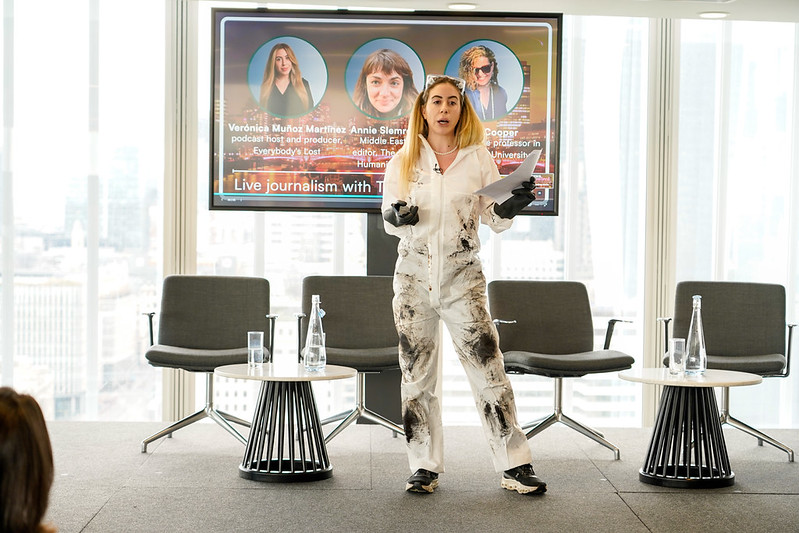
Live journalism is a public event rooted in rigorous reporting where the journalists are presenting a piece but also engaging with a theatre audience. For Cooper, this format is a way to not only build a publisher’s brand but also to foster a closer relationship with the public.
“We are not behind a screen, we are not algorithmic. We are engaging directly with the public,” said Cooper.
Slemrod from The New Humanitarian has been able to test this format first hand. One example was a showcase the outlet co-hosted with Laban Theatre in Lebanon. In this production, the stories were told of people who had been forced to flee their homes by Israel’s 2024 war in Lebanon. In that experience, she found that live journalism encouraged other people to share their own stories of displacement.
“These are humans telling human stories,” said Slemrod. “Humans are what I am looking for. I don't think AI does humanity very well. We have to find ways to showcase this humanity.”
Editor's note: the introductory paragraph of section five has been corrected to reflect that The Times is continuing to build upon an existing presence on Reddit.
In every email we send you'll find original reporting, evidence-based insights, online seminars and readings curated from 100s of sources - all in 5 minutes.