

News
Anatomía de una campaña de odio: Así fue la ofensiva en redes contra José Rubén Zamora y su familia

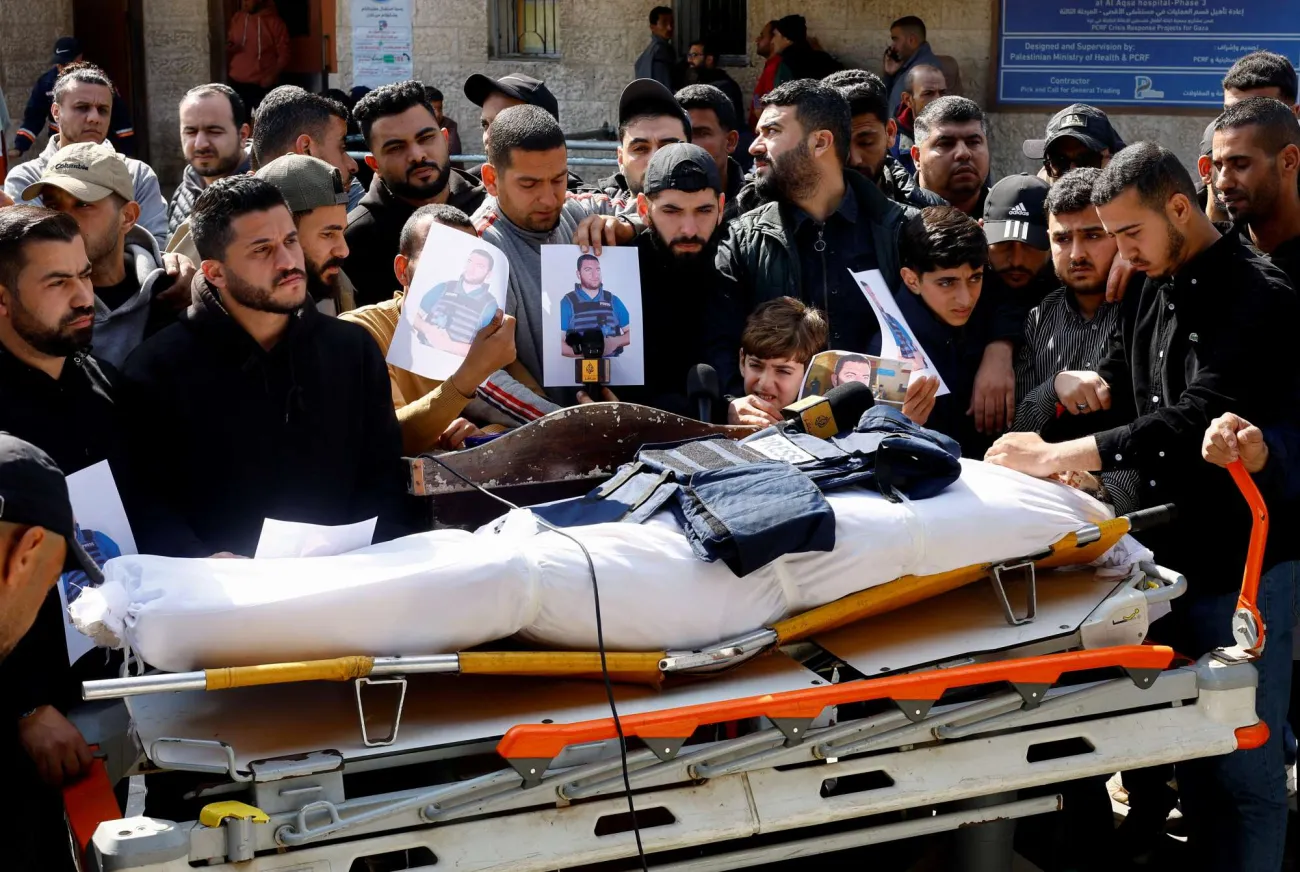
Mourners attend the funeral of Al Jazeera journalist Mohammad Weshah, who was killed in an Israeli strike according to medics, at Al-Aqsa Martyrs Hospital in Deir al-Balah, central Gaza Strip, April 9, 2026. REUTERS/Mahmoud Issa
In 2025, journalists were killed in such numbers, and with such frequency, that the violence no longer altered the behavior of states, militaries, or media institutions.
Killing the Messenger 2025, a report published by the International News Safety Institute (INSI), documents a year in which the deaths of reporters produced neither accountability nor restraint.
Despite international legal protections, those responsible faced near-total impunity. In its starkest conclusion, the report finds that the killings “disrupted nothing,” failing to change military conduct, diplomatic relations, or media practice.
At least 168 journalists and media workers died while doing their jobs last year, according to the report, many of them deliberately targeted. Most were local reporters, often working without insurance, institutional backing, or meaningful protection.
Journalists were killed across conflicts and political crises from Sudan to Ukraine, Mexico, and Iran. Nowhere was that toll higher than in Palestine, where INSI recorded 68 journalist deaths. When measured against the territory’s size, population, and the duration of the war, the report found a level of loss that exceeded every comparable modern conflict, forming a “mountain of journalist killings.”
That normalisation of violence is a central concern of INSI’s Annual Report 2025, which argues that the world crossed a threshold not because risks suddenly intensified, but because they began to register with “less surprise, less outrage, less urgency.” In that indifference, the report suggests, journalism itself has been quietly reshaped. Newsroom safety planning, once confined to distant war zones, has become inseparable from the practice of reporting anywhere.
Founded more than two decades ago by a small group of news outlets after a series of devastating losses, INSI is not an advocacy group but a safety collective of over 50 leading news organisations, built on the premise that competition stops where survival begins.
Through confidential coordination, shared intelligence, and its annual documentation of journalist deaths, the institute has become one of the profession’s few mechanisms for collective self-defence.
As Elena Cosentino, INSI’s director, writes in the annual report, protecting journalists is no longer a side project of journalism. “It is the condition for its survival.”
In this Q&A, Cosentino discusses how newsroom safety has been reshaped by drone warfare, online harassment, and near-total impunity for the killing of journalists, and why collective action has become essential to journalism’s survival. The conversation has been lightly edited for clarity and length.

Q. What specific shifts did you observe last year that pointed to a normalisation of attacks on journalists?
A. Gaza is what dramatically changed the equation in the most obvious way. Things have been getting worse for years, but Gaza was the most outrageous, overt, and shameless example of this normalisation.
It’s not that nobody cares when journalists are killed. People do care. The problem is that nothing happens as a result. From the very beginning in Gaza, there was this sense that what was happening there would not stay there, because the governments involved, including our own in the West, did not change their posture in response.
What changed operationally was that nothing changed. The military continued to operate in exactly the same way. Newsrooms continued to operate in largely the same way. The loss of journalists was absorbed into the background noise of the conflict, and the story continued, just without those people.
Another extremely worrying example has been the denial of access, in the case of Gaza, for a long time, despite sustained protestations by news organisations and legal cases brought by the Foreign Press Association in Israel. Nothing has changed as a consequence of these deliberate political choices.
If we accept not only the killing of journalists but also the denial of access and of the ability to practice journalism as simply the cost of doing business, then we are quietly agreeing to a world with less scrutiny, truth, and freedom. That is a choice.
What happens to journalists is always a precursor to what happens to civil society more broadly. When these losses and restrictions are absorbed, accountability is deferred and responsibility is diluted over time.
Q. You argue that journalists have been left to carry this burden individually. What would meaningful collective resistance actually look like in practice?
A. Responsibility has been pushed onto specific people, and of course individuals are afraid: of losing their jobs, of standing alone.
What has changed, and what gives me real determination, is the level of collective action we now see around safety. Over the past several years, I’ve seen a growing level of solidarity between major news organisations, at senior and operational levels, including around highly sensitive decisions that would not have been shared in the past.
Ten years ago, it felt like pulling teeth to get organisations to talk honestly about what went wrong or what they would do differently. Now, the floodgates are open. There is real trust, cooperation, and a recognition that if everyone contributes a little, everyone gains a lot.
If we could replicate this model beyond safety and apply it to the defense of journalism itself, we would be much stronger. This is not activism. It is about survival. Ultimately, the only thing journalists and news organisations can truly control is their own work, and if we act collectively, we still have the authority, credibility, and trust that give journalism its power.
Q. Which safety risks do newsrooms recognise but find most difficult to manage effectively?
A. The real problem is mental health. Not because it’s underestimated, but because it is extremely difficult to define, control, and scale [solutions]. Mental health support is open-ended in terms of cost and requires specialist care. It’s not something you can improvise in a newsroom or train someone to handle in a short course. It almost always requires external providers, which are inevitably expensive.
What makes this even more complex is that mental health risks now affect almost everyone. Journalists face not only physical threats, but legal pressure, digital harassment, psychological stress, and reputational attacks. That means the number of staff and freelancers who might need support is enormous, and scaling meaningful mental health care becomes incredibly difficult.
This challenge has intensified because of changes in places like the US. Ten years ago, journalists didn’t need hostile environment training to operate there. Safety training was reserved for people deploying to conflict zones like Syria, Afghanistan, or Sudan. Now, you have journalists working in environments where their own government may be hostile to them. That affects their home lives, their families, and their daily sense of security.
Mental health is the least tractable risk. And it’s compounded by online abuse.
Q. At what point does online harassment become a physical or operational safety threat for journalists?
A. At this point, the organisations we work with no longer see these as separate categories. Online harassment and physical violence are assessed at the same level.
Online threats often precede physical violence, happen at the same time as physical attacks, or act as a clear indicator that physical violence is becoming more likely.
This is especially true when attacks against journalists are being driven institutionally, through public attacks on social media by governments or state actors. That is the most dangerous signal. Public naming and shaming, accusing journalists of dishonesty or delegitimising their work, draws attention to individual journalists and directly increases the likelihood of physical violence against them. There is a very clear line between state-led online attacks and the escalation of physical threats to journalists.
Q. What role, if any, are tech platforms now playing in either exacerbating or mitigating threats to journalists?
A. A few years ago, we went through a phase when tech platforms were telling us they wanted to mitigate harassment as much as possible. At the time, we had regular contact with them as an organisation. We organised confidential discussions and exchanges with representatives from major platforms to improve channels of communication, especially in cases where journalists or news organisations were under threat. That has completely disappeared.
Today, the vast majority of news organisations tell me they no longer have any meaningful contact with tech companies. Many of those companies have dismantled the very departments that dealt with abuse, harassment, or fact-checking. Much of that work has been delegated to AI, which does not work nearly as well as it should.
This reflects a broader shift. In the current environment, tech platforms no longer feel the need to pretend to play nice. The logic of the business is what drives decisions now, and if people are abused, harassed, or worse in the process, that is treated as collateral damage.
Q. How should news organisations think about the gap between the protections available to international correspondents and those available to local journalists, particularly in conflict zones?
A. This is a huge and extremely important question, and it is very much at the forefront of the minds of people responsible for editorial safety. We talk about it all the time in our meetings.
The clear intention of most reputable news organisations is to offer the same level of protection to all staff and freelancers. But objectively, this is very difficult in certain parts of the world. There isn’t the same level of control over standards, and there isn’t the same ability to rely on law enforcement if something goes wrong.
Gaza is the clearest and most grotesque example of the injustice faced by local journalists. What has been done to journalists in Gaza would be considered completely unacceptable anywhere else. Gaza really marks a before-and-after moment, a watershed.
One thing we did in Killing the Messenger that is different from many other reports was to move beyond raw numbers. Numbers alone are abstract. So we looked at journalist deaths in relation to the size of the territory, the population, and the duration of the conflict. When you do that, Gaza becomes a mountain of death that dwarfs every other conflict. The number of journalists killed there in a single year would be equivalent to around 6,000 journalists being killed in the UK in a year. That would mean the entire BBC wiped out. We cannot even comprehend that.
For the past two and a half years, we have been discussing this constantly with leaders across news organisations -- what to do, how to support colleagues, and how to respond to the desperation and stress of journalists on the ground. People feel absolutely awful about their impotence. Not because of a lack of willingness, but because they were not allowed to help. They couldn’t send food, additional safety equipment, or even money. It was, and still is, simply impossible.
There is a very clear awareness of the disparity in the level of protection and training available to local freelancers compared with international correspondents. There is no doubt about that. The challenge is how to scale those protections despite the realities on the ground.
This is becoming even more urgent because news organisations increasingly rely on local journalists. And the question is how do we protect them when we are struggling to protect journalists even in democratic countries like the US?
Q. Why have existing legal mechanisms failed so consistently to produce accountability for the killing of journalists?
A. It’s not that there aren’t laws or mechanisms. The problem is that they are being willfully ignored.
They are ignored because it has been proven, day after day, that there is no cost to killing journalists -- not legal, political, nor reputational. Gaza is again the clearest example. Violence against journalists becomes an easy way to silence dissent because it carries no consequences.
This is a collective failure. It is the responsibility of governments that do not take a stand, that do not ostracise regimes that tolerate or carry out these killings. Internationally, there is a great deal of concern expressed, but almost never any direct consequences imposed.
There is no deterrent. And when there is no deterrent, these actions continue.
It’s not that journalists are completely powerless. We think we are because we act individually. But collectively, we have leverage. Journalism still has authority, credibility, and public trust, and that is not easily replaceable.
The problem is that the system keeps moving despite these injustices. It’s like the metaphor of the slowly boiling frog: the temperature rises gradually, and by the time you realise what’s happening, it’s too late.
Q. How has the spread of drone warfare altered the basic assumptions of hostile-environment reporting, particularly in conflicts where there are no clear front lines?
A. Massively. In a place like Ukraine, drones have effectively made it no longer viable or worthwhile for news organisations to visit what we used to think of as front lines.
There are two reasons for that. First, there often isn’t anyone on the front lines anymore. It’s drones fighting drones. Unlike traditional warfare, where you might see trenches or clearly defined positions, front lines can now stretch for square kilometers as no-man’s-land controlled by competing drones. You’re not going to risk your life to see something that can be observed remotely on a screen. In that sense, it has completely changed what “front line” reporting even means.
Second, it has profoundly changed the calculation of risk. Training for hostile-environment reporting was designed around traditional warfare: considering artillery distances, identifiable danger zones, areas you could plan to move in and out of. That framework no longer applies.
News organisations are still adjusting, as journalists always do. That often means deploying in smaller teams, making different choices about vehicles, and constantly reassessing what technology to use. There’s an ongoing debate, for example, about whether drone-detection technology is useful at all.
But there are clear limits. If you are being deliberately targeted, drones are precise and there is very little you can do. You can’t outrun a drone, and you can’t train your way out of that risk.
When the use of drones first expanded rapidly, it created a moment of panic. Over time, journalists have gained experience and learned how to adapt to some extent.
Q. Looking ahead, if current trends continue, what will credible newsroom safety planning need to look like five years from now?
A. Twenty years ago, editorial safety was separate from journalism. It was associated with foreign, ‘dodgy’ countries, war zones, and hostile environments. It was treated almost as a parallel business, not as part of everyday journalism.
If current trends continue, journalism and safety will become one and the same. That does not mean journalists will ever be fully safe: if that were the requirement, there would be no journalism at all. Journalists run toward risk when everyone else is running away.
What safety planning is about is training, preparedness, support, mutual assistance, and mitigation, doing everything possible to make journalism feasible while reducing risk as much as you can. It’s not about turning journalists into bodyguards or pretending risk can be eliminated. It’s about enabling the best, most revealing journalism with risk that is understood, proportionate, and consciously taken.
Risk appetite is different for everyone. It’s a personal calculation, but it’s also an organisational one. Newsrooms have to decide what level of risk they are willing to accept in relation to the public interest of a story.
What I already see happening and what will have to be the norm is that editorial leaders and safety leaders are in the same room, having the same conversations, working toward the same objective: telling the story.
I cannot imagine a newsroom five years from now that wants to survive and do real journalism - journalism without fear or favor - without a solid safety framework. That means clear policies, people who understand risk, and systems to help journalists make decisions in real time.
You don’t need vast budgets to think seriously about risk, to prepare journalists properly, and to put basic frameworks in place. But without that, journalism simply won’t be possible.
In every email we send you'll find original reporting, evidence-based insights, online seminars and readings curated from 100s of sources - all in 5 minutes.