



Audio, video and no news site: The young company rewiring Italy’s ageing media landscape
If you pass by one of Italy’s traditional news kiosks, you’ll notice stacks of newspapers, colourful magazines, and the country’s beloved puzzle weeklies. You’ll also spot one or two customers, usually elderly gentlemen, queuing to buy their morning paper. What you’d be hard-pressed to find is anyone under the age of 30.
Young Italians, much like their peers around the world, are not likely to read news in print, if at all. Unsurprisingly, our recent report on young audiences found that they primarily access news through online platforms. Legacy newspapers such as Corriere and Repubblica are building large subscriber bases, but most of those subscribers aren’t young.
The Italian news industry has historically been slow to innovate.
After the arrival of the internet, “we had very successful online news providers, but they were the same news organisations that were already dominating the offline market,” said Alessio Cornia, our partner for the Digital News Report in Italy and the lead author of a more detailed report on news consumption in the country that you can find here.
In the past couple of decades, some digital native outlets have gained popularity. Facebook-born Fanpage, now operating as an online newspaper, is the outlet with the largest online reach, and is especially popular with under-25s, according to data from the Digital News Report 2025. Digital-born newspaper Il Post reaches 14% in the same age group.
This crowded space now includes a growing media company called Be Water. Unlike other digital predecessors, Be Water is leaving the news website behind, and betting on attracting young audiences with audio and video formats.
Be Water now includes podcasting publisher Chora Media, social-first publisher Will Media and, more recently, sports news publisher Cronache di Spogliatoio. Also part of the company is Be Water Film, a film, series and documentary production company.
According to internal data, Be Water’s brands now reach a total audience of 8 million people across platforms. Chora and Will bring in €12,2 million in revenue and an EBITDA (earnings before interest, taxes, depreciation and amortisation) of €1,7 million. As survey data from our Digital News Report shows in the chart below, most of the audience of both news brands is under 35.
1. How it started
Italian print news has been in steady decline for over a decade. Television is still a key news source for many Italians, but not so much for the youngest. Only 28% of 18-24s surveyed for the Digital News Report 2025 said they used TV as their main source of news, compared to 67% for people over 54. When it comes to social media, the pattern is reversed: 32% of under-35s said it had been their main source of news in the previous week, compared to only 9% of over-55s.
It was in this context that Alessandro Tommasi founded Will Media, a company launched with an Instagram post in January 2020. Tommasi had previously worked in public policy at tech companies Airbnb and Lime and his goal was clear: unlike traditional news outlets, Will wouldn’t follow every twist and turn in national politics, and would aim to inform ‘curious people’ on the main trends changing the world.
There would be no website or printed edition. Will would live entirely on the online platforms its audience use every day.
Six years after its launch, Will is active on nine platforms: Instagram, WhatsApp, Telegram, Spotify, TikTok, YouTube, Facebook and LinkedIn, as well as through an email newsletter.
In parallel, Chora Media was launched in late 2020. Its founders were financier and novelist Guido Maria Brera, venture capitalist Roberto Zanco, film and TV producer Mario Gianani and Mario Calabresi, a journalist who had led La Repubblica and La Stampa, two of the top newspapers in Italy. Be Water, Chora’s parent company, was founded a few months later, in 2021.
In the beginning Chora was just a podcast company, a new concept for Italy, and was inspired by successful English-language podcasts like Serial and The Daily, and by production companies like Gimlet Media and Wonderly, Calabresi told me.
“It was born from the necessity of speaking to that broad slice of citizens who for some time had stopped reading the newspapers, watching television, or who had never even begun to use traditional media,” Calabresi said, emphasising that this was particularly under-40s who tend to distrust traditional journalism.
He viewed this as a supply-side problem and rejected the idea that young people only had short attention spans.
After 10 years leading legacy newspapers, co-founding a podcast startup could appear to be a big leap. But Calabresi, who’s now Chora’s editor-in-chief, told me he was motivated by “the profound crisis of trust” in traditional information. “Italian journalism today is a prisoner of breaking news, political controversies and crime news… Journalism should speak a bit more to citizens’ heads and a bit less to their bellies,” he said.
Calabresi saw audio formats as a way to rebuild a relationship with audiences. The slower pace of podcasts, he thought, would shield Chora’s journalism from the kind of sensationalism and clickbait prevailing in other mediums.
In June 2022, Chora Media’s parent company bought Will Media for €5 million (around $5.8 million). More recently, in January 2026, Be Water paid €7.5 million (around $8.7 million) for acquiring Cronache di Spogliatoio, a football-focused sports news outlet. Despite publishing written reports on a website, Cronache di Spogliatoio’s main focus is a video podcast structured like an informal talk show.
"Throughout the years, Cronache di Spogliatoio built a new and profoundly innovative way of telling the story of football and sport, able to speak to a large fan base in a modern and relatable language… It represents, for sport, what Will has represented for information: a new relationship with communities and younger generations,” said Guido Maria Brera, now president of Be Water, in the press release announcing the acquisition.
In a chatty interview with Chapeau, a video podcast focused on informal conversations with CEOs and business leaders, Brera shed some light on his attitude towards growth. “[In Italy] we’ve always tried to make profits to be bought by someone. As long as I live, I don’t want an exit, I want to buy,” he said.
2. The brands, their audiences, and how they fit together
Francesco Zaffarano, whom I interviewed back in 2022 about his work at Will, joined the company as editor-in-chief in September 2020. Except for a one-year stint at Devex, he has been there ever since in a range of senior roles. In December 2025, he became the head of product for both Chora and Will.
The process of incorporating Cronache into Be Water is starting with the business side and would mirror the playbook followed after Chora’s acquisition of Will in 2022.
Will and Chora have kept distinct identities. “The goal is to have a single group of people working on both brands while not losing those two identities,” Zaffarano said.
Among these distinctions are publishing channels, with Will focused on a native social presence, while Chora’s Instagram page is more aimed at redirecting audiences to its podcasts rather than being a destination itself.
Each brand has its own distinct voice. Will’s resembles that of a friend excitedly catching you up on updates you’ve missed and Chora maintains more of a distance from listeners. Audiences are also slightly different, with Chora’s skewing slightly older than Will, with a bit of an overlap, Zaffarano said. Both outlets appeal to the young, with the largest audience segment made up of Gen-Z and Millennials (spanning ages 14 to 45).
Chora and Will now employ around 100 people, of which around 30 are in the newsroom. The others are distributed within different areas: there’s a creative team working on audio, video and graphics production; an events team; a revenues team working on sales and client relationships; and also administrative, legal and HR teams.
Most of the employees are young, with an average age of 33.
In terms of content, Chora is not focused on breaking news but on storytelling, Zaffarano said. Its signature series include Black Box, a behind-the-scenes show of the world of finance, hosted by Brera, and Non hanno un amico, a satirical news show hosted by Luca Bizzarri.
Will’s social content mostly revolves around data and accessible explainers on current events and global trends. “Chora side focuses on story-telling and Will on explanation,” Zaffarano said.
There are some areas, however, where both brands do overlap. Chora specialises in podcasts, currently producing five daily shows and 11 series with weekly episodes, on top of limited series that have come to a close. Will runs four shows with its own branding. In total, and counting limited series, this adds up to over 400 titles produced by both news brands, Zaffarano said.
When Chora set out to produce SEIETRENTA (six-thirty), a new daily news roundup podcast with a range of hosts including Zaffarano and Calabresi, there was a risk of encroaching on the audience of Will’s established The Essential, a daily ten-minute podcast summarising the morning’s top headlines.
According to Zaffarano, though, SEIETRENTA was able to build a distinct following without cannibalising The Essential’s audience. He said the team outlined a different target audience, and cemented SEIETRENTA’s identity around being a morning press review and much longer than The Essential, with a length of around 30 minutes.
Chora’s other main news product is Stories, a daily foreign news podcast reported and hosted by Cecilia Sala, whom I profiled in 2022.
Stories was Chora’s first daily podcast, telling one story from around the world every day. It’s also the one with the most listeners, which Calabresi attributes to its focus on personal stories as a vehicle to explore a news topic, its accessible language and explanation, and the fact that episodes are sometimes produced on reporting trips to ‘hot’ news areas.
On one of these trips, Sala was arrested for three weeks in Tehran in December 2024. Her case drew international condemnation and calls to Iran to free her. She was released in exchange for the freedom of an Iranian engineer who had been arrested in Italy at the request of the US.

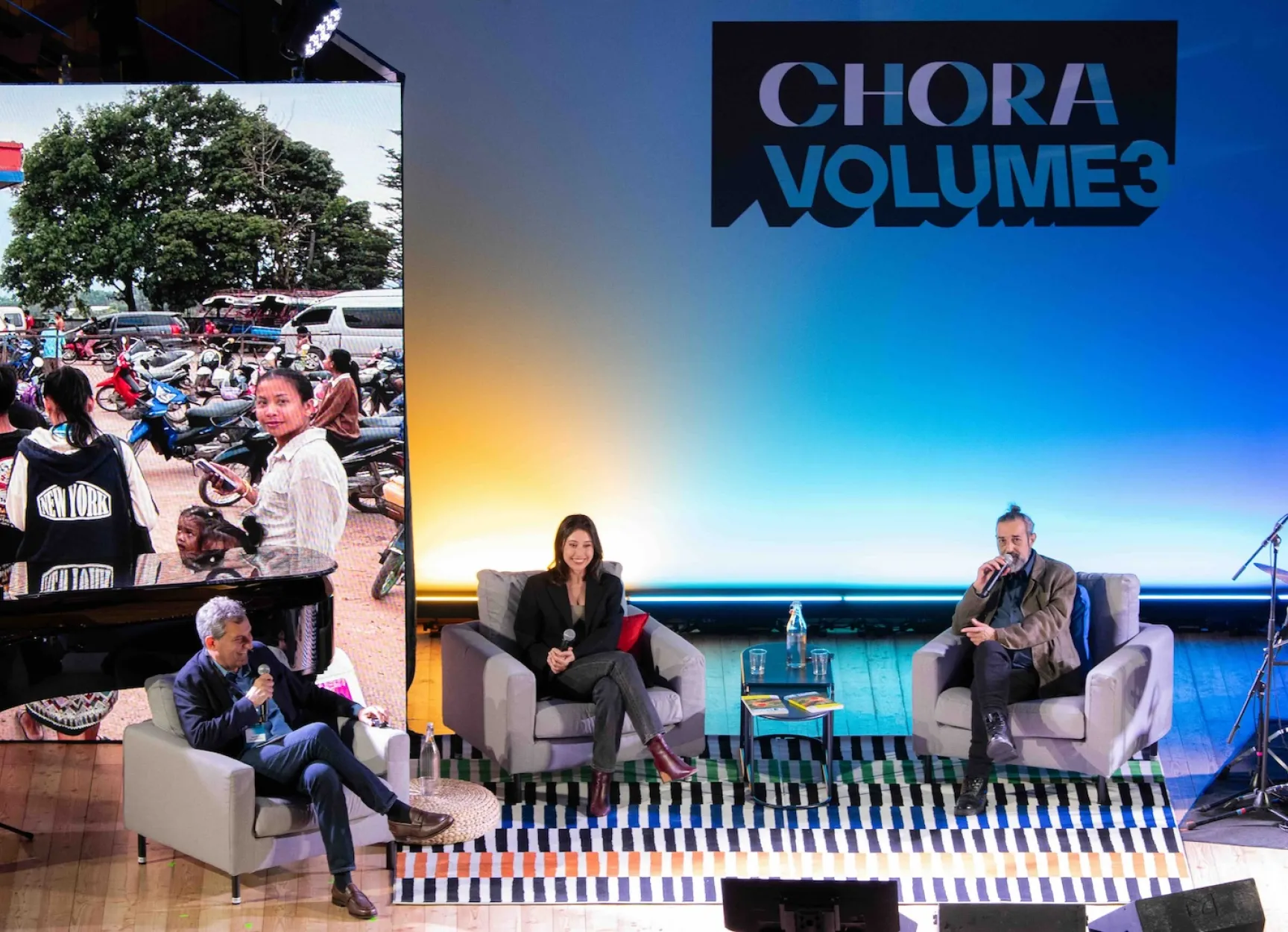
Cecilia Sala speaks at the Chora Volume 1 event in Milan, Italy in 2024. | Chora Media/via REUTERS
3. A changing news ecosystem
Despite the recent growth enjoyed by Be Water’s media brands, survival isn’t guaranteed. The recent history of digital media companies is littered with layoffs and closures.
Most recently, for example, Condé Nast announced the shuttering of tech publication Wired’s Italian edition. In Spain, Relevo, a young sports news site with a focus on serving young and female audiences, closed down in 2025 despite breaking the story that led to the Spanish Football Federation chief’s resignation.
As well as long-running funding issues, there are also growing concerns about the impact of artificial intelligence. Some Italian journalists, for example, pointed to a line in Condé Nast’s statement announcing the closure of Wired Italia as being part of a realignment of priorities as set out in a prior memo by CEO Roger Lynch, which outlined how the business is addressing opportunities and challenges posed by AI.
“Artificial intelligence is a work tool that we use already and that we will use more and more, but our bet is to have a strong, recognisable identity and a tone of voice to differentiate ourselves from others. We are convinced that credibility will continue to be the fundamental key to a relationship with listeners,” Calabresi told me.
Asked about resilience, Zaffarano stressed Chora and Will diversified their revenue streams, and this helped them through their early years.
Chora and Will get 70% of their income from branded content, Zaffarano said. These include longer-term ‘infotainment’ projects and deep dives on topics not strictly related to news, like a YouTube documentary on the overlooked parts of the Italian economy, in partnership with recruitment agency Adecco.
Sometimes, the team will formulate an idea and produce an initial post, or episode. Then they would look for commercial partners to obtain funding to work on this project longer term. As for the project itself, it is published on Will and Chora’s channels and sometimes on the sponsor’s own channels, with the partnership taking the form of a statement along the lines of “this episode is brought to you by…”
Will Media sometimes partners with companies to help them build online communities. For example, it has worked with investment management association Assogestioni to set up new channels offering personal finance and budgeting advice to young people.
On top of it, Will has a membership scheme, and both brands host in-person events.
In 2024, 8% of Will’s and Chora’s income came from a combination of their membership scheme and New Media Academy, an initiative offering courses on podcasting, content creation and digital journalism. Another 8% came from the transformation of content into films and TV series, 7% from events and another 7% from advertising on podcasts.
Events are a growing focus for the team. Their ‘flagship events’ are free to attend, but people can pay to secure a spot, and they are sponsored by external partners. The company also hosts branded events (sponsored by one business partner and free for attendees) and smaller editorial events, whose sole aim to help build a community around the brand.
Recent events include ‘Una notte a Teheran’ (One night in Tehran), a theatrical production starring Cecilia Sala and based on her own reporting, and a second tour of ‘Anni Settanta. Terrore e diritti’ (The 1970s. Terror and rights), a live show led by Mario Calabresi along with colleagues Benedetta Tobagi and Sara Poma, with a focus on one of the bloodiest chapters in Italian history.
Zaffarano said that revenue from events grew substantially in 2025, despite their considerable production cost. He said Will and Chora are now working to make their event production more scalable. Events remain “absolutely fundamental” for Chora and Will’s future, not just in terms of revenue, but also community building.
“People are asking us to bring our work into real life and we can’t pretend this isn’t the case,” Zaffarano said.
With close to two million followers, Instagram remains Will’s largest platform, with Tiktok and YouTube as second and third, respectively. However, the team invests more resources on YouTube than on TikTok, as the former affords them more control than the latter over how their content is distributed and monetised. YouTube is also a more natural destination for longer formats gaining popularity, such as video podcasts, Zaffarano said.
The team’s approach to publishing on platforms has evolved over time. “It’s not enough to simply produce good content,” Zaffarano said. “You also need a profound knowledge of the characteristics of each platform.”
Many journalists worry about the unstoppable rise of third-party platforms, and its detrimental impact on democracy, the news industry and the fight against misinformation. For outlets like Will and Chora, publishing almost exclusively on those spaces carries the risk that these platforms will change their terms unfavourably to their business models, like Facebook did with changes to its news feed, or X in deprioritising posts with links.
Cecilia Biancalana, a researcher at the University of Turin, pointed to the fact that platforms are owned by a handful of extremely wealthy and powerful businesses.
“This ecosystem is dominated by large private platforms that handle access to information according to market logic,” she said. “Platforms are private businesses oriented around profit. But journalists, like politicians and institutions, can’t afford to remain outside of platforms: it would mean accepting a growing invisibility.”
Biancalana argued it’s important for journalists to develop an understanding of the dynamics underlying platforms: how algorithms work, what incentives they produce, what risks come about.
For Zaffarano, Will and Chora’s positions as like-minded but different brands under a parent company, bolstered by the acquisition of Cronache di Spogliatoio, affords them more stability as they move on to their next chapter.
Being part of a larger company and coordinating between three editorial brands (Will, Chora and Cronache) “allows us to reach more people and work on a richer editorial offer,” Zaffarano said. The other key benefit he sees in this relationship is greater economic stability, as they can now offer clients partnerships across three different editorial brands.
“We were born in a moment when there was a great explosion of new independent outlets that were able to play around with formats and platforms and develop a different narrative,” Zaffarano said. “Now, there are many outlets doing this, or trying to, so we are looking out onto a new phase in which it’s fundamental to have a different, more articulate structure to be able to continue to do our work as we want to. This is why we’re bringing together brands that, even though they do different things, share the same starting point.”
You can read this article in Italian here.