



In this piece
Understanding young news audiences at a time of rapid change

A group of young women on their phones, France, December 15, 2025. Raphael Kessler/Hans Lucas
In this piece
Introduction | Key Findings | Methodology | 1. Young people and news access | 2. Young people and news attitudes | 3. Different ways of thinking about news | 4. Embracing audio and video | 5. Two new sources: Individual creators and Generative AI | Conclusion: What does this mean for publishers? | References | About the authors | AcknowledgementsIntroduction
For more than a decade, the Reuters Institute Digital News Report has documented fundamental shifts in how young people (defined in this report as those aged 18–24) interact with and think about news during a period of significant technological, media, and political transformation. As ‘social natives’, this demographic is moving away from traditional news media like television, print, and even news websites, gravitating instead towards a social-first and audiovisual-heavy media diet, where news is one type of content consumed among many.
While much has been said about the perceived lack of news engagement among younger people, our research also documents a greater sense of alienation among this segment of the public, some of whom find traditional news irrelevant, difficult to understand, or unfairly biased against their demographic. Mismatches between journalistic output and the expectations of young audiences highlight the need for newsrooms to examine both the question of how to reach young people where they are and, equally important, how to do so with news they find relevant, engaging, and ultimately worth their attention. Meeting the needs of this segment is crucial, not just for the current stability of the journalism industry, but also for the future of democratic societies as young individuals transition through adulthood (Røsok-Dahl and Ihlebæk 2024).
In this report we bring together evidence from over a decade of Reuters Institute research to shed light on young audiences today. Understanding generational shifts is vital for the financial sustainability of the news industry, which depends on a pipeline of younger consumers who will keep coming back to news. It also matters for the democratic health of our societies, which requires individual citizens, including young people, to be informed and collectively share a basic understanding of the world. Research consistently shows that news consumption boosts political participation, improves knowledge of current affairs, and improves resilience to misinformation, among other benefits (e.g. Altay et al. 2023; Mont’Alverne et al. 2024; Oser and Boulianne 2020).
This report has two main objectives. The first is to map out key behavioural and attitudinal trends among young members of the public, shedding light on key differences and changes in how they consume and relate to news. The story of the past ten years is not the move away from traditional media like television and newspapers. By 2015 young people had either already moved away from these as news sources or, in most cases, never used them in the first place. Instead, the story is about the move away from news websites as a source of news to social media and other forms of ‘distributed’ access. As we will show, this has emerged hand-in-hand with somewhat diverging interests, expectations, and needs when it comes to journalism – a different understanding of what news is and should be.
Second, we wish to illuminate what young people are proactively doing around news, not just what they are not doing compared to older groups. The data are clear that young people consume a plethora of media and information, often in more diverse and complex ways. In an increasingly fragmented social media universe – six online networks (Newman et al. 2025b) now reach more than 10% weekly with news content, compared with just two a decade ago – we see that young people tend to use different but also more platforms. Their growing appetite for audio and visual formats comes with a desire for the intimacy and authenticity of personality-led content. They also tend to be at the forefront of experimentation with new technologies, such as AI, and more open to its use by journalists. We highlight some of these opportunities and showcase examples of how publishers, large and small, are trying to meet these audiences where they are.
Key Findings
Based on secondary analysis of Reuters Institute research, we present the following key findings that summarise young people’s news attitudes and behaviours, and how they have changed.
- Young people (aged 18–24) are now clearly social-first rather than online-first when it comes to news. Ten years ago in 2015, young people’s main way of accessing news was through online news websites and apps of publishers. Today, their main source is social media.
- The 18–24s have embraced audiovisual platforms. They now rely on TikTok, Instagram, and YouTube for news, overtaking Facebook, which was the dominant platform ten years ago.
- On social and video networks, young people say they pay more attention to individual news creators (51%) than to traditional news brands (39%), in contrast with those 55 and older, who say they pay more attention to the news media.
- More broadly, young people are more likely than older groups to prefer to listen to or to watch news online – although the preference for reading is still ahead in most markets for now. They also consume more podcasts than older people, but news podcasts specifically are less of a driver than for older people.
- Young people are consuming news less frequently than older people. Around two thirds (64%) of 18–24s consume news on a daily basis, compared with 87% of people 55 and over. This is partly because social-led news consumption is less intentional and more incidental.
- Young people are also less interested in news. Just one third (35%) of 18–24s compared with 52% of those 55+ say they are ‘very’ or ‘extremely’ interested in news in 2025. Young people are less interested in topics like politics and are relatively more interested in fun and entertaining content. Young men are comparatively more interested in science and technology, and young women in mental health news.
- Around four in ten (42%) young people say they ‘sometimes’ or ‘often’ avoid the news – but this is similar to other age groups. All age groups cite the depressing nature of news as the main reason, but young people are relatively more likely to say news doesn’t seem relevant to them or they find it difficult to understand.
- People aged 18–24 are more comfortable with AI, using chatbots for news more often and in more elaborate ways than older people. Around 15% are using AI to access news weekly compared with just 3% of those 55 and over. They also hold more positive attitudes towards AI-assisted journalism and are more likely to say they use AI to help navigate and simplify complex news stories.
- Young people do not think in fundamentally different ways about how well the news media are performing compared with the older age groups – but there are differences of degree. Across age groups, views on the amount and fairness of news coverage tend to be positive, although 18–24s are slightly more likely to think they are not covered enough and covered ‘unfairly’.
- Most people across generations favour the idea of impartial news, but young people more often (32% compared with 19% of those 55+) think it ‘makes no sense for news outlets to be neutral on certain issues’, such as climate change or racism.
- Young people have wide-ranging but broadly similar ‘user needs’ when it comes to news, and average differences in trust in news by age are also smaller than often assumed – nine percentage points (pp) lower among 18–24s (37%) than 55 and overs in 2025.
Methodology
In this report we present findings on news use and attitudes among young people (defined here as those aged 18–24) based on secondary analysis of a range of Reuters Institute research. It draws on qualitative and quantitative research reports and datasets from the past 12 years, in particular our Digital News Report research from 2013 to 2025.
The quantitative data in this report come primarily from Digital News Report surveys, but in a couple of instances we draw on other surveys, including the Generative AI and News Audiences reports from our AI and the Future of News project. We also include illustrative quotes from qualitative studies we have published over the years, including two studies that focused squarely on young audiences (commissioned by the Reuters Institute and conducted by Flamingo and Kaleidoscope), as well as other studies on impartiality and trust in news.
In illustrating how publishers are responding to the challenges and opportunities we highlight, we include examples and descriptions sourced from Reuters Institute editorial publications, reports we have published on trends and predictions in the news industry, TikTok, creators, and desk research.
Because the focus of this report is a particular demographic group rather than differences by country, most charts show data from multiple markets pooled together. Cross-sectional quantitative data from a single year will typically be based on all markets included in that year’s Digital News Report. For longitudinal data, it is more complicated because the scope of the Digital News Report has grown from nine markets in 2013 to 48 in 2025. Therefore, when presenting data over time we only analyse data from markets included in every year. For example, for charts showing data going back to 2013, we show pooled data from nine markets (UK, USA, France, Germany, Denmark, Italy, Spain, Japan, Brazil) in every year to ensure a fair comparison.
Both the Digital News Report and the Generative AI and News Audience reports are based on online surveys conducted by YouGov.
The full methodology for the Digital News Report, including markets, sample sizes, and limitations, can be found on our website.
The full methodology for the Generative AI and News Audiences reports can be found on our website.
One limitation specific to this report is that, given the breadth of topics we cover, we focus on outlining broad trends among young people as a demographic group of interest and rarely examine within-group variation. However, we acknowledge that young people are by no means a homogenous group, and topline figures will in some cases obscure differences, including those associated with class, education, and location, all of which shape news use and attitudes.
In making sense of the longitudinal findings, we need to keep in mind the difference between age effects, which are changes that occur as people age (e.g. having children, buying a house) and cohort effects, which are generational differences resulting from the formative experiences shared by a generation born at a given moment in history (see e.g. Lau and Kennedy 2023; Duffy 2021). There are also period effects, which are shocks that affect everyone simultaneously, regardless of their age or cohort, such as the COVID-19 pandemic.
In this report we are interested in the differences between young audiences now and in the past. As such, we group people by their age at the time of the data collection. This study does not undertake cohort analysis – which is ideally based on data collected over a longer time frame than we have. However, in some core respects, we can see that young people today are distinctly different from young people of the past: they have grown up in a world – and an online media environment – that is very different from what it was, with implications for how they consume news today and will likely do so in the future.
1. Young people and news access
We start by describing how younger people (those aged 18–24) interact differently with news compared with older age groups – and how this has evolved over time.
When looked at through the lens of traditional news consumption, the temptation is to see this as a tale of what young people aren’t doing – that is, increasingly not consuming news from traditional sources and in traditional formats.
But this is only part of the story.
Throughout this section, and later in the report, we will also aim to show what young people are doing around news – how their habits and expectations are changing, how new formats, sources, and experiences substitute for or complement more traditional news consumption practices.
It is important to keep in mind that young people are avid digital media consumers – even if that media consumption is less likely to revolve around content aligned with a more traditional definition of news. Across 48 markets in 2025, 60% of 18–24s say that they feel like they are ‘always connected to the internet’, compared with 40% of those 55 and over. Many young people have only ever known a world shaped by computers, smartphones, and the internet.
Young people have moved from online-first to social-first
The effects of changes to the media landscape are perhaps most clear when we compare what young people say is their main source of news in 2025 compared with just ten years earlier. In 2015 young people were already online-first in terms of news – but by 2025 young people are better understood as social-first. In 2015 21% of 18–24s said social media was their main source of news, but a decade later this has risen to 39% – overtaking news websites and apps, which have decreased from 36% to 24% (Figure 1). Young people in 2025 are also less likely to say their main source of news is TV (21% down from 28% in 2015), but the shift in the past ten years has been less dramatic, chiefly because the move from offline to online had already happened.
Figure 1.
Young people consume news less intentionally and more incidentally
The consequences of the rapid shift from online-first to social-first news use are wide-ranging. One implication is that many younger people are consuming news less intentionally and more incidentally. Our research shows that when people come into contact with news on social and video networks, it tends to be because they see it while they are there for other reasons, and are less likely to remember the news brand that provided it (Kalogeropoulos et al. 2018), likely weakening people’s direct connection with news brands. We can see how this has played out over time by looking at the pathways people take to access news online. As we see in Figure 2, on average across nine countries people are less likely to directly navigate to news websites. Just 14% of 18–24s say their main way of accessing news is by going directly to a news website or app in 2025, far less than say via social media (40%) or search engines (26%). Comparatively, the proportion of 55 and overs whose main way is going direct is double that of the youngest age group (28%). Direct access is in decline for this group too, but it remains their most
popular pathway.
Figure 2.
Another implication is that younger people are consuming news less frequently. Figure 3 shows the percentage of people in each age group who say they access news daily. While the proportion of 18–24s accessing news daily has long been lower than for older groups, it is the comparative decline in usage that is notable here. Daily news use has fallen by 15pp among 18–24s since 2017, whereas news use among the 55 and overs has declined by just 5pp.
Figure 3.
Datapoints like these understandably cause anxiety in the news industry, but we should keep in mind that young people may be consuming information about current affairs in a different way, adopting a different definition of what counts as news. This is difficult to probe using survey data alone, but our qualitative research over the years suggests young people tend to have a broader definition of news beyond traditional topics like politics, crime, and business – a difference between ‘news’ (broader) and ‘the news’ (more traditional) (Collao 2022). As we’ll see later in the report, their definition includes (more) personally relevant and entertaining topics.
In any case, the shift from direct access towards more incidental news consumption on social media seriously undercuts the advertising and audience revenue models most publishers depend on. On the one hand, young audiences without a sense of loyalty towards particular brands are much less likely to pay for their content. On the other hand, social-first consumption is more vulnerable to the gatekeeping decisions of technology companies, whose choices can change the fate of news outlets relying on them. For news publishers, one of the challenges is not simply reaching young people but reaching them in ways that encourage them to be part of their core audience.
2. Young people and news attitudes
While it is clear that younger people are accessing news in very different ways compared with older groups – and that the way young people access news now is markedly different from how young people behaved ten years ago – we see less pronounced age differences when we consider people’s attitudes towards news.
Though we aim to highlight some differences by age in this section, it is important to be clear that in many cases these tend to be differences of degree rather than being fundamentally divergent. As we will see, younger and older people tend to have broadly similar views about news in terms of trust, impartiality, and fairness of coverage – even if young people tend to be a little more negative.
Young people are less satisfied with news coverage
In 2021 we asked respondents whether they felt the news media covered people their age enough, and whether that coverage, when it was done, was fair. The key point here is that around half across all age groups think they are reported on ‘about the right amount’, so overall people are satisfied with the balance of coverage (Figure 4). However, there are also some small age differences. Younger people are more likely to think that they do not receive enough coverage compared with older groups. Around a third of 18–24s (31%) say that people their age are not covered enough, compared with around 20% of those aged 35–54. Interestingly, those aged 55 and over are also slightly less satisfied with the amount of coverage they receive than those in the middle age groups.
Figure 4.
Similarly, around half across all age groups think that the news media cover people their age fairly. Yet it is also true that 18–24s are more likely to say that coverage of their age group is unfair – with around one third saying this (35%), compared with around a quarter of those 35 and over. Again, those in the oldest age group are also slightly more likely to think that they are covered unfairly than those in the middle. More detailed analysis of this data has shown that this curved relationship between age and fairness is evident in more than three-quarters of the 46 markets included in the 2021 Digital News Report dataset (Eddy and Fletcher 2025).
Figure 5.
Although we do not have data on fairness from other years, it is likely that this is a longstanding view. Some will remember when millennials pushed back against news stories and columns suggesting their financial woes were due to frivolous spending, and more recently Gen Z have defended themselves against depictions of their generation as undisciplined and lazy.1 It may be that the low proportion of young people in newsrooms (see Thurman et al. 2025 for UK data) contributes to coverage they perceive as unfairly representing them or overlooking them entirely.
There’s obviously been lots about housing prices, and, you know, the classic article was about how millennials spend too much money on coffee and avocados. That’s things that so many different outlets have done.
(Female, 26, UK) From Ross Arguedas et al. 2023.
If we break our data down by age and gender, we see that the perceptions of young women are key to understanding the differences by age. Young women (39%) are less likely to think people their age are covered fairly than young men (47%). This matters, since historically news has not always felt like it has been made for women, and especially young women, instead often pitched, for instance, to men interested in business and sports (Lee et al. 2023).
Figure 6.
One approach to tackling representation grievances might be through hiring in a way that better represents the audiences. Mediahuis launched youth-oriented SPILNEWS (Netherlands) in 2025, fronted by a small team of journalists in their twenties.2 SPILNEWS also maintains a WhatsApp community where young people can have a say in the news topics covered and get insight into how SPILNEWS makes its editorial decisions.

Young people are less wedded to impartiality and neutrality
Our data also suggest that young people have developed somewhat diverging views on the basic structure and tone of news coverage. When we ask people about impartiality and related concepts, there remains a broad consensus across age groups that this is something they want; facts not opinion. Most people think that news outlets should try to be neutral on every issue (Figure 7). But it is also true that younger groups appear to be slightly less committed to impartiality. For instance, when asked in 2021, a larger proportion of young people (32%) agreed there were some issues where it ‘makes no sense for news outlets to be neutral’, compared with a smaller proportion of older people (19% of 55+). We documented similar age-related patterns for other dimensions of impartiality in the 2021 Digital News Report.
Figure 7.
We found further evidence for this age difference in a qualitative study, where younger people tended to be less tolerant of views they deemed hateful or harmful, including social justice issues, even as they were generally opposed to the suppression of certain viewpoints (Vir 2021).
I feel like it’s kind of difficult to be impartial when it comes to the racism discussion.
(US, younger) From Vir 2021.
Society is constantly changing and what is acceptable and unacceptable is always changing as well.
(UK, younger) From Vir 2021.
Young people have lower trust in news
The small differences by age that we see when it comes to attitudes to news are also reflected in the data on trust. In 2025 across 18 markets, 37% of 18–24s say that they ‘trust most news most of the time’ – slightly lower than the trust in news among young people in those same 18 markets in 2015 (41%).
Trust among young people is 9pp lower than among people 55 and over. This age gap has been evident in the data since we first started asking about trust in news in the 2015 Digital News Report – and has remained roughly stable, even as trust has fallen in most countries and across all age groups. However, in contrast to what is often assumed, average differences in trust in news by age are relatively small.
It is also important to highlight that trust in news varies a lot from one country to another. Not only are there large differences in levels of trust by country, but the dynamics of what shapes trust within countries also varies. In many cases there are no significant differences in trust by age group, though it is rare for a country to have higher trust in news among younger people (Fletcher et al. 2025).
Figure 8.
Many different factors shape trust in news, but one reason why younger people have slightly lower trust in news may be because, as we saw earlier in this report, they are more likely to use social media as a source of news. In-depth analysis of this data suggests that in countries where social media news use has grown fast (and television news use has declined in parallel), trust in news has fallen at a faster rate (Fletcher et al. 2025).
Young people have lower interest in news
Although the differences by age for many news attitudes are quite small, they are a little more pronounced when it comes to interest in news. Here, younger people are clearly less likely to say they are ‘very’ or ‘extremely’ interested in news. In 2025, just 35% of 18–24s say that they have high levels of interest in news, compared with 52% of those aged 55 and over (Figure 9). Since 2013, interest in news has plummeted among all age groups and remains lowest among 18–24s. The proportion of young people saying they are ‘very’ or ‘extremely’ interested in news has dropped by 25pp since 2013.
Figure 9.
Why might this decline have occurred? At the outset, it is important to note, as Figure 9 shows, that interest has long been lower among younger people. This is likely for several reasons, including younger people being less politically interested or engaged and having less set habits or preferences (the use of social media as a main gateway to news arguably does not help settle those habits or preferences). There are arguments that some of this is the product of life stage, with some saying that young people will ‘age into’ news interest and consumption as they move into full-time employment, have children, or take on mortgages. While there may be some truth to this, the evidence, as we have seen, also shows there is something fundamentally different with young people of this generation (Scire 2025). That difference is rooted in the different behaviours: greater reliance on smartphones and social media, a lack of defined habits or news brand loyalties, as well as differences in underlying preferences and goals (Forman-Katz et al. 2025).
[News about politics] makes me feel small and no matter what my views, it won’t make any difference at all to what goes on in the country or world, so there is no point listening to it.
(Female, 22, UK) From Collao 2022.
Young people have similar levels of news avoidance
News avoidance is the stated intention or desire of someone to reduce, change, or take control of their news consumption habits, even if that does not mean that they are cutting themselves off from news entirely. As such, news avoidance is as much an attitude as a behaviour.
When we look at our 2025 data, we can see that a slightly higher proportion of people aged 18–24 say they ‘sometimes’ or ‘often’ avoid news, with 42% of this group avoiding compared with 37% of those aged 55 and over. However, despite what is often assumed, 18–24s are no more likely to be news avoiders than anyone else under 55. Nonetheless, news avoidance has increased evenly among all age groups over time, up from 30% among 18–24s in 2017, and up from 25% among the 55+ group in the same year.
Figure 10.
While overall age differences are small, the reasons for news avoidance are perhaps more revealing. The following chart shows the rank order of reasons for avoiding the news in 2025 among news avoiders aged 18–24 and the 55s and over. Both older and younger respondents in our survey agree the main reason they avoid the news is because it has a negative effect on their mood. However, a key age difference is that younger news avoiders are more likely to say they do so because it doesn’t seem relevant to them or they find it hard follow. One fifth of 18–24s (21%) say they avoid news because it doesn’t seem relevant to them, compared with 16% of 55+. Meanwhile, 15% of 18–24s say they avoid news because they find it difficult to understand, compared with just 5% of people 55 and over.
Figure 11.
If someone hadn’t read about Brexit at all until now and then tried to pick it up and they’re seeing what’s going on, they wouldn’t have a clue what it’s going to be like. You’d have to look everything up from scratch and then it would be even more of a chore.
(Male, 21–24, UK) From Galan et al. 2019.
I remember growing up with news and just thinking I’ve got to look up so much stuff that I don’t understand.
(Male, 25–30, UK) From Galan et al. 2019.
Social-first news startup The Daily Aus (Australia) is an example of a news outlet that has taken misgivings about relevance and difficulties in understanding news head-on, with a newsroom of young journalists providing young people with concise and jargon-free news. They also keep a finger on the pulse of their audience’s needs and preferences with weekly polls and, more recently, an annual report about young Australians – what they care about, how they live, and what gives them hope.3
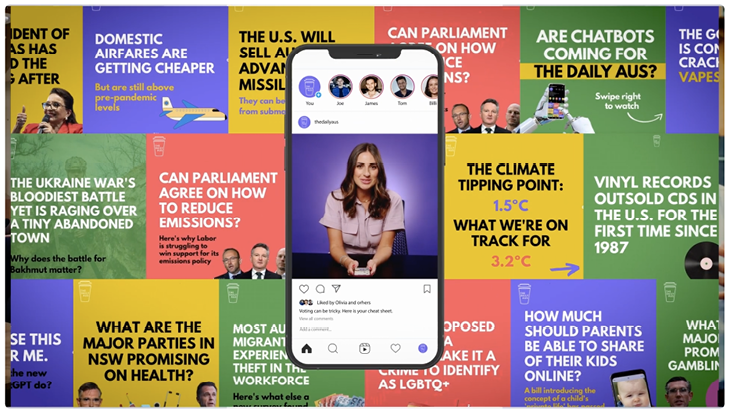
Born as a daily news bulletin posted to Instagram, The Daily Aus now delivers news across a variety of formats in a ‘digestible and engaging’ way.
In the next chapter, we explore what our data say about where young people are turning for news and information about current affairs.
3. Different ways of thinking about news
If young people (18–24s) are moving away from more traditional ways of accessing news, and more traditional ideas about what news is, what do they say they want news to be like instead?
In this section we switch from examining what young audiences are doing less of compared with older groups and instead explore the data on what young people say they want in a broader sense. Doing so means that we have to adopt a broader understanding of different news topics and user needs.
Young people are more interested in news that’s entertaining
If we focus on people’s topical interests, some differences between younger and older people become evident. As we have already seen, young people are less interested in news, and this is also evident in the data we have collected on interest in specific news topics (see Figure 12, with data from 2024).
But this figure also shows clear differences in the rank order of the news topics. While both groups are most interested in local news and international news, young people are relatively less interested in political news (ranked ninth compared with third for older people) and more interested in what we have called ‘fun news’, ranked equal fifth compared with tenth for those 55 and over. Entertainment and celebrity news also makes it into the top ten for younger people, with levels of interest close to identical for political news for the 18–24s.
Figure 12.
If we look at young people’s interest in topics by gender, further differences emerge (Figure 13, with data from 2024). Local and international news are in the top five for both groups, but young men are more likely to be interested in science, sport, and politics, whereas young women prefer mental health, crime, and entertainment news.
Figure 13.
Pulse Africa, owned by Ringier, is one example of a news company shaping its strategy around different topical preferences in young markets like Nigeria. Its approach to engaging young audiences places a strong emphasis on lifestyle and entertainment news among other topics looking to ‘inform, entertain, and create a sense of belonging’.4 The story here is that young people are not completely disengaged, but they approach and interact with the world (and with news) differently.
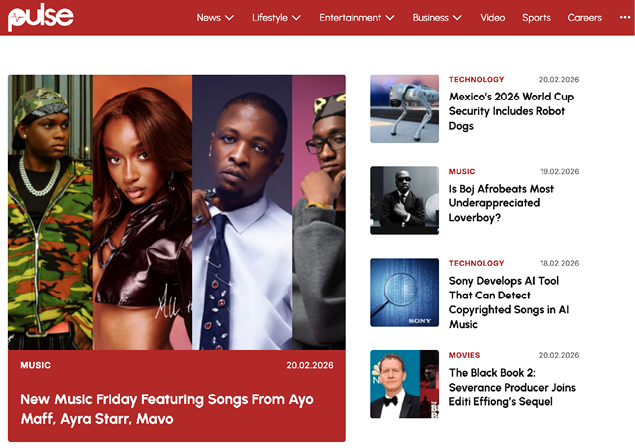
Lifestyle and entertainment content feature prominently on Pulse’s social media channels and website geared towards young Africans (image from Pulse Nigeria’s website).
Young people have a wide variety of news ‘needs’
Although news and entertainment serve somewhat different purposes, the increased use of platforms that provide both almost simultaneously may be shaping preferences and expectations. Research inspired by the User Needs model5 suggests that people expect a range of different things from news. While our own data suggest that people think the most important functions of the news are to keep them up-to-date with what’s happening, and to help them learn more about topics and events, it is also the case that around half of young people think that it is important for the news media to entertain them and make them feel better about the world (Fletcher 2024).
In terms of how well the news media do in fulfilling these needs, the picture is generally more positive than negative. Most young people think that the news media do a good job of keeping them up-to-date, for example (Figure 14, with data from 2024). But across all age groups, including young people, people are relatively more likely to think the news media do a bad job of making them feel better about the world, with ‘entertain me’ also faring poorly. Earlier, we pointed out the main reason all people avoided news is because of its negative effect on their mood. Here we can see that a fifth of young people (19%) say the news media aren’t helping with this.
Figure 14.
While most newsrooms agree that shying away from difficult topics like war, crime, and climate change is not an option, more are exploring alternatives to reporting through constructive or solutions-based approaches, or simply making space for more uplifting stories alongside the bad.
Sometimes I like to feel a bit empowered or inspired. So, I think [I like] amazing human stories and wellbeing, how to help yourself feel better.
(Female, 22, UK) From Galan et al. 2019.
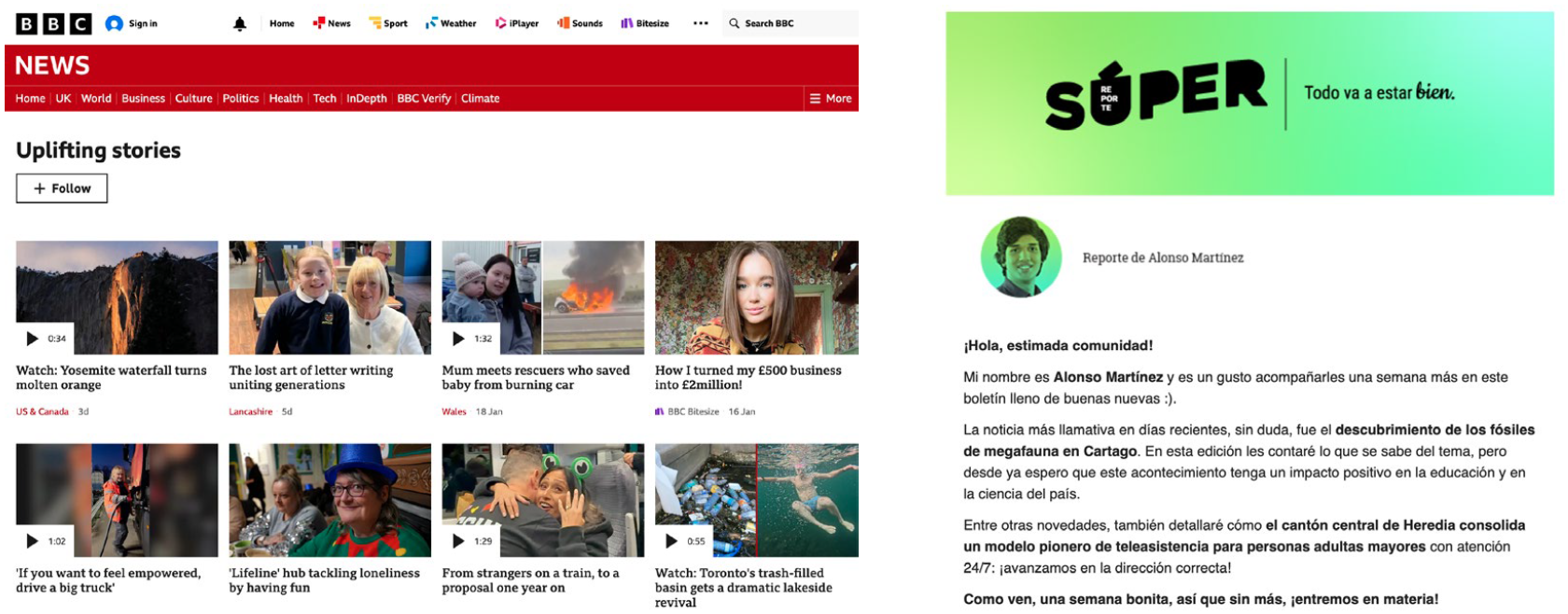

The BBC (UK), Daily Maverick (South Africa), and Excelsior (Mexico) have created designated sections within their websites that collate good news, while the Guardian (UK) and Delfino.cr (Costa Rica) offer uplifting newsletters. The Globe and Mail (Canada) has done deeper editorial restructuring with this in mind, creating new beats for ‘healthy living’ and ‘happiness’, among others.
4. Embracing audio and video
This chapter explores the different media formats that young people are accessing for news. While there are specific trends around platforms and formats, what unites them is the shift towards more audiovisual content.
While young people are certainly still consuming news online in traditional ways, they tend to be more likely than older groups to prefer audio and video, and the platforms that provide
these formats.
Young people are leaning towards audio and video news
When we ask in the abstract about people’s preferences for different formats when it comes to online news, while reading remains the favoured way to engage with news online across all age groups, we can see that preferences for watching and listening are higher among younger age groups (Figure 15, with data from 2025). This chart shows that, across all the markets we cover, 32% of 18–24s prefer watching news online, compared with 25% of 55 and overs. This has changed over the years, with audio and video preferences on the rise – especially in African, Latin American, and South-East Asian markets.
Figure 15.
The BBC’s Global News Podcast is a good way to present news as it can sometimes be hard to sit and read long articles.
(Female, 19, UK) From Collao 2022.
I tend to be a fan of a mix of videos accompanied by text and infographics to help me digest the facts.
(Male, 20, UK) From Collao 2022.
Young people are the age group who report watching most online news video, with nearly three out of four (73%) 18–24s saying they watched a short-form news video weekly in 2024, compared with 60% among those 55+. Much of this is driven by vertical video on platforms like TikTok and Instagram, a feature publishers are increasingly integrating into their own news websites and apps. Brands like The Economist, The New York Times, and CNN have all launched dedicated video tabs in their apps, as they try to increase engagement and encourage on-site video consumption, as well as repurpose content made for video networks (Newman 2026; Tameez 2025). Former BBC and Vice journalist Sophia Smith Galer, who pioneered TikTok journalism in the UK, has also launched an app to help journalists optimise their scripts for vertical video, including a teleprompter tool.


Young people are watching more long news videos and streaming too. Markets like Argentina have seen a boom in platform-native video like Olga and Luzu TV, which blend news and entertainment in a mix of live and pre-recorded videos.6 The latter has nearly three million subscribers on YouTube, now one of the 16 news brands in Argentina with the largest reach online (8%) according to our 2025 data, with an audience that skews young (16% among 18–24s). YouTube-native Kanal Zero in Poland has likewise achieved success with its fast-paced live broadcasts, debates, and interviews among an audience disproportionately made up of Millennials and Gen Zs.


Young people are gravitating towards audiovisual platforms
As we documented in the first chapter of this report, social media is now the primary access point for news among young people. But beneath this headline finding there are also important shifts in the specific social and video platforms young people are using – especially when it comes to news.
Figure 16 shows how social media use for news has changed among 18–24s (in a subset of nine markets we have tracked over time). When it comes to news, Facebook is clearly much less central for young people now than it was around ten years ago. For young people in 2014, it was by far the most widely used network for news, with 47% of 18–24s using it weekly. A decade later only 16% use it for news, leaving it trailing behind most of the other platforms. Instead, today’s young people prefer visual-based platforms like Instagram (30% in 2025), YouTube (23%), and, increasingly, TikTok (22%), resulting in a much more fragmented social and video platform ecosystem.
Figure 16.
The rise of TikTok has perhaps been the main social media story of the past decade, dramatically increasing in usage for any purpose among 18–24s, with almost half (47%) globally saying they used TikTok weekly in 2025 (Figure 17). Other platforms responded with their own short-form video features, with YouTube (Shorts) and Instagram (Reels) being launched, both in 2020. Meanwhile, those aged 55 and over have remained on Facebook, with use for any purpose remaining stable over time. In contrast, the decline in usage among 18–24s is substantive (down 37pp since 2014).
[Facebook is] ancient. Like, a mum’s thing. I don’t really use it anymore.
(Female, 18–20, UK) From Galan et al. 2019
A TV reporter who also has a TikTok page gives us regular updates on the situation. It feels comforting and more intimate than watching on TV news.
(Female, 22, UK) From Collao 2022.
Figure 17.
Aware this is where young people are increasingly spending time, publishers keen on courting them have leaned into TikTok (Newman 2022). The Washington Post was one prominent early adopter, pioneered by Dave Jorgenson (also known as the Post’s ‘TikTok guy’), who launched its channel in 2019 to great success. Many others have since followed suit on the platform, geared towards faster-paced, entertaining, and personality-driven news videos. However, Jorgenson left the Washington Post in 2025 to start his own media company (Local News International), taking much of the audience with him,7 and pre-empting one of the risks for organisations taking a personality-led approach, where news brands are sometimes overshadowed by the individuals fronting them.
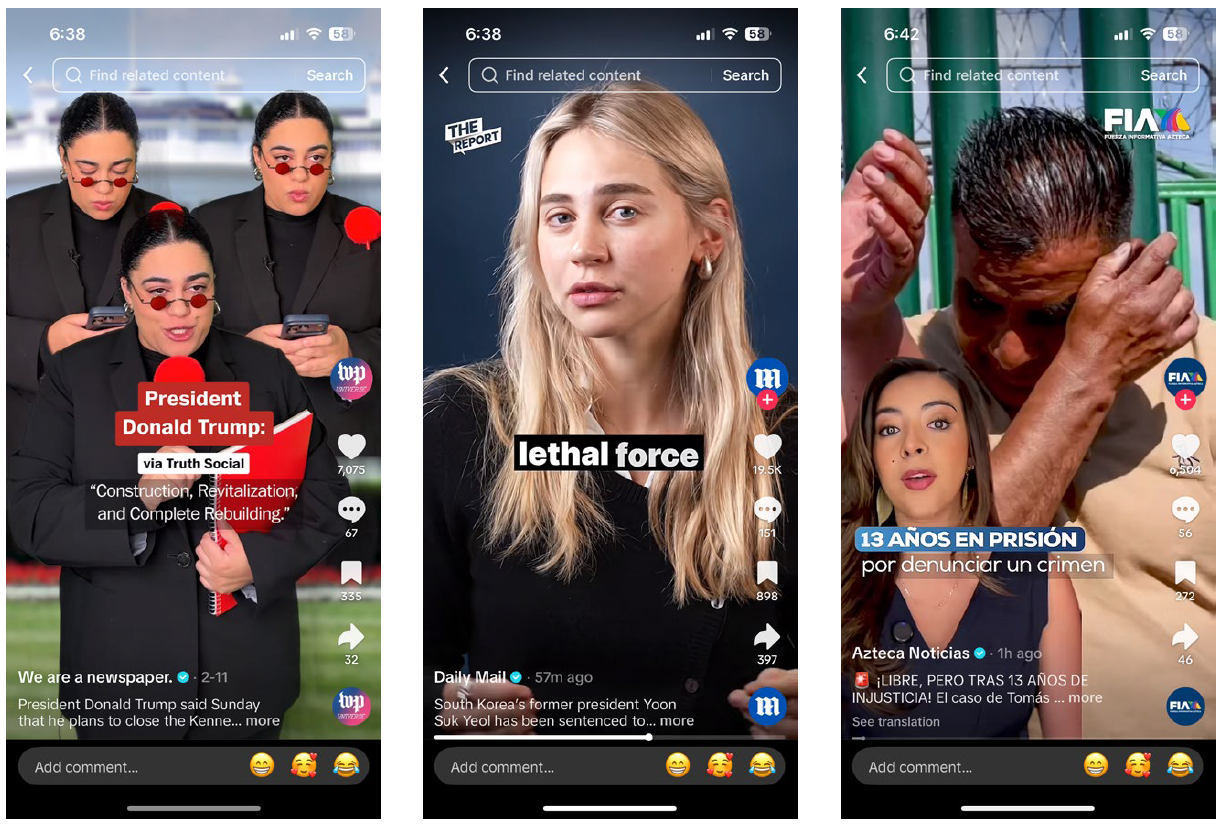
Video-led platforms more generally have proven to be fertile ground for digital news startups looking to fill gaps left by traditional outlets, many of them managed by and directed towards young people. US-based Roca News caters to Millennials and Gen Z via Instagram and YouTube, as well as a newsletter and app, aiming to provide ‘factual and enjoyable’ news. Ac2ality, founded in 2020 by four Spanish young women, has more than six million followers on TikTok, where it ‘translates newspapers’ for younger audiences.
Another way to understand the generational differences in platform use is comparing the social and video networks most used by 18–24s with those used by the 55 and overs. Figure 18, which includes all the markets in our Digital News Report 2025, illustrates the dominance of audiovisual platforms among the 18–24 age group, with the perennially youth-focused Snapchat even making an appearance on the list of most-used apps (24% report using it for any purpose weekly). Notably, YouTube is a popular platform across age groups, with growing usage even among those 55 and over (see also Ofcom 2025).
Figure 18.
This table also shows that social and video network use tends to be higher across the board among younger people. In fact, if we look at the average number of platforms used weekly for any purpose, it is 4.6 among 18–24s, compared with 3.4 among the 55+ group. This illustrates the diversification of young people’s media diets as they combine a larger number of platforms into their repertoires (Frey and Friemel 2023). The fact that they consume more media in more places, however, can also make it challenging for journalists to locate and reach them through any single platform.
On TV we always see the same things, but on YouTube, Spotify, TikTok, we have a range of diversity. … We can get all this and see that there is diversity, society far beyond just what we live.
(Male, 18, Brazil) From Newman et al. 2022.
Young people are consuming podcasts and audio
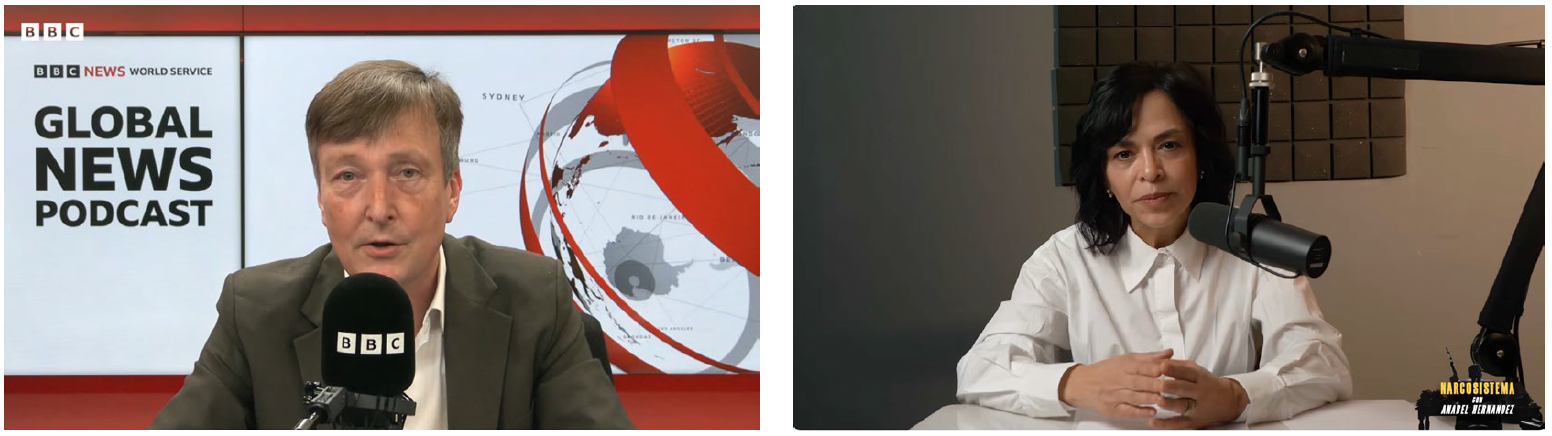
The rise of audiovisual platforms among younger people has also influenced another type of media: podcasts. Young people are more likely to engage with podcasts generally, but they also increasingly access podcasts in video form, raising the question of what constitutes a podcast in an increasingly visual multimedia environment. While the most successful video-based podcasts deal with topics outside the realm of news, the news industry is taking notice of the trend, with traditional news outlets like the BBC and the New York Times venturing into the world of video podcasting, alongside independent journalists like Anabel Hernández (Mexico) and newer digital brands like Watif (Spain).
Looking at the general landscape of podcasts using data from 2024, it is clear that they are a much more popular format among younger people than older: 59% of 18–24s reported listening to any kind of podcast monthly, compared with just 24% of 55 and overs (Figure 19). However, age differences are much less stark when we zoom in on news podcasts specifically. Close to half of the podcast listening for people 55+ is news, whereas it is a much smaller proportion (around a third) of the podcasts young people say they listen to. Differences in news podcast usage across regions are also small, despite the USA having a far more developed podcasting market than in other parts of the world.
Figure 19.
Why do news podcasts have relatively less appeal among young people? One factor may be around definitions of what podcasts or news-related podcasts are. Many young people may not see their favourite podcasts as being in the news category. These may be chat shows, comedy shows, or interview format shows that sometimes touch on news.
For hobby news I prefer things like YouTube videos or podcasts that I can listen to while doing other things. I’m listening to one about new TV as I write this. For legitimate news, I like to read it, though video aids like the videos of missiles being launched at homes in the current Russia/Ukraine crisis are welcomed when article relevant.
(Male, 18, USA) From Collao 2022
On the other hand, when we asked people to name the news-related podcasts they listened to most, Joe Rogan was often at the top of the list. Is the Joe Rogan Experience a news podcast? Or just a podcast that sometimes generates news because of its famous host and guests? Podcast listeners we talked to in qualitative research came down on both sides. Notably, many popular news-related podcasts exist outside of the mainstream, often with partisan leanings. Online, social-first, and video-first brands like MeidasTouch, The Young Turks, and Pod Save America have dominated spaces like YouTube. The Daily Wire, on the political right, has also built up a large following with podcasts from Ben Shapiro and Jordan Peterson.
5. Two new sources: Individual creators and Generative AI
All of the changes, behaviours, attitudes, and preferences we have outlined up to this point have contributed to the emergence of two new ways of getting news and information about the world: individual news creators and generative AI chatbots.
Both have started to grow in prominence in recent years, and are particularly popular with younger age groups. Both also have a complex, intertwined relationship with the established news media. Some individual creators rely heavily on repackaging and reinterpreting existing news coverage, and if asked about news, generative AI chatbots will often draw on material from news outlets.
In this sense, and others, these are not entirely ‘new’ sources of news, but their popularity and growth among young audiences makes them important to examine in the context of this report. They also highlight how many young people would like news to be easier to navigate. As we shall see, some of the most popular individual creators provide news explainers, and generative AI is used by some to make news easier and quicker to understand.
Young people are engaging with individual creators
The growth of video networks and podcasts is hard to understand without examining the role of creators or influencers, who are especially popular as sources of news among younger people. As we’ve shown in previous work (Newman et al. 2025a), this is an incredibly diverse and fragmented ecosystem. It is also one that varies hugely in size by country. It is much more prominent in parts of Asia, Africa, and Latin America – and increasingly in the USA. However, in Western and Northern Europe, the continued strength of the established media makes it tougher for individual creators to break through.
When we take a closer look at the creator ecosystem, commentary – often partisan and sometimes controversial – tends to draw most attention, with big names like Joe Rogan, Piers Morgan, and Candace Owens at the fore. However, we also find a subset of (mostly young) creators who simplify and decode news for young people, often remixing mainstream content into more accessible formats.
Hugo Travers (HugoDécrypte) from France famously grew a YouTube channel he started as a university student into a media company that ‘deciphers’ news for millions of young people. Other successful creators taking similar approaches include Dylan Page (News Daddy) from the UK, Kovy from the Czech Republic, and Abhi and Niyu from India.

Some well-known creators started their careers with traditional outlets, breaking out to focus on their own projects. For example, Taylor Lorenz previously covered internet culture at the Washington Post but left to run her own Substack and podcast. Others like Tucker Carlson (formerly Fox News) and aforementioned Dave Jorgenson (also from the Washington Post) have left news organisations and started their own small media companies, often looking for more editorial control or to make more money (Newman et al. 2025a).
Trying to get an accurate understanding of the reach and relative importance of news creators (compared with the mainstream press) is difficult for various reasons – and can easily be overestimated if we look solely at metrics like view counts on platforms. Nonetheless, the rise of independent news creators online has caused some concern in the news industry as it relates to attention, but also accuracy of information and the potential harms that unverified information might lead to. At the same time, some also sense an opportunity to learn more from individuals who clearly have a knack of engaging parts of the public that the news media struggle to reach.
One way to understand the rise of news creators is by looking at the proportion of social media users who say they pay most attention to creators vs traditional news brands. In 2025, we can see that more young people report paying attention to creators or personalities than to mainstream news (Figure 20). Around half of social media news users aged 18–24 (51%) say they pay most attention to creators or personalities for news. Only 39% say they pay most attention to traditional media or journalists. These figures are essentially flipped for social media users aged 55+.
Figure 20.
There are also important regional differences in online behaviour connected to the role of age. In many regions with young populations, the differences across age groups are even larger when it comes to preferences. In Africa, relatively more attention is paid to online news creators across all age groups, but especially among 18–24s.10 However, in Europe and Latin America, even the 18–24s say that they pay more attention to traditional news media and journalists when using social media for news.
These findings give us a baseline understanding of how attention dynamics for news vary by age groups, but there remains an open question about the extent to which creators replace rather than complement traditional outlets for news. We cannot definitively answer that question with these data alone, but our findings do suggest that the people most likely to consume news from online content creators are also the ones most likely to consume news from mainstream sources – they are news lovers.
Young people and generative AI
Since the release of ChatGPT to the public in November 2022, there has been a proliferation of generative AI technologies, companies, and use cases in all areas of life, including the consumption of news. Audiences have begun to use generative AI for news-related queries. Notably, this use of AI for news – and in general (Eurostat 2026) – is far more common among younger age groups. The following chart shows the proportion of people across all our markets in 2025 who say they used AI to access news in the past week. We can see that reported usage is considerably higher among 18–24s, with 15% saying they use it weekly, compared with just 3% of those 55+ (Figure 21). These figures will no doubt change over time.
Figure 21.
Much of this AI-related news use is likely driven by young people’s greater awareness of, comfort with, and adoption of new technologies more generally. We saw evidence for this in qualitative work we conducted in 2024 (Collao 2024), where young interviewees who had grown up with computers and smartphones suggested AI felt less disruptive and more like a logical next step in the evolution of technologies that were second-nature to them. This is one of the reasons why younger people tend to be at the fore of experimenting with new technologies, and in the case of AI, identifying how it could help solve practical challenges in their lives.
I’m used to computers and I’ve lived with them my whole life, so it’s [AI] like, ‘Ah, well, one more thing of daily life,’ no?
(Male, Mexico, 21) Unpublished quote from the Collao 2024 study.
I always use a lot of technology and even when AI started popping up, especially with ChatGPT, we were kind of the first people to hear about it because we’re, like, students and people have been saying, like, ‘It helps. You know, it can help you, right? It can help you, like, solve problems.’ So, we were kind of the first group to really try it out.
Female, USA, 22) Unpublished quote from the Collao 2024 study.
We see this generational divide in comfort levels in a question we asked in 2025 about AI and news in two hypothetical scenarios: (1) news made mostly by AI with some human oversight, and (2) news made mostly by humans with the assistance of AI. We see that people aged 18–24 are much more comfortable with AI’s involvement in the news-making process in both scenarios (Figure 22). Almost a third of 18–24s (30%) are comfortable with news being made mostly by AI, while 43% are comfortable with news being made with AI assistance. Comparatively, just 13% of 55 and overs are comfortable with AI-led news and 30% are comfortable with AI-assisted news. Attitudes differ by country too, with people in Europe much less comfortable with AI compared with people in the USA, where many of the most prominent AI companies are based.
Figure 22.
We also see age differences among the small group of people already using AI chatbots for news. Whereas older people more narrowly use them to get the latest news, younger people more often use them in more elaborate ways that help them navigate news (Figure 23). This may partly be a function of their greater comfort with new technologies, which lends itself to experimentation. However, some of these uses speak directly to the challenges we’ve seen young people encounter with news. For instance, nearly half (48%) of those aged 18–24 who used an AI chatbot for getting news (compared with only 27% among those 55+) say they used it specifically to make a news story easier to understand. Likewise young people are more likely to use AI chatbots for help evaluating news sources. These findings highlight how AI can support young people’s sensemaking as they navigate a crowded information environment saturated with brands they know less about and stories on long-running issues they may lack context for. However, it is important to be clear that using AI in this way is still very marginal, and people in all age groups are generally cautious about AI being used in the newsroom, particularly for content production.
Figure 23.
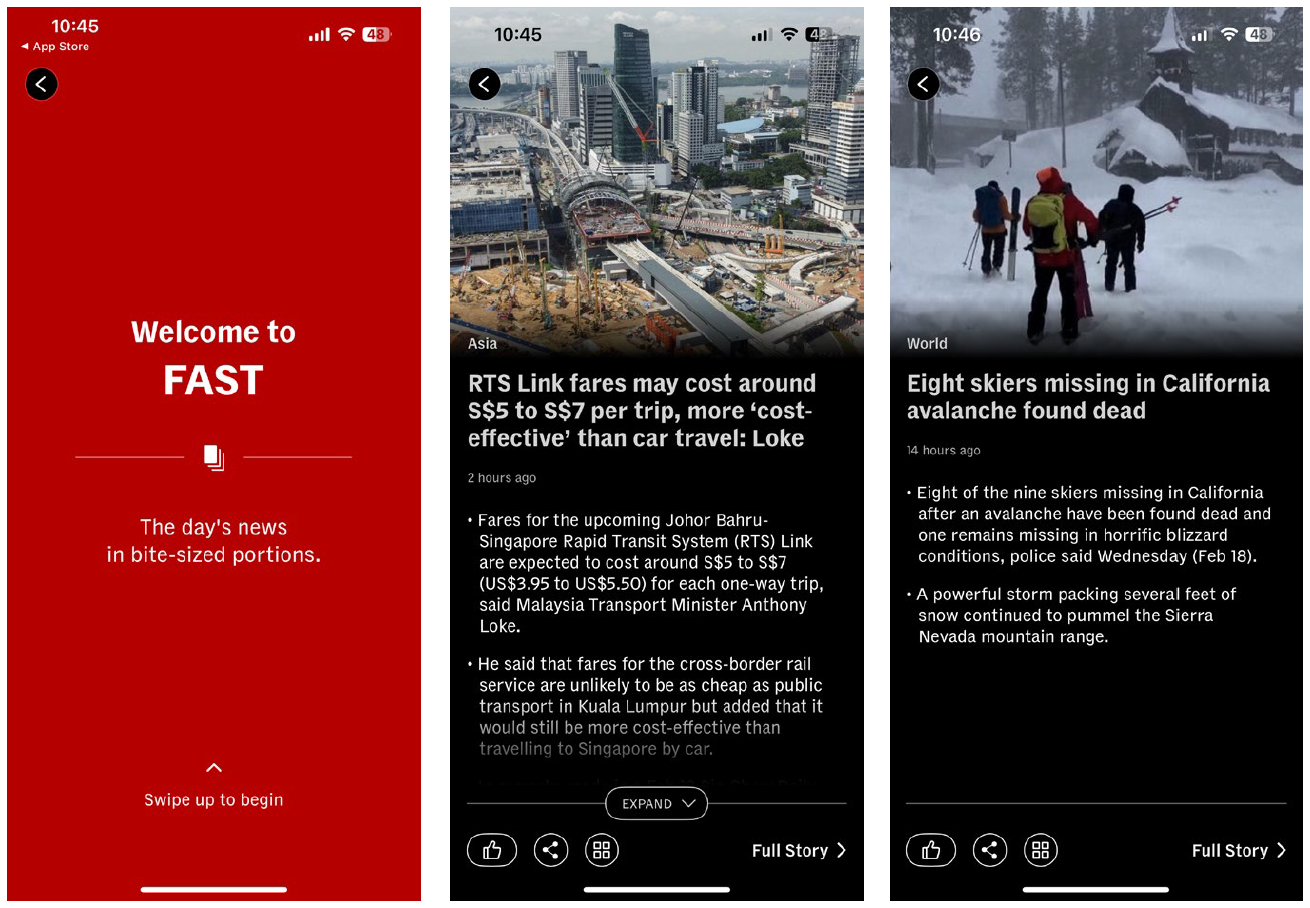
Nonetheless these findings also offer clues for publishers thinking about how AI may help them better serve young audiences. AI summaries have been rolled out in a growing number of newsrooms, aimed at condensing stories into shorter blocks or bullet points. Public service broadcaster NRK (Norway) and tabloid Aftonbladet (Sweden) both maintain their AI summaries have proven particularly popular among young people.11 Other outlets such as The Independent (UK) and Channel NewsAsia (Singapore) are rolling out standalone products or features (Bulletin and FAST, respectively) offering AI-powered news summaries for time-pressed consumers.12 Some of these products go a step further, incorporating the swiping logic of popular video platforms into the interface design.
In addition to their interest in AI to modify the language for different reading levels (24%) and to answer questions about the news (27%), young people also show relatively more interest in AI models that transform news formats, whether from text to audio (19%) or text to video (19%), as Figure 24 shows. This aligns with the stronger preferences we see among young people for audio and video formats online than older people, who, while being heavier users of offline TV, prefer reading news online. This is another area where publishers have taken notice, many of whom now offer the option to listen to text-based stories using an AI-generated voice. While many rely on more affordable generic tools available on the market, others, including some of Schibsted’s titles, have built bespoke AI models trained on the voices of well-known TV hosts.13
Figure 24.
The rise of AI is not without its challenges and concerns, however. For publishers, one worry is that using AI may trigger distrust because people are concerned about factual accuracy and being able to tell what is real and fake online.

AI models capable of creating realistic human-like text, audio, images, and video make it increasingly hard to discern what is real and fake on the internet, as many people experienced firsthand when the AI-generated image of the pope in a puffer coat went viral in 2023.14 Since the launch of ChatGPT in 2022, we see in our data rising concern about false and misleading content online. When asked about levels of concern regarding what is real and fake on the internet, 60% of those aged 18–24 say they were concerned in 2025, up 8pp since 2022, back to pandemic levels, where people were very concerned about all of the conflicting information they were seeing about COVID-19.
However, for young people, AI is also more likely part of the toolkit for coping with misinformation. When asked where they turn if they want to verify something in the news, the 18–24s are more likely than those aged 35 and over to say they’d go to an AI chatbot (Figure 25).
Figure 25.
Perhaps a more important point is that AI is still some way behind official and trusted news sources for all age groups. News organisations can perhaps take some comfort from the fact that, despite all the changes that we have documented in this report, both young and old may still turn to them when it matters most.
Conclusion: What does this mean for publishers?
The period covered in this study has been marked by rapid technological change, with disproportionate uptake and impact among young people. Alongside a decline in direct news access online, the past decade has brought the rapid ascent of social and video networks, the explosion of online creators and influencers, and the introduction of generative AI – forces that are reshaping how young people engage with news. To be clear: young people are consuming large amounts of media and information online, but in different places and in different ways.
Our findings suggest that differences between how older and younger people access news are driven more by structural differences in media use rather than by attitudes towards news – which, as we’ve shown, tend to be fairly similar. That said, it is also true that increased news access via social and video networks may also be (re)shaping expectations among young people to a degree. In closing, we recap implications for news publishers across three interlocking areas: pathways, formats, and definitions of news.
1. Pathways to young people
Direct relationships between publishers and young audiences have weakened, as young people increasingly come across news on social and video networks, rather than seeking it out directly online or offline. As AI tools and summarising interfaces become more common gateways, questions of visibility, attribution, and editorial control will only intensify. While incidental exposure can expand reach and engagement, it weakens brand recall and differentiation (Kalogeropoulos et al. 2018), not to mention news habit formation. However, there is little reason to expect that young people will age into news habits that, unlike older generations, they have never been socialised into.
For many publishers, the question is not if but how to leverage the benefits of new platforms while managing risks. Video networks like TikTok magnify dependence on opaque systems over which publishers have little control, and reliance on platform gatekeeping, history has taught publishers, carries long-term risks (Nielsen and Ganter 2022). Video-led networks designed for in-platform consumption further inhibit referrals, posing additional challenges for monetisation. In addition, policy debates around platform bans for young people, as we’ve seen in Australia and across Europe, introduce further uncertainty, potentially disrupting established pathways to news among teenagers.
Even so, many publishers judge the risk necessary and worthwhile to the extent that it offers an avenue to build recognition and connection with young audiences. Demonstrating real value to young people will be crucial for achieving this, and there is a clear need for high-quality information in platform environments that reputable organisations are well placed to fill. Organisations of all types – both legacy and digital-born – using these platforms will need to continue trialling strategies for bringing audiences back into spaces where they have greater control and can more easily generate revenue, such as websites, apps, and newsletters, or closed networks such as WhatsApp and Telegram.
It is also worth noting that, as a group, young people are not homogeneous in their makeup or their preferences, meaning they cannot all be reached through any single platform or format. What’s more, the past decade has seen a broad shift across digital platforms towards greater personalisation. Young people are therefore increasingly accustomed to media environments tailored to their individual preferences. Studies from single-country settings highlight both the perceived benefits of news personalisation and concerns about the authenticity and sincerity of these efforts, as well as the importance of designing news personalisation experiments with users, not just for users (Monzer et al. 2020).
2. Adapting news formats
Given the social-first nature of younger people’s news consumption, format is not a secondary detail but a core feature. Newsrooms that remain primarily text-oriented may find themselves realigning towards environments where video and audio are more salient. Some are already trialling the use of AI to transform text into audio (or vice versa), and many are foregrounding vertical video on their websites and apps. On platforms like TikTok, short, visual-first formats such as explainers and recaps are increasingly central. Even notifications may need to function as micro-stories that deliver value in themselves, rather than simply driving traffic.
Preferences for audio and video also elevate storytelling and interactivity. Younger audiences gravitate towards engaging and emotionally resonant formats, in contrast to the more linear and formal presentation associated with traditional news. Content designed for shareability, including templates, captions, and visual cues, allows young people to react, respond, and circulate stories within their communities. News, in this sense, becomes not only information but a resource for connection.
At the same time, personality-driven environments reconfigure the competitive terrain as creators and influencers vie for attention and authority alongside institutional sources. This does not negate the value of professional journalism, especially as many heavy news users consume both. However, it can shift expectations about voice and relatability. As we’ve seen, many newsrooms are experimenting with more conversational tones, humour, and collaborations with trusted creators, or investing in in-house talent that can bridge institutional credibility and platform-native delivery. Finding the right balance, one that engages but does not conflict with journalism’s core principles or brand identities, is something newsrooms continue to grapple with.
3. Definitions of news
Throughout this report we’ve seen evidence of somewhat expanding understandings of what constitutes news and who can claim to be a journalist (see also Collao 2022; Eddy et al. 2025a, 2025b). On the one hand, we see broad agreement across generations when it comes to core attitudes around things like impartiality and trust. On the other hand, we see some variation around the edges of traditional news. Young people are more interested in news topics that are entertaining and fun, and more open to receiving this from individual creators. While they stand by neutrality, the baseline of what counts as a legitimate point of view has moved somewhat on issues like social justice. We also identify unmet needs from young people who more often struggle to understand the news or find its relevance for their lives and are more open to relying on alternative sources like news creators and AI chatbots to satisfy them.
For traditional media, addressing these mismatches will partly be a matter of agenda – dedicating resources to issues that young people care about and are drawn to, as well as finding ways to make difficult topics more compelling or comprehensible for them. We see many newsrooms experimenting with the use of AI to efficiently convert content into different formats, summarise news stories, and potentially distil complex topics for young people who by virtue of their age have less historical context about long-running stories. Part of the solution may also be about talent. Young journalists will be better attuned to the interests and preferences of their generation, and native in digital storytelling. Likewise, trust among young audiences often takes on the form of peer-to-peer cross-checks, which could be a way for newsrooms to build trust among younger audiences.
This is a highly dynamic and experimental space in which traditional news organisations coexist with digital-native startups and creators. Youth-oriented outlets and influencers often benefit from a more intuitive grasp of platform storytelling, aesthetics, and norms, but they face persistent revenue constraints and sometimes depend on the original reporting of legacy organisations. Established media, meanwhile, must weigh how far to stretch their brands to serve younger audiences without alienating older ones, whether by expanding core offerings or developing differentiated products. This will also look different for news organisations with distinct financial imperatives and public service mandates. Nonetheless, collaboration, adaptation, and strategic clarity will be essential in navigating a landscape where visibility and relevance remain central challenges.
References
Altay, S., Nielsen, R. K., Fletcher, R. 2023. ‘News Can Help! The Impact of News Media and Digital Platforms on Awareness of and Belief in Misinformation’, The International Journal of Press/Politics, 29(2), 459–484.
https://doi.org/10.1177/19401612221148981Collao, K. 2022. The Kaleidoscope: Tracking Young People’s Relationships with News. Oxford: Reuters Institute for the Study of Journalism.
Collao, K. 2024. OK Computer? Public Attitudes to the Uses of Generative AI in News. Oxford: Reuters Institute for the Study of Journalism.
Duffy, B. 2021. Generations: Does When You’re Born Shape Who You Are? London: Atlantic Books.
Eddy, K., Fletcher, R. 2025. ‘Exploring Perceptions of Fairness in News Coverage Across 45 Countries’, Journalism, 0(0). https://doi.org/10.1177/14648849251362459
Eddy, K. et al. 2025a. ‘What Is News?’, Pew Research Center, 13 May 2025.
Eddy, K. et al. 2025b. ‘What Makes Someone a Journalist?’, Pew Research Center, 20 August 2025.
Eurostat. 2026. ‘64% of 16–24-year-olds Used AI in 2025’, 10 February 2026.
Fletcher, R. 2024. ‘More Than “Just the Facts”: How News Audiences Think About “User Needs”. In Newman, N., Fletcher, R., Robertson, C. T., Ross Arguedas, A., Nielsen, R. K. Digital News Report 2024. Oxford: Reuters Institute for the Study of Journalism, 44–48.
Fletcher, R. et al. 2025. ‘The Link Between Changing News Use and Trust: Longitudinal Analysis of 46 Countries’, Journal of Communication, 75(1), 1–15.
Forman-Katz, N., Lipka, M., Matsa, K. E., Radde, K., Baronavski, C., Coleman, J. 2025. ‘Young Adults and the Future of News’, Pew Research Center, 3 December 2025.
Frey, T., Friemel, T. N. 2023. ‘Social Media Repertoires: Investigating Multifaceted Social Media Use Among Late Adolescents’, Journal of Quantitative Description: Digital Media, 3, 1–33. https://doi.org/10.51685/jqd.2023.002
Galan, L., Osserman, J., Parker, T., Taylor, M. 2019. How Young People Consume News and the Implications for Mainstream Media. Oxford: Reuters Institute for the Study of Journalism.
Kalogeropoulos, A., Fletcher, R., Nielsen, R. K. 2018. ‘News Brand Attribution in Distributed Environments: Do People Know Where They Get Their News?’, New Media & Society, 21(3), 583–601.
https://doi.org/10.1177/1461444818801313Lau, A., Kennedy, C. 2023. ‘Assessing the Effects of Generation Using Age-Period-Cohort Analysis’, Pew Research Center Decoded, 22 May 2023.
Lee, J. Y. et al. 2023. Women in News Special Report: Gender Gaps in News Consumption and Engagement. Canberra: News and Media Research Centre, University of Canberra.
Mont’Alverne, C., Arguedas, A. R., Banerjee, S., Toff, B., Fletcher, R., Nielsen, R. K. 2024. ‘The Electoral Misinformation Nexus: How News Consumption, Platform Use, and Trust in News Influence Belief in Electoral Misinformation’, Public Opinion Quarterly, 88, 681–707.
https://doi.org/10.1093/poq/nfae019Monzer, C., Moeller, J., Helberger, N., Eskens, S. 2020. ‘User Perspectives on the News Personalisation Process: Agency, Trust and Utility as Building Blocks’, Digital Journalism, 8(9), 1142–1162.
https://doi.org/10.1080/21670811.2020.1773291Newman, N., Fletcher, R., Schulz, A., Andı, S., Robertson, C. T., Nielsen, R. K. 2021. Digital News Report 2021. Oxford: Reuters Institute for the Study of Journalism.
Newman, N. 2022. How Publishers Are Learning to Create and Distribute News on TikTok. Oxford: Reuters Institute for the Study of Journalism.
Newman, N., Fletcher, R., Robertson, C. T., Eddy, K., Nielsen, R. K. 2022. Reuters Institute Digital News Report 2022. Oxford: Reuters Institute for the Study of Journalism.
Newman, N., Ross Arguedas, A., Mukherjee, M., Fletcher, R. 2025a. Mapping News Creators and Influencers in Social and Video Networks. Oxford: Reuters Institute for the Study of Journalism.
Newman, N., Ross Arguedas, A., Robertson C. T., Nielsen, R. K., Fletcher, R. 2025b. Reuters Institute Digital News Report 2025. Oxford: Reuters Institute for the Study of Journalism. https://doi.org/10.60625/risj-8qqf-jt36
Newman, N. 2026. Journalism, Media, and Technology Trends and Predictions 2026. Oxford: Reuters Institute for the Study of Journalism.
Nielsen, R. K., Ganter, S. A. 2022. The Power of Platforms: Shaping Media and Society. Oxford: Oxford University Press.
Ofcom. 2025. ‘Tuning into YouTube: UK’s Media Habits Revealed’, 30 July 2025.
Oser, J., Boulianne, S. 2020. ‘Reinforcement Effects Between Digital Media Use and Political Participation: A Meta-Analysis of Repeated-Wave Panel Data’, Public Opinion Quarterly, 84, 355–365.
https://doi.org/10.1093/poq/nfaa017Røsok-Dahl, H., Ihlebæk, K. A. 2024. ‘Young People and News: A Systematic Literature Review’, Journalism Studies, 25(10), 1228–1248.
https://doi.org/10.1080/1461670X.2024.2372425Ross Arguedas, A., Banerjee, S., Mont’Alverne, C., Toff, B., Fletcher, R., Nielsen, R. K. 2023. News for the Powerful and Privileged: How Misrepresentation and Underrepresentation of Disadvantaged Communities Undermines their Trust in News. Oxford: Reuters Institute for the Study of Journalism.
Scire, S. 2025. ‘Blurred Lines: When It Comes to News Habits, Age May Be More Important Than Nationality’, Nieman Journalism Lab, 18 February 2025.
Tameez, H. 2025. ‘News Publishers Embrace Vertical Video with In-App “Watch” Tabs’, Nieman Journalism Lab, 25 November 2025.
Thurman, N., Henkel, I., Thäsler-Kordonouri, S., Fletcher, R. 2025. UK Journalists in the 2020s: Who They Are, How They Work, and What They Think. Oxford: Reuters Institute for the Study
of Journalism.Vir, J. 2021. The Relevance of Impartial News in a Polarised World. Oxford: Reuters Institute for the Study of Journalism.
Footnotes
10 It is important to note that several of our African survey samples do not include people aged 50+ because of difficulties in sampling, so data naturally reflect the preferences of younger audiences.
About the authors
Dr Craig T. Robertson is a Postdoctoral Research Fellow at the Reuters Institute for the Study of Journalism whose interests include trends in news consumption, audience trust in and perceptions of news, and the impacts of technology on the news industry.
Dr Amy Ross Arguedas is a Postdoctoral Research Fellow in Digital News at the Reuters Institute for the Study of Journalism. She has worked extensively on issues around trust in media and previously worked as a journalist for the Costa Rican newspaper La Nación.
Mitali Mukherjee is Director of the Reuters Institute for the Study of Journalism. She is a political economy journalist with more than two decades of experience in TV, print, and digital journalism. Mitali was Consulting Business Editor at The Wire and Mint in India. Prior to that she was Markets Editor at CNBC TV 18 and Prime Time Anchor at TV Today and Doordarshan.
Dr Richard Fletcher is Director of Research and Deputy Director of the Reuters Institute for the Study of Journalism. He is primarily interested in global trends in digital news consumption, the use of social media by journalists and news organisations, and, more broadly, the relationship between computer-based technologies and journalism.
Acknowledgements
The authors are grateful to the many Reuters Institute researchers, past and present, who have worked on the Digital News Report over the years, as well as other studies we draw on here. We extend this gratitude to the team at YouGov, which has fielded our Digital News Report surveys, as well as the teams at Flamingo, JV Consulting, and Craft, who carried out the qualitative studies we also include throughout.
Additional thanks go to Nic Newman and the Reuters Institute editorial team for the industry examples they have brought to our attention in the Trends and Predictions report and editorial publications, respectively, some of which we have included. In addition, we thank the current members of the research team, as well as our visiting fellows, for their very helpful comments and input on an earlier draft. Lastly, we express our gratitude to Alex Reid at the Reuters Institute for her efforts in ensuring the timely publication of the report.
