


News
Five takeaways from the Future of Media Technology Conference: How publishers are rethinking audience engagement

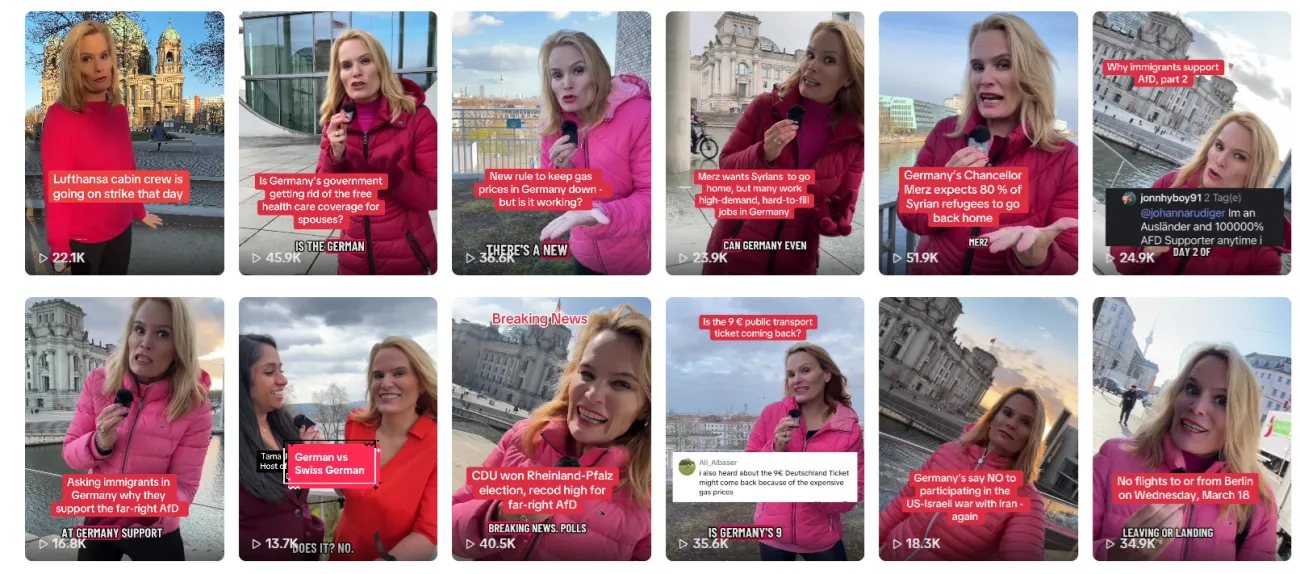
Most of the media managers we surveyed for our annual report on media trends said they want to turn their journalists into content creators. This is a direct response to the so-called creator wave, with social-native audiences turning towards independent, individual creators, rather than news brands, for their latest news.
Some journalists pioneered this shift. Dave Jorgenson launched the Washington Post’s TikTok account before creating his own company and independent journalist Sophia Smith Galer became a household name while working for BBC and Vice before charting her own path. Other media companies have set up creator studios focused on talent-led projects such as The Daily Mail, CNN, and The Guardian.
The German public broadcaster Deutsche Welle (DW) was one of the first big media organisations to establish itself in vertical video, under the leadership of Johanna Rüdiger, who worked as Head of Social Media Strategy at the broadcaster.
Rüdiger has just been promoted to DW’s first Coordinator of Digital Talents & Content Creators, a new role launched in response to this shift. We discussed the remit of her role and the content creator’s point of view. I also asked her whether this trend is the future of journalism or just a fad. Our conversation has been edited for length and clarity.
A. The role is basically about building up Deutsche Welle’s faces and content creators. We’ve been doing this for a long time already, since we started the DW Berlin Fresh account almost six years ago. Deutsche Welle has always been very digital, with hundreds of social media channels across Instagram, TikTok and YouTube, in more than 30 languages.
So for years, we’ve been working on turning more traditional journalists, including TV journalists, into content creators. But now we are taking that to another level, because it’s becoming even more important to build communities and report for communities.
People follow people, not institutions, and audiences often get their news from personalities and creators. So a lot of media companies now understand that they need to train journalists to become content creators. But the big question is how. How is it different from the way we normally report? And how can we keep our journalistic values – being neutral, impartial and objective – while also being personal and relatable?
That’s the main focus of my work.
A. There are two main parts to it. First, I look at our existing programming and channels: how can I help our journalists and presenters be more personal in their storytelling, more relatable, and better connected with their audiences?
The second part is looking at journalists at Deutsche Welle who already have their own personal channels and communities, or who want to build them. That’s a newer area for us, and I think it’s one of the most interesting parts of the role. I’ll be looking at how we can empower those journalists, and how their personal channels can connect back to our programming and help bring DW’s brand to a bigger audience.
A. A lot of newsrooms are still unsure. If a journalist at a legacy media organisation builds their own community, is that competition? Or is it something the newsroom can support and use as part of its strategy?
Before, it was simple: you might tweet a link to your article, and that was clearly promoting your work. But now journalists are making independent videos and building their own brands around their work. Many newsrooms are still figuring out how to incorporate that into their strategy.
More and more journalists want to build themselves up as a brand, and the question is how newsrooms can support and use that.
A. I’ve run my personal TikTok news account for almost six years now, and I’ve been on Instagram for a little less time. So being on this intersection has helped me a lot at Deutsche Welle.
There are a lot of creators who cover news but don’t see themselves as journalists.Many will say: “No, we don’t see ourselves as journalists. We cover news, but we’re not journalists.”
They don’t always have this expectation of neutrality or objectivity. They often come from a particular point of view for a particular community, which journalists also do to some extent. But many creators also have an opinion they want to share and it often crosses into activism.
The difference for us is that we have these journalistic values where we bring the facts, not our opinions. But how do I bring Johanna to a video without Johanna’s opinion?
It often comes down to small choices in wording, phrasing and self-editing. Sometimes we are not neutral on a topic personally, but we still need to make an impartial video about it. That means really checking yourself, the script and the language carefully.
I talk a lot in my workshops about point of view: we always come from a certain perspective, and we are speaking to a certain community. But that doesn’t mean we have to insert our opinion.
@johannaruediger I made a more detailed video about the drafted law on skilled worker and immigration here: @Johanna Rüdiger - Journalist #fachkräftemangel #fachkräfte #immigration #germangreencard #chancenkarte ♬ original sound - Johanna Rüdiger - Journalist
A. I’m telling the news like I’m telling it to a friend. I break things down. I use conversational language. As journalists, we often use very big words. We’ve done a lot of research and we’re proud of all that research, so our videos end up with lots of numbers and facts. But I see a lot of videos that are answering questions nobody ever asked.
So when I’m looking at scripts, I’m always very strict about asking: where is the audience? Are we talking to them authentically, at eye level? Are we telling our audience what this news means for their daily lives?
That’s what makes it personal. But then I let the facts speak for themselves. I don’t tell my opinion.
A. It’s about reaching people. We want people to go to their favorite Deutsche Welle channel, in whatever language that might be, and think: “OK, something has happened in the world and my trusted content creator, who I know has explained things to me in the past, is going to explain this news to me now. And then I know what’s going on in the world.”
That’s the relationship we want. It’s about building a relationship with the audience.
On my personal channels, I get this very much now, because I’ve been in this space for so long. People will actually send me links to stories when something happens, links from news outlets or legacy media, and say: “Johanna, is this true? Can you make a video explaining it?”
A. I don’t know if they’re that hard to reach. I’ve never really liked the way we talk about news avoidance. Everybody wants to understand what’s happening around them, why something matters for their lives, or why their lives are changing – on the platforms they’re already on, and in an easy way.
If your friend calls you up and tells you a piece of news, you listen to that. So I always think it’s about how we tell the news. And it goes back to something I was taught in journalism school: we decide what the news is, and the audience can be thankful that we’re bringing them the news. We say, “This is the news. This is important for you. Take it.” And then our job is done.
Now it’s the other way around. Everything is so audience-driven. And if you’re still stuck in that old way as a journalist, where you think, “I’m deciding what the news is today,” that’s a problem.
That’s what I love about my community. They keep me on my toes. If I make a video for them about a new law, and I just say, “Oh, there’s this new law,” but I can’t explain what is going to change in their lives, then I might as well not post the video. Because in the comments they’ll ask: “When is this starting? What does this mean? Do I have to pay more? Can I get the visa now?”
So that direct interaction with our community keeps us on our toes. And this is how we reach audiences: with that personal approach.
A. Maybe one day every journalist will automatically be a content creator. But I’ve been doing this for six years now, in different roles — basically always working on digital transformation and teaching traditional journalists to report more like content creators. So it’s an ongoing process.
With the rise of AI, it’s even more important that you know and trust a person, and that you build a relationship with your audience. If you’re a successful content creator and you’ve built a real community, then you become a little bit more independent from the algorithm.
Once you’ve built a community that thinks, “I’m going to go to Johanna’s account to check if she’s done a video on this,” then you don’t need to depend on the algorithm quite so much.
A. I don’t think it’s a response to the algorithm. It’s more a response to what the audience wants, and how the audience wants their news to be told.
I always tell everybody: don’t be dependent on one app, and don’t be dependent on one algorithm. If you build the overall brand, then yes, maybe TikTok is going to go away. But then you move your community to another app. So I don’t see us reacting to algorithms so much anymore.
In every email we send you'll find original reporting, evidence-based insights, online seminars and readings curated from 100s of sources - all in 5 minutes.