



In this piece
Journalism, media, and technology trends and predictions 2026

News influencer Vitus "V" Spehar films a video for millions of followers. REUTERS/Magali Druscovich
In this piece
Executive summary | 1. Pressures on journalism mount | 2. Answer engines and the implications for access | 3. Content strategies shift towards distinctiveness | 4. Social media’s mid-life crisis and the video-fication of everything | 5. Responding to the creator wave | 6. AI slop, deep-fakes, and misinformation | 7. Latest tales of AI in the newsroom | 8. Changing business models and barriers to Innovation | 9. What’s next in technology? | 10. Conclusions | Survey methodology | Footnotes | About the author | AcknowledgementsExecutive summary
We are still at the early stages of another big shift in technology (Generative AI) which threatens to upend the news industry by offering more efficient ways of accessing and distilling information at scale. At the same time, creators and influencers (humans) are driving a shift towards personality-led news, at the expense of media institutions that can often feel less relevant, less interesting, and less authentic. In 2026 the news media are likely to be further squeezed by these two powerful forces.
Understanding the impact of these trends, and working out how to combat them, will be high up the ‘to do list’ of media executives this year, despite the unevenly distributed pace of change across countries and demographics.
Existential challenges abound. Declining engagement for traditional media combined with low trust is leading many politicians, businessmen, and celebrities to conclude that they can bypass the media entirely, giving interviews instead to sympathetic podcasters or YouTubers. This Trump 2.0 playbook – now widely copied around the world – often comes bundled with a barrage of intimidating legal threats against publishers and continuing attempts to undermine trust by branding independent media and individual journalists as ‘fake news’. These narratives are finding fertile ground with audiences – especially younger ones – that prefer the convenience of accessing news from platforms, and have weaker connections with traditional news brands. Meanwhile search engines are turning into AI-driven answer engines, where content is surfaced in chat windows, raising fears that referral traffic for publishers could dry up, undermining existing and future business models.
Despite these difficulties many traditional news organisations remain optimistic about their own business – if not about journalism itself. Publishers will be focused this year on re-engineering their businesses for the age of AI, with more distinctive content and a more human face. They will also be looking beyond the article, investing more in multiple formats especially video and adjusting their content to make it more ‘liquid’ and therefore easier to reformat and personalise. At the same time, they’ll be continuing to work out how best to use Generative AI themselves across newsgathering, packaging, and distribution. It’s a delicate balancing act but one that – if they can pull it off – holds out the promise of greater efficiency and more relevant and engaging journalism.
Our podcast with the author
Spotify | Apple Podcasts | Transcript
How media leaders view the year ahead
These are the main findings from our industry survey, drawn from a strategic sample of 280 digital leaders from 51 countries and territories:
- Only slightly more than a third (38%) of our sample of editors, CEOs, and digital executives say they are confident about the prospects for journalism in the year ahead – that’s 22pp lower than four years ago. Stated concerns relate to politically motivated attacks on journalism, loss of USAID money that previously supported independent media in many parts of the world, and significant declines in traffic to many online news sites.
- By contrast, around half (53%) say they are confident about their own business prospects, similar to last year’s figure. Upmarket subscription-based publishers with strong direct traffic can see a path to long-term profitability, even as those that remain dependent on advertising and print worry about sharp declines in revenue and the potential impact of AI powered search on the bottom line.
- Publishers expect traffic from search engines to decline by more than 40% over the next three years – not quite ‘Google Zero’ but a substantial impact none the less. Data sourced for this report from analytics provider Chartbeat shows that aggregate traffic to hundreds of news sites from Google search has already started to dip, with publishers that rely on lifestyle content saying they have been particularly affected by the roll out of Google’s AI overviews. This comes after substantial falls in referral traffic to news sites from Facebook (-43%) and X, formerly Twitter (-46%) over the last three years.1
- In response, publishers say it will be important to focus on more original investigations and on the ground reporting (+91 percentage point difference between ‘more’ and ‘less’), contextual analysis and explanation (+82) and human stories (+72). By contrast, they plan to scale back service journalism (-42), evergreen content (-32), and general news (-38), which many expect to become commoditised by AI chatbots. At the same time, they think it will be important to invest in more video (+79) – including ‘watch tabs’ – more audio formats (+71) such as podcasts but a bit less in text output.
- In terms of off-platform strategies, YouTube will be the main focus for publishers this year with a net score of +74, up substantially on last year. Other video-led platforms such as TikTok (+56) and Instagram (+41) are also key priorities – along with working out how to navigate distribution through AI platforms (+61) such as OpenAI’s ChatGPT, Google’s Gemini and Perplexity. Google Discover remains a critical (+19), if slightly volatile, source of referral traffic, while some publishers are looking to find new audiences via newsletter platforms such as Substack (+8). By contrast, publishers will be deprioritising effort spent on old-style Google SEO (-25) – as well as traditional social networks Facebook (-23) and X (-52)
- Last year we predicted the emergence of ‘agentic AI’, but this year we can expect to start to see real-world impact of these more advanced technologies. Some sources suggest that there will soon be more bots than people reading publisher websites,2 as tools like Huxe and OpenAI’s Pulse offer personalised news briefings at scale. Three-quarters of our respondents (75%) expect ‘agentic tools’ to have a ‘large’ or ‘very large’ impact on the news industry in the near future.
- Alongside the traffic disruption from AI, news executives also see opportunities to build new revenue from licensing content (or a share of advertising revenue) within chatbots. Around a fifth (20%) of publisher respondents – mainly from upmarket news companies – expect future revenues to be substantial, with half (49%) saying that they expect a minor contribution. A further fifth (20%), mostly made up of local publishers, public broadcasters, or those from smaller countries, say they do not expect any income from AI deals.
- More widely, subscription and membership remain the biggest revenue focus (76%) for publishers, ahead of both display (68%) and native advertising (64%). Online and physical events (54%) are also becoming more important as part of a diversified revenue strategy. Reliance on philanthropic and foundation support (18%) has declined this year, after cuts of media support budgets in the United States and elsewhere.
- Meanwhile news organisations’ use of AI technologies continues to increase across all categories, with back-end automation considered ‘important’ this year by the vast majority (97%) of publisher respondents, many of whom integrated pilot systems into content management systems in the last year. Newsgathering cases (82%) are now the second most important, with faster coding and product development (81%) also gaining traction.
- Over four in ten (44%) survey respondents say that their newsroom AI initiatives are showing ‘promising’ results, but a similar proportion (42%) describe them as ‘limited’. Two-thirds of respondents (67%) say they have not saved any jobs so far as a result of AI efficiencies. Around one in seven (16%) say they have slightly reduced staff numbers but a further one in ten (9%) have added new roles/cost.
- The rise of news creators and influencers is a concern for publishers in two ways. More than two-thirds (70%) of our respondents are concerned that they are taking time and attention away from publisher content. Four in ten (39%) worry that they are at risk of losing top editorial talent to the creator ecosystem, which offers more control and potentially higher financial rewards.
- Responding to the increased competition and a shift of trust towards personalities, three-quarters (76%) of publisher respondents say they will be trying to get their staff to behave more like creators this year. Half (50%) said they would be partnering with creators to help distribute content, around a third (31%) said they would be hiring creators, for example to run their social media accounts. A further 28% are looking to set up creator studios and facilitate joint ventures.
More widely, could 2026 be the year when AI company stock valuations come down to earth with a bump, amid concerns about whether their trillion-dollar bets will pay back their investors? Meanwhile the amount of low-quality AI automated content, including so-called ‘pink slime’ sites, looks set to explode, with platforms struggling to distinguish this from legitimate news.
We can expect more public concern about the role of big tech in our lives. This may include individual acts of ‘Appstinence’ and other forms of digital detox and a desire for more IRL (In Real Life) connection. Governments will also come under pressure to do more to protect young and other vulnerable groups online, even in the United States.
The creator economy will continue to surge, fuelled by investments from video platforms and streamers. At the top end creators will look more like Hollywood moguls with big budgets and their own studio complexes. Within news, we’ll also see the emergence of bigger, more robust, creator-led companies delivering significant revenues as well as value to audiences – offering ever greater competition for traditional journalism.
Words, phrases, and acronyms we could be hearing more of in 2026
Last year we predicted the popularity of phrases such as AI Slop, Agentic AI and Brain Rot. This year watch out for more mainstream mentions of:
Vibe coding
[/ vaɪb/kəʊ.dɪŋ/ ] noun
Def: Coined by one of the founders of Open AI in early 2025, it has come to define the practice of writing code, making web pages, or creating apps, by just telling an AI program what you want. Great for prototyping or personal projects.
Digital provenance
[/dɪdʒətəl/prɒvənəns/] noun
Def: Describes the ability to verify the origin and history of digital media in an AI-infused world where sophisticated deep-fakes are becoming more common. See also associated terms such as watermarking, attestation databases, and the C2PA (Coalition for Content Provenance and Authenticity).
AEO
[/eɪiːˈoʊ/] noun
Def: Answer Engine Optimisation describes ways in which content providers can get better visibility within AI chatbots and other AI driven interfaces. See also GEO (Generative Engine Optimisation) and SEO (Search Engine Optimisation).
Liquid content
[/ ˈlɪkwɪd ˈkɒn.tent/] noun
Def: Describes content or stories that are not static but adapt in real time based on the viewer's context, location, time, or interaction. AI facilitates this by tailoring content to individual preferences. Requires traditional media companies to move away from authoring ‘articles’ towards more flexible atomic objects.

The remainder of this report is divided into nine themes or chapters with a discussion of each followed by some more specific predictions about what might happen in 2026.
1. Pressures on journalism mount
While many publishers have confidence in their own news organisations, this year’s survey shows continued low confidence in journalism as a whole. Only around a third (38%) say they are confident, down 22pp from the figure in our 2022 poll. The proportion who says they are not confident has risen from 10% to 18% over the same period.
In examining open comments, we can identify three main reasons for this shift. First, there is uncertainty linked to the rapid adoption of AI and the potential further loss of visibility through search engines and social media. We cover this extensively in the next chapter of this report.
The pace at which AI-driven changes will unfold is difficult to predict, but the impact will be undeniable.
Jan Willem Sanders, Managing Director, Follow the Money, Netherlands
Second, there is a sense that traditional media are losing touch with sections of society, including younger people and those less interested in news. Respondents worry that increased reliance on social media – including non-journalists such as creators and influencers – could lead these groups to be more vulnerable to low-quality or unreliable information.
When social media platforms are flooded with fake news and toxic content, it’s the right time for journalism to prove its value.
Le Quoc Minh, Editor-in-Chief, Nhan Dan Newspaper, Vietnam
Third, many respondents worry about the way some politicians are ignoring, denigrating, or undermining journalism as part of an international playbook to reduce scrutiny.
Populist politicians have discovered the way to disintermediate the role of traditional media by labelling it as fake news and threatening or exercising legal action, putting additional pressure on media organisations and their business model.
President of a leading South American media company
In its 2025 World Press Freedom Index, RSF concludes that press freedom globally has fallen to its worst level since their Index began. A key driver, according to RSF, has been the worsening economic position linked to declining advertising and reader revenue which has made news media more dependent on government or its supporters. At the same time, in a growing number of countries, existing or new legislation, including foreign agent, cybercrime, and national-security-type laws are being used to make it harder or more dangerous for journalists to operate.
Politicians have also stepped up their efforts to tar legitimate journalism as ‘fake news’, with messages that are reinforced and amplified by networks of supporters in social media. In a dramatic escalation of Donald Trump’s long-running attacks on the media, the White House recently rolled out a new section of its website that publicly criticises media organisations that it claims have distorted coverage. An ‘Offender Hall of Shame’, features brands such as the Washington Post, CBS News, CNN, and MSNBC (now known as MS Now) with stories labelled as ‘biased’ or examples of ‘left wing lunacy’. This follows ongoing lawsuits against the Wall Street Journal and the New York Times, and legal settlements with ABC and CBS.
Public service media are also under pressure amid public spats with politicians and challenges over their perceived impartiality around issues such as politics, Gaza, and trans rights. A row with Donald Trump over the editing of a speech led to the resignations of the BBC Director General and its CEO of News and a claim for damages of $10bn. Meanwhile populist parties in Europe including Reform UK, the AfD in Germany, and the Sweden Democrats have called for a reduction in the scope of public service media and its funding. A referendum in Switzerland, due to be put to the vote this year, proposes a reduction in the annual licence fee by more than a third and threatens to cut income in half.3
Despite all this, some publishers continue to look on the bright side. A small number of mostly subscription-based publishers, especially in Northern Europe and North America, report that they are doing better than ever, financially and in audience terms.
Meanwhile many executives feel that trusted, high-quality, accurate content will be increasingly valued in a world of AI slop, deep-fakes, and toxic social media debates.
I think it is an incredible time to be in News and journalism and the public are seeking out trustworthy news and information.
Justin Stevens, Director of News, ABC, Australia
What might happen this year
Politicians further bolster their ‘owned media’ presence
Politicians such as Narendra Modi and Donald Trump already reach hundreds of millions of people via their social media feeds. Others communicate directly through daily live press conferences that are streamed via the internet. The next logical step could be hosting podcasts or YouTube shows. Governor of California Gavin Newsom set the trend in February 2025 hosting a podcast widely seen as fuelling his national political ambitions. In the UK, the Greens’ Zack Polanski became the first sitting leader of a UK party to host a regular podcast, Bold Politics, targeted at younger, digitally engaged voters while short-lived former Prime Minister Liz Truss has launched her own YouTube show that was roundly panned by the critics.4 Don’t be surprised to see a sitting national leader jumping onto this bandwagon in 2026 as they seek more direct, unfiltered channels to reach supporters and bypass traditional gatekeepers.


Journalism fights back
Until now marketing campaigns have been pushed by a single brand, but a more coordinated approach may be necessary to counter current narratives. A recent poll in the United States suggested that a majority of teens have negative views of journalists, and think words such as ‘fake’, ‘lies’, and ‘bias’ best describe their work.5 They widely believe that journalists make up quotes, are less impartial than content creators, and do more to harm democracy than to protect it. Our own research shows that these attitudes are not confined to the United States or to young people and with more AI-produced content on the way expect to see more media literacy initiatives, along with campaigns that show the value of professional verified news. Brave owners willing to stand up to legal threats from politicians may also be necessary to restore some confidence.
2. Answer engines and the implications for access
Publishers expect traffic from search engines to almost halve (-43%) over the next three years, following recent dramatic declines in referrals from social media. The latest concerns are focused on Google’s AI Overviews, which now appear at the top of about 10% of search results in the United States6 and have been rapidly rolling out elsewhere. A number of studies show that the proportion of ‘Zero-click searches’ – where the user doesn’t click through to any website – increases significantly when these overviews are shown. Meanwhile the separate ‘AI mode’ tab is now available in 120 markets, with full multi-modal capabilities from Gemini-3 providing more reasons to switch. Expectations vary, with a few optimists believing the negative impact of these changes will be less than 20%. At the other end of the scale, around a fifth of respondents expect a loss of more than 75% of their company’s search traffic.


Q5. What is your expectation in terms of how traffic from search engines might have changed in three years time? Base = 268. Note: Responses were collected via a slider ranging from +100% to –100%.
While the long-term impact of these changes is likely to be profound, evidence about current trends is mixed. Some publishers have reported significant declines in traffic from search, but others say there has been little change so far. Aggregate data, sourced from the analytics company Chartbeat for this report, show that Google traffic from organic search to over 2,500 sites was down by a third (33%) globally between Nov 2024 and Nov 2025 and by 38% in the United States, but it is not clear how much of this is down to AI overviews. Queries around ‘hard news’ subjects in Google have been largely exempted from overviews, perhaps because of so-called hallucinations. Publishers that specialise in lifestyle or utility content such as weather, TV guides, or horoscopes are more likely to have been affected. Traffic from Google Discover, which is more important in global markets with strong Android penetration, is also down, with social referrals having stabilised in the last year.
Correction: A previous version of this report swapped the bases at the bottom of the two charts above, which show aggregated data from news websites tracked by Chartbeat. The global figures do come from aggregated data from 2,576 sites worldwide, including 797 US sites, and 1,031 sites across Europe. The US figures only include aggregated data from 797 US sites. The error has now been corrected.
But declines in Google referrals are not the only challenge. ChatGPT has become one of the fastest growing apps of all time with around 800m weekly active users worldwide. Reuters Institute surveys show that searching for information of different kinds is now one of its most widely used AI functions,7 with up-to-date news now a part of that story. Within ChatGPT and similar chatbots, links are provided in the form of a small ‘citations’ button for those who wish to dig deeper into the subject via an original source. Chartbeat data do show a rapid rise in the number of referrals from ChatGPT, but its contribution to overall referrals remains little more than a rounding error. Google delivers 500 times as many referrals as ChatGPT from search alone; 1,300 times as many if you take into account Discover traffic.
Meanwhile publishers remain ambivalent about how to manage the relationship with platforms. Should they sue, or do deals to get visibility? Or both?
According to the Tow Center’s AI Deals and Disputes tracker,8 there have been a number of new deals this year between OpenAI and leading publishers such as the Guardian, the Schibsted Media Group, and Axios – at the same time as others continue to pursue lawsuits. Amazon has also secured AI licensing deals with several major publishers, including the New York Times, Condé Nast, and Hearst, to use content for training – as well as for powering features in products like Alexa. In December, Google joined the party, though the company emphasised that the cash on offer is part of the next phase of its partnership programme rather than directly tied to AI licensing. At the same time, they announced new features such as Preferred Sources and extra context around citations to ‘connect people to the sources they love’.9 The terms of deals remain opaque, with some involving licensing of content, others focused on revenue share, prominence, innovation, or training access. Overall, though, publishers are realistic about what this might mean for their bottom line, with just 20% of survey respondents expecting this to be a significant source of income and an equal proportion expecting nothing. Half (49%) are expecting a minor contribution.
What might happen this year?
Levelling the playing field
So far most of the big deals have been with upmarket newspapers and news agencies, leading to concerns that local providers and independent news outlets will be left out in the cold. Some industry organisations will be looking to fill that gap, helping to represent collective interests this year. Another emerging approach is Really Simple Licensing, a way for publishers to set payment terms and attribution requirements. RSL launched in September and aims to create a scalable and sustainable way to manage content rights for publishers (and creators) of all kinds. Others have called for an international initiative to deal with the asynchronous relationship between publishers and platforms. Former Google executive, Madhav Chinnappa, has championed the idea of a ‘Nato for News’ where publishers work together to get a fair price for their content in a way that benefits the entire ecosystem. This might include payment for access (e.g. data feeds), something that he argues is of great value to AI companies, rather than necessarily licensing the content itself.10
Answer Engine Optimisation (AEO) services explode
Beyond dealmaking and lawsuits, there will be a focus this year on better understanding how content is being used by chatbots, overview boxes, and other answer engines. This is partly to track brand visibility, but also to enable content to be optimised for these new systems. Expect to see more digital marketing agencies repurposing their services to include AEO and GEO (Generative Engine Optimisation), as well as new specialist consultancies and analytics systems emerging.
Many of the techniques are similar to SEO but there are some differences to how content may need to be created and described to maximise the opportunity. As with SEO, over time these approaches will at least partly determine what content is produced and consumed.
3. Content strategies shift towards distinctiveness
In a world where AI can create personalised content experiences across almost unlimited subject areas, publishers are rethinking where and how they can most effectively compete with the machines. Respondents think it will be important to focus more on on-the-ground reporting (+91 difference between the proportion who said ‘more’ and the proportion who said ‘less’), more analysis and framing (+82), more community-building efforts such as live events (+75), more human stories (+72), and more fact-checking and verification (+63), as well as opinion or commentary (+55). By contrast, publishers say there should be less emphasis on service journalism (-42) and evergreen content (-32), such as travel guides, product reviews, or stories about ‘what’s on TV tonight?’ Some clearly recognise that AI chatbots will answer these questions more effectively than publishers in the future, even if some of the content was generated by them in the first place.
Overall, the majority of surveyed news executives believe that future success lies in being more distinctive, even if that means losing some overall reach and reducing the amount of general news (-38). ‘Journalism’s best response is to double down on the things that make us valuable and unique’, says Taneth Evans who is Head of Digital at the Wall Street Journal. ‘This year has seen most waking up to the importance of quality, originality and direct, meaningful relationships with our audiences’, she notes. ‘AI platforms will continue to scrape our websites and repackage our content’, says Martin Schori, Head of AI at Aftonbladet. ‘The answer to that is probably to focus on journalism that can’t easily be summarised in the three bullet points’, he says.
It is a similar story in global majority countries. ‘We are committing our resources to meaningful, deep dive journalism and analysis and moving away from broad news coverage’, says Ritu Kapur, co-founder and Managing Director of the Quint in India. That’s not an option for news agencies, but even here the direction of travel is similar: ‘We’re shifting away from volatile third-party platforms and toward direct audience relationships and community spaces where we fully own the connection’, says Maria Lorente Estrada, AFP Bureau Chief for Latin America. ‘We also plan to expand our exclusive content offerings – from premium investigations and newsletters to behind-the-scenes access and on-the-ground reporting.’ But others believe the extent of the technology shift will require more than just doubling down on distinctiveness: ‘Discoverability and user retention strategies are crucial in the emerging AI UI ecosystem’, says Stefan Ottlitz, outgoing CEO at Der Spiegel: ‘The platforms we are used to are being challenged by completely new form factors like voice or chat that will be solving tasks more easily.’
A key task for publishers is not just to deliver news but to build experiences that drive habitual use: ‘As traffic from search continues to decline, we must find better ways to directly engage our readers – whether it be across newsletters, podcasts, or puzzles – and to educate them about our brand’, says Sophia Phan, Senior Audience Editor at Nine in Australia.
What may happen this year?
Further shift to video and audio formats
Over three-quarters of our survey respondents (79%) said it would be important to invest more in video, with a majority (71%) also looking to expand audio formats as a direct response to the AI threat. ‘If creating text no longer costs anything, that brings brutal new competition’, says Christof Zimmer, Chief Product Officer at Der Spiegel. While AI chatbots can easily rework and summarise text, well-structured linear video or audio is more likely to be linked to and consumed as a whole – at least that is the theory. But even if formats change, the underlying message about distinctiveness applies: ‘Generic news no longer works; it’s about getting out there, uncovering news, bringing in new perspectives. And that has always been our focus’, says Zimmer.
Greater automation another path to success?
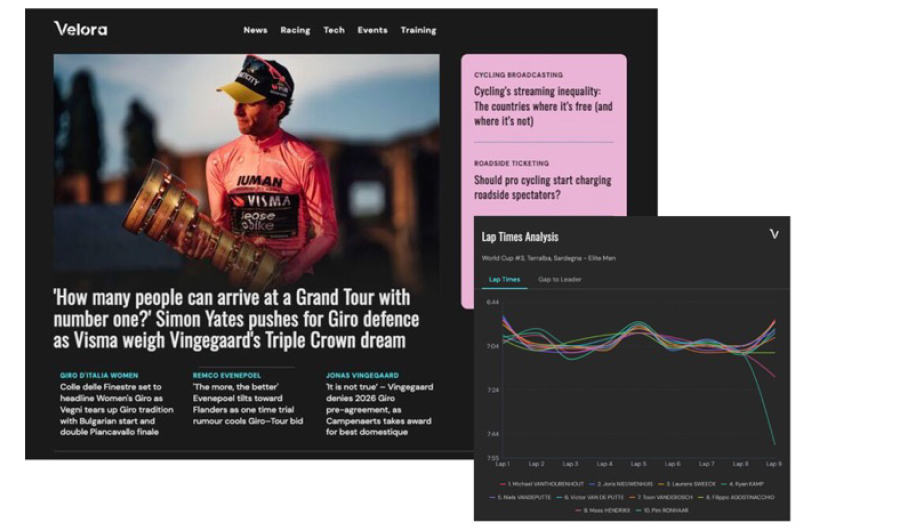
While a distinctiveness strategy may work for some publishers, others are deliberately leaning into AI to create greater scale and efficiency. Newsquest, a leading regional UK publisher, has created more than 30 ‘AI-assisted reporters’ across its titles, staff who are equipped with an AI tool called News Creator to draft stories – up to 30 every day – which are then checked and supplemented. This approach supports its scale-based business model, while freeing up colleagues to focus on better original journalism.11 Velora Cycling is a one-person newsroom that delivers specialist news and data that would previously have needed a large team to run. News is selected from multiple sources, with AI managing drafts, selecting images, tagging content, generating social media posts, and helping with fact-checking. All this is subject to human oversight from a former editor of Cycling News who adds his expertise and commentary.12 We can expect these low-cost approaches to become widespread this year, especially in specialist areas and also in local news.
Velora Cycling: a one-person news operation with AI at its heart

Overall, we may see something of a barbell effect with human distinctiveness on one side and more automated approaches on the other. Those in the middle could find their audiences and revenues squeezed.
4. Social media’s mid-life crisis and the video-fication of everything
Traditional social networks like Facebook and X continue to go through an identity crisis as open sharing and connection goes out of fashion. In a recent court filing, Meta revealed that only 17% of time spent on Facebook and just 7% on Instagram now involves content from friends and family. Most of the time is spent watching videos (or other content) from strangers in an endless feed based on personal interests.
These AI recommendation engines, perfected and popularised by TikTok, are now the main way of capturing attention. Organic sharing still happens but much of it has moved to private spaces and groups on networks such as WhatsApp, Telegram, Signal and Discord.
These changes are captured in this graphic from the Financial Times, based on an analysis of Global Web Index data.
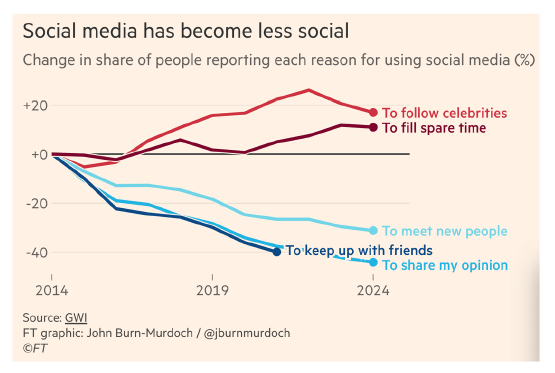

As attention models shift, there is less space for often depressing journalistic content and greater focus on more joyful creators who can keep people engaged and entertained within the feed. And in terms of formats, because video is often the main way in which attention is being captured, there is less opportunity to link out to websites or apps. Taken together this has led to the average number of referrals to news websites from Facebook falling by 43% in the last two and a half years and from X by 46%, according to our Chartbeat data. ‘It’s clear we need a strategic re-set for our platform (“reach”) strategy’, says the CEO of a leading international media company – ‘so much has changed in the last 12 months’.
So how are publishers responding to these changes in the platform environment?
Each year we ask executives where they plan to put more and less effort when it comes to platforms and channels. Top priorities for 2026 are video networks YouTube (+74 percentage point difference between ‘more’ and ‘less’ effort) and TikTok (+56) alongside a continued focus on understanding how to get distribution via AI chatbots (+61). By contrast, publishers are planning to devote fewer resources to X (-52), Facebook (-23), and BlueSky (-11) – as well as old-style search optimisation (-25). One traditional network that has bucked the general trend is LinkedIn (+40), which has become an important source of traffic for specialist and business publications in particular.
While most publishers have a primary strategy around building direct relationships via websites and apps, they recognise that this may not be enough to reach younger audiences. NRK in Norway, for example, has restarted its news account on TikTok, as the platform has become a more important source of news for young people. It had previously withdrawn from TikTok to focus on its own website.
Others, especially in parts of the world where Android phones dominate, are looking to build traffic via Google Discover, the feed that sits on smartphones by default as well as in the Google app. A few publishers are also finding success with WhatsApp and Instagram channels, a relatively new way to broadcast news content into previously hard to reach spaces.
What might happen this year in social and video?
Publishers turn to Substack
Once seen as a refuge for individual creators, news brands are increasingly experimenting with the service as a quick way of trying new propositions and unbundling content. FT’s Alphaville has launched a free newsletter on Substack, not as a replacement for its existing blog, but as an additional way to distribute its content and reach a wider audience.13 The move is a strategic decision by the Financial Times to embrace new content discovery ecosystems. The Daily Mail, Press Gazette, and Piers Morgan are some others to have recently launched on the platform.
Substack has been adding new functionality over the past year and, like other creator-friendly networks, has been pushing into video, including most recently live streaming from the desktop. Substack is looking to compete with bigger platforms this year, including YouTube and LinkedIn. Expect a range of new product announcements including more flexible payment options and possibly advertisements too.
Vertical video hits the mainstream
Publishers have been dabbling in vertical video for some time but could this be the year that the format takes centre stage? There are two key reasons why it might. First, younger people in particular are increasingly using YouTube and TikTok as a source of news,14 convincing publishers that they need to have a strong presence to combat misinformation and to market their brands.
Second, there is evidence that older groups have also become used to swiping through vertical video content – so publishers such as The Economist, and the BBC have been integrating more video into their own websites as an engagement strategy. Much of this content is serving a dual purpose, also feeding platforms such as TikTok, YouTube Shorts, and Instagram Reels. In October the New York Times added a curated vertical video feed including news, opinion, and content from across its lifestyle verticals contained within a new watch tab on its app. This refocusing on short-form video is partly driven by potential advertising opportunities, with branded content set to be added in early 2026. The Washington Post has indicated it will be following suit along with a slew of other publishers.
Watch tab as an engagement tool showing the breadth of New York Times video


Online becomes TV: from the laptop to the living room
Beyond short-form video, the big story of the year could be the further encroachment of video platforms into the traditional television space. A recent Ofcom report in the UK showed that YouTube was often the first choice for younger viewers accessing Smart TVs and older people had doubled the time they spent with the platform since 2023. The top trending content on YouTube increasingly resembles traditional TV, with talk and entertainment shows dominating. A recent deal for YouTube to show the Oscars from 2029 along with growing interest in sports events symbolises the shift of power away from traditional channels. But creators and podcasting talent are also a key part of streamers content strategy. Netflix has signed up Gary Lineker’s popular The Rest is Football podcast for the World Cup and we’ll see many more deals for the most engaging creators as the competition hots up. Expect public and commercial broadcasters to step up their campaigns to demand greater prominence for their content within YouTube and other online platforms this year including news.
5. Responding to the creator wave
The shift of platform priorities away from content (shared by friends and family) towards viral hits (shared by anyone) has turbo-charged the creator economy. But it is not just that. In the last few years there has also been a revolution in easy-to-use creator tools that have made it possible for anyone to create professional content from their bedroom. These capabilities are now being enhanced by new AI products (Nano Banana, Sora, etc.) that can create compelling animations or videos to enhance the storytelling. Finally, the platforms are finding ways to incentivise the best creators, not just with advertising but with subscription options, direct commissions, and licensing deals.
All this is leading to a further expansion of content choices for consumers and much greater competition for traditional publishers. It’s also blurring the line between creators and journalists and media companies. Additionally, there is a growing talent problem for news media, with top stars setting up on their own or demanding more money to stay. Overall, publishers are more concerned at this stage about the new competition (70%) than talent loss (39%), though this is already becoming a significant problem in large countries such as the United States where the creator economy is most developed.
Concern is also matched by some admiration. ‘The rise of creators has pushed us to think more deeply about voice, authenticity, and direct audience connection’, says Maria Lorente Estrada, bureau chief for AFP in Latin America. ‘Rather than seeing them as competition, we’re learning from their agility and experimenting with more personality-driven formats, behind-the-scenes storytelling, and clearer value propositions. Ultimately, creators remind us that audiences gravitate toward content that feels human, expert, and trustworthy.’ Having said that, our recent research report Mapping News Creators and Influencers across 24 Countries highlighted how much creator content is focused on opinion, rather than news.15 Many of the most popular creators, we found, are engaged in partisan commentary and, unlike journalistic institutions, they have no obligation to report the news fairly and accurately, even if many try to do so.
What might happen this year with creators?
Journalists become more like creators but at what cost?
Three-quarters of our publisher respondents (76%) said that they would be getting journalists to behave more like creators this year. Wired, for example, has set out a strategy to build its best-known writers into ‘platform personalities’ – from vertical video on TikTok and Instagram to live events.16 The New York Times has been putting the faces of its correspondents front and centre on its homepage. The Economist, which for years shunned bylines, has changed its approach in some areas, showcasing key talent through podcasts and newsletters.
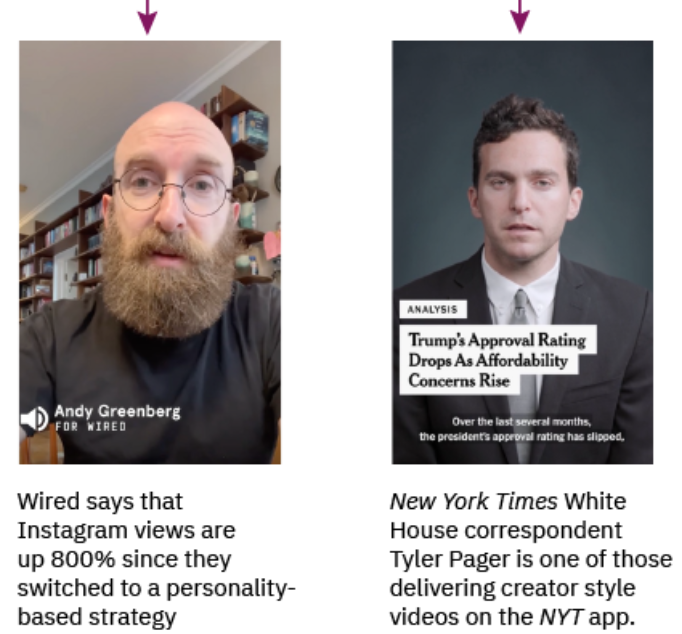
This trend raises new issues for media companies that have previously suppressed their personalities in the name of greater objectivity or a consistent voice. ‘We are currently developing guidelines for our journalists who wish to operate as individual creators’, says Ivaylo Stanchev, Editor-in-Chief at Capital in Bulgaria. ‘Our goal is to clearly define the boundaries to avoid conflicts of interest and potential reputational risks, ensuring that their personal activities do not compromise our editorial standards.’
Another significant risk is that, by helping journalists to build their independent profile, they may be giving them confidence to leave – taking their followers with them. The Washington Post’s TikTok guy, Dave Jorgenson, worked at the company for eight years picking up many prizes in the process before setting up on his own. Almost overnight the reach of the Post’s ‘Universe’ YouTube channel, which hosted his videos, crumbled, overtaken by Jorgenson’s new enterprise LNI (Local News International), according to data from Rival IQ.
YouTube views over time – W Post (official), W Post (Jorgenson), and LNI
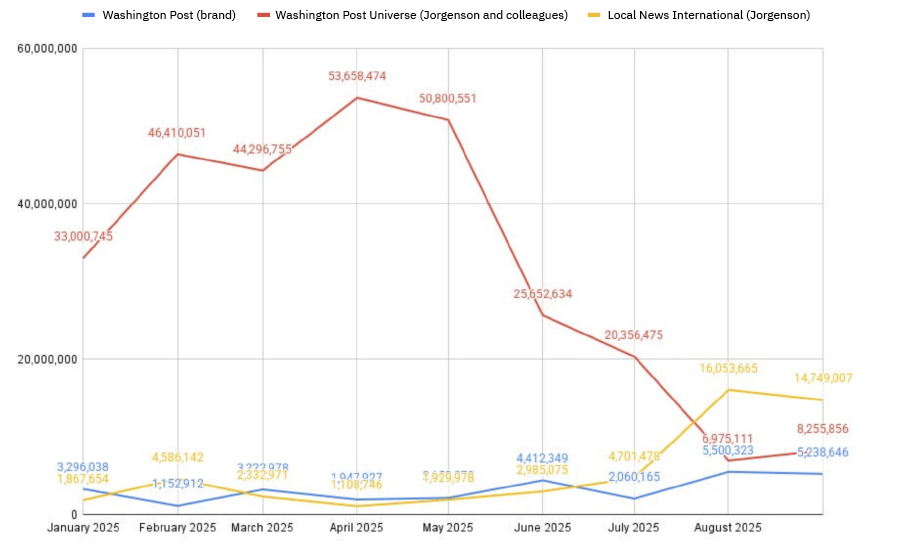

Source: Matthew Karolian Substack quoting data from Rival IQ.
Creator-led publisher brands proliferate in 2026
A second approach being pursued by multiple news organisations is to hire young creators who understand how to package content for platforms like TikTok and Instagram Reels.
DMG New Media is a new unit from the Daily Mail made up of around 60 young creators, designers and video editors. The unit is charged with building audiences through the group’s social media accounts, but has also launched vertical channels for entertainment, gaming, and money. This is not just for marketing. The aim is to make money globally through sponsorships and branded content. The Interactive Advertising Bureau (IAB) estimates that US creator advertising spend will have reached $37bn in 2025 – and is expected to grow four times faster than the industry as a whole.17 UK growth projections are similar, with brands increasingly treating creator marketing as a core advertising channel rather than a digital add-on, but they remain concerned about brand safety. Against that background the Mail and other publishers see an opportunity to reassure brands with a creator-like offer, backed by the credibility of a traditional news organisation.
CNN Creators is a new brand that will launch fully in 2026, an attempt to capture the informality and tone that works with younger audiences – on television as well as social media. It involves a big investment in a purpose-built studio in Doha, Qatar, designed to facilitate collaborative and spontaneous content creation. The focus will be on subjects of interest to younger audiences, including tech, art, sport, culture, and social trends.
CNN Creators debut show from Doha, Daily Mail’s social gaming channel and sponsored content for This is Money
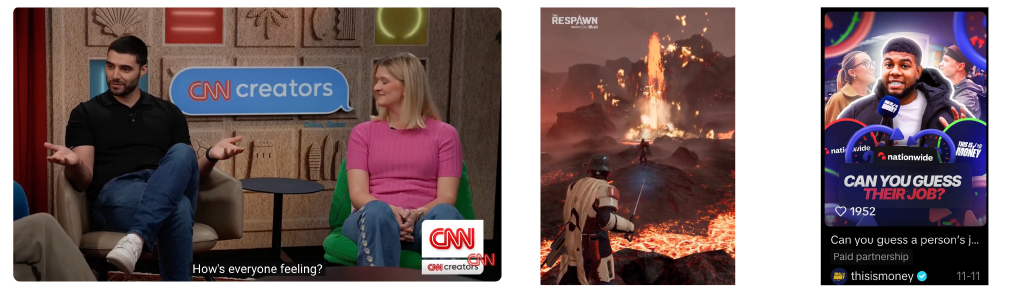

SPIL is a new initiative from Mediahuis in the Netherlands inspired by detailed research into the changing habits of young people, which found that most are interested in trustworthy news aimed specifically at them. SPIL News is fronted by a small group of journalists in their twenties, who post content to TikTok, Instagram, and YouTube. In addition, SPIL is collaborating with young journalistic creators from across the Netherlands to enrich the offer.
ABC News Loop from Australia’s public broadcaster will also launch in early 2026. The new service of ‘made-for-social’ explainer journalism aims to give users context on major issues while cutting through the noise of opinion and misinformation.
These new services are recognition that publishers will need to change the style and format of their journalism if they are to engage younger people. Trying to get them to come directly to websites and apps that are optimised for older groups is unlikely to bring results.
Creator studios, partnerships, and new talent deals
A third approach that we are likely to see more of this year is the development of creator studios where publishers provide support services and incubate new talent. UK-based digital news publisher the Independent recently signed successful YouTuber Adam Clery as creative director. He runs his own football channel (ACFC), now jointly branded with the Independent, but the plan is also to co-opt other successful external creators in specific verticals.
Vox Media in the United States has been signing up creators from ‘streamer or podcast-first backgrounds’ for some time – providing sales, marketing, and distribution, as well as production support and live events. Recent deals included Hacks on Tap with David Axelrod, Mike Murphy, and John Heilemann and a multi-million-dollar revenue share deal in 2025 for Pivot and related podcasts from Kara Swisher and Scott Galloway. Many of these deals are reported to be heavily weighted towards the talent, with media companies looking to build creator networks at scale that could become powerful future revenue generators.18
The Adam Clery Football Channel (supported by the Independent) and Pivot with Kara Swisher and Scott Galloway (supported by Vox Media)

A different kind of partnership – also based on revenue share – is the Washington Post’s Ripple project set to roll out further during 2026. The Post is offering writers, including independent substackers, the opportunity to publish their columns on its website and app – separated from the existing WP opinion section. Over time, the Post is looking to extend the idea to non-professionals, supported by an AI tool that helps turn rough-and-ready copy into an engaging piece of journalism.
Distinguishing good creators from bad ones
In a world where anyone can produce professional-looking content it is getting harder to define what marks out journalism. This is a challenge for media companies but also for journalistically minded creators who want to be taken seriously. The News Creators project from FT Strategies has proposed Information Credibility Guidelines for those that feel a strong personal responsibility for the accuracy of their content, but lack the formal frameworks of a traditional newsroom. Liz Kelly Nelson’s Project C also emphasises the importance of maintaining ethical standards, building trust, and finding sustainable business models.19 Some traditional media regulators have also said they would consider applications from individual creators who are prepared to sign up to their codes.20 Platforms are interested in using any signals that are developed to identify creators that produce valuable public interest content around important subjects such as elections and the war in Ukraine – and downgrading those that produce unreliable content – in their algorithms. Governments have been creating lists of influential creators in the field of politics and public policy so they can be included in communication plans and invited to press conferences. Expect to see more action in this space this year, though none of this will be easy, given the sheer number of creators and very different interpretations of what quality content looks like.
6. AI slop, deep-fakes, and misinformation
By some estimates, the majority of content being produced on the internet is already created by artificial intelligence.21 From automated news articles, to hyper realistic images, catchy tunes that sound like your favourite artists, or fake videos, AI-generated content is transforming the web. Social media feeds have been particularly afflicted, with a recent Guardian investigation suggesting that nearly one in ten of the fastest-growing YouTube channels globally only show AI-generated video.22 TikTok has revealed that its platform already hosts more than one billion AI videos, including one of rabbits bouncing on a trampoline (right) that has racked up 25 million views. The fear is that human-generated, verified content will soon be drowned out by machine-made ‘AI slop’.
Much of this is not trying to deceive and is in keeping with a long internet tradition of playfulness, surrealism, and satire, but others worry about the wider implications of powerful new AI tools that can generate realistic images and video, especially when it comes to news.
AI-manipulated images and videos were a feature of a number of election campaigns across Asia, Latin America, and Europe during 2025. In the Dutch elections in October right-wing leader Geert Wilders opened his campaign with an AI-generated video depicting a future Netherlands living under Sharia law.23
A few days before the Irish presidential poll, a fake video of the eventual winner, Catherine Connolly, circulated on social media, in which she apparently announced her withdrawal. Evidence is also emerging that pro-Russian groups used AI extensively in the Moldovan24 and German elections.25 While the majority of these videos do not gain traction and are quickly debunked, some do occasionally take off.
At the same time platforms have been getting rid of human moderators and fact-checkers, under pressure from Donald Trump who sees them as ‘censors’ attempting to stifle free speech. This puts the US at odds with governments elsewhere that are looking to increase obligations on tech platforms around policing their own rules.
It is still early days and the implications for democracy – and trust in the news – remain unclear, but the potential for deception and manipulation at scale means that, at the very least, new safeguards will be needed. ‘As AI sweeps the world, there will be growing demand for human-checked, high-quality journalism’, argues Edward Roussel, Head of Digital at The Times and Sunday Times and around half (52%) of publisher survey respondents agree that these trends have the potential to strengthen the position of news media.
Some of this may be wishful thinking. If audiences are unsure what is true or false on the internet, this does not necessarily mean they will turn back to news media. Surveys show that a significant proportion in most counties deeply distrust the news media overall, with others happy to rely on user comments or even AI chatbots to check the facts. At the same time, it is in the interest of platforms to ensure that misinformation and ‘AI slop’ does not degrade the experience (so called ‘enshittification’26) and undermine their business models.
What may happen this year?
Digital provenance moves centre stage
The industry will be focused on two core approaches this year. First, stepping up initiatives to add metadata to professionally produced (and other) content to show where it came from and how it was edited, using standards such as C2PA (the Coalition for Content Provenance and Authenticity).
Progress until now has been painfully slow. Currently fewer than 1% of news images or videos published globally include C2PA metadata, although pilot adoption is growing across news agencies and broadcasters such as the BBC. These approaches require adoption and buy-in across the entire ecosystem and metadata can easily be stripped out at any stage, but there is a common interest in rolling out approaches which could help give prominence to high-quality verified content without losing the creativity – and engagement – that goes along with the use of much AI.
Second, expect to see platforms increase their efforts to detect synthetic or manipulated content. Until now, these systems have only been partly effective, with some experts suggesting that TikTok can automatically detect less than half of AI-generated content.27 Given that some kind of AI may be involved in all content production in the future, these systems are going to need to be much more sophisticated to take into account the way AI is being used and the intent behind its use.
Better labelling and literacy initiatives
Alongside technical standards we can expect to see more effort to educate content producers and creators about what they need to label and why. For example, anyone uploading to YouTube now needs to disclose altered or synthetic content that could be mistaken for a real person, place, or event. These disclosures ultimately lead to decisions about whether to show an AI-generated label – and we can expect to see more prominent labels this year around sensitive topics such as elections and health crises. Overall, though, platforms are treading a fine line as they are encouraging creators to create content using AI (e.g. Meta’s Vibes,28 OpenAI’s Sora) at the same time as trying to detect and restrict certain type of uses.
AI content farms
We will see more and more fake news sites setting up that look like journalism but on closer inspection turn out to be automated slop. In France, journalist Jean-Marc Manach has identified more than 4,000 fake news websites powered by Gen AI that he says have been set up to game Google algorithms29. Meanwhile, in the UK, ’North London News’ is one of many sites regurgitating content from real websites, according to a Press Gazette investigation.30 In addition to containing factual inaccuracies, the site also uses American spellings, another tell-tale sign of AI generation. In the US, zombie local websites have been operating for some years and according to Newsguard they now outnumber real local websites there.31

Workslop runs riot
A further challenge this year will be the indiscriminate use of AI-generated content in the workplace. A recent survey by the Harvard Business Review (HBR) found that four out of ten respondents had been exposed to workslop, which they defined as low-quality documents and presentations created by AI tools, over the previous month.32 The HBR argues that workslop is destroying productivity because it ‘lacks the substance to meaningfully advance a given task’. Another study from late 2024 suggested that 54% of content on business network LinkedIn is AI-generated or AI-assisted and these figures are only likely to have increased with new tools being integrated into the platform.33 Words like ‘delve’, ‘leverage’, and ‘pivotal’ now pepper emails and other work documents, tell-tale signs that AI may have been working in the background, along with the overuse of the em dash (—). Expect to see a backlash against this behaviour in the year ahead.
7. Latest tales of AI in the newsroom
While news organisations are keen to show their human credentials, they are also embracing AI in their own newsrooms to drive efficiencies and to improve journalistic quality. It is a delicate balancing act, not least because a number of leading organisations have also publicly criticised the accuracy of news outputs from leading chatbots. A recent European Broadcasting Union (EBU) study claimed that the output of ChatGPT, Perplexity, and Gemini misrepresent news content almost half the time.34
Despite these misgivings, every year we find news executives rate a range of AI and Gen AI use cases as ‘very important’ to their business – and those numbers grow every year. Back-end automation tasks, such as transcription, copyediting assistance, and automated metadata, remain the most widely mentioned use case (64%) but importance for coding and product development (44%), commercial purposes (33%), and newsgathering (29%) are all sharply up.
The importance of coding and product development has increased by 16 percentage points in our survey this year, a reflection of significant improvements in capability over the past year. Tools like Claude and ChatGPT can now understand entire projects, reason across thousands of lines of code, generate tests, and in some cases complete entire development cycles. AI ‘coding agents’ such as Replit allow those with no coding ability to create prototypes, websites, and apps within minutes, speeding up the development and testing process.35
Overall, however, we have also detected some disillusionment with AI progress in the newsroom. Headline generators and alt-text automation have been widely adopted, along with style guides integrated into content management systems, while automated summaries are integrated into many websites. But is any of this really moving the dial?
When asked which adjectives best describe the impact of current initiatives only around one in ten (13%) said transformational. Just over four in ten (44%) said promising, but a similar proportion (42%) said limited.
Many media companies have invested heavily in setting up bespoke AI teams as well as paying for licences to allow staff to experiment. This year, finance teams may be asking more questions about when they can expect to see material savings. When it comes to jobs, two-thirds (67%) of our respondents said there had been no reduction in roles as a result of AI and one in ten (9%) said jobs had been added. Most of the other respondents (16%) said that just a handful of job cuts had been made – either staff or freelances.
For a number of publishers their stated aim is not efficiencies but instead using AI to improve the journalism. And amid all the gloom there have been some great examples of this in the past year in this area:
- The New York Times regularly uses AI to sift through mountains of information in any format (text, video, pdf) to find patterns and provide context. When Charlie Kirk was assassinated, they quickly transcribed thousands of podcasts and videos to identify the debate style and narratives that built his movement. Similar investigations in the past had taken a year or more to complete. This took two weeks.36
- Amid growing tension on the Russian/Finnish border, Helsingin Sanomat in Finland is deploying ‘micro-automations’ using AI to better inform journalists in real time. HS Watchdog bots are able to trawl though publicly available Telegram channels and other Russian-language material and alert journalists to developing news.
- The Reuters News Agency has deployed an AI tool (FactGenie) to speed up breaking news for financial clients by automatically pulling key facts from press releases and allowing journalists to verify them quickly. The tool is used by 150 journalists around the world and has halved the average time it takes to send non-corporate alerts.
- In Norway, a local news outlet, iTromsø, has developed an AI tool (Djinn) that sifts through government documents and archives, leading to a number of scoops. They say this also frees up time to get out of the office and talk to local people, which they still see as the key selling point.37

What can we expect in newsroom AI this year?
The year when we start to use the agentic capabilities of AI platforms to the full
Some experts argue we’ve barely begun to scratch the surface of the latest capabilities of tools such as ChatGPT and Gemini. These are now fully multimodal with agentic capabilities and are able to orchestrate and manage much more sophisticated processes, including journalistic investigations, strategy, and audience research.
In one example, independent consultant David Caswell replicated a project looking at future scenarios for News AI using agentic processes. This involved creating multiple AI personas as well as digital twins of some of the original human participants. His evaluation was that synthetic research participants produced outputs that were overall on a similar level to the human version, and better in some areas – as well as being cheaper and quicker to do.38
In Sweden, the newspaper Svenska Dagbladet (SvD) has started to experiment with an AI-generated research group, based on interviews with some of its existing subscribers – as well as some potential ones.39 The idea is that these digital twins are always available for editors to consult with about story treatment or suggested headlines. The first iterations of the system, developed with US-based start-up Verso, will be tested with editors early in 2026. The Times of London also recently used a synthetic research panel to test the name of a new business podcast. Agentic advertising and marketing will start to gain traction in 2026 with AI optimising campaigns against pre-agreed goals, personalising campaign messages as it learns.
How some AI companies are selling the benefits of synthetic research
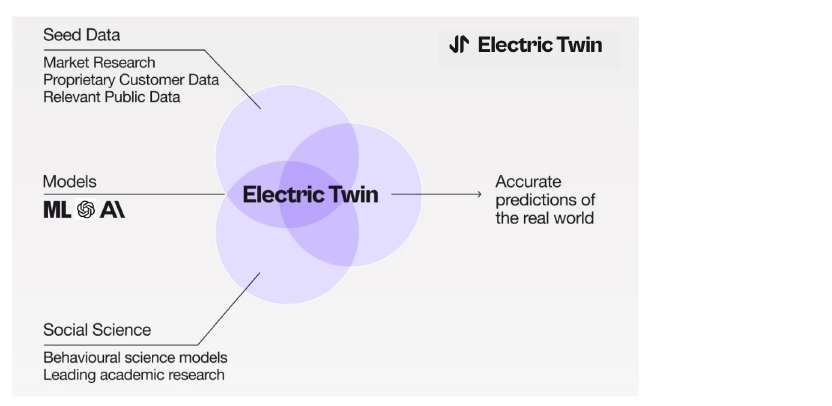

A new category of market research agencies that specialise in synthetic focus groups is also emerging, including companies like Aura and Electric Twin – disrupting and undercutting existing methodologies. And the same will be true for strategy projects. Expect to see the first media companies using these tools for scenario planning and modelling this year.
Greater adoption of synthetic presenters and avatars
Until now, Western traditional media companies have shied away from AI presenters, partly to allay fears about job cuts, though there has been less reticence in Asia and Africa. In Zimbabwe, the Centre for Innovation and Technology (CITE) has created an AI-generated news presenter called Alice, one of seven covering different beats including climate change, city news, and weather. This avatar-led approach has enabled the outlet to produce more videos with fewer staff. It also means that individual journalists are less exposed in a country where journalists are often subject to intimidation, according to Zenzele Ndebele, CITE’s founder and director. Audience reaction has been mixed, with younger users more accepting of the change.40
The BBC has also been experimenting with synthetic presenters – but in audio. The corporation recently trialled daily audio bulletins of football news for a number of top football clubs including Newcastle and Liverpool.41 Each used a bespoke regional accent in association with Eleven Labs, a specialist technology provider. The BBC says the cost of producing a product like this for every premiership club using traditional approaches would be prohibitively expensive. Over time it seems inevitable that we’ll see more of a mix of real and synthetic presenters, to allow a wider choice of video experiences in different languages and accents.
Smart content adaption
Some degree of homepage personalisation is already widespread on news websites but other types of personalisation around format and experience are emerging – powered by Generative AI.
- In India readers of the website Scroll can see different versions of an explainer story by changing a slide bar at the top of the story – providing more or less context according to preference.

Norway’s best-selling tabloid, VG, has introduced an AI-generated message that tells users what has happened since they last visited the website.

- Similar approaches are being taken by streaming providers, which is likely to supercharge these types of content adaptation. Amazon recently introduced Amazon Video Recaps, where AI is used to summarise a whole season of shows for viewers who want to catch up before starting their next binge-watching sessions.
Stand-alone publisher chatbots become part of site navigation
This year we can expect to see more of use of Gen AI in improving content discovery. Publishers find that audiences struggle to think of original questions to ask publisher chatbots such as Hej Aftonbladet, Hei VG, and Ask FT, with most likely to click on suggested prompts. This suggests that these chatbots may be better used as features for onward navigation, offering extra background or prompting users to dig deeper at the bottom of a story.

8. Changing business models and barriers to Innovation
While many publishing executives surveyed are confident about their business prospects this year, a significant number are not. For many news organisations, old business models are continuing to deteriorate faster than newer digital revenue streams are able to grow.
As in previous years we find that, for commercial publishers, paid content (76%) such as subscription and membership will be the most important focus for the year ahead, though there is also a renewed interest in native/brand advertising (64%), perhaps because of increased advertising budgets in this area linked to short-form video. Face-to-face events (54%) have also increased in importance in recent years as publishers look to build stronger communities in real life.
The most significant new growth opportunity, according to our data, is getting platforms to pay for content (37%), through licensing or other approaches. Interest in platform funding has almost doubled in the last two years, since some AI companies started to offer big deals, despite concerns about overreliance on big tech.
Meanwhile independent journalistic organisations operating in countries with poor press freedom were badly hit when the US administration froze over $250m in assistance in early 2025, forcing outlet closures, lay-offs, and stripping journalists of essential protection.42
New product development will be critical
While the core focus remains on trying to improve and optimise core products (59%), there is recognition that this may not be enough. New products and revenue streams will also be required, with 37% of our survey respondents expecting this to be the key focus.
Artificial intelligence is seen as a key enabler in strengthening existing products, for example through offering higher levels of personalisation, as well as in new product development – making it possible to try new things at lower cost. However, innovation often remains a struggle for product teams that are keen to put out new products quickly but often come up against a risk-averse newsroom. The Washington Post, for example, recently went ahead with a new AI-generated podcast service, despite internal tests showing that it has misattributed quotes and misinterpreted facts, causing an inevitable public row.43 These tensions within news organisations are set to grow as the need to innovate becomes more pressing.
There are many other barriers to innovation. Six in ten (62%) of our respondents say that media companies simply aren’t investing enough in future models, citing lack of resources. There is also a skills problem, with around half (53%) identifying challenges in either attracting product people who can help define the right solutions, or the technical and design talent to deliver them.
The other big problem identified by our survey is alignment. Around a quarter (26%) think the top-level strategy is not sufficiently clear, with half (49%) complaining about internal competition between different groups which makes it hard to align different parts of the organisation around new projects.
What might happen this year?
Consolidation, partnership, and other economies of scale
Expect to see further mergers and acquisitions (M&A) this year as companies recognise they need more scale to compete with tech platforms and address problems of access. These large publishers are able to strip out cost by consolidating technology, advertising, and other services – potentially making innovation harder to achieve at the brand level. Large publishers are also in a position to aggregate and bundle subscriptions to increase retention and long-term value.
New models for local news
This sector, which is crucial for local democracy and engagement, has been amongst the most disrupted by digital media. But this also offers opportunities. One Finnish publisher is planning a radical new model in 2026, based on gamification and inspired by the language learning app DuoLingo. Part of the idea is to involve and incentivise the community into not just reading the news but participating in it. Stars or tokens can contribute to discounts or other benefits. The concept is still being developed but will probably also use AI in radical ways to rethink what local news and communities could become in the future.44
9. What’s next in technology?
The pace of external change shows no sign of slowing and we can expect another year of rapid innovation with a focus on agentic AI, automation, and new interfaces. But are these changes happening too quickly? Could we see an emerging backlash against technology get stronger?
Browser wars and agentic apps
With more content being aggregated and consumed within the browser itself, we can expect more pressure on Google Chrome’s dominant position. New competitors, such as Neon from Opera, Dia from the Browser Company, Atlas from Open AI, and Comet from Perplexity, offer a range of AI integrations including agentic capabilities. These browsers can handle tasks such as summarising or translating webpages, email drafting, shopping and other task completion – based on natural-language commands. Some can also browse the web on your behalf pulling together personalised news summaries.
Specialised apps offer similar capabilities. Huxe, built by former Google NotebookLM engineers, uses agentic approaches to create an audio briefing that runs through your email, special interests, and the top news of the day. It can also create on-demand podcasts (DeepCasts) on a particular topic and live streams that adapt to voice commands. Open AI’s Pulse, which offers a card-based briefing linked to previous ChatGPT queries, is available to professional users but expected to roll out further this year.
These developments mean that content is becoming increasing ‘liquid’, in that the format can be changed – actively or passively – based on the viewer’s context, interaction, time, or location. This means that it will be harder for publishers to control how news stories look in the future. It will also be harder to know how content is being used. If an AI browser automatically summarises content on behalf of a user, does this count as a human visit? With more agentic bots reading content how will measurement and therefore monetisation be affected?
In our survey, three-quarters of respondents (75%) see these changes as having a large or very large impact on publishers over the next three years.
Given the many unknowns in this area it is hard to identify clear responses to these changes but some media companies argue that more rapid innovation is the key. ‘The article as we know it is gone’, says Gard Steiro, Editor-in-Chief at Norway’s VG, which is rethinking its products and retooling production to make it easier for more atomic content to be reworked for different users.45
New AI-driven devices on the way
Existing devices have been getting AI upgrades and new ones are expected. Voice has been a key focus, with smartphones now using AI voice assistants as a key selling point. Amazon is continuing to roll out its much-delayed Alexa+ functionality in its Echo devices, which will come free for millions of Amazon Prime subscribers. All of this will help popularise voice as an access point and increase the importance of publisher integrations that can respond to the most popular content queries.
Meanwhile former Apple designer Jonny Ive and Open AI’s Sam Altman have been prototyping a new device, with AI at its heart, sometimes billed as the ‘smartphone killer’. It is rumoured to be screen free and is described by Altman as ‘beautiful and playful’. Ive has talked about the need to transform the sometimes-unhealthy relationship many people currently have with their devices. He wants the new device to help make us ‘more peaceful, less anxious, and less disconnected’.46
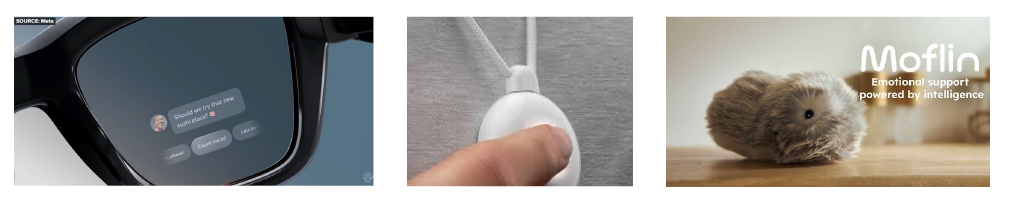
Other attempts to integrate AI into new devices have proved disappointing. The Rabbit R1, a handheld AI assistant, and the Humane AI pin were withdrawn from the market. The Friend necklace is the latest riff on this theme and Meta is persisting with its AI smart glasses, releasing three new models to somewhat positive reviews. We can also expect to see more AI pets in 2026 – less about information and more about emotional connection. The Moflin from Casio, originally aimed at Japanese consumers, mimics pet-like behaviour with coos, life-like movements, and reacting to touch, sound, and light.47
Meta’s latest mixed reality smart glasses (with AI), AI Friend capturing conversations, AI Pets for emotional connection
What may happen this year?
Anti-screen movements grow
From dumbed-down mobile devices to deleted social media accounts, there are growing moves to get away from technology and spend more time in real life (IRL). Sales of dumb phones with small screens that can only handle simple messaging are growing.48 The Light Phone is designed to shut out scrolling feeds that trap people in digital attention loops as well as all advertisements. Apps are made to look boring, with black and white design, to reduce screentime. Young people in particular are embracing movements such as ‘Appstinence’, with others proudly defining themselves as Luddites, the 19th-century movement of English textile workers that physically attacked machines that threatened to take their jobs. A recent rally in New York heard anti-tech speeches and smashed up Apple products.
Light Phone III: Black and white apps to reduce screentime, Punkt phones are designed to stop the scroll, HMD Fuse gives options to unlock functions as the child gets older


Some nightclubs and concerts now take smartphones away at the door as a condition of entrance, or demand that stickers cover up the camera, to allow music lovers to stay in the moment.49
More widely there is some evidence that the public mood is shifting, with greater awareness about the potential harms of mobile and social media. Expect more support for smartphone restrictions in schools and all eyes will be on the impact of the social media ban for under-16s in Australia, where even many of the teenagers affected have welcomed the move. Other countries are likely to follow suit this year and even some US states are expected to defy Donald Trump by imposing restrictions of various kinds.50
10. Conclusions
The news industry remains in transition with old models fading and new ones not yet fully formed. Big tech platforms remain in the driving seat, armed with new tools that can aggregate and remix content in ways that often look like magic. But the platforms do not hold all the cards – at least when it comes to news and information.
Not all content can be easily summarised. Reliable news, human stories, and points of view remain important both to individuals and to society. Trust matters, as does the experience of consuming news, including connection with others. This is hard for avatars and hyper-personalised apps to replicate even as they bring greater value in specific areas. Against that background it is unlikely that traffic from search and AI aggregators will dry up completely, but the terms of trade for access – licensing, citations, revenue share – are up for grabs with many opportunities as well as challenges.
The rise of creators, closely linked to the way in which video is increasingly taking attention away from other types of media, is a second critical trend to navigate, especially for news media with roots in print. Some adjustments may be needed, in terms of tone and format, but shifting too far towards personalities risks undermining some of the characteristics that audiences most value and expect from news media. It is also worth noting that most news creators are not competing directly, indeed they still rely on news providers as the basis for their discussions. As creators look to grow there could be opportunities for news organisations to support or partner with these businesses, at the same time as learning about how to better engage and connect with audiences.
This year’s survey shows that news executives recognise the challenges ahead and are up for the fight. The industry may get smaller overall, with some attention going elsewhere, but businesses that ultimately thrive are likely to be those that have a clear sense of their role and of the value they can create for specific audiences. That is also likely to mean more joined-up organisations, clear about their values but also able to embrace change so they can take advantage of the opportunities to come.
Survey methodology
280 people completed a closed survey between 18 November and 20 December 2025. Participants, drawn from 51 countries and territories, were invited because they held senior positions (editorial, commercial, or product) in traditional or digital-born publishing companies and were responsible for aspects of digital or wider media strategy. The results reflect this strategic group of select industry leaders, not a representative sample.
Typical job titles included Editor-in-Chief/Executive Editor, CEO, Managing Director, Head of Digital, Director of Product, and Head of Innovation. Just over half of participants were from organisations with a print background (52%), around a fifth (22%) came from digital-born brands, and a further fifth (19%) from broadcasters. Around 7% came from a mix of news agencies and other media. These proportions are similar to previous surveys.
The 51 countries and territories represented in the survey included Australia, New Zealand, the Philippines, Vietnam, Japan, India, Indonesia, South Korea, South Africa, Kenya, Argentina, Uruguay, Brazil, Colombia, Mexico, and Egypt, but the majority came from the UK, US, or European countries such Germany, Spain, France, Austria, Finland, Norway, Denmark, and the Netherlands, as well as Poland, Hungary, and Slovakia, amongst others.
Participants filled out an online survey with specific questions around strategic and digital intent in 2025. Over 90% answered most questions, although response rates vary. The majority contributed comments and ideas in open questions and some of these are quoted with permission in this document.
The author is grateful for additional input from a number of publishers, academics, and industry experts when preparing this report via background conversations, interviews, and emails. These included Rasmus Kleis Nielsen, University of Copenhagen; David Caswell, AI expert at Structured Stories; Chris Moran, Head of Editorial Innovation at The Guardian; Ebba Linde, Director of Product Enablement at Schibsted; Inanna Lallerstedt, Senior Product Manager at Svenska Dagbladet (SvD); Troels Jørgensen, Digital Director at Politiken; Nick Moar, Head of New Media at DMG Media; Esa Mäkinen, Executive Editor at Helsingin Sanomat; Olle Zachrison, Senior News Editor AI, BBC News; Lippe Oosterhof, Entrepreneur in Residence at the Washington Post; Steven Wilson-Beales; Alexandra Borchardt, media consultant and Senior Research Associate at the Reuters Institute; George Montagu, FT Strategies; Madhav Chinnappa, senior consultant and former Google executive; Dmitry Shishkin, Strategic Editorial Advisor, Ringier; Damian Radcliffe, University of Oregon; and David Tvrdon, writer and digital strategist, Slovakia.
Footnotes
1 Data based on the number of page view referrals in aggregated to over 2,000 news websites and apps in the Chartbeat network.
6 Several studies from mid-2025 based on US data showed rates of 10–15%, twice as high as in January 2025. E.g. Semrush
14 Digital News Report 2021–25 shows e.g. TikTok increasing form.
20 Charlotte Dewer, Chief Executive of IPSO, the biggest UK media regulator, recently said on the BBC’s Media Show that she would welcome approaches from individual creators.
21 An Amazon Web Services study estimates that 57% of online content is created by or translated by AI. arXiv
26 ‘Enshittifcation’ was first used by the British-Canadian author Cory Doctorow to describe the decline in online experience, as platforms prioritise profit over high-quality content.
33 The Register. LinkedIn later commented that much of this was assisted rather than created.
34 BBC Media Centre The study’s methodology was criticised by some academics for not reflecting how people actually use AI chatbots and for not fully taking into account blocking of AI crawlers.
39 Interview with Inanna Lallerstedt, Head of Product and Growth, SvD.
About the author
Nic Newman is Senior Research Associate at the Reuters Institute for the Study of Journalism where he was lead author of the annual Digital News Report 2012–25. He is also a consultant on digital media, working actively with news companies on product, audience, and business strategies. He has produced a media and journalism predictions report for almost 20 years. This is the tenth to be published by the Reuters Institute. Nic was a founding member of the BBC News Website, leading international coverage as World Editor (1997–2001). As Head of Product Development (2001–10) he led digital teams, developing websites, mobile, and interactive TV applications for all BBC Journalism sites.
Acknowledgements
The author would like to thank 280 news executives from 51 countries and territories who gave up their time to respond to our survey around the key challenges and opportunities in the year ahead.
Respondents included 64 editors-in-chief, another 64 CEOs or managing directors, and 51 heads of digital or innovation, and came from some of the world’s leading traditional media companies as well as digital-born organisations (see breakdown at the end of the report).
Survey input and answers helped guide some of the themes in this report and data have been used throughout. Some direct quotes do not carry names or organisations, at the request of those contributors.
The author is particularly grateful to Mitali Mukherjee, Director of the Reuters Institute, Richard Fletcher, Director of Research, Federica Cherubini, Director of Leadership Development, and the wider team at the Institute for their ideas and suggestions, and to a range of other experts and news executives who generously contributed their time in background interviews (see full list at the end of this report).
Thanks also go to Alex Reid for her input on the manuscript over the holiday season and keeping the publication on track. As with many predictions reports there is a significant element of speculation, particularly around specifics and the report should be read bearing this in mind. Having said that, any mistakes – factual or otherwise – should be considered entirely the responsibility of the author.
Published by the Reuters Institute for the Study of Journalism with the support of the Google News Initiative (GNI).