



The cockroaches’ reckoning: How Gen Z protests exposed India’s ‘lapdog media’ and ushered in a new wave of reporters
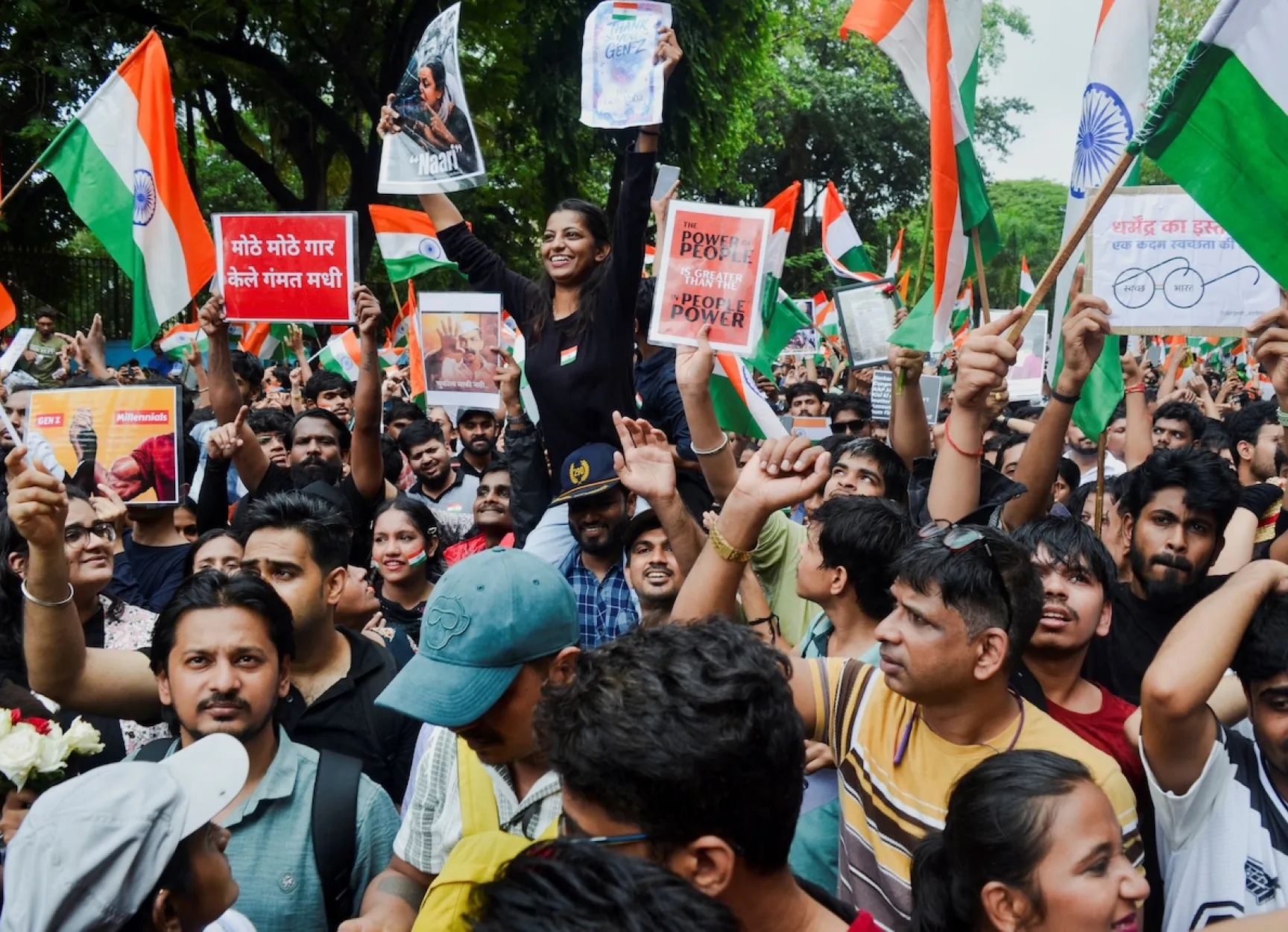
India’s massive youth-led movement didn’t just earn an unexpected retreat from the government. It also showed Gen Z’s distrust and anger toward the country’s legacy media, which they perceive as pro-establishment.
Nowhere was this more evident than at the protest site at Delhi’s Jantar Mantar area where a large banner displayed the faces of mainstream television news anchors – dubbing them “India’s worst enemies”, “more dangerous than terrorists or anti-nationals.”
The protests in the capital in June-July were led by the satirical Cockroach Janta Party (CJP) and culminated in the resignation of India’s education minister over repeated exam paper leaks, handing a rare setback to prime minister Narendra Modi, who’s been in power for over 12 years.
Several videos showed protesters heckling, accosting and even physically assaulting reporters covering the protests with chants of ‘Godi media’, which can be translated as “lapdog media.”
Manisha Pande, editor-in-chief of independent outlet Newslaundry, said she wasn’t surprised by the anger directed at mainstream Indian TV news channels. “We've been leading up to this moment for a very long time,” she told me. “A large number of people, irrespective of their ideology or the party they vote for, have come to believe that their real-life concerns are simply no longer reflected in prime-time news.”
Why cockroaches?
The Cockroach Janta Party (CJP) started out as a joke — a satirical reaction to Chief Justice of India (CJI) Surya Kant’s disparaging remarks in May likening some unemployed youth to cockroaches.
Abhijeet Dipke, who at the time was pursuing a Master’s degree in Boston, embraced the insult and posted an AI-generated image showing a cockroach sporting sunglasses addressing a large crowd.
Dipke, 30, would go on to form the Cockroach Janta Party (or cockroach people’s party), intended to be a play on Modi’s Bharatiya Janta Party (BJP). His social media post listed “unemployed, lazy, chronically online, and ability to rant professionally” as eligibility criteria for anyone willing to join. Dipke had previously worked in the opposition Aam Aadmi Party’s social media team.
Within days the CJP’s Instagram account amassed millions of followers, overtaking the BJP’s account that had 8.7 million followers at the time.
Saurabh Shukla, co-founder of The Red Mike, an independent news outlet on YouTube that won praise for its coverage of the protests, said he sensed early on that this was going to be something big. The Red Mike makes most of its revenue through YouTube.
Shukla reached out to Dipke, who he knew from before, and asked if he was up for an interview on camera. That video, published on 21 May, got over a million views.
“At that time Dipke had no plans to come to India. He had no plans of forming the CJP, nothing at all,” Shukla said. “Woh hansi mazak mein [in a light-hearted way] we did that interview and it exploded.”
The CJP channelled widespread anger over student suicides related to a retest of the National Eligibility cum Entrance Test (NEET), a highly competitive exam to study medicine. At least 12 students across the country died allegedly by suicide in around a month between the cancellation of the NEET exam on 12 May and a retest on 21 June, the Indian Express reported. The number of student suicides linked to the exam, which a court gave a nod to in 2016, is much higher.
Delhi’s Jantar Mantar grounds, a designated protest site, became the venue for the Cockroach Janta Party to rally people to its cause. The CJP’s call for reforms in an education system that prioritises test scores and rote memorisation over learning struck a chord.
Many young Indians believed the system viewed them as vermin to be quashed and the chief justice, who later clarified his cockroach remark, had only said the quiet part aloud. An acute lack of jobs and simmering discontent over frequent infrastructure lapses in several BJP-ruled states saw people across age groups, religions and socio-economic strata join the protests as well.
The demonstrations in June-July were primarily in Delhi. But they also saw young people hold large gatherings in Mumbai and Bengaluru. The movement eventually became larger than the CJP or its leaders. It transformed into an outlet to express dissent, which has practically been criminalised in India. Modi himself coined a derogatory term for protestors: ‘andolanjeevi’ or those who survive off protests.
“The protest sites at Jantar Mantar and elsewhere across India have become more than places of political dissent,” independent journalist Neha Dixit wrote. “They have turned into cultural fairs — spaces for celebration, catharsis and belonging.”
The Gen Z reporters on the ground
The movement drew parallels to the anti-government Gen Z protests which overthrew incumbent regimes in Sri Lanka, Bangladesh and Nepal, where anger was also directed at legacy news media. However, unlike other recent revolutions in South Asia, where Gen Z organised on platforms like Discord and Telegram, the movement in India seemed less co-ordinated.
Most of the videos shot by protesters themselves were uploaded to Instagram, whose parent company Meta is reported to be censoring posts on New Delhi’s request.
Vipul Kumar, a Gen Z journalist with independent news outlet The Wire, said he was asked twice or even three times by protesters if he belonged to a lapdog media outlet. “Especially the young people that were out there were extremely vigilant that no establishment media should push their narrative and that they don’t demean or defame protesters,” Kumar said.
As Delhi Police restricted mobile internet services at the protest site, Kumar would interview people, record visuals and head to the exit to relay information to the newsroom. He relied on his phone, a monopod and a small mic to report.
Kumar told me journalists carrying a traditional mic with a logo were perceived as being pro-establishment, whereas those that used a more discreet collar mic or Bluetooth mic were left unbothered by protesters.
“Any person with those mics was questioned,” said Kumar, who stressed that even reporters who didn’t belong to any establishment media but used a traditional mic were heckled.
Newslaundry’s Manisha Pande said a TV mic has come to symbolise the government in people’s minds. "It’s remarkable that the microphone – the very tool that once symbolised journalism – has now come to represent something bad, even hostile. For many people, it has come to represent an uncaring State,” she said.
India’s news ecosystem
India was ranked 157 out of 180 countries in the RSF’s World Press Freedom Index for 2026. Gautam Adani and Mukesh Ambani, India’s two richest men and close allies of Narendra Modi, own vast TV news networks.
Journalists who question the BJP are often harassed. Prominent broadcast journalists have migrated to platforms like YouTube after finding no place for themselves in corporate-owned newsrooms that depend on ad revenue.
Independent news media like The News Minute, Article 14, Scroll and others doing accountability journalism survive precariously and face constant threats of litigation and scrutiny into their finances.
Much of legacy TV news’ credibility crisis stems from the way it has demonised those who have challenged the State: university students, farmers, Adivasis (indigenous people) and protesters against the Citizenship Amendment Act, many of whom were Muslims.
Television news channels, whose audiences are middle-aged and older Indians, have also been called out for stoking Hindu-Muslim animosity, spreading pro-government disinformation and ignoring opposition voices.
The proportion of English-speaking Indians who turn to TV for news is much higher among adults over 54 (54%) than among those under 25 (30%), according to the Digital News Report 2026 tracking news consumption habits globally. Most young Indians get their news from Instagram (61%), YouTube (55%) and WhatsApp (53%).
The recent protests were often blacked out by mainstream TV news channels even though they had overtaken the capital in July, with authorities shutting down several metro routes to Jantar Mantar.
According to Red Mike’s Saurabh Shukla, who previously worked with NDTV, now owned by the Adani Group, what differentiated independent outlets from legacy media is that they never let go of the story. “This was our chance as independent journalists to cover it the way it should be covered,” he told me. Shukla said he and PEEK TV’s co-founders Priyanshi Sharma and Vedanta Agarwal were there from day one.
“Every day we did something,” he said. “In fact, when there were only 50 people on the 22 or 23 June I was there; when there were 20 people, I was there; when it was raining, I was there; when it was very hot I was there.”
Reporting from the protests
Journalist Priyanshi Sharma, one of the founders of PEEK TV, a short-form video news outlet, said the blackout by legacy media at the onset of the protests caused an information vacuum filled by independent journalists, news creators and commentators on video platforms.
When the protests seemed to be fizzling out, Sonam Wangchuk, a well-known educator and activist, joined their ranks by going on a hunger strike.
By day 21 of his hunger strike, when Wangchuk had lost a dangerous amount of weight, with fears that he might die on the government’s watch, the Delhi Police forcibly removed him from Jantar Mantar, unwittingly invigorating protestors.
PEEK TV’s Priyanshi Sharma said she fielded many questions on their reporting and read comments alleging the CJP was bribing them for news coverage.
“While we were covering this protest for that whole month,” Sharma said, “a lot of times people would ask us, and some of our seniors also would ask us, ‘Why are you doing this? Just stop doing it! It’s not going to lead to anything.’ We kept reporting because it was a protest that had genuine students participating in the heart of Delhi. As journalists, we also felt that hunger strikes should not be normalised.”
On 20 July, when protesters tried to march to the parliament, Delhi Police and other paramilitary forces unleashed a violent crackdown involving tear gas, pellet guns and indiscriminate charges. While TV news focused on the policemen who were injured, newspapers like The Hindu and The Hindustan Times fact-checked the official narrative that no pellet guns were used on the day.
YouTuber Samdish Bhatia’s video documenting the violence in the capital, where Bhatia can be heard repeatedly calling out to his cameraman Parth to show police and security forces raining blows on protesters, has over 6 million views. The video on YouTube has several replies from people contributing small sums in gratitude and to sustain the channel.
Powerful artificial intelligence CCTV cameras at every corner, facial recognition software, and even a policeman wearing smart glasses were seen at Jantar Mantar. Food delivery apps were barred from bringing food to protesters and restaurants sending food were even questioned by the police.
Yet India’s Gen Z were undeterred. Videos showed them fanning each other as the crowds swelled at Jantar Mantar. They vented their anger through humour, quirk and irreverent profanity-laden posters and chants not seen or heard in any recent protests in India, where respect for elders is ingrained since childhood.
While the BJP’s social media game has always been strong, entrenching itself on Facebook, WhatsApp and X, the party was no match for an unserious generation whose memes and dance reels went viral.
“This was called an Instagram protest and we were always Instagram first,” PEEK TV’s Priyanshi Sharma said.
Sharma, who worked as an anchor with NDTV in the past, was sad to see reporters being heckled by protesters. “It's not these reporters who are behind the rot in legacy media that we are seeing,” she said. “It's the owners and the anchors and the higher-ups, not the reporters who are just reporting the story on the ground.”
Journalism or activism?
PEEK TV, barely a year old and launched by two Gen Z journalists, got a shoutout at Jantar Mantar’s ‘wall of fame’ poster, mentioning journalists who did a commendable job.
But the reception was not always uniform.
Sharma said a group of protesters who didn’t appear to be from Delhi got verbally aggressive when she asked them if they were lost on their way to the parliament in the absence of CJP volunteers who could direct them.
Shukla from The Red Mike said he faced a dilemma on 20 July while reporting in the evening from Delhi’s Janpath road, when there was mayhem and stones were pelted at the police. Every protest has some fringe elements that try to spoil it, he said, and he thought showing the violence would ruin the entire movement.
“We were in a dilemma but we showed it,” Shukla told me. “We said, ‘Look, the police are chasing them away. There’s stone pelting happening from that side.”
The Wire’s Vipul Kumar said not everyone reporting from Jantar Mantar was practising journalism. Some, he said, were indulging in activism and, in a few instances, vigilantism. Kumar pointed to the incident where a reporter pulled down the face covering of a protester while filming him, claiming he perpetrated violence.
“The line was blurred in those couple of weeks,” Kumar said. “People were desperate to make heroes. I don’t know why.”
Priyanshi Sharma said the protests also changed what is perceived as political. For example, many brands who shied away from political content have now expressed interest in collaborating with PEEK TV, which earns revenue primarily from such partnerships.
In the aftermath of the protests, a bill promising stricter punishment for those who leak official documents was passed in the monsoon session of parliament, with MPs using slang like ‘clock it’, ‘delulu,’ and ‘FOMO’ for the first time.
Modi, who asked his ministers to be more active on Instagram, posted a vertical selfie video on the platform in his bid to woo Gen Z.
In another video, he said he forgave the youth who used profanities against him. But BJP supporters doxxed young women, harassed them, threatened to rape them for insulting the prime minister. People have posted pictures of hoardings urging Gen Z to pledge against making “anti-prime minister slogans.” Meanwhile, prime-time news speculated if the agitation was foreign-funded and algorithmically amplified.
Newslaundry’s Manisha Pande described prime-time news’ response as self-preservation. “They have to say, ‘These are bad people, these are rioters, these are terrible people,’ because their own survival depends on discrediting them,” she said. “They have gone so far in being with the establishment (that) they are pretty much the establishment right now. They are an arm of this government.”
What's next for India's media?
When asked how Indian legacy media can regain the trust of its audiences, Shukla was sceptical. He said there are many things legacy media should do which they are incapable of doing. “When you take money from the government and run the channel, then you will not be able to question the government,” he said, referring to the prominence of state advertising in the revenue of legacy outlets.
Shukla had just returned from a reporting trip in the eastern state of Jharkhand, where students are fighting for a slew of examination reforms inspired by the protests at Jantar Mantar. During his trip, Shukla met a few young people who wanted to be journalists after watching him on YouTube.
One of these youths who asked Shukla for advice told him he didn’t have the money to go to Delhi to cover the protests but had been covering the Jharkhand protest since day one. “We just need hard work, a phone and a small mic,” Shukla told him.
“You need to have the courage within you,” Shukla told me. “That boy was convinced and I saw him do a lot of good work.”
Spurred by the CJP protests, Gen Alpha kids in India (those born after 2010) have started making videos exposing the dismal state of local government schools and civic amenities. In two separate videos from Maharashtra, children in school uniforms pretended to be reporters showing the condition of roads riddled with potholes during the monsoons in their respective villages. The pretend microphones in their hands were rolled-up umbrellas and empty water bottles.