



In this piece
Creating news for (and with) people with learning disabilities

Emily Ann Riedel is a journalist for TV Bra, a non-profit TV news station in Norway that produces a weekly news magazine show with a staff of 10 journalists who all have a learning disability and/or are autistic. Credit: Supplied/TV Bra
In this piece
Despite urgent industry-wide efforts to reach new audiences, there are 1.2 million adults in the United Kingdom that no mainstream news provider is currently trying to reach. According to the charity Mencap, that figure represents adults with learning disabilities – more than 2% of the wider population.
Last year, during my fellowship at the Reuters Institute, I spoke to people with learning disabilities about their experiences of the news, reviewed existing research, examined five international examples of “easier news”, and convened panel discussions with 31 people with learning disabilities and/or autism across England and Wales.
What emerged was not a story about a niche audience, but about a structural blind spot in journalism – and a significant opportunity for public service media to become more inclusive, relevant, and useful.
At its core, the resulting report (download the PDF below) asks an uncomfortable but overdue question: can mainstream journalism credibly claim to serve the public interest while excluding more than a million adults from meaningful access to news?
People with learning disabilities consume a lot of media, but struggle to access and understand most mainstream news.
Research by the BBC as far back as 2005 found that three-quarters of people with learning disabilities watched television news, but many found it difficult to follow. Nearly half said it used too many unfamiliar words; a third said it moved too fast; others said it contained too much information, jumped between stories without enough context, or was emotionally distressing.
Two decades later, little has changed.
In recent BBC focus groups and in interviews conducted for this project, participants consistently described the same barriers:
“It was too quick to understand everything at once.” – Harry
“They used some words that I didn’t understand.” – Andrew
“A lot of news seems like it’s made to distress people, made to make people scared.” – Mo
Participants also spoke about the emotional impact of news. Many described feeling overwhelmed, anxious, or frightened by stories they did not fully understand, especially when coverage lacked context or resolution. Some said family members discouraged them from watching the news because it upset them.
At the same time, participants were clear that they wanted to engage.
“I do like watching the news. I find it quite interesting, the whole of the world and the country.” – Lucy
“I’d like to be able to understand and contribute to more conversations that are happening around me.” – Eliph
“Everyone should have their own way of reading the news and understanding the news.” – Josh
The problem is not lack of interest. It is lack of access.
This matters because news is not just information; it is infrastructure for democratic participation, social inclusion, and public understanding. When people cannot access reliable, understandable news, they are excluded not only from public debate, but from the shared cultural and political life that journalism helps create.
What’s already working elsewhere
While the UK has done relatively little in this space, other countries have begun to experiment with easier or more accessible forms of journalism.
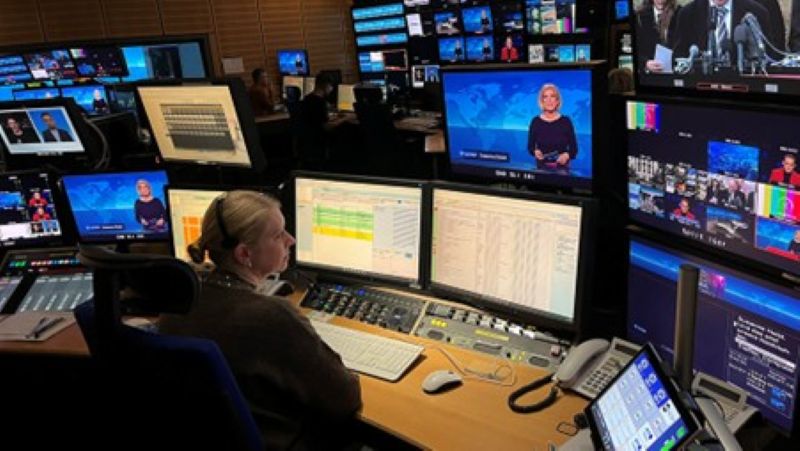
In Germany (pictured below) and Austria, public broadcasters now offer daily television news written in plain language, delivered more slowly and with simpler sentence structures. These programmes are integrated into mainstream news operations, not treated as marginal or optional.
In Norway, a non-profit channel called TV Bra employs reporters with learning disabilities and autism to produce a weekly news magazine show, covering everything from local stories to parliamentary politics. Representation and participation are central: people with learning disabilities are not just audiences, but journalists.
In the UK, the People First podcast in Yorkshire is also produced by people with learning disabilities who interview guests and shape the editorial direction themselves.
And in the United States, an investigative project by ProPublica paired in-depth reporting on disability services with accessible versions, public storytelling events, and community engagement. The initiative led to the creation of the Plain Truth Project, a platform to learn more about the media needs of people with a learning disability, to distil best practice in journalism, and to advocate for change.
These examples differ in format, tone, and ambition but together they demonstrate three things:
- Easier news is possible.
- It does not have to mean “dumbing down”.
- It can take many forms: accessibility, representation, participation, or a mix of all three.
As Sonja Wielow, who leads Germany’s plain-language Tagesschau, put it, “People value that we take them seriously. And they are interested in politics, they are interested in international affairs, they are interested in climate change and sport – and all the usual stuff.”
What people with learning disabilities actually want
To avoid designing solutions about people rather than with them, I convened five panel discussions with people with learning disabilities and autism, and asked them for feedback on clips from some of the existing easier-news formats introduced above.
The results resisted simplification.
Participants did not agree on a single preferred tone, format, or platform. Instead, they expressed nuanced, sometimes contradictory desires:
- News should be serious — but also friendly.
- They wanted both short bulletins and deeper explanations.
- They wanted factual reporting, but also practical information and guidance.
- They valued accessibility, but also representation and participation.
- They wanted dedicated spaces — but not segregation.
“It can be fun and friendly, but sometimes serious as well.” — Nancy
“It needs to have a balance, because at the end of the day you want it to be friendly, but you want it to match the world. You don’t want to turn it into a joke.” – Kumudu
Perhaps most importantly, participants emphasised that they wanted news not only to tell them what is happening, but to help them make sense of it and act on it.
This suggests that accessible journalism is not just about language, but about editorial intent.
What this means for journalism
Making news easier to understand is not a dilution of journalistic standards; it is an extension of them. It requires reporters to understand stories more deeply, explain them more clearly, and consider more carefully who their work is for.
This is not a technical problem alone. It is a cultural one.
Journalism has historically been shaped around assumptions of speed, prior knowledge, and cognitive fluency that exclude many people – not only those with learning disabilities, but also people with dementia, brain injuries, limited literacy, or who speak a different first language.
Designing journalism that more people can understand does not narrow its audience; it widens it.
Public service media in particular has both an obligation and an opportunity here. The BBC, for example, has a remit to serve all audiences, support learning, and enable democratic participation, yet people with learning disabilities remain effectively invisible within its news output. The full project PDF contains several ideas for how to remedy this.
The question, then, is not whether accessible journalism is needed, but whether mainstream journalism is willing to take responsibility for it.
This will require:
- Treating people with learning disabilities as a legitimate audience.
- Investing in formats and workflows that support accessibility.
- Involving people with lived experience in design and production.
- Accepting that journalism may need to look and sound different in order to be fairer.
None of this requires abandoning core journalistic values. It requires applying them more broadly. And the skills required – empathy, curiosity, clarity, judgement – are not new.
Go Easy Read kindly prepared a sample of what this article might look like if it were translated into an accessible format for learning disabled audiences. A true Easy Read format includes images (as shown below) to support understanding and seeks feedback from learning disabled audiences ahead of publication. You can download the full Easy Read PDF below.
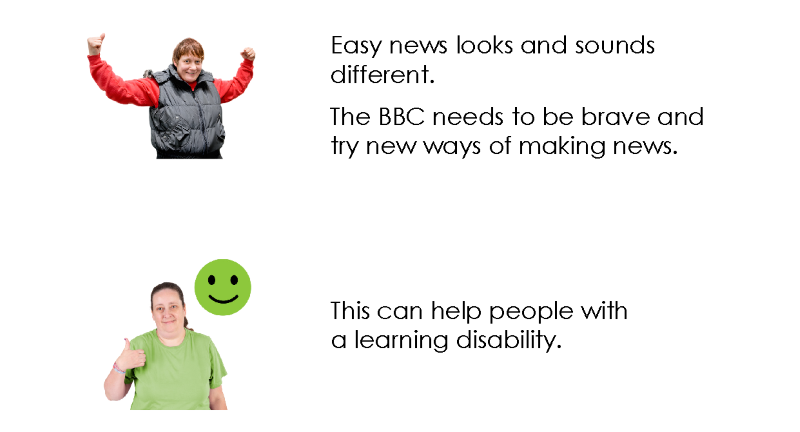
Here, we show how the text might read without illustrations:
About this report
My name is William Kremer. I am a BBC journalist.
A journalist is someone who makes the news.
I wanted to find out how people with a learning disability get news.
So I looked at reports from the BBC and universities.
And I asked people with learning disabilities about news.
This report tells you what I found out.
The problem with the news
Many people with a learning disability are interested in the news.
But they often find the news hard to understand.
They said:
- The news is too fast.
- Some words are hard to understand.
- The news does not explain things enough.
- The news can be scary or upsetting.
Lucy said: "I do like watching the news.I find it quite interesting, the whole of the world and the country, Donald Trump and the Prime Minister."
Harry said: "It was too quick to understand. Sometimes I wish the reporters could speak slowly, so there is time to understand what is happening."
Andrew said: "Some parts I did not understand what they were talking about. They used some words that I did not understand."
Mo said: "A lot of news seems like it is made to make people scared. It is not fair for some people. Especially for people with a learning disability."
Why this matters
The news is important because it gives people information that can help their lives.
For example:
- It helps people decide who to vote for in elections.
- It helps people work together to make things better.
- It stops people getting wrong ideas, like from social media. This is sometimes called fake news.
The BBC
The BBC makes TV, radio, and online news.
The BBC’s job is to make news for everyone.
In the UK, people with a learning disability help pay for the BBC.
But people with a learning disability cannot always understand BBC News. This is unfair.
Easier news around the world
In Germany and Austria
- In Germany and Austria, easier news is on TV on Monday to Friday.
- The easier news looks like normal news but it is slower and uses easy words.
- Disabled people in Austria get training to help make the news.
Thomas is a trainee. He said: “I just think it is very important and fair that we work here. We make the message more inclusive.”
In Norway
- A TV channel in Norway called TV Bra has reporters with learning disabilities or autism.
- Their reports look different and are more fun than normal news.
- They interview politicians and ask questions for their viewers.
A politician is someone who helps make important decisions for the country.
Emily is a reporter at TV Bra. She said: “I love being a reporter! I have to be very professional. I have to follow the script and not talk about personal stuff.”
In the UK
In the UK, people with learning disabilities make a podcast at People First.
Podcasts are recordings you can listen to online.
- People with learning disabilities choose what to talk about.
- They interview people.
- And they record the podcast themselves.
Luke works on the podcast. He said: “I love everything that we do, not just the podcast. And we always have new people to interview. It really makes us grow and grow.”
In the United States of America
Journalists worked with people with a learning disability to do an investigation.
An investigation is when journalists look closely at a problem to understand what happened.
The journalists had meetings with people with learning disabilities.
And they said what they found out in a way that was easy to understand.
What do these examples tell us?
We can make news easier for people with a learning disability.
These 3 things are all important:
- News should be easy to understand.
- News should show more people with a learning disability. It should be about things that are important to them.
- People with a learning disability should help make and present the news.
But it is hard to do all 3 things in the same programme.
So people with a learning disability might need more than one news programme.
Josh said: "Everyone should have their own way of reading the news and understanding the news."
What do people with a learning disability want?
Over 30 people with a learning disability answered questions for this report.
They had lots of things to say.
They did not agree about everything.
They said:
- They want news every day that they can understand.
- They want people with learning disabilities to present the news.
- News should be friendly but sometimes serious.
- News should do more than just say what is happening. It should give people useful information.
- They still love TV and radio but some people also like social media and podcasts.
Eliph said: "I would like to be able to understand and contribute to more conversations that are happening around me."
What should happen next?
The BBC should make news for people with a learning disability.
The best way to do this is to make:
1. easy news every day
2. a longer easy news TV show every week.
The weekly programme can give more information.
This can help people with a learning disability understand.
The weekly programme can also have sport and fun things.
This can make news feel less upsetting.
What can the BBC do?
The BBC could also
- make easy news stories online.
- ask people with learning disabilities what works well.
- work with a charity to train people with a learning disability.
- start a news club for people with a learning disability.
Easy news looks and sounds different. The BBC has to be brave and try new ways of making news.
This can help people with a learning disability.
But this does not mean the BBC must stop doing good reporting.
It means the BBC is doing good reporting for more people.
Harry said: "It’s very, very important that everyone can watch the news in a more accessible format."

More on:


