


News
Anatomy of a hate campaign: How a few powerful actors targeted an editor to frame journalism as a crime

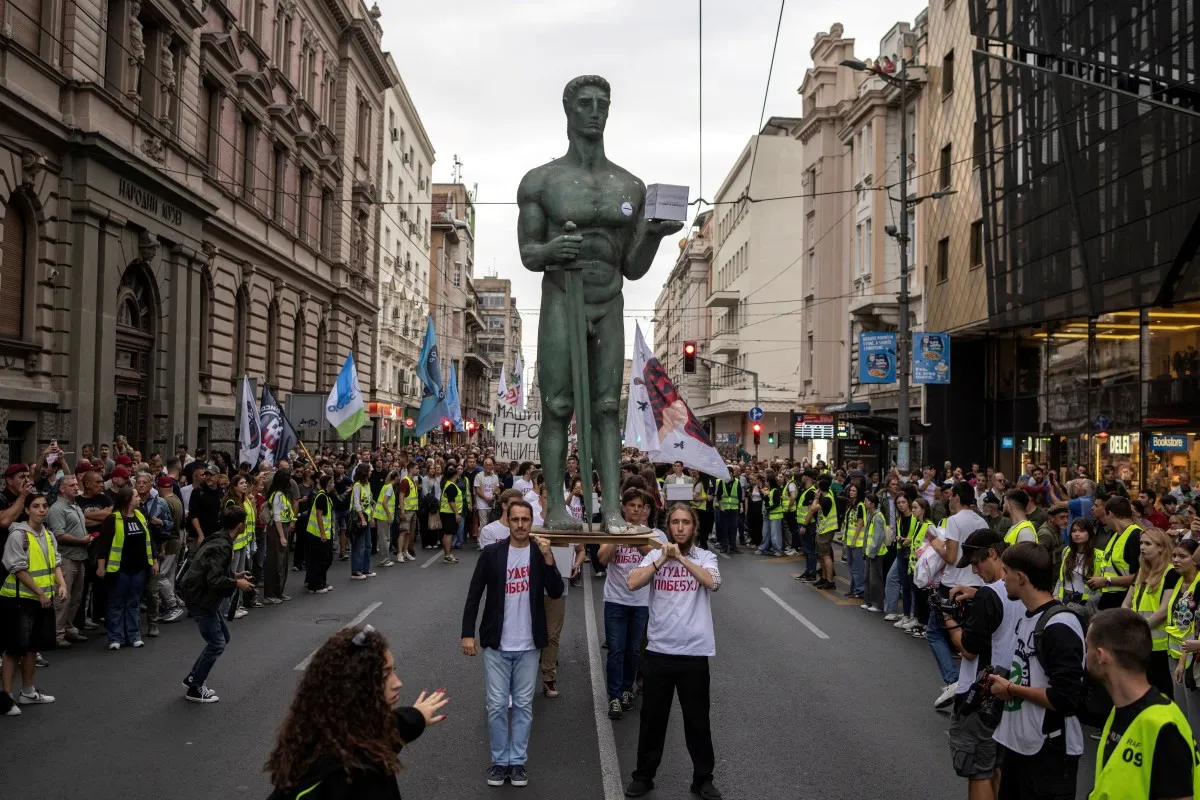
Students walk the streets carrying boxes bearing the certified signatures of their supporters, an initial step toward being included on the voting list, with the submission of the “Students Win” list to the Republic Election Commission in Belgrade, Serbia, September 14, 2026. REUTERS/Marko Djurica
On 1 November 2024 the canopy above the entrance to the main railway station in Serbia’s second-largest city collapsed. Sixteen people died, crushed under the weight of the concrete roof that fell on top of them. Protests broke out, first in the affected city of Novi Sad, then in the capital Belgrade and across the country.
The protesters blamed the government for negligence, corruption and a lack of transparency. Ministers resigned. After government supporters physically attacked student protesters, the prime minister Miloš Vučević also stepped down. The protests shaped a large student movement that is still active today.
In early September, President Aleksandar Vučić announced early parliamentary elections would be held on 25 October. Vučić, who has held power in Serbia over the last 12 years first as first prime minister and then as president, stepped down to run for prime minister again.
Over the past decade, Vučić and his Serbian Progressive Party (SNS) have eroded civil rights and democratic norms, according to external observers like Freedom House. This backsliding has also included press freedom. Under Vučić, Serbia has fallen 45 places in RSF’s World Press Freedom Index in the past decade, from 59th to 104th.
Journalists were already facing challenges before the Novi Sad collapse. But the tragedy marked the beginning of a relentless crackdown documented over the summer by a report by Media Freedom Rapid Response (MFRR). Ahead of the upcoming elections, I spoke to Serbian journalists and media observers to learn more about the threats facing the Serbian press and how it’s fighting back.
The Serbian digital public sphere is quite free, said Milica Šarić, director of the Center for Investigative Journalism of Serbia (CINS) and a former Reuters Institute journalist fellow. It’s easy to find many articles on crime and corruption by outlets like the one she leads. However, behind this appearance of freedom hide manifold pressures on journalists. These include everyday challenges such as high rents and the cost of living as well as fear of retaliation for their work.
Funding for organisations such as CINS can be a struggle. The outlet is funded by grants and individual donations and, like many similar organisations, was impacted by the USAID withdrawal in 2025.
Other donors are now rethinking where to put their money, Šarić explained. At a time of worldwide conflict, some of the international funds that used to go to journalism or civil society are being cut or redirected to other countries or purposes.
When it comes to investigations, Šarić and her team have struggled to access public information and are consistently denied interviews with representatives of state agencies, she said, an issue also mentioned by RSF in its yearly World Press Freedom Index.
“The atmosphere here in Serbia more and more resembles the time when [Slavko] Ćuruvija was killed,” said Ivana Stevanović, executive director of the Slavko Ćuruvija Foundation. Her organisation is named after a Serbian journalist who was murdered in 1999 and was founded by his children to support Serbian local and investigative journalism.
Before his murder, Ćuruvija was in legal trouble due to a controversial law which empowered authorities to prescribe crippling fines for journalists under broad and loosely defined anti-defamation rules. The information minister at the time was a young Aleksandar Vučić, who more recently said he had been wrong to introduce the fines.
Today government officials often target the media in public comments, Stevanović told me. After noticing a pattern, her foundation began to count the number of “verbal attacks” by 60 top officials against journalists, tallying up instances of “pressure, labelling, discrediting, disparagement, dehumanisation or criminalisation” and listing the worst offenders. Vučić was the politician with the most verbal attacks in August, with other high-ranking government officials also at the top of the list.
The European Commission’s 2025 report on Serbia, a candidate for EU membership, requested high-level officials to stop verbally attacking journalists, a practice the report says has “a chilling effect on the freedom of expression.”
It’s not just politicians themselves smearing critical voices, Stevanović said, but also pro-government tabloid newspapers and TV stations.
State ownership and political influence over the media limit the reach of independent voices. As Snjezana Milivojevic, the author of the Digital News Report Serbia page notes, all national commercial TV channels are owned by Serbian companies with ties to political elites.
These pro-government news organisations often label independent journalists as “enemies of the state” or “traitors”, and this narrative spills over to individuals, some of whom threaten journalists in social media posts, phone calls and letters to newsrooms, Stevanović said.
Unprecedented numbers of journalists were physically attacked while covering the protests that evolved from the Novi Sad tragedy. Sometimes, their assaults were ignored by the police officers present, such as in a 2024 case involving two cameramen documented by the SafeJournalists network and the Independent Journalists’ Association of Serbia.
Online violence rarely remains online. Journalists have increasingly been at the receiving end of attacks while reporting, often by unidentified men, sometimes even by the police. This violence escalated during local elections on March 29, when several journalists were obstructed in their reporting, had individuals try to seize or break their devices, and were physically assaulted. Two reporters were seriously injured near the city of Bor, one of the localities heading to the polls. Lazar Dinić and Ivan Bjelić, both journalists for Revolt, a new publication focused on covering corruption and protests, suffered head injuries at the hands of unknown individuals.
During periods of tension such as elections or protests, attacks on journalists tend to increase, said Fiona O’Brien, regional director for Europe and Central Asia at the Committee to Protect Journalists (CPJ). In these situations, “information becomes more valuable and the information space becomes more contested,” she explained. The Novi Sad canopy collapse stands out as a significant moment.
“The trajectory of the decline [of press freedom] steepened from that moment onwards. So it is a milestone, but it's not like things weren't already getting worse,” O’Brien said.
Despite the increase in physical violence against journalists, very few perpetrators have been held to account, with only three convictions for physical assault obtained out of 140 cases concerning journalists and media workers in 2025, according to the MFRR report.
“Impunity paves the way for more attacks,” O’Brien told me.
Spyware is another concern. Two journalists from the Balkan Investigative Reporting Network (BIRN) were targeted with Pegasus spyware last year, according to Amnesty International. Fourteen more members of civil society, including student protesters, were also targeted this year, at least one of them with Pegasus, according to the Citizen Lab.
Ana Brnabić, President of the National Assembly and acting President of Serbia since Vučić's resignation, said the state had no knowledge of students being spied on, and questioned the students’ account. Pegasus manufacturer NSO Group claims it sells the spyware only to governments for the purposes of tracking criminals and terrorists.
“The whole atmosphere is completely hostile. Political power in Serbia has declared war against independent journalism,” said Stevanović from the Slavko Ćuruvija Foundation.
Šarić from the Center for Investigative Journalism of Serbia told me the situation is unprecedented: “This year I'm seeing something I haven't seen before, and that's a complete burnout in our journalists, our editors and people running media organisations.” Several independent media organisations are struggling to keep their staff, she said. Some of her own colleagues are leaving.
“In the media community we are very worried that we are on the brink of something bigger, a journalist killed or seriously injured,” Stevanović said.
Six Serbian journalists are currently in exile for reasons connected to their work. Four of them left the country this year. At the end of June, freelance journalist and military analyst Aleksandar Radić left Serbia. He was one of the first to report on the possibility that a sonic weapon was used against anti-government protesters in 2025. He had since come under investigation and surveillance, according to RSF.
Dinko Gruhonjić is the programme director of the Independent Journalists’ Association of Vojvodina and associate professor of journalism at the University of Novi Sad. In March 2024, an edited video of him went viral. The video, which featured footage from his appearance at a 2023 human rights festival in Croatia, gave the misleading impression that he expressed satisfaction at sharing a name with Dinko Šakić, a Croatian World War II war criminal.
Gruhonjić strongly denies this was what he was saying. AFP fact-checkers have found that the clips were taken out of context, and that the full video showed him making a joke about the name-calling of which he was already a target. Gruhonjić made a similar joke in a TV programme aired in early 2024, and said nobody paid attention to it then.
As someone who identifies as an anti-fascist and as a critic of Serbian nationalism, Gruhonjić has faced threats for years. In his writing, he has often argued for Serbia to take responsibility for war crimes committed in its name. The purpose of the video, he said, was “to completely ruin my professional integrity.”
Since then, Gruhonjić has been the subject of government-aligned TV broadcasts, been publicly condemned by politicians, and been accused by pro-government tabloids of “secretly directing” the student protests that followed the Novi Sad collapse. In April, Minister of Culture Nikola Selaković said in Parliament that Gruhonjić was “created to attract someone to do something bad to [him].”
Threats of violence mean Gruhonjić and his family no longer feel safe in their own city. “When you are on the street, you need to be careful because you never know who is approaching. You need to look over your shoulder,” he said.
Gruhonjić compared his situation to being in prison and in a COVID-19 lockdown. “If you want to go out,” he told me, “you need to plan where, how, with whom. And if you go out in the evenings, you need to go with your male friends.”
His family has also been on the receiving end of threats. In June, Gruhonjić’s son’s car was severely damaged in an act of vandalism.
Gruhonjić has been a professional journalist for almost 30 years, he said. As well as his work at the university and the journalists’ association, he’s the chief correspondent for the northern province of Vojvodina at a regional news agency and the editor-in-chief of the Novi Sad-based investigative portal VOICE.
Gruhonjić believes he’s being targeted because of his involvement in journalism, university education and NGOs, while also not having the backing of a political party or a social movement that could protect him.
Legal harassment has become the norm for many investigative outlets. One of them is Serbia’s Crime and Corruption Reporting Network (KRIK), a non-profit founded in 2015.
“Since day one, we've been facing various types of pressures. But as of five years ago, the most urgent and the most damaging one came from SLAPP cases,” said Bojan Elek, a project manager at KRIK.
SLAPP is an acronym for Strategic Lawsuit Against Public Participation and refers to legal action, often against a journalist or a media company, with the aim to intimidate or prevent them from engaging in reporting in the public interest. SLAPPs are often defamation lawsuits but may take other forms. In Serbia, for example, insults are a criminal offence.
“We were starting to receive lawsuits for basically every investigative story that we published,” Elek told me.
KRIK is currently fighting 13 active cases it identifies as SLAPPs, according to Elek and the MFRR report.
These ongoing procedures are demoralising and time-consuming. “We waste most of our time just showing up in courts,” Elek said. There is also considerable financial risk for KRIK, which is funded entirely from donations and grants. The organisation doesn’t have a budget to pay potential fines.
These circumstances led KRIK to publicly defend its work. The outlet first joined Reporters Shield, a membership organisation developed by journalists at OCCRP, an investigative reporting network, that provides legal support and a mutual defence pot to fund legal costs for members fighting litigation.
KRIK then went a step further, joining forces with other outlets often targeted by SLAPPs to attend each other’s court dates. They first teamed up with BIRN Serbia and the Slavko Ćuruvija Foundation.
“The first idea was simply to show solidarity,” Elek said, by being in the room with colleagues who were being sued. “Then, because there were a bunch of journalists in the courtroom, we started reporting from these courtrooms as well.”
Their articles started being picked up by other independent media, and they realised they had an opportunity to broaden their network, Elek told me. This initiative came to be known as Network 33 after the combined number of active SLAPPs the founding organisations were facing at the time they began meeting in the summer of 2024. Towards the end of 2025, the team received a generous three-year EU grant, which they are using to scale up their efforts.
Network 33’s approach of solidarity and publicity seems to be working. KRIK hasn’t been sued yet this year, Elek said.
Reporting on these cases helps safeguard journalists’ reputations and dispel the widespread assumption that if people are called into court, they must have done something wrong, he explained. “There are other ways to counter SLAPPs such as legal aid or policy advocacy. But we thought, let's do journalistic work to help other journalists,” Elek said.
Since the media freedom mission to Belgrade that informed MFRR’s report, the situation for press freedom has not improved, said O’Brien from CPJ, who fears it might get worse in the run-up to this year’s parliamentary elections.
“The real fear is that this is going to escalate significantly and we are going to see real pressure and physical violence against journalists,” O’Brien said.
While Serbian authorities responded to some of the alerts included in the report, O’Brien said she wouldn’t describe them as constructive or genuinely engaging with the issues raised in the report.
One alert concerned “discrediting and threatening remarks” made by politicians in the National Assembly, including the minister of culture’s words about Gruhonjić being “created to attract someone to do something bad to [him].” The official reply was brief and technical, stating that denigration and defamation are not crimes in Serbia, with the latter being a possibility for civil litigation, and that a case concerning insult needs to be brought by the alleged victim. For other alerts, the reply just stated that cases had been opened. Some had been dismissed; for others, fact-finding and investigation are ongoing.
The Serbian government, Vučić’s Serbian Progressive Party and the Ministry of Culture were approached for comment for this article. No response was received ahead of publication. The article will be updated if they respond.
O’Brien stressed the European Union has leverage to improve the situation for Serbian journalists as Serbia is a candidate to join the bloc.
“We can't entertain the idea of an EU member state in which the sorts of things that are happening to journalists in Serbia happen every day,” she said.
For Gruhonjić, “the most important support” came from his fellow journalists. He was also helped by human rights and press freedom organisations, and stressed the importance of psychological support. “The lack of effective institutional protection in Serbia makes this international solidarity particularly important,” he said.
When speaking to his journalism students, Gruhonjić stresses the importance of digital security, source protection, and legal and ethical issues. “Professional standards are not simply technical skills,” he said. “In environments like Serbia, they become a form of democratic resistance.”
Asked about the potential tension between maintaining standards of impartiality and defending yourself from political attacks, Gruhonjić draws a distinction between news reporting and opinion writing. For news, you have to be as objective as you can, he said. When writing a column, “we as journalists have the whole right to express ourselves and what we think about topics in society,” he said.
For Šarić, maintaining a strict standard of impartiality is difficult but essential. She identifies as an “old-school” journalist who believes professional journalism should be as impartial as possible.
A perceived lack of passion in her outlet’s reporting has even led some other independent journalists to wrongly assume it works for the government, she said.
“It's so hard not to take sides.The entire nation is either for the government or against the government, and nothing else matters,” Šarić told me. “But neither my news organisation nor I can take that path. That’s a thin line and if you cross it, you can never go back.”
In every email we send you'll find original reporting, evidence-based insights, online seminars and readings curated from 100s of sources - all in 5 minutes.