


News
Trust Conference 2026: Seven learnings (and a final warning) about the threats to journalism from AI to strongmen

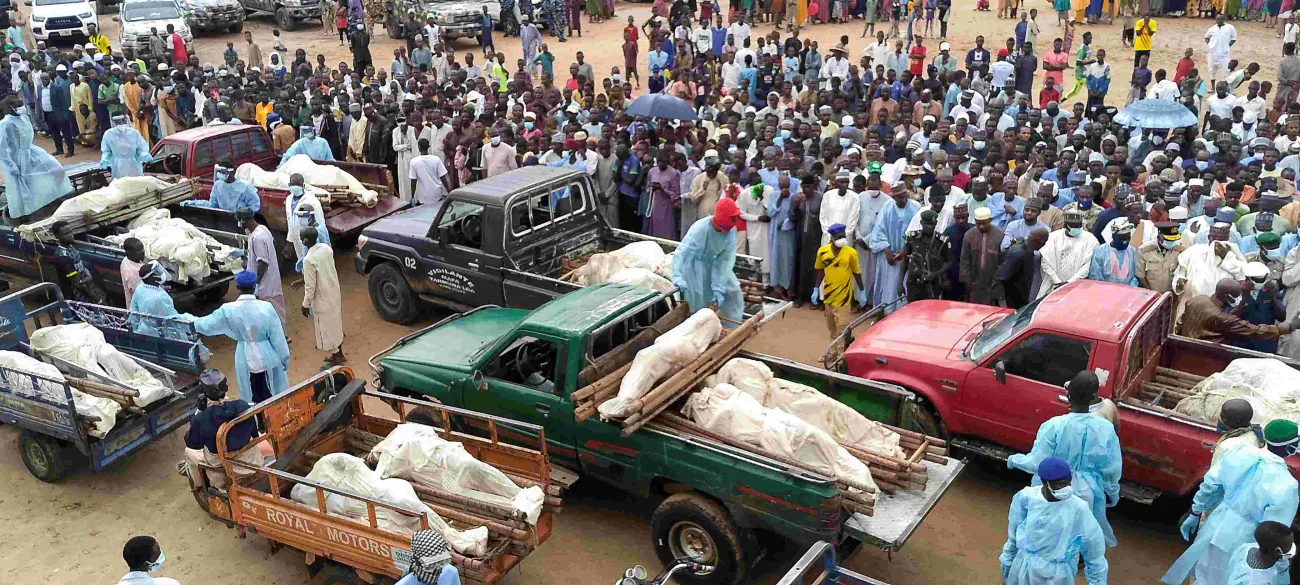
Trucks carry the wrapped bodies of people killed by suspected Boko Haram militants, during their funeral in Yobe, Nigeria September 3, 2024. REUTERS/Stringer
When Dorcas Wangira, then a BBC Africa health correspondent, travelled to Kenya’s coast in April 2023, investigators were uncovering what would become one of the country’s deadliest religious tragedies. What she remembers most about the first time she entered Shakahola Forest, near the coastal town of Malindi, is the smell of decomposing bodies.
Investigators were digging up shallow graves containing the remains of followers of Paul Mackenzie Nthenge, a self-proclaimed pastor accused of instructing them to starve themselves to death in the belief that it would take them to heaven. Police had also rescued survivors from the forest, and the full scale of the tragedy was still unclear. “The stench of the bodies, I will never forget that smell,” Wangira recalled. “It was unbearable.”
She had covered disease outbreaks and the Covid-19 pandemic. She initially expected to spend a few days reporting on a story that appeared, despite its tragedy, relatively contained. But as more bodies were discovered, the scale of the investigation grew. The death toll would eventually reach 429.
Investigators and volunteers moved through the forest, digging up shallow graves one after another. “I remember taking pictures of some of those graves,” she said. “Some were small graves for children. I think that was what really cracked me.” At first glance, this appeared to be a story about religion. Mackenzie presented himself as a pastor. His followers believed starvation would prepare them to meet Jesus. Churches, scripture and faith dominated the public conversation.
As Wangira continued reporting, she came to see that the story was also about crime, money and institutional failure. Followers had sold their possessions before entering the forest, and investigators were examining allegations of financial exploitation alongside the deaths. Postmortems later showed that not everyone had died of starvation. Some victims had been strangled or suffocated. The investigation also raised questions about why authorities had failed to act despite repeated warnings about Mackenzie’s activities.
As a Christian, Wangira was reporting on a religion she knew well. The assignment forced her to separate the beliefs she grew up with from the actions of a man who claimed to preach the same faith. That discipline became especially important as she listened to Mackenzie’s sermons while reporting the story.
“This Mackenzie character is very charismatic,” she said. “If you’re not careful, you actually start to believe what he says.”
Wangira’s challenge was not only to look past religion, but to avoid flattening it. Reporting for an international audience, she was conscious of the risk that coverage of the tragedy could reinforce stereotypes about Africans as gullible or easily manipulated by religious leaders.
That concern extended to language. Coverage, she said, had to resist collapsing an entire faith into one preacher’s actions.
Ari Goldman, a former religion reporter for the New York Times who taught religion reporting at Columbia University for more than three decades, makes a similar distinction. The actions of one religious group, he argued, should never be taken to represent an entire faith. “If you’re writing about something the Vatican is doing,” he said, “you don’t blame all Catholics. You blame the Vatican.”
Wangira was not the only reporter looking beyond religion to uncover a larger story. To understand the challenges of covering religion in Africa, I spoke to journalists in Kenya, Nigeria, Burundi and Malawi who have investigated religious extremism, violence and cult-like movements. Their experiences reveal the difficulties of reporting on deeply held beliefs while navigating personal faith, community sensitivities and the risk of reinforcing stereotypes.
In northern Nigeria, Munyal Manunyi began investigating mob killings of people accused of blasphemy after noticing how often the attacks made news, and how rarely they were examined in depth. Her reporting took her to the families of Deborah Samuel, a Christian student lynched over accusations she insulted the Prophet Muhammad, and Gideon Akaluka, a trader killed more than two decades earlier. Decades apart, the cases revealed the same pattern, families still waiting for justice and no one held accountable.
“What drew my attention,” she said, “is the need to dig up facts. A lot of lives have been lost and so many cases kept coming up, yet no solution has been rendered.” As a Christian, the investigation also challenged some of her own assumptions.
She had never entered a mosque before. “I felt I was stepping on hot coals,” she said. Instead, she found herself welcomed by an imam who answered her questions about Islamic teaching and the place of blasphemy in the religion. “I had to put aside my belief and report objectively. The aim was to dig for truth,” she said.
To navigate the tension between personal belief and objectivity, Goldman developed an approach he calls “empathetic objectivity.” It begins with learning the symbols of a faith, its rituals, language, clothing and forms of prayer. The next step is “crossing the threshold,” entering a church, mosque, synagogue or temple to observe and, where appropriate, participate.
“You understand church in a different way when you’re in church,” he said. “My job as a reporter is to be there and not just to stand on the outside.” The final step is what Goldman calls “bracketing.” Reporters immerse themselves in another person’s world, but mentally place brackets around their own identity. “I’m here, I’m singing, I’m participating, I’m in their shoes,” he said. “But I’m still who I am. I’m still the observer.” Bracketing, he said, keeps him from “going overboard.” It allows him to be empathetic without surrendering his independence.
Manunyi described a similar effort to separate her personal faith from her reporting. “I just had to report it the way it was without siding with my own religion or the other way round,” she said.
Those conversations reshaped how she understood the killings. Islamic scholars argued the attacks had little to do with mainstream teaching, describing many perpetrators as young men with little knowledge of the Quran who were easily mobilised by political actors.
Reporting the story also showed how hard it was to get people to speak publicly about religion. A Senior Advocate of Nigeria, the highest professional rank awarded to distinguished lawyers in the country, whom Manunyi approached declined to speak, citing the issue’s sensitivity. “If a lawyer could be scared to speak,” she said, “what more of me?”
Like Wangira, Yakubu Mohammed, an investigative reporter with Nigerian online newspaper Premium Times, found himself reporting on a faith he knew personally. He has spent much of the past decade covering Boko Haram, the Islamic State West Africa Province, banditry and communal violence. Yet he resists describing himself as a religion reporter.
“I will not say I’m covering religion,” he said. “I’m covering jihadism, security, banditry and every other thing that intersects with security.”
In October this year, Mohammed reported on the killing of Sheikh Yahaya Masusuka, an Islamic cleric in northern Nigeria known for advocating peaceful coexistence among people of different faiths. The extremist group Ansaru claimed responsibility, accusing the cleric of undermining Islam. Mohammed’s reporting examined the group’s claims alongside police findings and analysis from a security researcher, who warned that extremist groups could target religious figures who challenged their ideology.
The distinction matters because, in his experience, religion alone rarely explains the violence. Reporting on an attack means speaking to soldiers, officials, displaced families and religious leaders, none of whom offer the whole story. Years of reporting convinced him that many recruits join extremist groups with only a limited grasp of the religious ideas the groups claim to defend.
“Many people lack knowledge of the religion, so they easily fall for this kind of religious blackmail,” he said.
That leaves him navigating two risks. Ignore what extremist groups say about themselves, and the reporting has gaps. Repeat it uncritically, and it becomes a vehicle for them. Mohammed tries to report what the groups claim while asking Islamic scholars where those claims depart from mainstream teaching, providing readers with context rather than settling theological debates.
“The first thing you should do is check your bias whenever you are writing,” he said. “I’m a Muslim, but I’m a Sufi Muslim. If tomorrow there is an insurgency led by a Sufi man, how will I report it?” When a story comes too close to his own community, he said, he hands it to another reporter.
Every religion reporter, Goldman said, confronts the same reality. No one arrives at a story without beliefs, assumptions or cultural baggage. “We value objectivity,” he said. “As flawed as it is, I think it’s a goal worth pursuing.” Complete objectivity, he added, is impossible. “We all have our own perspective on the world. We have our own baggage and our own set of values.”
That caution extends to language. For years, he said, attacks in Nigeria were routinely described in headlines as the work of “Fulani terrorists,” a framing that collapsed an entire ethnic and pastoral community into the acts of a violent few.
“Every Fulani today is perceived to be a terrorist,” he said.
The same care shapes how he reports attacks on places of worship. If the identities of those killed have not been confirmed, he avoids describing them as Muslim or Christian simply because they were attacked in a mosque or church.
Looking back, Mohammed said he has become increasingly aware of how easily journalists reinforce assumptions they never intended to make.
“Before we are journalists, we are human,” he said. “In the early days of my career, I also made some of these mistakes.”
Mohammed’s reflections resonated with Armel Gilbert Bukeyeneza, who as a reporter with online newspaper Iwacu, in Burundi, spent over four years investigating the Zebiya movement, led by a self-declared prophetess whose followers claimed she performed miracles. What began as coverage of a local religious movement in his home region grew into a broader investigation of the intersection of religion and politics, later published in his book La Bible et la gâchette (The Bible and the trigger).
Like the other journalists, Bukeyeneza, a Christian, was not reporting from outside the story. “I’m a believer,” he said. “But I’m also a journalist.” He tried to follow a simple principle: “You listen, you don’t judge.” Rather than asking whether the prophetess’s claims were true, he became more interested in why so many people believed them. Education, he realised, offered no simple protection against manipulation.
As the movement grew, it became more than religion. Politicians aligned with competing sides, and relations with the authorities deteriorated. In 2013, police clashed with followers, killing several.
“There was a lot of power play, religiously and politically,” Bukeyeneza said. The prophetess fled into exile, and Bukeyeneza’s reporting followed the same path. After fleeing Burundi’s 2015 political crisis, he continued reporting on the movement from exile, including another deadly clash in eastern Congo in 2017.
Years of fair reporting eventually earned Bukeyeneza access to the prophetess, one of the hardest people in the story to reach. When he went to Congo, her followers recognised him from his earlier reporting. Because they had never found it inaccurate or unfair, he said, they did not treat him with suspicion. Instead, they agreed to pass along his request for an interview. His goal, he said, had never been to discredit the movement, but to understand it. Weeks later, while living in Uganda, Bukeyeneza received a phone call. The prophetess had agreed to an interview, but he needed to call immediately. Anticipating it might be his only chance, he had already prepared about 20 questions.
“The story was there, waiting for her to respond,” he said.
He had expected an obscure religious figure. Instead, despite never finishing high school, she answered his questions “like a politician that has been in politics for many years.” The story, he said, had never only been about faith. It was also about leadership and power. Reporting on the movement also reshaped how he thought about covering religion.
“I don’t think it’s to question people’s belief,” he said. “Everyone believes in something, or nothing. It’s not our role to question that. But there are things affecting society, facts, and those are what you have to question.”
Goldman makes a similar distinction. Religion reporters should describe not only what they see, but what believers understand themselves to be experiencing. He illustrates the point with communion in a Catholic church. A journalist could accurately report that worshippers ate bread and drank wine, but that description alone misses the meaning of the ritual for Catholics.
“I would say I went to church and I saw people taking what they believe to be the body of their Lord,” Goldman said. “I don’t have to say something that I don’t believe is true, but it is true that they follow this, and it has that meaning for them.”
For Goldman, the danger is assuming that an outwardly familiar religious practice carries the same meaning across faith traditions. A journalist may mistake a Buddhist ritual for prayer simply because it resembles Christian worship.
“They may be facing the Buddha, they may be on their knees, but they’re not praying,” Goldman said. The lesson, he said, is that outwardly similar acts can carry profoundly different meanings. “The biggest mistake is assuming you know when you don’t know,” he said.
Looking back, Bukeyeneza said the investigation taught him less about one prophetess than about the place religion occupies in Burundian society. “Religion is so powerful in our societies,” he said. “It can even extinguish our ability to think, our ability to question.”
If faith complicated reporting for the other journalists, secrecy complicated it for Kandani Ngwira. The Malawian investigative journalist spent nearly a year reporting on what insiders called the Teachers Group (TG), a secretive organisation that operated through international aid charities. A cross-border investigation with the Center for Investigative Reporting examined allegations that the group had received millions in foreign aid while demanding absolute loyalty and financial sacrifice from members.
Ngwira described a tightly controlled organisation where members surrendered what he called “common economy, common time and common distribution,” giving up their money, labour and much of their personal lives.
“They brainwash you to abandon your family and embrace the group as your family,” he said. “The group is a cult because one of its pillars is secrecy.”
Unlike the other reporters, Ngwira was not struggling to understand belief. He was struggling to reach people taught not to speak.
“It was not possible to penetrate [the group],” he said. “No one was willing to give information. This is how they thrived all these years.”
The investigation depended on persuading former members and junior employees to talk, often after months of building trust. “Sometimes it is not the CEO or high-ranking officers who can give you a breakthrough,” he said. “Sometimes it is the low-ranking people.” But he couldn’t stop there.
“We heard very compelling narratives, but there were no documents to back some of the allegations.” Those claims were left out until evidence could substantiate them. After publication, the organisation launched what Ngwira described as a SLAPP suit intended to intimidate the newsroom and its sources. The group ultimately lost its appeal.
Although the stories unfolded in different countries and faith traditions, the journalists I spoke to arrived at the same conclusion. Reporting on religion demands more than scepticism. It demands understanding.
Bukeyeneza compared covering religion without specialised training to asking a reporter to cover science without understanding it.
He argued that covering religion in Africa requires sustained training rather than occasional workshops, and that African journalists should lead much of that work because of their understanding of the continent’s religious histories, languages and communities.
Goldman shared his concern about the lack of specialised religion reporting. “A big [US] news organisation may have ten people covering the White House and twenty covering sports and no one covering religion,” he said. “It’s a very important story, and it’s neglected.”
Part of the problem, Goldman argued, is that journalists are conditioned to seek certainty. Religion does not always lend itself to that. “There are some unknowns, and there are mysteries,” he said. Journalists are often uncomfortable with that, and the result is coverage that misunderstands religion more than it explains it. His prescription was straightforward: “Hire smarter reporters who know about the subject, and don’t dismiss it as superstition.”
Mohammed also linked training and the quality of reporting on religious violence. Journalists who do not understand the dynamics of conflict, he said, risk reinforcing the very divisions they are trying to explain.
The Shakahola Forest tragedy convinced Wangira that religion deserved to be treated as a specialist beat rather than an assignment any general reporter could pick up.
“I’ve seen some newsrooms train journalists on reporting religion and even extremism,” she said. “An extra layer of training for this particular kind of reporting is very helpful. Otherwise you just get carried away without really understanding what you’re doing.”
Looking back, Wangira no longer thinks of Shakahola primarily as a religious story. “It was a criminal story first of all,” she said.
“Religion was just a part of it,” she said. “It was not the entire story.”
In every email we send you'll find original reporting, evidence-based insights, online seminars and readings curated from 100s of sources - all in 5 minutes.
