


News
Five takeaways from the Future of Media Technology Conference: How publishers are rethinking audience engagement

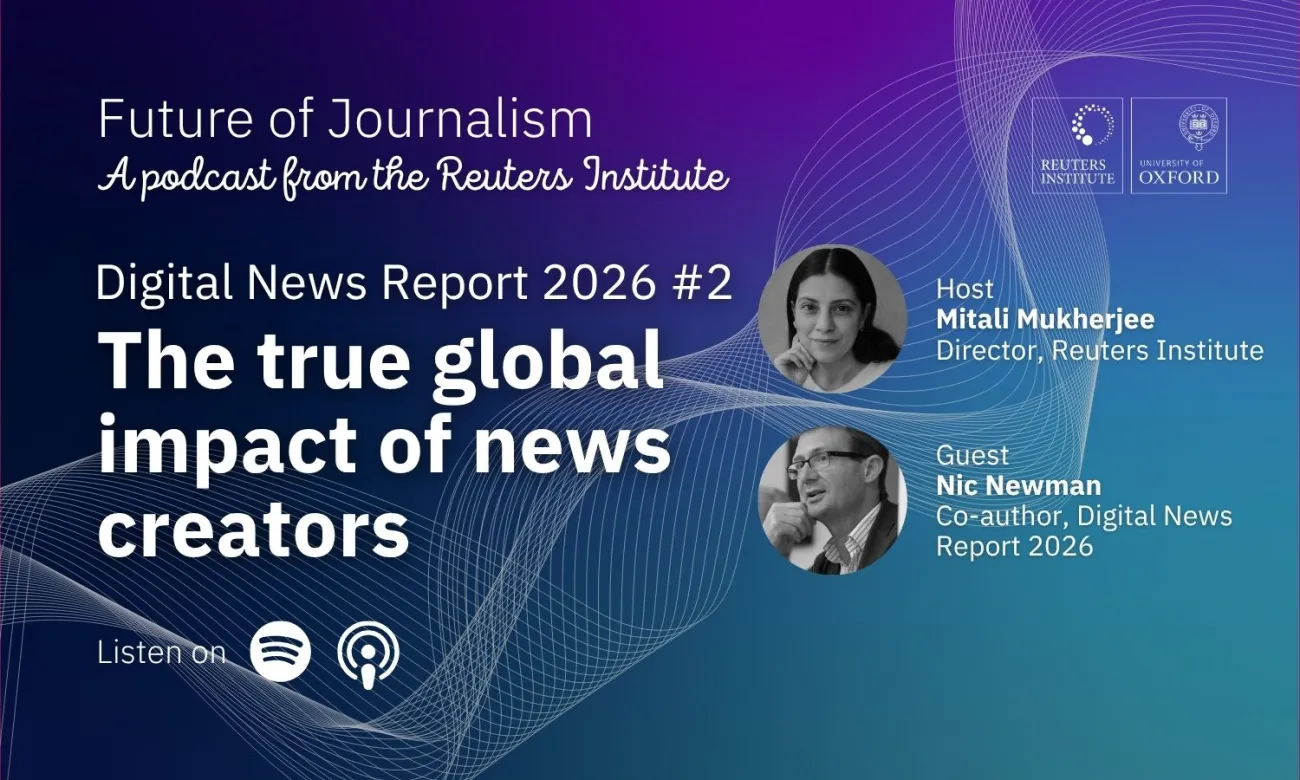
In this episode of Future of Journalism, we draw on findings from the Digital News Report 2026 to explore the role of news influencers and creators across the world. We’ll look at how usage rates differ across the world, what their audiences find most engaging and how different national contexts and news ecosystems are driving their growth.
Nic Newman is a Senior Research Associate at the Reuters Institute. He is also a consultant on digital media, working actively with news companies on product, audience, and business strategies for digital transition. He is the co-author of the Digital News Report 2026 and authored a special chapter of the Digital News Report 2026 on the impact and role of news creators.
Our host Mitali Mukherjee is the Director of the Reuters Institute. She's a political economy journalist with more than two decades of experience in TV, print and digital journalism.
What is a news creator? | Who follows news creators? | The appeal of news creators | Creator ecosystems | What mainstream media can learn from creators
Mitali: Nic, there are so many different names and definitions, but we're sticking with news creators. So let's start with what distinguishes a news creator from other journalists, because we've tried to unpack this in the past and we're still holding with the same categorization in terms of definition.
Nic: Right, in the report and also in the survey, we define news creators as individuals or groups of individuals that create and distribute content primarily via social and video networks, but also other online platforms like Substack, for example, and have some impact on public debates. I think the other aspect is news creators are also independent from institutions. They really prize that independence. So they're not part of an organisation, for example, that might have some kind of hidden motive. What you see is what you get. And I think in terms of what distinguishes them from journalists, there's obviously a bit of an overlap, right? A lot of the best known creators, the most mentioned ones are former journalists, people like Piers Morgan, Megyn Kelly, Tucker Carlson, for example, in the United States. But then there are also a lot of hybrid figures we find from traditional media who are actually freelancers. They run their own podcasts and newsletters, but they also work for traditional media people like Owen Jones, for example, in the UK, who's also a columnist for The Guardian. And then finally, there are younger creators who behave like journalists in many ways. They do explanatory journalism, many of them, but they haven't had any formal training. And in fact, they prefer to be known as creators, even though they're doing journalistic things. So I think we can say it's quite a muddy and murky dividing line.
Mitali: Let's go top down with some of those categories and findings as well, Nic. And we scratched at this topic last year, but we've gone into it in a much deeper fashion this time. And the first question that would come to mind is what proportion of people across these markets that we are serving are actually saying that they are consuming news from news creators?
Nic: Right. This is the first time we've directly addressed this with survey respondents, and the answer is about a quarter. So, on average, 27% say they've consumed at least some news from a news-focused creator in the last week. Even more actually have consumed news from an influencer who may occasionally talk about news, such as lifestyle influencers. But we're mainly here focused on these news creators. But those numbers vary significantly across countries. So it's about 10% in countries like Netherlands, Denmark, but rising to about 50% in Thailand, Peru, Morocco, and even more in parts of Africa. In India, for example, though, we need to remember that the sample in those countries is a bit more urban, a bit more educated, so not necessarily fully representative of the wider population. But in general, I think we can say that people are less likely to access some of these creators in northern European countries where there are still strong connections with traditional news brands. Conversely, people are more likely to use creators in some countries in Asia, such as Indonesia and India, Latin America, Africa, and also in the United States, where in most of these countries, use of social media is higher and brands also have much weaker connections and weaker trust.
Mitali: So in some ways, we're seeing similar trends that almost go hand in hand with kind of social media usage, as you said, in some of these Asian and African markets. Also dependence on or turning to news creators. You mentioned the numbers and that they vary between regions, but on the question of whether or not people rely solely on creators for news, what did we find?
Nic: Yeah. So I think this is one of the most interesting points. So we found lots of people using creators, but the vast majority of those are also using traditional media and other sources. So actually there's a relatively small number that say they only get news from creators, about 3% across the 48 countries, and only around one-in-ten say that they get most of their news from creators, and they're also using other sources. So the key point here, and we've said this before, is that most creator content is complementary to traditional media, or it's building on traditional media content rather than replacing it. So if you take opinion-based creators, for example, they're mainly commenting on news that has been gathered by mainstream media. Younger creators that we talked about are mainly remixing or explaining the news. Again, that's, that's generally come from other sources and Substacks that are going into great depth are also building on news that has been created and gathered by traditional media.
Mitali: And I think it's really important point for people listening as well, because some of the anxiety amongst news industry colleagues has been around the fact that they're eating into, you know, an existing market. But as you say, our findings seem to point out that this is complementary rather than competitive in many markets. The differentiator, I suppose, is something you touched upon a little bit at the start of this conversation, which was what is so appealing about creators for people who listen in to them or watch them on some of these third party platforms. In the past, we've talked about words like authenticity. But what else did we find?
Nic: Yeah. Again, this is the first time we've directly asked about it. And we asked our respondents to compare news creators and traditional media against some of these characteristics, like authenticity, for example. And what we find in general is that people think that creators are more entertaining, they are easier to understand, more accessible, more relatable than traditional media, but less trustworthy and less impartial. But if you ask people who actually use creators and, remember, that's about a quarter on average across our countries, creators score more highly on all of these attributes than mainstream media, including trust, including impartiality. So for people who use creators, they trust them more than journalists. And I think that goes back to the point I was making about personal accountability and independence. So people see what they see. They see what they get. There's no hidden motives or agendas. And I think that's why we're seeing such surprising results around trust. The impartiality bit is slightly odd, because clearly many creators have a very particular point of view and don't adhere to traditional notions, journalistic notions of impartiality. But in fact, they are often really open and honest about their biases. And I think that's something that's really appreciated by the audiences and helps explain that one.
Mitali: Could you share a little bit quickly about the age slice as well on this? Nic? Because that's important in terms of which age groups news creators seem to be working better for.
Nic: Clearly, younger people, because younger people are exposed to more creator content through social media. But I think also there's something around that point of view and identification with the individual, which really resonates with younger people. And we've seen that in a lot of the other research that we do.
Mitali: One of the other things that you've done in this year's chapter is try to build a catalogue, which we've done in the past around, you know, op-eds or more specialisation or more news-adjacent content. How did you approach it this time?
Nic: Yes. This time we've identified a number of different creator ecosystems, we're calling them. And what we've done is we've analysed the names that respondents mentioned most, and we've found interesting patterns, which I think cast more light on differences between countries and some of the reasons for it. So we've identified four ecosystems. Firstly, politically polarised ecosystems. This is where we tend to find creators engaged in political opinion from both sides of the political debate. And these individuals most mentioned by respondents, we can think of the US, Brazil, Serbia, many more. Secondly, we identify critical voices, especially in countries where mainstream media is controlled by the government or largely controlled by the government. We can think here of Turkey, Hungary before the recent elections, for example. The third ecosystem we're calling youthful changemakers, and this is where the most mentioned creators are not engaged in political opinion, but they tend to be filled with these younger voices. And then finally, we talk about limited or hybrid ecosystems. And this is where we see that creators are not yet making a really significant impact, but where we do see some move towards personality driven news. And so in these countries, we see more hybrid journalist creators in countries like Norway, Sweden, the Netherlands, etc. These categories, I should say, are not mutually exclusive, but I think they do help explain why we're seeing such different patterns.
Mitali: Let's dig into the categories a little bit more. And maybe we start with the politically polarised ecosystem. The US is one that you pointed to as an example, which is in some ways reflective of the media landscape itself.
Nic: Right. And I think the most mentioned news creators in the US tend to be these, uh, strident commentators either from the left or the right. So on the left, you have names like Hasan Piker, uh, Aaron Parnas, Brian Tyler Cohen, for example. And then on the right you've got, uh, Tucker Carlson, Ben Shapiro, Candace Owens, many more. And in that sense, as you say, the creator ecosystem is really mirroring the media in general, which also shows very high degrees of polarisation in terms of audiences, uh, following media companies on one side or the other of that divide. But if anything, I think what we see is creators are amplifying those differences. So, um, uh, you know, some if we look at the audience makeup, for example, of these creators, we find very little crossover, with the exception of Joe Rogan, who has such a large audience that he has people from both the left and the right, but the others. Essentially, what we find is people exclusively pretty much talking to people who share their views. And it's a similar story in some of the other countries we mention.
Mitali: And then there is the second category, which is that this is the space to be critical of those in positions of power, uh, with the belief that mainstream media or traditional media is either controlled by the government or is co-opted.
Nic: Right. And we can think here of Turkey. Reporters Without Borders suggests about 90% of the national media is now under government control. That's a similar story in Hungary before the recent election. And it's striking that in these countries, news creators really have become a centre of opposition. So much of the public looking for independent news has turned to some of these news creators, or some of the few remaining independent outlets, and many of those that the public, for example, in Turkey, consider to be news creators on our list are actually former journalists who are no longer able to operate freely within the mainstream media. So former TV anchors, former columnists, and the most mentioned five names in our list are all highly critical of the government's positions. Similar story in Hungary. And we saw in recent in the build up to the elections, YouTube, Facebook carried a lot of anti-Orbán narratives, and our most mentioned names included very prominent government-critical meme and satire accounts as well. Very influential. And also actually the name of the opposition leader, Péter Magyar, who went on to become prime minister and very much used these channels in a creator-like way to build his presence, to build his anti-corruption message. And we also find that people who use [news creators] in these countries are far more likely to trust them than they are to trust the mainstream media, according to our data.
Mitali: And I think we saw that post elections in Hungary as well, where he drew upon the independent media first to answer their questions. And then there's the third category, which speaks to the point we were making earlier about younger audiences being drawn to creators. They're also looking at younger voices, aren't they?
Nic: Right. And France is probably the best example of this, and we've mentioned it before. HugoDécrypte, real name Hugo Travers, has become the single most important news source for young audiences. For example, in France, he reaches more than a quarter, 28% of under-35s. In France, that's twice as many as historic news brands such as Le Monde or Le Figaro. And his YouTube and TikTok channels distill these complex political and global issues into these accessible short formats, combining clarity, and actually in many ways, a fairly neutral explanatory tone. At the same time, in France, we see a lot of creator-led brands aimed at young people. So Brut has been around for a while. Konbini, there's a YouTuber called Guillaume Pley who has created a very popular long form podcast called Legend. And then we also find younger journalists focused on the environment in our list as well. So we see this pattern of younger creators everywhere, but in particular, where traditional media have struggled to connect with those younger audiences. And France is a good example of that.
Mitali: And then we have the final category, which is hybrid journalists and creators.
Nic: Right. So in countries like Denmark, Norway, Germany, we find a relatively small number of individuals identified by respondents as news creators and the ones that are often not independent digital natives, but they tend to be journalists or presenters from traditional media organisations who've then been extending their presence onto social platforms. So these kind of hybrid figures, and they adopt some of the stylistic elements of creators, such as directly addressing the audience, more informal tone using vertical video, using humour, for example. But they remain rooted in those institutions. So an example would be Jan Böhmermann, a journalist and satirist who presents a weekly show on ZDF, for example, but he's also a big figure in social media. He's the co-host of one of Germany's top independent podcasts. And then alongside these hybrid journalist creators, respondents also in these countries name entertainment or lifestyle focused influencers, much more so people like Oskar Westerlin in Norway, Enzo Knol in the Netherlands, Rezo in Germany would be examples of those. So not primarily talking about news. So I think this is another sign that the creator ecosystem is just less developed in some of these countries, partly because traditional media is much stronger, partly because they're smaller markets, partly because there's much lower use of social media.
Mitali: Yeah, ↑ we've been tracking news creators and their rise for a couple of years now. Nic, what lessons or markers can traditional news publishers take away from it? Because we've seen a little bit of a move in the journey where they're now encouraging their own journalists to think like creators, or they have specific partnerships with some creators.
Nic: Yeah. I think it's a real challenge because they're clearly connecting. But on the other hand, uh, most of the creators, as we said, have a particular point of view. Audiences find that really attractive, but that point of view doesn't necessarily fit with journalistic norms. So many publishers are really thinking about how do we take the best bits? How do we lean in, for example, to personality? How do we show our personality more? How do we create a more informal tone that really connects with younger people? And so that involves, you know, training a number of journalists in vertical video, for example. But how do we do that without losing our objectivity? And I think that's a difficult balance. So some are hiring creators, bringing them into the organisations to help modernise the output. Some are partnering, some are hosting creator studios or creating different kind of structures to partner with creators.
But on the other hand, I think that our finding that creators are largely complementary to traditional news organisations does open up that opportunity to partner in different ways, and I think we will see more of that for distribution, but also for content creation. So, for example, we're seeing content creators presenting programs in France now with the public broadcaster. So I think that kind of content partnership is something we'll see more of.
Mitali: Nic, thanks very much for joining our podcast today.
Nic Thanks very much.
In every email we send you'll find original reporting, evidence-based insights, online seminars and readings curated from 100s of sources - all in 5 minutes.