

This year’s Digital News Report shows the extent to which news creators are recognised and valued by audiences. More than a quarter of our global sample (27%) now get information each week from news creators, whom we define as ‘individuals or groups of individuals that create and distribute content primarily via social and video networks and have some impact on public debates’. In the Executive summary we also found that these news creators are widely seen as more entertaining and easier to understand than traditional news media. At the same time, they are often viewed as being less trustworthy and less impartial by the general population.
Listen to a podcast on the chapter
Spotify | Apple Podcasts | Transcript
In previous research (Newman et al. 2025) we categorised news creators into four camps: commentary, investigation, explanation, and specialism – and also identified a layer of ‘news-adjacent’ comedians, musicians, actors, and gamers who also, from time to time, take a position on political and civic debates. But this is messy and complicated work with increasingly blurred lines between journalism and political activism.
This year’s survey is our most comprehensive yet in terms of the range and depth of data we have collected. It includes information about usage and attitudes – as well as the names that audiences consider to be news creators in all 48 markets in the Digital News Report. In this chapter we try to make sense of these datapoints through the lens of four different creator ecosystems.
First, we identify politically polarised systems where the most widely mentioned creators tend to be partisan commentators who often lead or shape public debates. Second, in countries where press freedom is under pressure, we find news creators as a source of opposition and scrutiny. Third, in a number of countries we find young news creators making their mark. Fourth, we identify a number of relatively stable democracies with fewer native news creators, where hybrid ‘journalist creator’ models are emerging.
It is important to note that these creator ecosystems are not mutually exclusive; they still contain different types of creators, and not all countries in our survey map neatly onto them. Across markets we find many different types of news creators with a mix of approaches. Despite these important caveats, differences in the most-mentioned creators across markets remind us that some media systems are likely to be more or less receptive to news creators than others.
Usage and impact of news creators across countries
In the Executive summary, we showed significant differences between countries such as Kenya and Nigeria – where the vast majority use creators for news each week – and more traditional media environments such as the Netherlands and Japan, where only a minority do. When comparing these data, we should remember that our online survey sample in all African countries as well as India will tend to overrepresent younger, urban, English-speakers – fully representative numbers are likely to be lower.
But even amongst those that use creators, only a small proportion say ‘most or all of their news needs’ are met by these creators (see the next chart). This supports previous research which shows that creators mostly play an additive or supplementary role, commenting on news, adding opinions and perspectives, or explaining the news – rather than breaking or investigating stories.1
Proportionately, a small number of countries seem particularly dependent on creators. In Kenya, a third of our sample (33%) say that all or most of their news needs are met by creators. That figure is around a quarter in Thailand (26%) and Peru (23%) and around one in seven (15%) in the United States and Hungary. However, the proportion that only use creators for news is much smaller – around 7% in Kenya, and 3% in the United States.
More widely, one of the driving factors seems to be the extent to which people use social media to access news. To understand the link with social media we plotted the proportion that say they get most or all of their needs met by news creators and the proportion that say social and video networks are their main source of news. Not surprisingly we see a clear correlation between the two.
Part of these differences relate to age. As we saw in the Executive summary, younger people are much more likely to use social media for news, and the share of young people in Kenya – where around three-quarters of the population is under 35 – is much larger than in Japan, where the equivalent figure is around a quarter. But other factors are at play, including polarised politics, the size of the market, and the extent to which traditional media are seen to represent – or not represent – different audience interests. These are some of the factors driving our four creator ecosystems.
1. Politically polarised (and influential)
In countries such as the United States, Brazil, Mexico, Poland, and Serbia, the most-mentioned news creators in our survey tend to be strident commentators from one side of the political divide or the other. These are countries that tend to have low trust, weak public service media, and high dependence on social media. The creator ecosystem in these countries tends to mirror the media in general which also show high degrees of polarisation, but if anything, creators seem to be amplifying these differences. In the United States (see the next figure) many of the top creators mentioned are former TV anchors, such as Tucker Carlson and Don Lemon, who moved to unregulated online platforms, partly to allow them to explore a wider range of views.
United States

Carlson, for example, recently platformed Nick Fuentes, someone often described as an antisemitic white nationalist, on his podcast (7.2m views on YouTube alone)2 – something he would have found hard to do as a mainstream anchor on Fox. Others, like Aaron Parnas, 26, a progressive TikTokker and former securities litigator with over 5m followers on the platform, and Nick Shirley, 24, a right-wing YouTuber with almost 2m followers, come from a generation of digital natives. In December 2025 Shirley made a viral video (100m+ views), alleging fraud at Somali-run childcare centres in Minnesota that was amplified by Vice President J. D. Vance and led to federal investigations, despite limited evidence.3
Lack of trust in the ‘mainstream media’ is a key driver of reliance on creator-led news in the United States. If we combine the group that only gets news from creators with those that mostly do (12% total) we find they are three times as likely to say that news from creators is more trustworthy than mainstream media, when compared to the general population. And if we look at the smaller group that say they only get news from creators (3%) we also find an even greater tendency to partisanship. This group is more likely to self-identify as being very left or very right-wing – suggesting that a creator-only diet could be reinforcing and amplifying extreme and sometimes unreliable views.
We see a similar story in Brazil, where again the top news creators tend to be anchored on either the left or the right and are disproportionately accessed by partisans. As in the United States, most political commentators are men and many have courted controversy. The most widely mentioned is Nikolas Ferreira, a right-wing commentator and politician who has built a huge following online (8m followers across YouTube, X, and Instagram) through exploiting culture-war issues. On the progressive left, creators such as Felipe Neto (80m followers across social platforms) have huge influence with younger generations, while Galãs Feios (‘Ugly Heartthrobs’ in Portuguese) is a creator-led channel that mixes satire with progressive political critique.
2. Creators as critical voices
A second case that emerges from our research is where creators operating online act as a locus of opposition – or even overt protest – against an unpopular government (or one that largely controls the mainstream media).
In Turkey, Reporters Without Borders suggests that around 90% of the national media are now under government control. Against this background, much of the public has turned to the few remaining independent media outlets and to news creators to learn about the impact of the economic and political crisis. Many of those that the public consider to be news creators in Turkey are former journalists who are no longer able to operate freely within mainstream media. Others are digital natives trying to build a new independent future for journalism. The most-mentioned five names are all critics of the current government.
It is a similar story in Hungary, where Facebook and YouTube became key channels for opponents of the government of then Prime Minister Viktor Orbán, which at the time of our survey had a stranglehold over mainstream media. Péter Magyar, the opposition leader who defeated Orbán in recent elections, did so partly on the strength of his strong social media presence. His creator-like style and tone, which was personal, urgent, and unscripted when alleging corruption in the ruling party, helped build his nationwide profile. Péter Juhász has been another strong voice campaigning against oligarchic influence and media capture under Viktor Orbán’s government. Jólvanezígy and Fókuszcsoport are creator-led brands which mix political analysis with humour and play a significant role in shaping political opinions with younger groups.
In India, where Prime Minister Narendra Modi exercised considerable control over leading media outlets – especially television – the two most-mentioned creators are Dhruv Rathee and Ravish Kumar, who are both known for being critical of the government on their YouTube channels.
Meanwhile we find a slightly different picture in Peru, where digital journalists, streamers, and small media brands have played a significant role in the country’s ongoing political crisis.
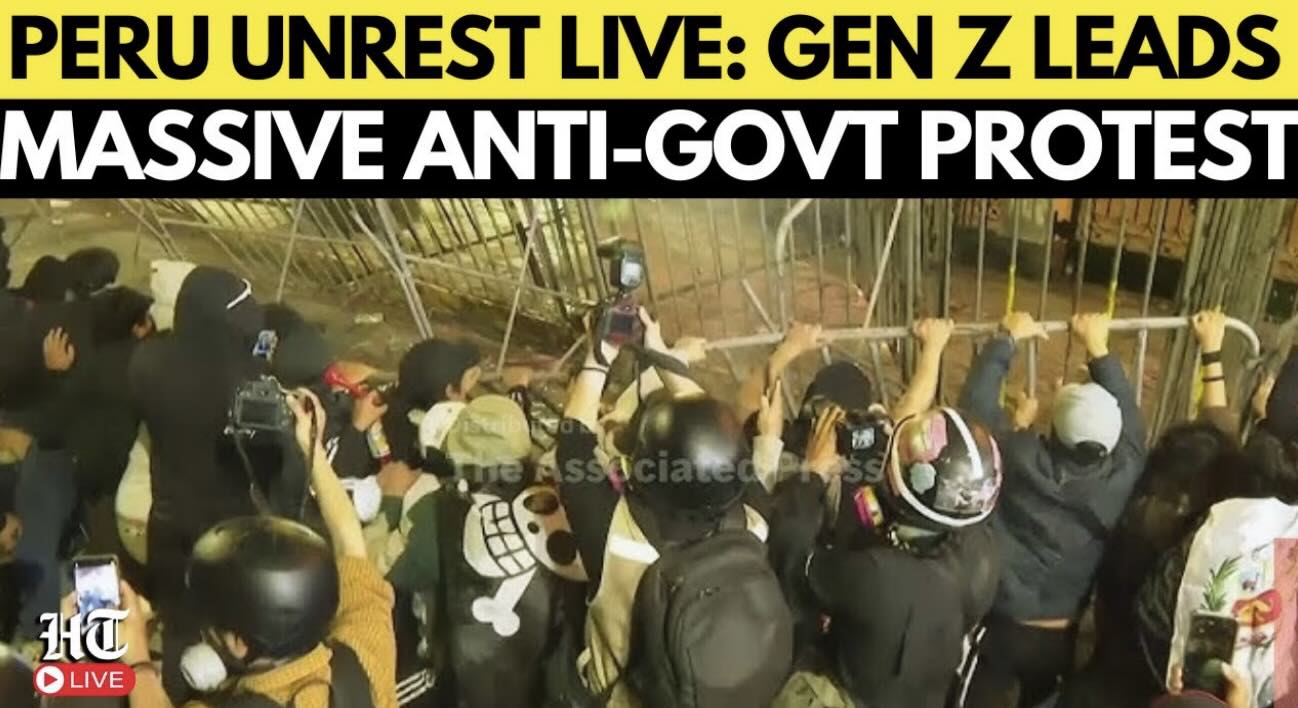
Here the issue has been less related to government control of the media and more about wider frustrations with elites. Deep distrust of traditional media has created a vacuum for creators to fill, with live streams and short video output on Facebook, TikTok, Instagram, and YouTube proving especially popular with young people. Creators have helped to amplify voices of protesters, especially rural and indigenous communities, and challenge perceived bias in the mainstream media.
In all these countries we find that those that depend on creators for all or most of their news are much more likely to say that they find their content trustworthy when compared with mainstream media.
3. Youthful changemakers
In a number of countries, we find significant elements of news consumption shaped by young, platform-native creators bringing a new approach to storytelling and politics.
In France, HugoDécrypte – real name Hugo Travers – has become the single most important news source for younger audiences. He reaches more than a quarter (28%) of all those under 35 – twice as many people as historic news brands such as TF1 and Le Figaro. His YouTube and TikTok channels distil complex political and global issues into short, accessible formats, combining clarity with a neutral, explanatory tone. Around him sits a layer of creator-led brands such as Brut and Konbini, which produce social-first video journalism designed for platforms. YouTuber Guillaume Pley has also created a breakout hit with Legend, a popular long-form interview, while young journalists focused on the environment, such as Hugo Clément, also strike a chord. News-adjacent influencers such as Squeezie, a popular gamer, complete the list.
Young creators and creator-led brands are particularly popular in countries where traditional media have struggled to connect with GenZ audiences. In France our data show how 18–24s see news creators as not just more entertaining than mainstream media, but also easier to understand, more authentic, more knowledgeable, and more trustworthy. The contrast with the wider population could not be starker.
Against this background it is not surprising to find networks such as TF1 partnering with popular YouTuber Gaspard G to create a new format for the 2027 election that mixes long-form political interviews with archive footage.4
We find similar youth focus in the Czech Republic, where Karel ‘Kovy’ Kovář is a leading explainer, translating complex issues into engaging, youth-oriented content. He has an average audience age of 26, according to our data.
Youth-focused creators making news entertaining and easier to understand
Most-mentioned by survey respondents in their markets

In the UK, Dylan Page heads the list and has 19m followers on TikTok alone. We also found high name recognition for TLDR, a collective effort to make news and politics easier to understand. In Italy, Geopop is a hugely successful science-based explainer brand founded by Andrea Moccia, and in Spain the team behind Ac2ality uses creator-led approaches (7m followers on TikTok) to engage young people with serious topics such as the Iran War.

4. More limited creator ecosystem with hybrid and imported elements
Our final category takes in many smaller countries in Northern and Eastern Europe as well as Japan. Lower use of social media, older populations, and the continued strength and relative trust in established news brands have limited the emergence of independent news creators, so far at least.
In countries such as Denmark, Norway, Germany, and Sweden, the relatively small number of individuals identified by respondents as creators are often not independent digital-native figures, but journalists or presenters from traditional media organisations who have extended their presence onto social platforms. These figures adopt some of the stylistic elements of creators – such as direct address, personal tone, vertical video, and humour – but remain rooted in institutional media. One example is Jan Böhmermann, a journalist and satirist who presents a weekly show with ZDF and is co-host of one of Germany’s top podcasts, Fest & Flauschig, along with active social accounts.
Hybrid journalist creators/podcasters are emerging in many European countries

Alongside these ‘hybrid journalist creators’, respondents frequently name entertainment or lifestyle focused influencers, whose engagement with news tends to be occasional. Examples include Oskar Westerlin in Norway, Enzo Knol in the Netherlands, and Rezo in Germany. There are some nuances in Sweden and Norway, however, with a small home-grown right-wing creator ecosystem that aims to fill gaps left by mainstream media on issues like immigration.
A different pattern emerges in markets such as Ireland, Canada, and Switzerland, where domestic creator ecosystems are nascent and audiences instead rely on ‘imported’ creators. In these cases, respondents frequently mention international figures such as Joe Rogan, political podcasters like Alastair Campbell and Rory Stewart from The Rest Is Politics, or Fabrizio Romano, the Italian influencer and expert on football transfers. This reflects a form of cross-border media consumption, where global or neighbouring markets fill the gap left by weaker domestic creator presence.
Conclusions
This chapter has explored four ecosystems that help explain how news creators are shaping public debate across countries: politically polarised, creators as a form of political opposition, youth-focused creator systems, and markets where creator influence remains limited or imported. However, these should not be seen as fixed or mutually exclusive. In practice, many countries display elements of several models at once, and creator ecosystems continue to evolve rapidly.
Across these different contexts, one consistent finding is that creators are rarely replacing traditional news media outright. Instead, they tend to play a more supplementary role, helping audiences to interpret, explain, critique, or react to the news rather than break stories themselves. Even in countries such as Kenya, Peru, or the United States, where reliance on creators is high, only a minority say that most or all of their news needs are met in this way.
At the same time, the structure and impact of creator ecosystems varies considerably. In some countries, particularly those with polarised politics or weak trust in mainstream media, creators have become powerful voices shaping competing narratives. In others, especially where governments exert control over traditional media, creators and independent digital journalists have emerged as an alternative source of scrutiny. Elsewhere, we are seeing the emergence of ‘hybrid journalist creator’ models where existing radio and TV stars (and others) lean into creator approaches while remaining part of the traditional media ecosystem, offering a different potential future for the industry.
Across countries we find that news creators are disproportionately reaching younger audiences, by providing more accessible and engaging formats than traditional media. A few high-profile individuals (HugoDécrypte/Dylan Page/Kovy) are effectively building youth-based news brands, joining existing social-first media such as TLDR, Ac2ality, GeoPop, and Brut. Taken together, young people say these are more entertaining, easier to understand, and more trustworthy than traditional news media – a major challenge for the industry.
Creators now represent an important and growing layer within the news ecosystem. Understanding how they operate in different contexts – and how they interact with both big tech platforms and traditional media – will be critical in assessing their long-term impact on news consumption and public debates.
Footnotes
1 https://reutersinstitute.politics.ox.ac.uk/news-creators-influencers/2025
2 https://www.theguardian.com/us-news/2025/oct/31/conservative-reaction-tucker-carlson-nick-fuentes-interview
3 https://edition.cnn.com/2026/01/02/us/fraud-minnesota-programs-scandal-trump