


News
Anatomy of a hate campaign: How a few powerful actors targeted an editor to frame journalism as a crime

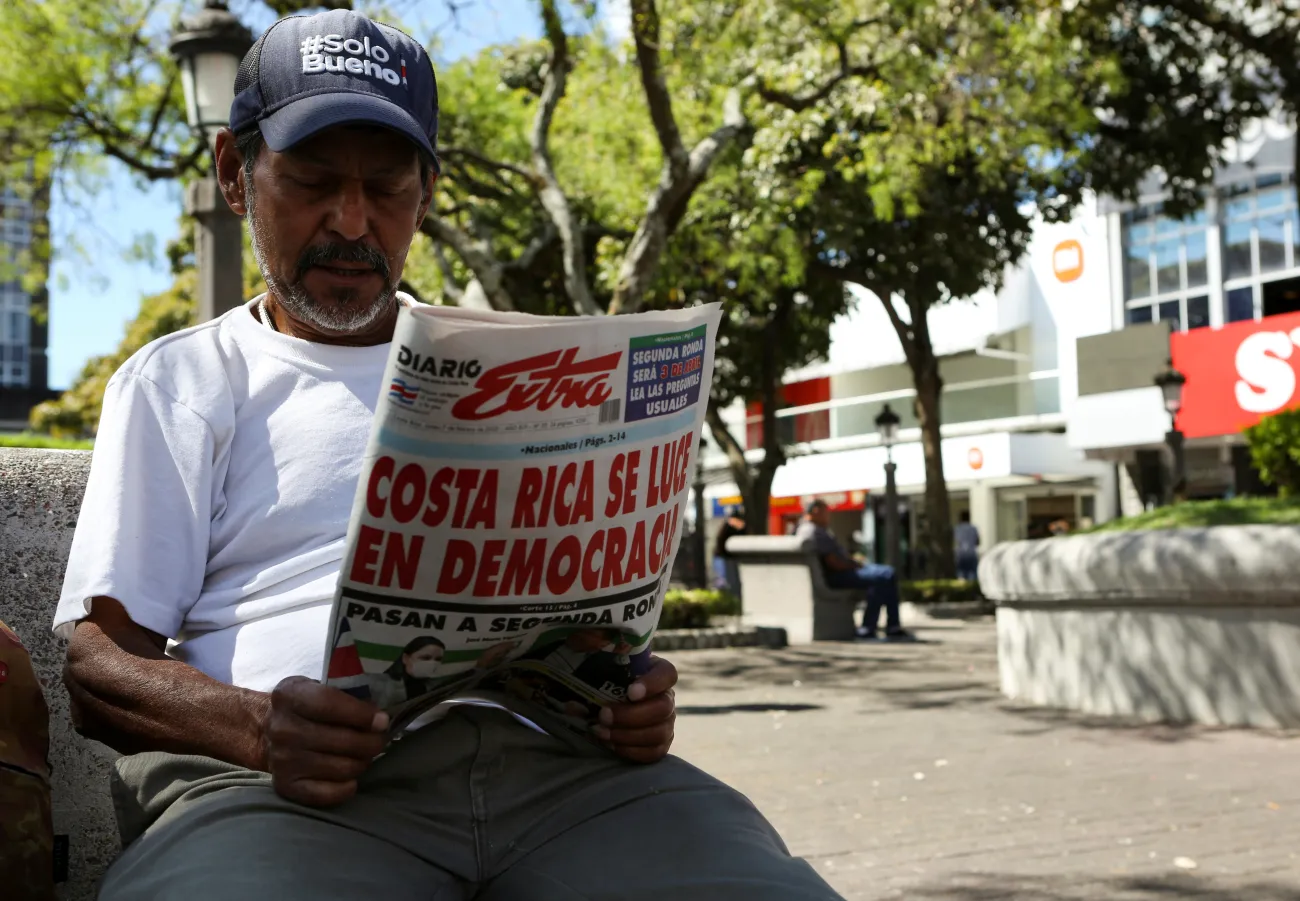
A man reads a newspaper with a cover story on the preliminary results of Costa Rica's first-round presidential election, in San Jose, Costa Rica, February 7, 2022. REUTERS/Mayela Lopez
Costa Rica has fallen more than 30 places in RSF’s press freedom index in the past five years. In 2021, the country ranked 5th on the index, behind only four Nordic countries. By 2026, Costa Rica had plummeted to 38th place.
How is it possible that a beacon of democratic values in a region marked by authoritarianism, war, and attacks on journalists has experienced such a precipitous decline?
To explore the answer to this question, I spoke with six Costa Rican experts and independent media editors, who explain how they envision the future of the profession and speak about the challenges they face.
The decline in press freedom in Costa Rica is not a random phenomenon, but the product of a series of structural causes. José Zamora, the regional director for the Americas at the Committee to Protect Journalists, stressed the country’s troubles are connected to democratic backsliding around the world.
“Costa Rica used to be a stable, well-organised, democratic country. It is the most democratic country in Central America,” says Zamora. “Suddenly, there’s this democratic backsliding, but you also have polarisation and disinformation. It’s like the perfect storm.”
In 2022, Costa Rica elected economist Rodrigo Chaves as its new president. Chaves adopted an authoritarian style and implemented a deliberate strategy to weaken the independent press. During his four years in office, which ended in May, he employed several tactics to suppress the work of the press.
Yanancy Noguera is a Costa Rican journalist with a career spanning more than 25 years. She is now the founder and director of the collaborative journalism program Punto y Aparte and the president of the Costa Rican Association of Journalists and Professionals in Mass Communication.
Noguera argues that Chaves’ conflict with the press began with the coverage of his past as a World Bank employee. In August 2021, media outlets such as La Nación revealed a World Bank sanction linked to allegations of sexual harassment. Chaves did not outright deny these reports, but he rejected the characterisation of his actions as sexual harassment. He argued that the coverage was biased and attributed it to powerful groups interested in halting his political rise. Since then, he has intensified his confrontational rhetoric against critical media outlets.
“During those four years, we experienced constant disparagement of the media: ‘This outlet lies, that outlet lies,’” Noguera said. “Furthermore, he repeatedly used the term ‘prensa canalla (‘scoundrel press,’) alongside a sustained campaign to discredit media outlets and journalists.”
Fabrice Le Lous is the editor-in-chief of the newspaper La Nación, one of the country’s oldest media outlets and the primary target of attacks by the Chaves administration. Le Lous explains that the constant attacks against those who hold those in power to account or are critical of the government—former presidents, judges, legislators, independent media executives, journalists, etc.—create a binary perception of “them versus us,” “good versus bad”; and are part of a populist strategy that has been observed beyond Costa Rica, in leaders such as Donald Trump, Javier Milei, Nayib Bukele, and Daniel Ortega.
“Ultimately, it’s more a matter of anti-democracy,” says Le Lous. “Because there is an undermining of some of democracy’s most important structures, such as respect for the separation of powers, institutional integrity, the Constitution, and, in our case, freedom of expression.”
The demonisation of the press is one of the first things populist leaders do when they begin to embrace authoritarianism. It is not a new tactic. But over the past five years, it has intensified as the world has moved toward authoritarianism.
V-Dem, an organisation dedicated to measuring democracy, notes that the global decline in this form of government has been accelerating in recent years. According to V-Dem figures, as of 2025 there are more autocracies than democracies, with 74% of the world’s population living in non-democratic countries. Costa Rica remains at stable levels. But the country, like the United States, shows clear signs of regression.
Attacks on the press often serve as an early warning of democratic deterioration, as they seek to weaken accountability and reduce the space for public scrutiny. These attacks follow a familiar script: leaders often portray independent media as enemies, using labels such as “traitors,” “corrupt,” or (in this case) “scoundrel press.”
Hulda Miranda Picado is the coordinator of Interferencia, the investigative journalism team at Radioemisoras of the University of Costa Rica. She points out that the main factor behind backsliding is the rise of a movement with authoritarian traits, which seeks to weaken the press and silence critical voices through ridicule, stigmatisation, and systematic discrediting.
“Criticism is legitimate in a democracy,” she said. “What’s concerning is that those in power discredit those who hold the state accountable, because that ends up encouraging campaigns of insults on social media, and ultimately leads to self-censorship, which means less oversight of those in power.”
Miranda Picado, like many of the journalists I spoke with, said she has seen an increase in hostility toward her work, and not only from the president’s office but also through systematic harassment on social media.
Several journalists noted that the government has reportedly facilitated a network of like-minded influencers to echo the president’s attacks on the press and spread derogatory messages. A clear example is the troll “Piero Calandrelli,” who said he received instructions from Assembly members to attack the press. Calandrelli himself stated in another statement that the influencer “Robert Junior” acted as a liaison between the Presidential Office and a network of Facebook and TikTok accounts that support the government, attack the media, and question the opposition.
Jimena Soto, the editor of the newspaper CRHoy, also states that the government has launched a financial attack against independent media, diverting government advertising to propaganda outlets, influencers, and troll accounts, as part of a broader effort to weaken the financial foundation of journalism.
“They began cutting back on that advertising budget and redirecting it toward small websites that started popping up. These sites called themselves ‘media outlets’ but are actually propaganda outlets for this government, lacking any standards,” Soto told me. “On top of that, this government began taking steps to attack the media’s revenue base.”
The withdrawal of advertising was one of the issues most frequently mentioned by the journalists I spoke with. Several described it as a “carrot-and-stick” strategy or an “economic stranglehold.”
In Costa Rica, Soto said, the central government includes ministries as well as autonomous institutions with significant economic clout, such as the Costa Rican Electricity Institute and the National Insurance Institute. Before Chaves came to power, these entities used to invest in independent media outlets because they had the largest audience and the widest reach.
Berlioth Herrera, director of the news outlet El Observador, says that government advertising is part of a broader problem: the media sector is seeking to redefine its business model. It is not just advertising that is in crisis, but the traditional way in which the media sustained themselves financially.
“Private companies are opting for the cheapest advertising, which comes from Meta and Google. What’s left for the media is government advertising, and there have been varying criteria applied there, which has plunged several media outlets into crisis,” she says.
Herrera also said there is a fear that the private sector will withdraw its advertising support from critical media outlets out of fear of government reprisals against their own businesses.
Noguera, the president of the Journalists’ Association, states that, unlike in other countries in the region, media outlets in Costa Rica do not typically receive donations from international organisations, so their survival depends exclusively on the revenue they generate in the local market, which is now under siege.
The media outlets I spoke with have managed to stay afloat through several revenue streams. Outlets like Interferencia survive because their funding, although public, comes through the University of Costa Rica’s budget. Outlets like CR Hoy and El Observador, despite the challenges, still have a robust base of private advertisers that allows them to avoid relying on government advertising.
However, this combination of economic factors has caused several small media outlets to bow to pressure in order to survive, while others have resorted to self-censorship to avoid becoming the next target of the government.
“We’ve gone from a system that might have been more pluralistic, with greater media diversity, to an ecosystem in which there are independent media outlets and those that are not. Some have been cowed by the Chaves movement, while others simply stop covering certain topics,” says Noguera.
In addition to facing economic hardships and government harassment, journalists in Costa Rica are finding it increasingly difficult to do their jobs. Miranda Picado asserts that there is a clear policy of delaying responses, ignoring requests, or restricting access to information that was previously freely available.
“At Interferencia, we do investigative journalism, and that kind of work depends on timely access to public information. In recent years, we’ve faced more difficulties in obtaining official information, with delayed or non-existent responses, and a growing need to resort to legal action or to persist for months to gain access to documents that should be public,” she said.
Much like Andrés Manuel López Obrador did in Mexico, Chaves turned press conferences into a controlled spectacle, where he only answered the questions that suited him. According to the journalists I spoke with, these events ceased to function as genuine press conferences and instead became a venue where some journalists were ridiculed.
“We were among the very few media outlets that never stopped attending his events or press conferences,” Herrera told me. “On a couple of occasions, he responded to our reporter in a confrontational manner, and then we’d face attacks from trolls. But whenever that happened, we weathered it and kept working.”
Noguera describes the dispatch of inspectors from the Ministry of Health, Labor, or Finance to media outlets and journalists as a form of punishment for their editorial stance. For example, Soto told me that Leonel Baruch, chairman of the board of directors at CRHoy and someone who has no influence over the newspaper’s editorial line, was the subject of a tax investigation initiated by the Ministry of Finance to put pressure on the media outlet.
“Since they know that Costa Rica has strong institutions, constitutional jurisprudence that defends press freedom, and international agreements that also protect it, they cannot directly attack the media outlet as happens in other countries,” Soto told me. “What they’ve done is try to attack the outlet’s financial power in an effort to force it to give in.”
In May 2026, five of the seven members of the board of directors of the newspaper La Nación had their tourist visas to enter the United States revoked. The U.S. government provided no official explanation. However, La Nación viewed this incident as a possible attempt to punish the executives for the newspaper’s editorial stance.
Le Lous, the newspaper’s editor-in-chief, said that this cannot be confirmed, as there is no concrete evidence of a request from the executive branch to Washington, but that the visa revocations are occurring within a pattern that has exclusively targeted public figures, judges, and executives of independent media outlets perceived by the ruling party as “enemies of the government.”
“In addition to what we can infer and what we hear off the record, the New York Times itself suggested in its immediate coverage of the visa revocations that the United States might be punishing critics of its allies,” explains Le Lous.
Zamora, CPJ’s director for the Americas, points out that many authoritarian leaders in the region tend to seek mutual support and collaborate with the Trump administration. They believe that this alliance strengthens them and helps them avoid accountability—a sentiment that is also reflected in their hostile relationship with the press and in measures such as revoking visas without a clear explanation.
“The best way to avoid accountability is to suppress the press,” Zamora said. “If they have a good relationship with the United States, that helps them.”
Soto, of CRHoy, notes that the newspaper’s board chairman, Leonel Baruch, also had his visa revoked, along with others who have been critical of the Chaves movement, such as some justices of the Constitutional Court, Congress President Rodrigo Arias, former President Óscar Arias, and several sitting legislators.
Another of Zamora’s transnational concerns is what this deterioration means for journalists who came to Costa Rica from other countries in the region. Although precise figures are not available, a significant number of journalists who have faced reprisals in Nicaragua, Guatemala or El Salvador chose Costa Rica as a refuge. Some media outlets, such as El Faro, even went so far as to relocate their operations there to stay safe from President Nayib Bukele’s regime.
“The Ortega regime has begun targeting Nicaraguan journalists in exile in Costa Rica, who are now forced to face a second exile,” explains Zamora. “This is also happening in El Salvador, where attacks on the press continue and the bank accounts of members of El Faro have been frozen.”
Rodrigo Chaves stepped down as president of Costa Rica in May of this year. His successor, Laura Fernández, presented herself as the heir of Chaves’s presidency, which he could not continue due to term limits.
Laura Fernández has publicly adopted a more conciliatory tone and shown a greater willingness to engage in dialogue with the press than Rodrigo Chaves did, but her political stance remains clearly aligned with Chavism and with the continuation of the Chaves agenda. Furthermore, she has already sparked controversy with statements in support of the Ortega regime, which has strained her relationship with journalists and critics.
Journalists do not believe that the harassment will change during the term of Fernández, a staunch ally of Chaves and defender of his political legacy. Central America has recently witnessed a massive crackdown on the press in Nicaragua, Guatemala, and El Salvador. Although Costa Rica has not reached those levels, it risks following in the footsteps of its neighbors.
Soto said that she and her colleagues ask themselves every day how to prevent that from happening, given that their own government has also expressed admiration for Bukele’s administration.
“What we can do is to continue doing our job to the best of our ability,” says Soto. “Fortunately, Costa Rica has very robust institutions that defend us and maintain very clear boundaries between what the executive branch can and cannot do.”
The journalists I spoke with do not expect things to improve in the short term. The current government is a continuation of the past, and Chaves could return to power. However, they still have faith in the strength of their democratic institutions, and they are fighting to protect the separation of powers, access to public information, and the existence of a critical press.
Miranda Picado said that defending press freedom is not about defending a particular media outlet, but rather the citizens’ right to receive independent information and demand accountability.
“Nicaragua didn’t lose its press freedom overnight,” says Miranda Picado. “It was a gradual process of delegitimising journalists, increasing restrictions, and the concentration of power. Costa Rica is still a long way from that scenario, but it’s important to pay attention to these signs before they become structural problems.”
Le Lous, who worked as a journalist in Nicaragua until 2018, says that although there are few independent media outlets, they remain committed to their democratic role of holding those in power accountable and helping the public understand what is happening in Costa Rica.
“No one should take democracy for granted or assume that we know everything,” he told me. “I believe that the media has a very important role to play here, but so do all actors in civil society. And well, that’s what I can tell you: I’m not afraid.”
In every email we send you'll find original reporting, evidence-based insights, online seminars and readings curated from 100s of sources - all in 5 minutes.
In every email we send you'll find original reporting, evidence-based insights, online seminars and readings curated from 100s of sources - all in 5 minutes.