


News
Anatomía de una campaña de odio: Así fue la ofensiva en redes contra José Rubén Zamora y su familia


A China Coast Guard ship is seen in the distance in the South China Sea. | Credit: Frances Mangosing
In the last two years, tension between the Philippines and China has escalated in a David vs Goliath maritime dispute in the South China Sea, a geopolitical flashpoint where several countries have overlapping territorial claims. The sea is an arena for global power struggles as a Filipino death could trigger the intervention of the country’s mutual defense treaty ally, the United States.
China is harassing Filipino vessels with “grayzone tactics” such as water cannons and ramming attacks which so far have fallen short of an act of war. But for Filipino journalists witnessing these events on the frontlines, a war of propaganda is already on.
Under president Ferdinand Marcos Jr., the Philippines has actively protested China incursions, a departure from Marcos’ more China-friendly predecessor Rodrigo Duterte. The country has opened access to military bases to the US, expanded defence and security engagements with new allies from Canada to Japan, and launched a “transparency” campaign that has allowed journalists to embed on official missions at sea.
The archipelago is China’s most vocal critic in Southeast Asia. It holds a ruling favoring its claim from the arbitral tribunal in The Hague that China refuses to recognise. The country’s position is unique, even unprecedented. While China casts the Philippines as a puppet of the US, Filipino analysts and officials argue it has its own stakes in the area under its exclusive economic zone, which it calls the West Philippine Sea.
Most Filipino journalists are likely to cover an aspect of the dispute at some point in their career.
The West Philippine Sea is a wide beat that intersects with issues from foreign affairs to food security, says Marites Vitug, author of Rock Solid: How the Philippines Won Its Maritime Case against China and Unrequited Love: Duterte’s China Embrace. When reporting for her second book alongside co-author Camille Elemia, Vitug said she found “Filipino journalists are not that vulnerable to Chinese pressure or disinformation.” However, that status is hard won.
Former president Duterte, the populist who led the Philippines from 2016 to 2022, kept warm ties with China and quarreled openly with Western institutions and figures. Now detained at the International Criminal Court for a war on drugs that killed thousands, his presidency was defined by a democratic backslide and clampdown on the free press.
In 2021, Duterte issued a gag order barring government officials from publicly commenting on the West Philippine Sea. Journalists struggled to get access to the area.
Officials credit the policy turnaround to Marcos’ alarm when China used a military grade laser, temporarily blinding a Filipino crew in February 2023. Frances Mangosing, then writing for the Philippine Daily Inquirer, broke that story. She was surprised when Coast Guard spokesman Jay Tarriela posted on social media that her article “marked the beginning of the Philippines’ transparency campaign.”
Starting on a Sunday shift allowed her to get more legwork done for Monday stories. “I had more time to reach out to sources or officials who were willing to talk,” said Mangosing, who now works as a freelancer. “So honestly, I think I just got lucky that he shared it with me first.”
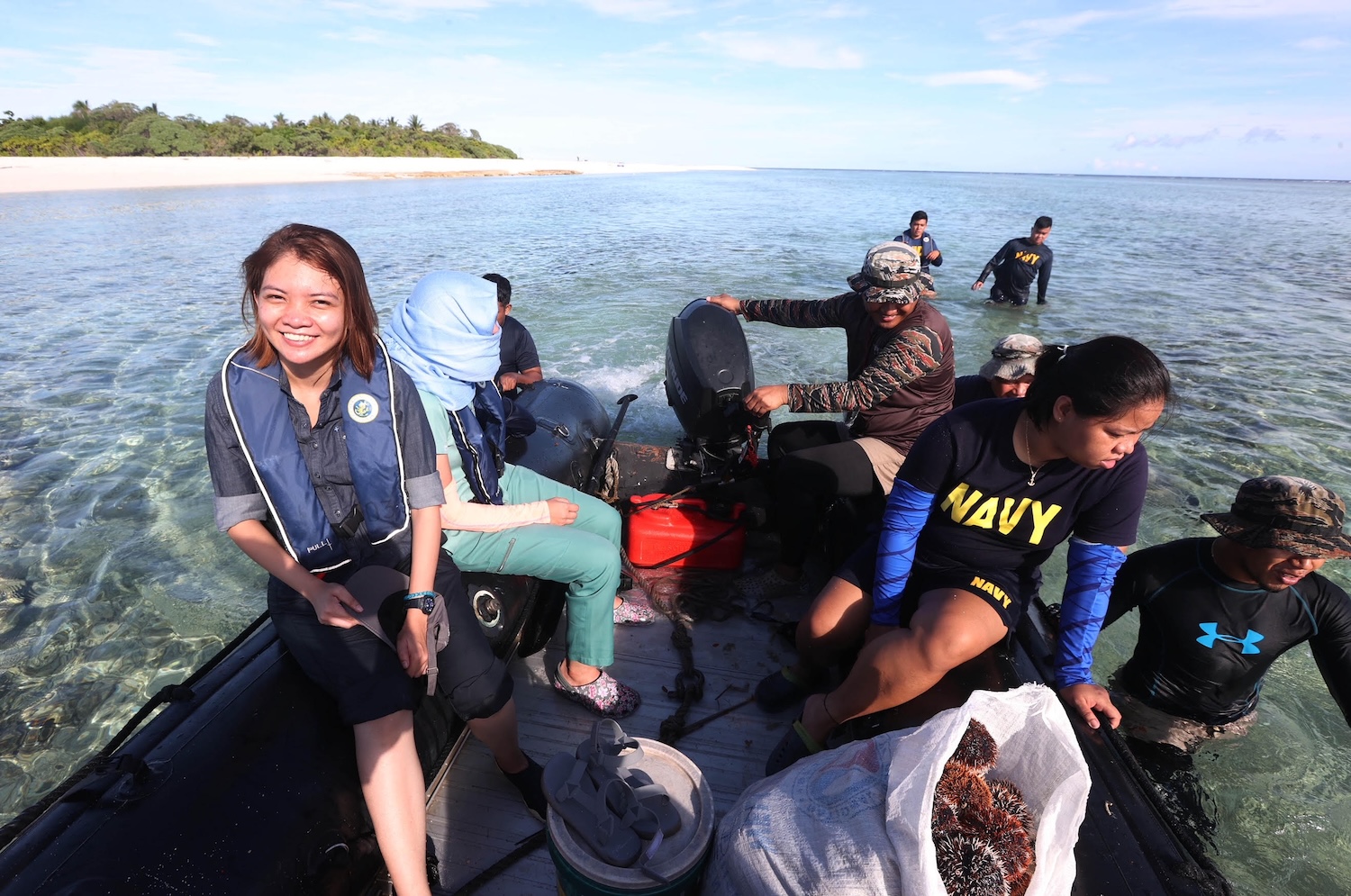
Under the transparency campaign, Filipino journalists gained unprecedented access to Philippine missions in the West Philippine Sea – including a regular resupply mission to troops at an outpost on Second Thomas Shoal – and returned with first-hand footage of China’s use of water cannons and other dangerous maneuvers at sea.
After an embed, journalists typically attend a mandatory debriefing where verified information, as well as on- and off-the-record details, are clarified. A public press conference follows. (Full disclosure: I have been on one of these missions and debriefings myself, as a former reporter for the Washington Post.)
In August 2024, the Philippine Daily Inquirer ran an exclusive about Malaysia receiving a diplomatic note from Beijing, pressuring it to cease its energy exploration in disputed waters. It was tipped to the newspaper by a Malaysian journalist, prompting an investigation by Malaysian authorities into the leak.
Vitug points out that this demonstrates the Filipino press has a reputation of being more open than its neighbors in criticising the Eastern superpower. “We are still lucky to be able to do that,” said Vitug, a columnist at digital news site Rappler. “That’s the kind of freedom we have.”
China-linked interference is another growing concern. In 2020, Facebook took down an inauthentic network targeting Filipinos traced to China.
Since then, operations have grown more sophisticated. Filipino newsrooms have reported bot-like accounts with China-affiliated features actively spreading disinformation on local politics, from a deepfake of Marcos doing drugs to amplifying Duterte’s call for the southern island of Mindanao to secede.
In 2024 the Foreign Correspondents Association of the Philippines recorded incidents indicative of interference, including correspondence from suspicious accounts – potentially in attempts to influence the news agenda or gather intel. The incidents were minor and generally ignored by journalists.
In October 2025 a Reuters investigation found that a Manila-based marketing firm had been tapped by the China Embassy for an influence campaign. Social media accounts made to look like Filipino citizens undermined Philippine maritime claims and its alliance with the US.
Earlier this year, the China consulate in New Zealand attempted to pressure organisers of a film festival to pull out the documentary Food Delivery: Fresh from West Philippine Sea, which covers the conditions of Filipinos on the frontline of the conflict. Its director, Baby Ruth Villarama, said the incident was an indicator that China was also likely behind an incident when the documentary had been prevented from screening at a privately organised festival in the Philippines.
While the Filipino media industry tends to vocally resist foreign influence, Vitug says that newsrooms struggling financially are the most vulnerable.
“If some of them are offered free content partnerships by [Chinese state media], it’s a lot of content for free and it can help local papers,” said Vitug. The arrangement carries risks of publications carrying China’s official state lines, or the local outlets feeling pressured to self-censor.
In one domain awareness flight last February, award-winning photojournalist Ezra Acayan did not expect to get more than stock photos of Scarborough Shoal and surrounding Chinese Coast Guard vessels. But a Chinese helicopter came within three meters of the plane they were on.
“It happened so fast… If I had to describe it, it was like road rage,” said Acayan, who shoots for Getty Images and New York Times. “There was a moment it felt like we were flicked at, cornered. The pilot said, ‘That was a close call.’ If we had been hit, he wouldn’t have had enough altitude to correct the plane. We would have been dead.”
In March 2024, the National Union of Journalists in the Philippines (NUJP), the Foreign Correspondents Association of the Philippines, and the Defense Press Corps issued strongly worded rebukes of a China government official’s claim that journalists were manipulating video to “project the Philippines [as] a victim.” The Defense Corps wrote that journalists joining the missions “risk their lives in the face of unwanted aggression to bring the unvarnished truth to light.”
The NUJP has released guidelines for reporting on China and its local chapter in Zambales, the seaside province facing the western border, has partnered with the Integrated Bar of the Philippines for legal guidance navigating threats related to West Philippine Sea coverage.
“These initiatives help ensure that we are prepared and supported in our work,” said Joanna Aglibot, a regional correspondent for the Philippine Daily Inquirer and chair of NUJP-Zambales.
Maritime incursions have become so common that Acayan recalled a barrage of messages from his editor checking in on him after a vessel he was on was rammed by the Chinese Coast Guard. “For us, it’s normal already – but at the same time, that shouldn’t be happening,” said Acayan. “This isn’t normal.”
At the core of geopolitics, Acayan says he is still drawn to the people behind the scenes. “These people are the focus of my work,” he said.
Mangosing said that one of her most memorable trips was embedding with the Navy for ten days at sea on a rotation and resupply mission across various outposts. “Seeing it all up close – the effort it takes just to bring supplies and fresh troops to those remote stations – made me appreciate even more the people out there keeping watch over what’s rightfully ours,” she said.
China “has a unified narrative,” Aglibot points out, while the Philippines’ diverse voices can make sifting through information challenging. The stories of fishermen, the most marginalised sector on the frontlines of the issue, has been a “grounding force.”
“Beyond immediate challenges,” Aglibot said, “they face long-term economic losses and emotional distress due to constant threats and intimidation by Chinese coast guards.”
The issue has a ripple effect on small-scale fishermen who do not go out to farther waters. “As many fishermen displace from [Scarborough] Shoal, they have since turned to municipal waters for their livelihood, increasing competition, overfishing, and depleting fish catch,” Aglibot said.
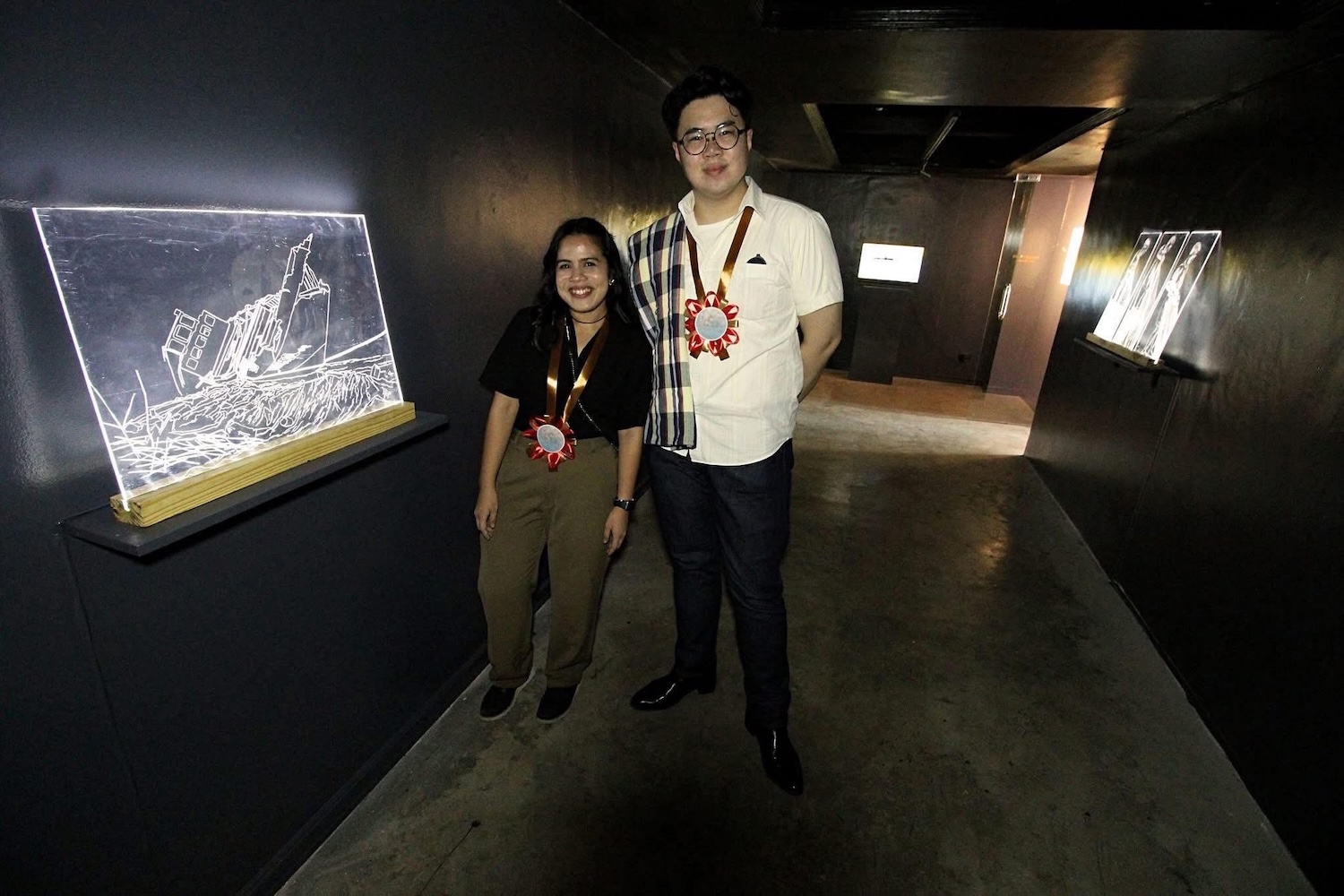
She collaborated with visual artist William Matawaran, using photos and audio she recorded to produce Ghost Ships, a mixed media and soundscape exhibit that spotlights fishermen.
“This is a huge story — it’s so much bigger than you,” said Acayan, the photojournalist. “Especially when you’re in the middle of the sea, you’re so small.”
In every email we send you'll find original reporting, evidence-based insights, online seminars and readings curated from 100s of sources - all in 5 minutes.
