



Exposing the regime from afar: How Cuban journalists report on the island from exile
Year after year, Cuba remains the worst country for press freedom in Latin America and one of the worst worldwide. The country’s Constitution declares the news media to be state property, effectively rendering any journalism outside the official press illegal.
However, the situation has deteriorated even further after the pandemic. In 2021, after a series of nation-wide protests, the regime significantly tightened control over online content, and this impacted the short-lived spring of independent outlets that came with the mass arrival of mobile internet to the island in 2019.
Hundreds of journalists were forced to flee the island while the ones who remained continued to endure harassment, imprisonment, and attacks by the government. Many were unable to exercise journalism altogether.
The struggle to maintain independent reporting now falls largely on those outside the island. Through conversations with four exiled journalists, a picture emerges of a movement that is physically displaced but editorially undeterred. It is worth noting that there are still journalists in Cuba doing independent journalism despite their government’s repression.
A mass exodus
There has been a mass exodus from Cuba in the past few years. The latest migratory wave of people leaving the island began in late 2021 and reached its peak between 2022 and 2023. For many researchers, and even for the Cuban government itself, this has been the largest exodus of Cubans in the history of the country.
According to Cuban outlet El Toque, at least 150 Cuban journalists went into exile between 2022 and 2024 due to harassment by state security agents. A study coordinated by the University of Costa Rica documented 98 Cuban journalists forced into exile between 2018 and 2024. However, the real number of those currently living in exile is likely much higher, due to under-reporting and earlier waves.
One of the journalists who was forced to flee the country during this period is Abraham Jiménez Enoa, who founded the magazine El Estornudo and has written for global newspapers such as El País and the Washington Post. Much of his journalism consisted in showing the “hidden” reality of life in Cuba, which made him a target of government harassment.
“Beyond having your private communications monitored, being followed, kidnapped a couple of times, illegally interrogated, and having your family and friends harassed, and having friends in Cuba who also have immigration restrictions, you are on a kind of blacklist that you can’t get off,” he said. “The island is a kind of political prison.”
After the 2021 mass protests, however, the government decided to change tactics and ease the restrictions on those blacklisted, which included journalists like Jiménez Enoa, activists and members of Cuba’s civil society. Many made the most of this easement to leave the country and never came back.
Jimenez’s own departure was dictated by these circumstances: authorities told him they would grant him a passport only if he left Cuba. Otherwise, he faced detention at home. His exit in 2022 was part of the government’s successful effort to desarticulate the independent press movement.
"It’s quite possible that 90% of journalists who were born with the internet are now in exile. Many have left the profession, others have continued. As for those independent media outlets, some have disappeared and others remain, but now from exile,“ he said. ”Repression continues inside the island, but not at the levels of when I was there. And not because they are better people, but because they have no one to repress."
‘They told me my daughters could go to prison’
Luz Escobar, an independent journalist who collaborated with outlets such as 14ymedio and Diario de Cuba, endured similar acts of repression through her career as a journalist in the island. These included surveillance, harassment, internet cuts, and arbitrary arrests. However, the deciding factor to leave the country came when the persecution started being directed towards her daughters.
“They started going to their school, finding out about them from friends, from their friends’ mothers,” she told me. “They also started threatening me with them, something they had never done before, telling me that my daughters could go to prison or that I would be summoned to the juvenile section of the Home Office for any reason.”
Escobar and her family departed to Spain in 2022, where she now remains in exile, unable to return to Cuba. With this forced exile, her journalism career has taken a hit as she has been unable to do the same kind of journalism she used to practice back home.
She first started working for a Cuban newspaper in exile but her role had to be cut after the Trump administration’s cuts on USAID. She now works on multiple projects, including social media management for a Cuban outlet, a podcast, and a network of female journalists in independent media to improve the freelance salary rates she has encountered.
“Generally speaking, I’m not doing journalism,” she said. “Sometimes, a German or American newspaper will write to me when something extraordinary happens in Cuba and commission work from me on that.”
Journalists in exile being forced out of journalism are not a new phenomenon. Jiménez Enoa also mentioned that he had to shift from journalism into other storytelling avenues such as writing books or documentaries as his inability to be on the ground makes traditional reporting difficult.
“There are thousands of colleagues I know, not only Cubans, but also people from many other countries who had to leave the profession because they had to make a living,” he told me. “It’s very unfortunate, as what those governments wanted ends up happening, which is to dismantle the press.”
Operating from inside and from abroad
The most recent wave of mass migration has impacted Cuban outlets that operate from abroad. Both El Toque and Cubanet are Cuban outlets operating from exile. Both have editorial hubs in the United States, but they have continued to collaborate with reporters inside the island to be able to report on the ground. This decade’s repression has forced many of those reporters to abandon journalism altogether.
José J. Nieves, the Editor-in-Chief of El Toque, said they have lost entire teams of collaborators on the island. This has left El Toque without journalists on the ground, at least publicly. Nieves says that there has been an open criminal process against El Toque in Cuba, which has led people to be threatened with being persecuted for working with them.
“We have been the target of two waves of repression in Cuba in 2022 and 2024. This included arrests, interrogations, public exposure, bans on living in the country, everything that is in the Cuban regime's repressive manual,” he said. “That led us to lose an entire team in 2022 and then another group of people working more clandestinely, more cautiously, who were nevertheless detected in 2024.”
As these reporting teams were eliminated, El Toque appealed to its audience to become "citizen reporters." A WhatsApp button they implemented has facilitated a surge in tips and has become a critical tool for coverage.
While the outlet is not blocked yet in Cuba, the team operates with the understanding that this status could change at any time, and they are actively preparing for a scenario where they might be blocked by establishing strong multimedial presence in other channels.
“Other Cuban media outlets are blocked, so learning from them and from other media outlets in exile that are blocked in their respective countries, we have a strategy in place to overcome a scenario of censorship. This has not yet arrived, but we are constantly preparing for it,” said Nieves.
Jiménez Enoa described to me some of the difficulties of doing independent journalism within Cuba, including having his work tools (like phones and laptops) confiscated, constant censoring, and threats of arrests.
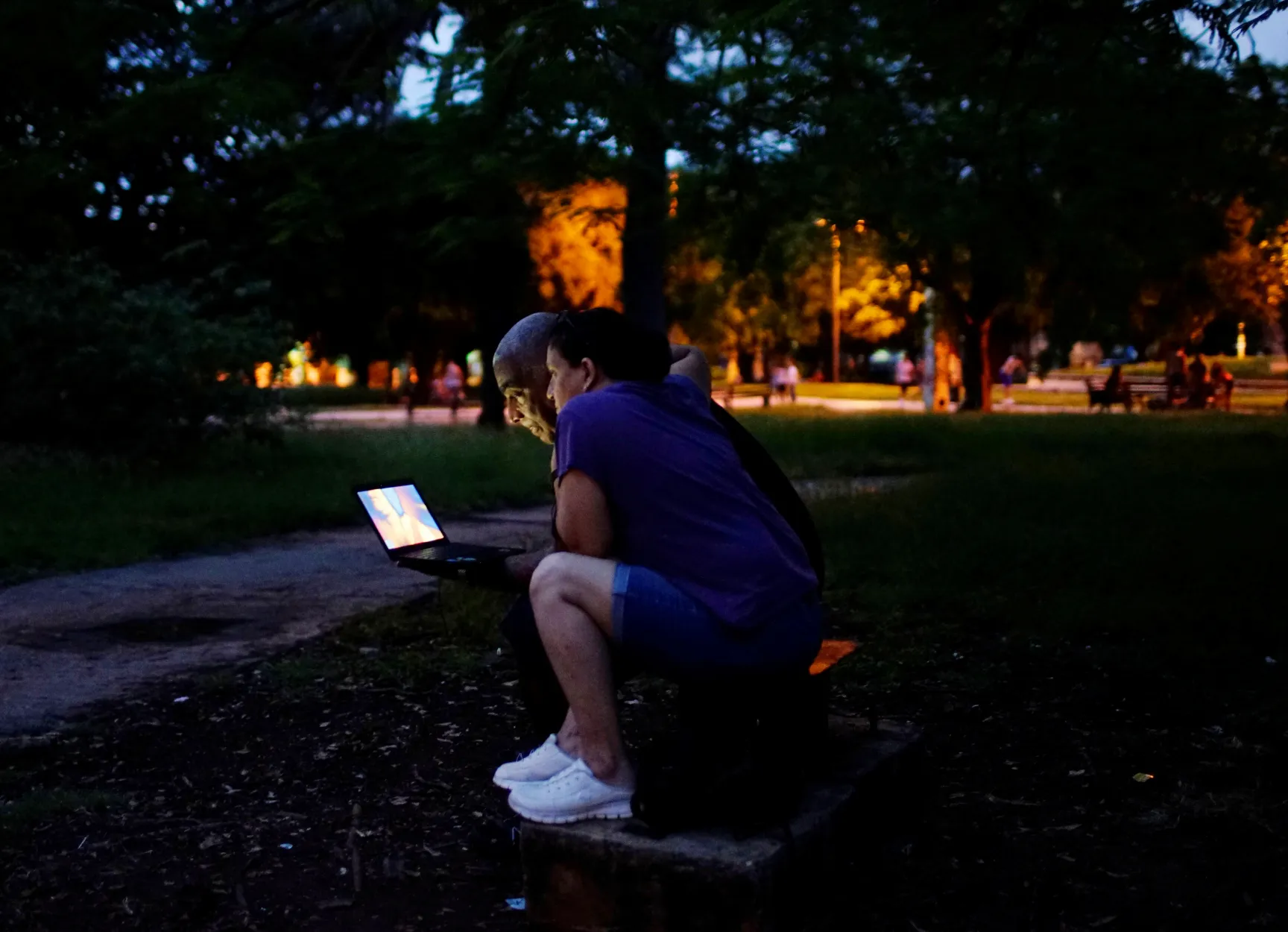
Even doing simple research was complicated. His office was literally a park where he had to sit near an antenna to access the public wifi zones that existed initially. This was difficult, expensive, and logistically complex, as connecting for an hour initially cost the equivalent of a day’s pay.
The harassment did not only extend to him, but also to his sources. After writing a lengthy report about two street vendors, Jiménez Enoa said, the young men had their licenses revoked and were interrogated, effectively losing their job because of his reporting. And yet, despite his warnings of any potential consequences, sources were still keen in sharing their stories, Jiménez Enoa told me.
“In a context of this magnitude, where people have no voice, where you can be sent to prison, where you can be judged, where you can be made to lose your job, people also get tired and have no other choice but to tell what is happening. As a method of relief and also to tell the truth,” he said.
The funding crisis
Unlike El Toque, Cubanet still has a network of around 30 reporters in the island, according to its editor Roberto Hechavarría Pilia. But they have had to operate with strict security protocols to be able to keep them safe, which include implementing pseudonyms and secure communication channels, for example.
For Hechavarría Pilia, however, the biggest issue has been to secure funding to keep the Cubanet going. The outlet was affected by the freezing of public subventions from the United States early in the year, which led to operational difficulties for several months.
“Fortunately, [that programme] was restored and we are currently working on our projects again, still with some limitations, but almost back to 100%,” he said.
Cubanet, which has been in operation since 1994, has financially supported itself via private donors or public grants from abroad. In the current context where journalism is undergoing a funding crisis, Hechavarria Pilia said they have been looking at other funding avenues like ad revenue or sponsorships. But, due to the content they produce, it has been hard to monetise their work.
“In the current context, it is very difficult to monetise content related to human rights and social issues, because what is most easily sought after is entertainment content, and that content is not part of Cubanet's mission,” he told me.
Escobar, one of the independent journalists exiled in Spain, said that one of her first jobs in exile was with the outlet Diario de Cuba. However, her position was cut, alongside many others, after the funding freeze from the US. The folks at El Toque also experienced cuts from US federal funds, although not directly from USAID. As these funds were not restored for them, the outlet was forced to cut its staff significantly, reducing the team of over 35 people down to 18.
In order to reduce dependence on grants, which Nieves considers to be a “model in crisis,” El Toque is developing new income streams which include subscription products for audiences outside of the island and a media service agency.
“We are trying to move further and further away from dependence on philanthropy and international cooperation grants and towards other forms of generating income,” he said. “That is why we are also working more consciously toward Cuban audiences outside of Cuba.”
From exile to the island
Despite all these financial, logistical, and safety difficulties, all the journalists I spoke to believe in the importance of their work as a vessel for democratic resistance even from exile.
The 2021 protests are partly the result of the reporting provided by exiled media and on the ground reporters. Hechavarría Pilia believes these protests occurred because the public is better informed and able to see through the government’s lies.
“Since 2020, protests have been very frequent and we definitely attribute this to the fact that people are becoming better informed. They can see the lies in the Cuban government's propaganda and compare them with what is really happening inside the country,” he said.
For Nieves, independent journalism is a way to amplify the voices of citizens who want to report on the realities in Cuba. While El Toque is an outlet operating in exile, 70% of their audience comes directly from the island.
“Just like with citizen reporting, people want to expose their situation in Cuba, which is very serious and they will always find a way to do so,” he said. “As journalists, we have to help them and amplify their voices with our resources and our tools.”
When it comes to the question of returning to Cuba, all the journalists I spoke to told me they think it’s currently impossible, dangerous, and often undesired due to the circumstances.
Escobar, who resisted for such a long time, says that she no longer has the strength to return and start over, having gone into exile later in life. While acknowledging that returning physically to live in Cuba is unlikely, she, like the other journalists I spoke to, maintains their dedication to her mission from abroad.
“What I don't see myself doing is disconnecting from Cuba and forgetting about Cuba,” she told me. “I'm going to continue working for democracy to come to Cuba and for journalism to continue growing, but I’m going to do it from exile from now on.”
In every email we send you'll find original reporting, evidence-based insights, online seminars and readings curated from 100s of sources - all in 5 minutes.
- Twice a week
- More than 20,000 people receive it
- Unsubscribe any time