



In this piece
The changing shape and new economics of news podcasting: From listening to watching, from podcasts to shows
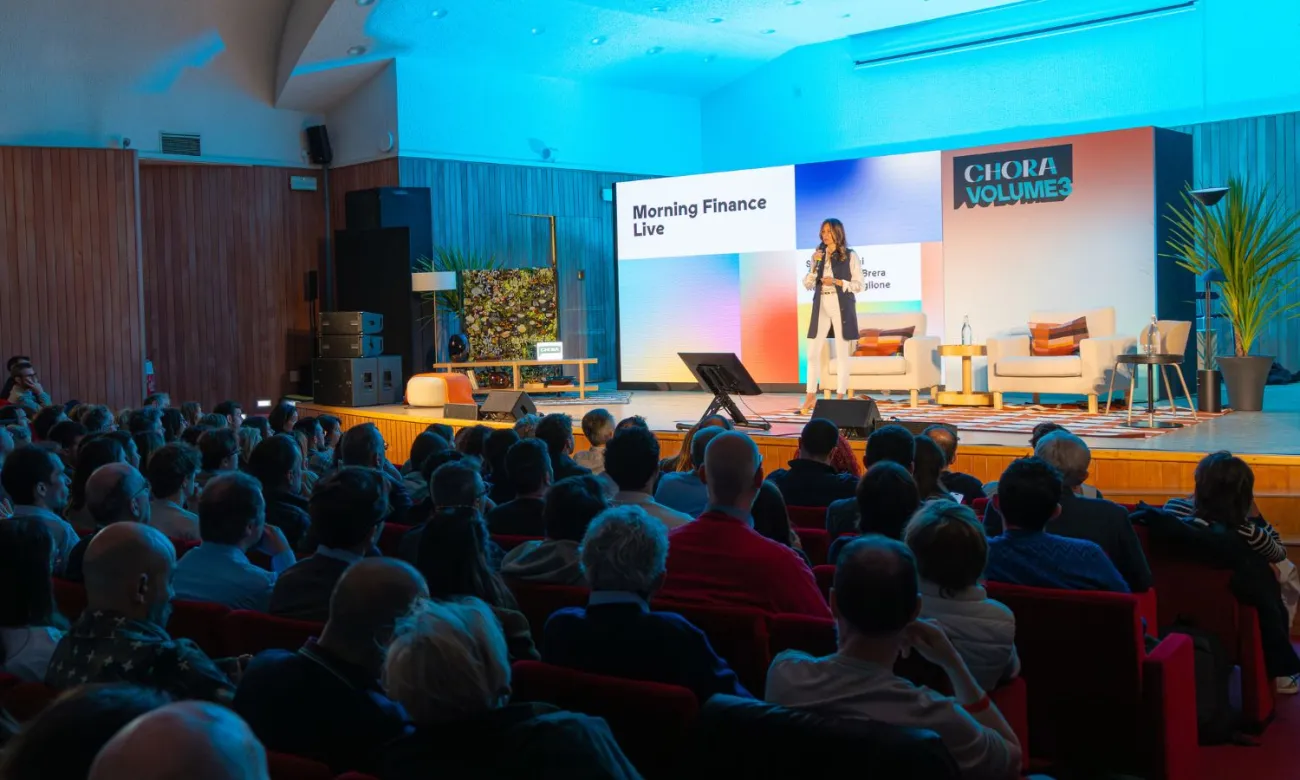
Live event by Italian podcasting company Chora
In this piece
Executive summary and key findings | Methodology | 1. Podcasting: A changing landscape | 2. The shift to video and its implications | 3. The new economics of podcasting | Conclusion | Appendix – list of interviewees | About the author | AcknowledgementsExecutive summary and key findings
Just over two decades after the term podcasting was first coined, the medium is undergoing something of a revolution. Audio podcasts are being transformed into video ones, personality-driven chat shows are squeezing out more traditional narrative series, and business models are changing, with some shows going behind paywalls. At the same time, a range of third-party platforms are increasingly leaning into both video and audio podcasts through algorithmic prioritisation and new product features. This report explores how audiences feel about these changes and how news publishers are responding in terms of both content and business strategy.
The report draws on qualitative audience research into preferences around different formats, as well as willingness to pay for podcasts – conducted in the United States (US), the United Kingdom (UK) and Norway. It is also based on interviews with leading news publishers such as the New York Times, the Guardian, The Economist, the Financial Times, The Times and Sunday Times, Schibsted, Bonnier, Die Zeit, Der Spiegel, Politiken, and the Observer – as well as podcast-first companies Goalhanger and Chora Media. We also talked to representatives from industry platforms and business experts. A full list of interviewees can be found in the Appendix. Here are the key findings.
- Over the last year publishers have been rapidly shifting their podcast efforts towards video – or at least adding video elements – principally as a response to changing strategies from YouTube, Spotify and Apple, and the consequent greater visibility of video within those platforms.
- Some publishers have decided to create multi-modal versions of all their shows. Others are taking a more pragmatic approach, converting chat formats to video but keeping narrative and investigative shows as audio-only productions, which they still believe has long-term value.
- Evidence shows that video podcasting audiences overlap strongly with audio ones suggesting the same people are accessing them in different contexts. In some cases, however, video formats are bringing in entirely new audiences with different expectations, raising questions for publishers about how to handle the change without alienating traditional (audio-first) audiences.
- We also find significant differences across countries in terms of adoption to video podcasting. Our research finds that users in the US are more open to the format, with those in Norway much more resistant. This partly relates to the smaller impact of video platforms such as YouTube in smaller Nordic markets, as well as the lower supply of locally produced video podcasts.
- In terms of motivations, most publishers continue to see podcasts as a good way of attracting and engaging new audiences, especially younger ones, but for subscription publishers they are now also playing an increasingly important role in retention, as well as driving revenue. The human dimension of podcasts and their role in habit-building is also seen as a critical defence against the machine-driven efficiency of AI. Our research shows that podcast use is largely complementary to other types of news and they are valued for building knowledge and adding depth.
- Linked to these characteristics a number of publishers (The Economist, Die Zeit, the New York Times) have recently set up ‘podcast-only’ subscriptions. But as our qualitative research shows, persuading consumers to pay for previously free content remains challenging, which is why others are focusing on bonus content, events, and merchandise – as well as including podcasts with other parts of their subscription bundle.
- Podcast-first companies such as Goalhanger and Chora Media place ‘talent’ and ‘shows’ at the heart of their operations – rather than newsrooms – and are rethinking how to extend the value of these franchises with bonus content, newsletters, text, and further product extensions. Some traditional media companies are looking to replicate this model by building out studios (e.g. the Guardian) to develop internal talent as well as to create new kinds of partnerships with creators.
- As audio and video podcasts grow and develop, they are becoming increasingly hard to categorise and define. This raises challenges for parts of the industry that have previously measured, created, and sold content through specific channels. This blurring of content formats will require advertisers, platforms, and publishers to work in new ways if the full potential is to be realised.
Methodology
To understand more about audience perspectives, we conducted a qualitative project with the market research company Differentology. The aims were to understand the nature and context of podcast consumption, and the motivations for use, in three countries with high and mature levels of usage that have also seen significant experimentation around business models: the US, the UK, and Norway. We designed the research to uncover insights around the three key themes of this report 1) the growing role of personalities, 2) the greater prevalence of video, and 3) public attitudes towards payment and subscription. We ran a 50-person online community comprised of regular news and current affairs podcast users (20 in the US, 18 in the UK, and 12 in Norway) where we set various tasks, including diaries of podcast and news consumption. We followed this with mini-groups drawn from a subset of these users to further explore issues in greater depth. All audience quotes referenced in this report come from this study, which was conducted in February 2025. Names have been changed to protect anonymity.
Publisher and other interviews for the report took a semi-structured approach and were conducted in March 2026. Thirteen leading publishers were chosen from the US, the UK, and Northern Europe, including many of those that are at the cutting edge of podcast trends. Due to the focus on business models, we did not interview public broadcasters on this occasion though they remain a key part of the overall news podcast landscape. We also interviewed three independent experts – James Cridland, editor of Podnews; Esther Kezia Thorpe, co-founder of Media Voices and the UK Publisher Podcast awards; and Grzegorz Piechota, Researcher in Residence at INMA – as well as representatives from YouTube, the Interactive Advertising Bureau (IAB), and Acast, one of the world’s leading podcast monetisation platforms.
Some quantitative data comes from the Reuters Institute Digital News Report, an annual online survey of news use conducted by YouGov. See details of the methodology.
1. Podcasting: A changing landscape
Podcasting started life more than 20 years ago as a way of accessing and distributing audio programming in a more convenient way. Audiences were often small, there was little or no commercial model, and listeners were passionate about the grass-roots nature of the medium. But in the last few years many of these assumptions are being challenged, with greater professionalisation, much larger audiences, and an increased overlap with video.
The latest Edison Infinite Dial report (2026) in the US suggests the proportion listening or watching podcasts (45% weekly) has reached an all-time high, with much of the recent growth coming from video.1 News and current affairs are a big part of that, with leading podcasters such as Joe Rogan and Ezra Klein clocking up audiences running into millions and regularly shaping political debates. Our own research shows that podcasting now plays an important and influential role in the media landscape across countries.2
1.1 Changing content mix
In our earlier reports on news podcasting,3 we identified three different types of news podcasts, and we’re using a similar but slightly updated categorisation here, drawn from analysis of open fields in open responses to our 2025 Digital News Report survey where we asked respondents about their favourite news podcasts. This categorisation is also informed by our more detailed qualitative research with users in the US, the UK, and Norway. These definitions reflect how audiences think and include a wide definition of news that includes current affairs, specialist news, documentaries, and true crime.
- First, we found a large number of daily news podcasts, mostly from traditional publishers. Some of these were briefings involving multiple stories, a such as Up First (NPR) and the FT News Briefing, but others were so-called ‘deep-dive’ podcasts looking at the background to one particular topic, such as Today in Focus from the Guardian and Forklart (Explained) from Aftenposten in Norway.
- Second, we found a large number of personality-led conversational podcasts. These typically involve two or more people talking around a broad subject area, often on a weekly schedule but sometimes more frequently. Examples include The Rest is Politics from Goalhanger, The Ezra Klein Show from the New York Times, and Football Weekly from the Guardian.
- Third, we identified documentary-style podcasts. They are often known as limited series and frequently have a ‘blockbuster’ feel and use narrative production techniques. These typically take a lot time and money to produce, but are generally highly appreciated by audience members, who recommend them to others, similar to how books or TV shows are discovered. Examples included Serial (2014) and Sweet Bobby (2022) from Tortoise Media and The Prince (2022) from The Economist.
Figure 1. Three different types of news podcast
1. Daily news podcasts
Briefing and explanation
- Tend to be brand-led rather than personality driven
- More traditional in tone, often looking to provide simple briefings or explain complex stories in concise way
- Often requires significant investment in staff for daily output
- Designed for daily habit forming
Examples: Up First, Today in Focus, Forklart

2. Conversational podcasts
Accessible current affairs
- Personality led, interviews, often opinionated & subjective
- Tend to be longer in length, provide insights, discussion & debate
- Entertaining and informal tone across politics, tech, culture, etc
- Cheaper to make, easier to convert to video
Examples: The Rest is Politics, The Ezra Klein Show, The News Agents

3. Documentary style podcasts
Narrative, investigative
- Long form, episodic deep dives into a specific topic or themes (crime, economics history)
- Expensive, time consuming, and highly produced. Compelling nature often demands binge consumption
- More evergreen content designed for concentrated listening
Examples: Sweet Bobby, Serial, The Prince

Over the last few years, we’ve seen significant changes in the market with fewer documentary-style series, especially in the US.4 The narrative boom that began with Serial in 2014 led to investment in podcast studios such as Gimlet, Wondery, and Pushkin, but monetisation proved weaker than expected. Platforms such as Spotify, which had partly funded the boom, cut back and production has largely shifted into cheaper conversational podcasts. ‘There’s been a lot of concentration in the podcast industry in the United States and a higher volume of conversational shows being published vs. limited series,’ says Nina Lassam, Vice President of Audio and Video Shows at the New York Times. ‘Our approach is always to lead with the right format for the journalism,’ she adds. Part of this change has also been driven by platform changes where algorithms demand more volume (or video) to maintain visibility.
In the UK there have been a number of new launches in both daily and conversational news. ‘The competition is so much more intense than when we started Today in Focus [2018],’ says Phil Maynard, Head of Podcasts at the Guardian. Personality-led conversational shows such as the News Agents (2022, Global Radio), presented by Jon Sopel, Emily Maitlis, and Lewis Goodall, and The Rest is Politics, presented by former Labour spin doctor Alastair Campbell and Conservative politician Rory Stewart (2022, Goalhanger), have leapt to the top of the charts, overtaking traditional deep-dive formats while bringing in new younger audiences.
‘Shows have also become more reactive,’ says Maynard, pointing to how The Rest is Politics and others have pioneered extra podcasts when major news breaks. ‘Podcasts that were taking two or three days to turn around weren’t necessarily what the audience wanted, or at least it wasn’t the only thing they wanted. They also wanted reactive stuff, and they wanted the people that they trust most to tell them what’s just happened,’ says Maynard. The Guardian has leant into this trend by launching The Latest, a daily reactive ten-minute video podcast, as an extension to its long-running deep-dive podcast, Today in Focus.
As the domestic market has become more crowded, we’ve also seen the proliferation of international versions, e.g. The Rest is Politics USA and News Agents USA. Most of these new shows have followed a personality-based route, linked to the relatively low cost involved – and again, most have a strong video element.
Figure 2. News podcasts are becoming more reactive, more frequent, and more video based

The final significant change has been around platforms and platform strategy. Podcasting grew on the basis of free distribution based on an open standard RSS (Really Simple Syndication). In this decentralised system, anyone could start a podcast and potentially reach a global audience across multiple platforms, including Apple, which helped to popularise the service. There was no approval system and limited use of algorithms. But in the last few years this approach has come up against a number of other big platforms that operate different models and want a greater degree of control.
Spotify, YouTube, Netflix, and others see podcasts as a significant opportunity to grow their business and have invested in new content from individuals and publishers, some of it exclusive to their platforms. Discovery mechanisms, which have long been a challenge for audio podcasters, have been supercharged and platforms such as Apple and Spotify now also offer different routes to monetisation, including subscription.
At the same time, podcast-only start-ups such as Podimo and Podme have become a feature of some European markets, stimulating the market for paid content, while publishers and broadcasters have invested in their own podcast and radio apps (BBC Sounds in the UK and NRK Radio in Norway), where they also increasingly hold exclusive content. When it comes to news podcasts specifically, Digital News Report data over time shows that Apple has lost ground, with YouTube now the most important platform for podcasts in the US and Spotify playing a major role elsewhere.
Figure 3.
These platform changes are accelerating the shift towards conversational and video-first podcasts. Spotify pioneered video podcasts in 2020 for a few limited shows, partly as a defensive move against YouTube. By 2024 there were over 250,000 video podcasts on its platform and half of the top 20 shows, including the Joe Rogan Experience and Alex Cooper’s Call Her Daddy, are now available in video.5 YouTube has also incentivised podcasters as part of its wider creator strategy. In February 2026 Apple announced enhanced support for video, allowing users to switch seamlessly between audio and video formats (so-called multi-modal usage).
Online platforms are pushing video partly because they see podcasts as a good (cheap) way of driving usage through connected televisions, enabling them to compete meaningfully with streaming services such as Netflix.
Conversational podcasts are already finding significant audiences this way. ‘We have a fairly large young audience [and] they are very comfortable watching on the telly at home,’ says Conrad Withey, Chief Commercial Officer at Goalhanger. ‘Around 40% of our YouTube views now come via connected TVs,’ he adds. Netflix has also announced a podcast service and has commissioned Goalhanger’s The Rest is Football team to provide regular video-first shows during the 2026 World Cup.
Platforms have also added support, to different degrees, for business models that do not centre on advertising. This has enabled the option to paywall premium podcasts or to offer bonus content for subscribers or members.
All these changes, when taken together, are incentivising more quality content from traditional publishers and other creators, which in turn is attracting larger audiences to consume podcasts. They are also, however, raising questions about what a podcast is, if it can no longer be defined just as audio or by the freely distributed nature of the medium. We’ll explore these issues in subsequent chapters starting with how the consumer sees these shifts, followed by the perspective and responses from publishers.
2. The shift to video and its implications
2.1 Audience perspectives
In our qualitative audience research conducted in the US, the UK, and Norway, we explored consumption habits, the motivations for using news podcasts, and attitudes to video podcasts in particular, compared with more analytical daily news podcasts and documentary-type series.
Data from our own Digital News Report (Reuters Institute 2012–2024) looks specifically at news usage as a subset of overall consumption. This research also shows growth over time and across countries, but outside the US the numbers tend to be more modest. While around one in seven Americans (15%) consume a news podcast weekly – a proportion similar to those that read a printed newspaper or listen to news and current affairs on the radio – it is a different story in Europe. In Norway and the UK weekly news usage is 11% and 7% respectively, with traditional news radio still much more popular overall.
Figure 4.
Despite the relatively modest numbers, news podcast users are an important subset of the overall market. Our survey data shows they tend to be younger, more educated, and very or extremely interested in news, as well as being more willing to pay for it, compared to the rest of the online population. Digital News Report data show that only a small proportion (<2%) across countries say podcasts are their main source of news, but our interviews clearly show how they supplement information provided by other sources for this group of super-engaged users.
I have incorporated news podcasts into my routine because they offer something that other news sources don’t. Unlike short news segments on TV or written articles, podcasts allow for long-form discussions, giving experts and journalists the time to break down complex topics in a way that feels more engaging and conversational.
Vanessa, 33, US
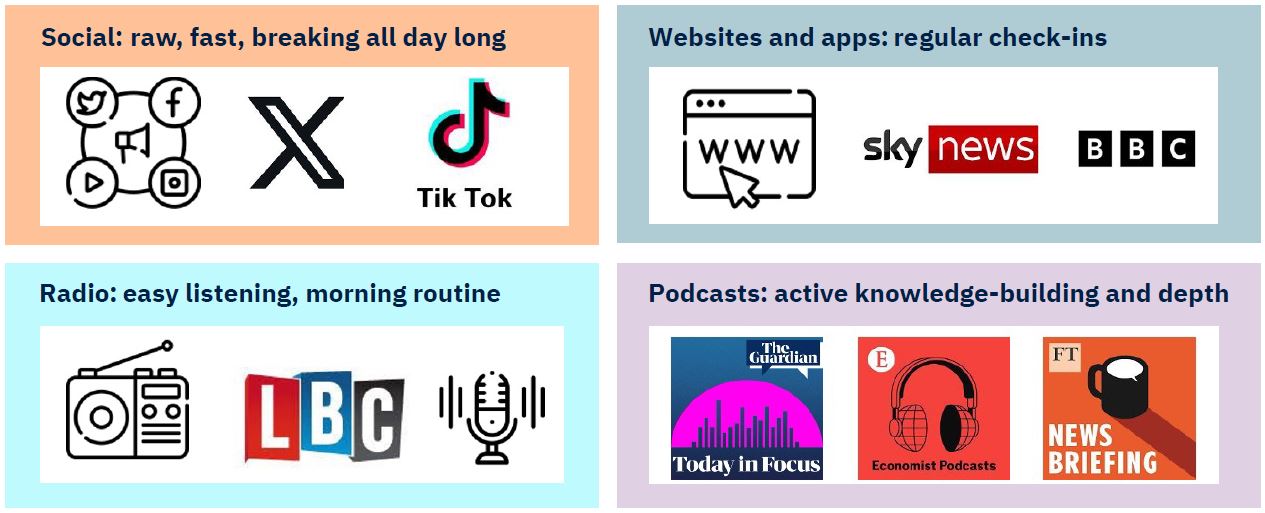
A picture of how podcasts complement other news sources emerge from the media diaries of respondents. Kieran, a 21-year-old from the UK, explained how he uses social media such as X and TikTok for quick discovery, online news sites for checking on breaking news, and radio for more relaxed access, but podcasts have a specific role in active knowledge-building: ‘The advantage news podcasts have is that they provide longer, in-depth analysis,’ says Kieran.
Figure 5. News diet and different purposes of sources for Kieran, 21, one UK news user6

This extra depth comes up again and again as this educated and engaged group looks for new perspectives to layer on top of basic facts that they have mostly read elsewhere.
At the same time, podcasts are part of a switch towards more convenient, flexible ways of accessing the news. ‘Podcasts fit well into my routine because they allow me to stay informed and entertained without needing to dedicate exclusive time to them,’ says Ben, 23, a regular user from the UK. Respondents talked about the value of listening to podcasts on the daily commute, while walking the dog, or exercising in the gym. This makes the growing popularity of video podcasts particularly surprising as the demands of the screen make it harder to multitask, but our interviews suggest that there are three core reasons to use video.
1. Format preference. Many younger respondents in particular, who have grown up with networks such as YouTube and TikTok, are used to watching online video, with many saying they prefer to take in information this way:
I love watching podcasts because I feel more connected to the presenter and guest as well as being able to absorb the information better (because I’m a visual learner). Having the visual adds an extra sensorial element which elevates the experience.
Charlotte, 27, UK
Audio podcasts create intimacy because hosts are speaking directly and personally into your ear, but for some people video seems to strengthen so-called ‘parasocial attachments’ – the one-sided sense of closeness some people feel with hosts or media personalities. Video adds cues around facial expressions and body language that can deepen these relationships.
I think the video, you kind of see the emotions, you see what they’re wearing, you see what’s going on, you see their surroundings … you can kind of see the emotions better.
Nathan, 31, US
Nathan uses YouTube heavily for other purposes and says this significantly influences his choice of format. He knows that podcasts exist on other platforms (e.g. Apple) but says he has never even explored that option because it is so convenient to have them in the same place as his other favourite content.
2. Context. Location matters too. At home, many people who already use YouTube heavily or have access to connected televisions tend to default to video, but they also consume audio in circumstances where screens are not an option: for example, in the car, while exercising in the gym, or while cooking.
If I am working remotely from home and don’t have anything going on, I would say that it is definitely about 80% listening to video, the other 20% audio. And then when I’m working away from home, then I would say the majority of time it is about 80% audio, 20% video.
Jamie, 47, US
It’s probably 95% video, 5% audio. That 5% would be when I’m driving. It’s just my favourite way to consume the content.
Travis, 49, US
3. Content type. There are also practical reasons for wanting visuals around news-based content: for example, to better explain a complex story (e.g. a scientific concept) or for breaking news. One US respondent wanted to see footage of the Palisades fire in California, for example, which was happening during our focus groups. Overall, however, the majority said they were more likely to be attracted to video for non-news-related podcasts such as comedy, fashion, or entertainment, where the role of the host was seen as more important.
With news I’m only interested in the facts or the story and not invested in the particular content creator itself. Whereas with other genres I would probably say I enjoy visualising the content itself, as I am more invested in the individual content creator or the guests.
Kieran, 21, UK
This chimes with the experience of many publishers who say that the vast majority of their news-based content is still consumed in audio. Goalhanger, for example, say that around 10–15% of YouTube consumption of The Rest is Politics, a show with a strong audio heritage, is in video. That contrasts with The Rest is Science, which has a majority video audience (around 60–70%) and is presented by Michael Stevens, a creator who cut his teeth on YouTube, along with the academic Hannah Fry, who has worked extensively in television.
Figure 6. The value of video compared with audio: typical decision-making journeys
1. Format Preference
Am I in the mood for watching or listening? Am I an auditory or visual learner? How much attention do I want to pay to the content/hosts?
Mindsets:
- Aural (audio)
- Visual (video)
2. Context
Where am I? What else am I doing? Do I have a high-quality connection? Am I on the move or do I have access to screens at home?
Availability:
- Busy / On-the-move (audio)
- Available / At home (video)
3. Content Type
Does the content benefit from visuals? Is it mostly factual (news) or does emotional connection with the host (lifestyle/comedy) heighten my experience?
Preference:
- News / Factual (audio)
- Lifestyle / Comedy (video)
Journeys drawn from qualitative interviews
These interviews support survey data that shows that, depending on the circumstances, the majority of podcast users in the US now consume podcasts in both video and audio. The 2026 Edison Infinite Dial report shows that 26% of Americans aged 12+ listen to and watch podcasts weekly, twice as many as those who only listen (13%) and considerably more than those that only watch (6%). Edison concludes that video is not replacing audio but rather that it is ‘expanding the tent’. The lesson for publishers is clear. Podcasting is now a dual-format medium, and commissioning and production strategies need to shift as a result.
Figure 7.
We do not have equivalent data from other markets, but our interviews in the UK and Norway suggest that the turn to video is less pronounced or at least happening at a different pace. This may be because audio platforms, including those run by public service broadcasters, play a bigger role than YouTube in these countries, but also because many publishers have been slower to create video versions. Stronger trust in traditional TV broadcasters, and their broad commitment to impartiality, may also be limiting the development of alternative personality and opinion-led video podcast shows that have been such a popular feature of the US market.
It’s 100% audio; I listen when I’m on the go, I want the information in my ear, my eyes are occupied. If I am to watch a podcast, I might as well watch the news on TV.
Erik, 52, Norway
These country differences are reflected in the lists of top news podcasts mentioned by survey respondents (in an open-ended question) in the 2025 Digital News Report. The Norwegian list in particular is still dominated by audio-first podcasts from the public broadcaster NRK, as well as commercial publisher Schibsted. The UK market has, however, seen more significant transformation. Despite strong audio preferences, all of the top podcasts listed now have video versions, with Goalhanger and Global Media competing strongly with the BBC. In the US, two audio-first products The Daily (New York Times) and Up First (NPR) still head the list, but the growing popularity of YouTube is shifting the balance with most personality-based podcasts now video-first in both sensibility and audience composition.
Figure 8.
In summary, across all three markets we find strong commitment to podcasts as a complement to other forms of media. Podcasts are particularly valued for providing depth and understanding as well as diverse perspectives – and for their informal and entertaining style. The role of hosts in building parasocial relationships is a crucial ingredient in creating habitual use, and there is some evidence that video/visual signals can help further strengthen those connections. Video may be less important in the context of news than in other genres, though it can be helpful in explaining complex topics or illustrating breaking news. At the same time video can distract from the pure qualities of an audio experience. Audio’s flexibility in allowing people to consume while doing other things remains hugely prized by many. Against this background, it is likely that both formats will continue to co-exist as producers and creators try to make the best of this more complex environment.
2.2 Publisher responses to the shift to video
Across interviews with publishers in Europe and the US, we find that video is reshaping discovery, production, and editorial strategies in news podcasting, even though the underlying economics and audience behaviours remain uncertain and differ across markets.
Publishers talk about three key reasons to take video seriously – linked to their wider business objectives.
1. Acquisition. Interviewees say that both video versions of their podcasts and short-form video promotion for those shows are enabling them to reach substantially new audiences, a process that is proving increasingly challenging in other ways. ‘The discovery mechanisms for video are much better,’ says Nina Lassam from the New York Times. ‘Video as a medium is extremely personable and transferrable. People share clips on Instagram, on TikTok, and on YouTube Shorts. I think the audience is new, and I think it is bigger.’ The hope is that video will open that marketing funnel much wider, catching more young people who are heavy users of these platforms.
2. Retention. Video deepens the parasocial relationship between hosts and their audience, building engagement and loyalty that is harder to achieve with websites and apps alone. Podcast audiences are spending far more time with audio (and video) than they do with text and publisher data suggests this reduces subscription churn, even if those podcasts are offered for free on third-party platforms.
3. Revenue. Advertising volumes and rates are substantially higher for video and so the format offers greater potential financial return than audio, as well as offering a relatively affordable route into television.
At the same time, however, publishers worry about the extra costs involved in converting audio podcasts to dual-use ones. Some also think that video could distort or even destroy the artisanal craft of audio podcasting, leading to even more personality-driven formats because they are easier to translate into video than highly produced narrative shows.
The shift to video is also forcing organisational change inside newsrooms. Historically, audio teams, video teams, and social media teams operated separately. Now video podcasts are blurring these boundaries. Recording a show can generate multiple outputs: a full podcast episode, a video version, short clips for social media, transcripts, and written articles. For publishers this requires new workflows, new skills, and new structures.
The following case studies bring some of these issues to life.
2.2.1 The New York Times: selective focus on video where the content is right
The New York Times currently operates more than a dozen ongoing podcasts across news, culture, and opinion. In recent years it has shifted its strategy toward ongoing shows rather than limited series, reflecting the discovery advantages of recurring formats and personality-led programmes. Video has become an increasingly important element of this strategy. Several shows – including Hard Fork, Popcast, and The Ezra Klein Show – now publish video versions alongside their audio editions.
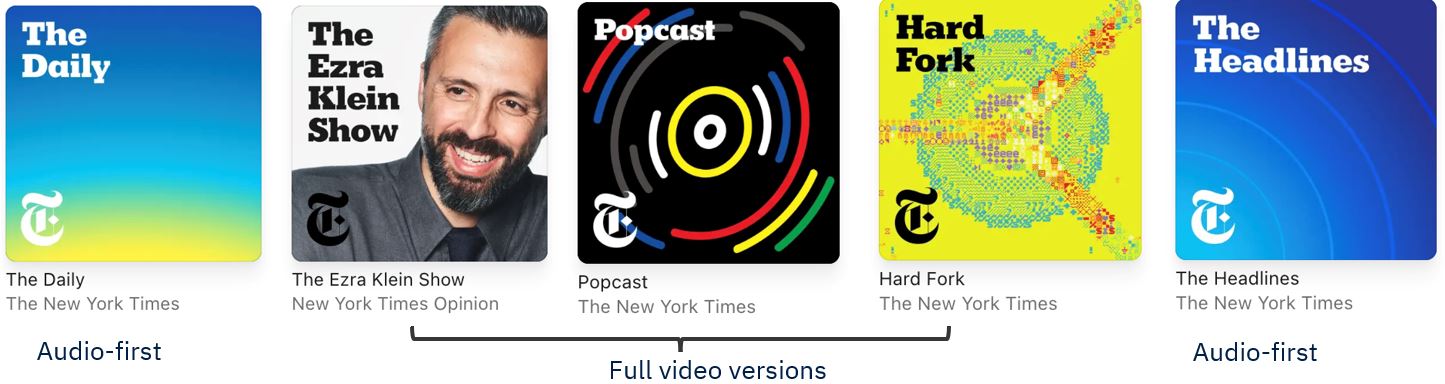

However, the Times has also discovered that not every podcast works well as video. Its flagship daily news show, The Daily, remains primarily an audio product. ‘Making The Daily exactly the same in video would be a challenge. The production of the show is established in audio and our listeners have grown to value the relationship they have with that journalism in audio,’ says Nina Lassam, Vice President for Audio and Video Shows. She argues that while new shows might need a different approach there is little point in tampering with a successful hit. ‘It’s a very healthy business. I don’t think there’s an existential threat to established audio-only shows.’
At the same time, the New York Times is experimenting with content designed specifically for visual consumption rather than simply filming audio recordings. In this model, podcasts become part of a broader ‘show-based approach’, combining audio episodes, video clips, social media distribution, transcripts, and written journalism. In turn, this throws up new questions about how to create and distribute content: ‘While a video department can create stand-alone pieces or series, shows are about building a repeatable franchise that is designed to be listened to and watched week after week,’ says Lassam. Staff at the Times are increasingly expected to be comfortable in front of the camera and on social media, in addition to writing and researching articles. Meanwhile the core objectives remain the same; both reaching new audiences and introducing them to the wider New York Times ecosystem.
2.2.2 The Guardian: embracing video but not forgetting audio
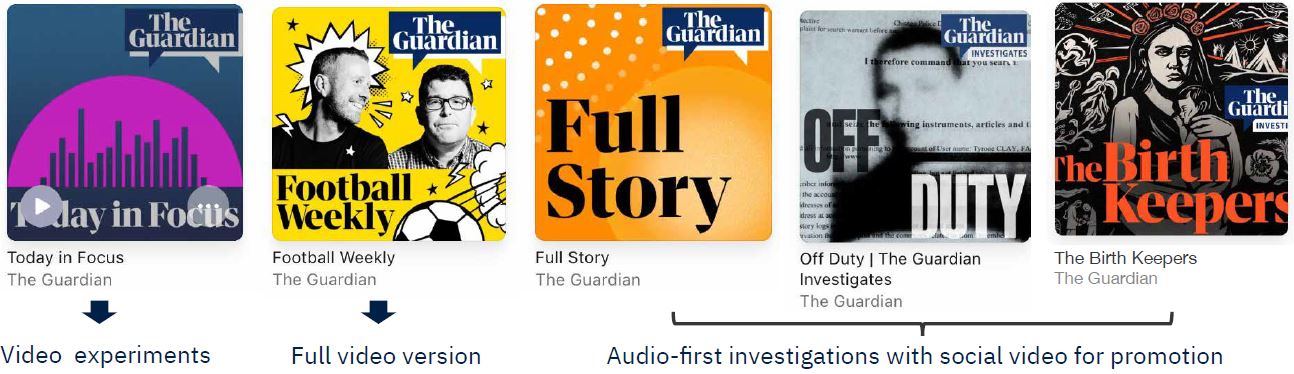
The Guardian has adopted a similar approach to the New York Times, combining audio-first storytelling with selective video production. The organisation’s main daily podcast Today in Focus remains primarily an audio show, but they have started filming some of the key interviews and recently launched video spin-off, The Latest, a short evening video update distributed on YouTube (December 2025). This reflects the Guardian’s view that different types of journalism require different approaches. ‘Whilst we are really interested in and are investing in video podcasts, we are also keenly aware that there is still this huge audio-only audience out there,’ says Nicole Jackson, the Guardian’s Global Head of Multimedia. Jackson stresses that they remain fully committed to audio investigations, such as The Birth Keepers and Missing in the Amazon, but even these now often involve video interview extracts and promotional clips for social media. By contrast, they have found that conversational formats translate relatively easily into video. The long-running Football Weekly now has a full-video version, and there are ambitious plans around this for the World Cup.
From a strategic perspective, the Guardian sees video as an additional audience layer rather than a replacement for audio. Internal data suggests that many listeners switch between formats depending on context, often watching at home but listening during a commute. At the same time, the company remains cautious about the financial implications of large-scale video production, which adds cost even if advertising commands higher prices. ‘It would be quite easy to jump two-footed into video podcasting and then suddenly find that we’ve got a non-sustainable business model,’ says Robert Abel, Head of Audio Business and Strategy. As a result, the Guardian is experimenting selectively rather than adopting video podcasts wholesale.

The shift to video has also led to a wider rethink in terms of a major internal programme to equip journalists with new skills. It also recently launched Guardian Studios (February 2026), a unit aimed at tapping into the creator economy and building content and talent that appeals to young audiences.
2.2.3 Die Zeit: video for discovery, audio for depth
German weekly Die Zeit has developed one of the most successful podcast portfolios in the German-speaking world, producing around 25 regular podcasts across politics, culture, and society. Some of their best-known podcasts include Was jetzt?, a daily news production; ZEIT Verbrechen, a popular true-crime series; and Alles gesagt?, a long-form interview podcast that can run for several hours.


Video is becoming increasingly important but the publisher remains cautious about converting all podcasts. ‘Some of our formats are so intimate that adding video could change the way the conversation is going’, says Constanze Kainz, Head of Podcasts at Die Zeit and also host of the daily news podcast Was jetzt?. ‘That’s not the case with all podcasts, for example, when the hosts are recording remotely anyway. For us, video-podcasts does not always mean high-end, professionally lit TV studios. What matters to us is that the connection between listener and hosts stays the same, because in audio-first podcasts it’s all about authenticity.’
At present, the company produces two video shows, is building new studios, and is experimenting with new video-first formats. Like other publishers, Die Zeit is using video for promotional clips, which often go viral on platforms such as TikTok and Instagram in ways that audio clips rarely do. In Die Zeit strategy, therefore, video functions primarily as a discovery layer, while the full podcast experience remains – for now – mostly centred on audio.
2.2.4 The Observer/Tortoise: narrative focus that can lead to tv commissions
Tortoise Media has forged a strong reputation for long-form audio investigations, publishing over 20, including breakout hit Sweet Bobby and Elon’s Spies, as well as the daily Sensemaker news podcast, The News Meeting, and the flagship Slow Newscast. After the ‘slow news’ brand acquired the historic Observer title, it’s been rebranding its podcasts and thinking about how to best incorporate video. Platforms like YouTube allow the new Observer to reach wider audiences, particularly younger users, as well as open up new advertising markets.


But this does not mean simply turning existing narrative podcasts into video. Properly adapting long-form investigations requires full-scale documentary production with significantly higher costs. For the most part, their approach has been to create separate video versions that tend to be 10-15 minutes long on YouTube, with shorter cut-downs for social. The formats are related, but not interchangeable. Each is designed for its own platform and audience behaviour.
One recent example was The Real Salt Path, based on an investigation by journalist Chloe Hadjimatheou, that questioned some of the central claims underpinning the blockbuster book (and film). The story was broken in text, alongside an audio podcast, and social media video elements were also part of the package. A full TV documentary followed later in partnership with Sky and Candour Productions, after a bidding war. ‘It’s really exciting that, as well as online video, our approach to storytelling means we can experiment with co-producing documentaries for TV, as well as selling the rights to our investigations to drama companies,’ says Director of Strategy and Partnerships Alice Sandelson.
Tortoise has sold around a dozen of its stories to film and TV production companies and if they make it to production these deals can be lucrative – though the timescales can be long. Sweet Bobby was sold to Netflix and shown in 2024 and there is a documentary with another broadcaster coming out later in 2026.
Beyond IP and licensing income, which can be patchy, The Observer is also using investigative audio to drive its subscription business. ‘We see huge numbers of subscribers join to listen to our audio series, but the challenge is churn,’ says Sandelson, ‘because we see listeners binge-listen to series in three days. So we are focusing on more bonus episodes and exclusive content to increase loyalty.’
2.2.5 The Financial Times: video podcasts as a complement to specialist journalism
The Financial Times has also taken a relatively cautious approach to video podcasting, reflecting both its subscription-driven business model and the specialist nature of its journalism. The FT’s portfolio includes long-running shows, such as FT News Briefing, a daily news podcast; Behind the Money, an investigative financial podcast; FT Tech Tonic, covering technology trends; and Political Fix, analysing UK politics.


These programmes remain primarily audio-first productions, designed to fit naturally into listeners’ daily routines, such as commuting. However, the FT has started to experiment with video and is actively looking at opportunities to bring out the personalities behind its journalism. Head of podcasts, Cheryl Brumley, points to FT Unhedged, a market show hosted by columnists Rob Armstrong and Katie Martin, as a good example of likely future commissions: ‘It’s become a total breakaway hit, and was our second most-listened-to podcast. And that’s leaning into a talent-led chatty style.’ These type of shows also lend themselves more easily to video, with interviews captured by lightweight cameras. Short video clips are also produced specifically for discovery on business-focused platforms like LinkedIn.
Because the Financial Times is heavily focused on subscriptions, its podcast strategy is closely linked to acquisition and engagement metrics. Podcasts introduce audiences to FT journalism while reinforcing relationships with existing subscribers. In this sense, video plays a supporting role: expanding reach without fundamentally altering the underlying journalism.
2.2.6 The Economist: leveraging video as part of a subscription offer
The Economist’s podcast portfolio includes a daily show, The Intelligence, alongside several weekly specialist podcasts covering topics such as China, science, and business. In contrast to other news organisations featured in this chapter, this title put most of its shows behind a paywall in October 2023 to provide extra value for existing subscribers, as well as launching a separate audio subscription. As such, the shift to video consumption and distribution raises strategic dilemmas for The Economist. Platforms like YouTube can provide significant extra reach for their output, but there are limited opportunities to convert audiences directly into paying subscribers. ‘The challenge for the business overall is that we are both trying to maintain discoverability from the collapse of search and the growth of AI, while also maintaining high numbers of highly engaged subscribers,’ says Director of Podcasts John Shields, ‘And podcast videos crystal,ise that dilemma’ [because of the benefits associated with greater discoverability].
Partly as a result, The Economist has focused on how it can leverage video to increase subscriber engagement within its website and app. The Economist Insider is a new subscriber-exclusive video show (2025) where top editors, including Editor-in-Chief Zanny Minton Beddoes, debate current events, geopolitics, technology, and defence. ‘Most of our subscribers have watched it,’ says Shields, ‘and it’s our most popular newsletter too.’ From Summer 2026 it will begin to roll out Economist Play, a new component of its mobile app with additional shows.
At the same time, The Economist is exploring whether full-video versions of its audio podcasts could be distributed for subscribers through The Economist app and third-party platforms and has invested more in cameras and studios.
2.2.7 Bonnier News: leveraging podcasts within a multi-brand ecosystem
Swedish-based Bonnier News operates one of the largest podcast portfolios among European newspaper publishers, with roughly 70 active podcasts across its different brands. These shows range from national news podcasts produced by titles such as Dagens Nyheter and Expressen to podcasts about crime (Krimstad) and sport created by local newspapers. The company’s strategy reflects its broader digital subscription model. Podcasts are viewed primarily as a way of bringing new audiences into the Bonnier ecosystem and encouraging them to engage with the company’s journalism.


Video podcast formats are developing slowly in Sweden, with a stronger audience attachment towards listening rather than watching. As a result, Bonnier’s primary focus remains on audio production and cross-promotion within its network of brands. ‘I think that we can admit that we really don’t understand video podcasting,’ says Martin Jönsson, Business Intelligence Director at Bonnier News. ‘We’re not even sure if people are watching it or just using YouTube or Spotify as platforms to listen.’ Different dynamics are also at play in Nordic markets, partly because some publishers have been looking to build out their own audio platforms or using premium podcasts to drive subscriptions, as the popular Expressen brand has been doing, and these publisher strategies may also be changing audience expectations.
Having said that, some Bonnier brands are actively experimenting with video. Business title Dagens Industri, for example, has been reorganising its video, audio, and social media teams into a studio model and plans to produce full-video formats for some of their podcasts. Some sports podcasts from Expressen and local newsbrands are moving in the same direction.
More widely, Bonnier has concentrated on building umbrella podcast formats across its local titles. For example, crime podcasts produced by different local newsrooms are combined into national feeds, allowing editorial teams to collaborate and promote one another’s work. This strategy emphasises scale and editorial collaboration across brands, rather than video-first production.
2.2.8 Schibsted and Podme: navigating video in a subscription ecosystem
Schibsted’s podcast strategy, which is closely linked to its ownership of the Podme platform, illustrates how video podcasting is complicating audio-based subscription models. Podme operates as a dedicated podcast subscription service in several Nordic countries. The platform hosts both journalistic podcasts from Schibsted newspapers and entertainment-focused shows produced specifically for the platform. A few successful news shows from Schibsted brands, such as the successful daily news podcast Forklart, remain free across third-party platforms to maximise reach, but many other shows are paywalled or restricted in other ways. Executives say that the shift to video has been slower in Norway, partly due to technical challenges with distributing Spotify video along with audio, and lower historic use of YouTube for podcasting, but that is changing now.
‘We’re definitely going into video and will be offering many of our titles as video versions,’ says Kristin Ward Heimdal, Country Manager for Podme in Norway. That means enabling video within their own Podme platform but also taking advantage of the extra reach offered by third-party platforms. While video is great for reach and likely to grow, especially for entertainment shows, Schibsted is confident that high-quality distinctive audio will continue to be a key selling point. ‘We have a really big subscriber group in the Nordics that are paying for our service. And we get a bafflingly low number of requests about video. We don’t have users screaming about “where is the video?”,’ she says.
As the rest of the industry increases its focus on creator-driven video, Schibsted emphasises that high-quality narrative podcasts coming from its newsrooms will remain a key part of their podcast subscription business. ‘We’re gonna work really hard to make sure that that remains a competitive advantage for us,’ says Heimdal.
2.2.9 Politiken: video as a way of future-proofing the core experience
The Danish quality title Politiken sees video podcasting as being largely driven by platform pressures and international trends rather than domestic audience demand. There are fewer advertising upsides in a smaller market like Denmark and with much of the industry still focused on audio, most content that is currently labelled video podcasting is focused on short promotional clips rather than full episodes.
Creating high-quality video shows presents practical challenges and can be ‘extremely expensive’, argues Politiken Digital Director Troels Jørgensen, especially if hiring external talent, and this has pushed Politiken towards largely working with, and reskilling, internal staff. Across the industry, he observes a similar recalibration: while ‘all of the major Danish publishers … are gearing up on video’, they are doing so within tight economic constraints. The result is a cautious approach where video is seen as strategically necessary but operationally complex and unlikely to deliver immediate financial returns.
Even so, Politiken has upgraded its production infrastructure, creating a hybrid studio with new cameras and a redesigned setup. However, their distribution strategy diverges from the platform-first approach seen elsewhere. Rather than pushing full-video podcasts onto YouTube and Spotify, Politiken intends to keep most video content behind a paywall as part of its subscription offering. This reflects a broader strategic view that video, like audio, is not primarily a direct revenue stream but a way to deepen engagement. Jørgensen sees video’s value in helping to make the Politiken product feel more relevant – particularly for younger audiences who are less attached to text – and part of a ‘multi-modal’ news experience, where users, in the future, are likely to move seamlessly between formats. Social platforms will play a supporting role, with YouTube Shorts, TikTok, and Instagram Reels used primarily as promotional tools to drive audiences back to the core product.
2.2.10 Chora Media: from narrative podcasts to video-driven communities
Italy’s Chora Media provides an example of how one digital-first podcast company is adapting to the shift towards video. Founded in 2020, Chora initially focused on highly produced narrative audio series, financially viable because platforms – particularly Spotify – were willing to fund original podcast production. However, as platform funding dried up, Chora shifted its strategy towards ongoing shows, such as daily news and video podcasts. This shift has reflected the changing economics of the podcast market, where recurring shows are easier to monetise through advertising and brand partnerships. The shift to video has been further enhanced though the group acquisition of Will Media (2022), aimed at younger audiences and with a reputation for social video, and Cronache di Spogliatoio (2026), a sports-focused media brand built around football.


Within the Chora brand itself, the portfolio includes a mix of narrative or semi-scripted audio podcasts, such Seietrenta (explanatory briefing on top stories) and Stories (international affairs). Shows also includes true crime (Narciso), a daily comedy podcast (Non hanno un amico), which is one of the most listened-to in Italy, and a growing number of conversational shows in different niches, such as business and media and technology (Actually). ‘We are still being perceived as an audio brand but the transformation is coming pretty rapidly,’ says CEO Riccardo Haupt, who sees video as a significant opportunity to reach new and younger audiences on platforms such as YouTube.
The shift towards video is particularly visible in the company’s sports brand Cronache di Spogliatoio, which has developed a strong video-first model. The show operates almost like a television programme: presenters sit around a table discussing football while interacting with a live online audience.
More than 60% of viewings of Cronache di Spogliatoio’s podcasts now takes place on connected televisions, illustrating how video podcasts increasingly resemble traditional television. In this model, podcasts are only one element in a broader community-driven media brand that includes social media, events, and interactive live broadcasts. Chora will be looking to see which aspects of this YouTube-centric and community-based model could be applied to its news portfolio.
2.2.11 practical and structural challenges
Der Spiegel: The German quality publisher illustrates the organisational and practical challenges that video podcasts are creating for some traditional newsrooms. Platforms such as Spotify and YouTube have been encouraging publishers to produce video versions, but Der Spiegel’s podcast production style, which is mainly highly edited interviews and tightly structured narratives, does not easily translate into video.
As one editor explained, heavily edited audio can be difficult to film because each edit requires corresponding video cuts, making production significantly more complex. For this reason, Spiegel has adopted a selective approach, where it is planning new video experiments as well doubling down on shows where video has already worked. Its most successful production is a crime podcast with SPIEGEL-TV, Im Verhör, which has its own set and features reconstructions and other visual elements. The show has run for around 70 episodes and has been successful in audio – in partnership with subscription platform Podimo – but has also racked up millions of video views on YouTube as well as Der Spiegel’s own channels.
The Times and Sunday Times: Historically, podcast production sat within the audio division of Times Radio. More recently, however, the company has moved podcasting into the core newsroom and begun reconsidering how audio and video teams should work together. According to the organisation’s head of podcasts, Dan Box, the industry is approaching an ‘inflection point’ where publishers must decide how podcasts should evolve as audio and video formats converge. Apple’s new vision is of a world where users switch seamlessly between audio and video versions, which means that audio and video files need to match precisely in length and structure. This could reverse the current workflows in that publishers may need to edit the video first and then derive the audio version from it. In that context the idea of an isolated podcast department may not make sense for much longer. ‘We’re moving teams into a model of audio/video publishing,’ says Box. ‘It’s going to have to be more fluent and it’s going to have to happen faster.’
2.3 Comparative approaches to video podcasting
While all publishers recognise the shift to video consumption and distribution, we find a range of different approaches and a number of practical concerns. Some publishers remain cautious, not wishing to undermine the core characteristics of successful audio shows, while starting to experiment with video-first formats. Conversational formats are seen as relatively easy to convert while narrative podcasts lend themselves more to video brand extensions or short clips for social media promotion. Most media companies are rethinking workflows with some investing in ‘show’ or ‘studio’ models. Nordic publishers that already have strong and loyal podcast businesses are taking a more cautious approach than those in bigger markets with a greater potential to drive advertising revenue. Table 1 outlines some of the key strategies associated with featured companies.
Table 1.
3. The new economics of podcasting
Most publishers continue to see podcasting as good for attracting new audiences and for bringing in additional advertising revenue, but in parallel some news organisations have been pursuing an audio subscription strategy. But as we saw in the previous chapter, the shift to video podcasts is now complicating these strategies. In this final section we examine business strategies and ask how video might change the playing field.
While podcasts have traditionally been ad-supported and free at the point of use, a number of publishers have recently created premium or freemium propositions. Schibsted, the New York Times, The Economist, Die Zeit, and Politiken are among those to have experimented with paywalled audio content. This is based on the idea that the sticky nature of podcasts combined with the strong attachment to hosts mean that consumers might be prepared to pay for podcasts even as they remain resistant to paying for text-based content. This approach has been fuelled by platform changes enabling subscription and membership models.
3.1 How consumers view payment
Our own qualitative research across three countries – the US, the UK, and Norway – shows that attitudes are shaped by negative views about payment more generally. Most of the public say they are reluctant to pay for podcasts with so many free options available, despite saying that they value news podcasts highly. Several respondents described a willingness to simply switch to another podcast if their favourite show introduced a paywall. Another said they would only consider paying if a show offered something genuinely distinctive, such as exclusive interviews or investigative reporting unavailable elsewhere.
A lot [of my favourite podcasts] have been locked behind very expensive paywalls. Instead, I find what I need – whether it’s entertainment or news – on NRK’s [public broadcaster] pages.
Lea, 39, Norway
If a podcast offers exclusive content, expert insights, or a unique perspective, I might consider paying.
Leanne, 22, UK
Price sensitivity also plays an important role. While some participants were open to paying, the amounts mentioned tended to be modest – typically around $5–10 per month or the equivalent. In an environment where many consumers already pay for multiple entertainment subscriptions, audiences tend to be selective about adding media subscriptions.
If my favourite news podcast was suddenly unavailable, I’d probably be willing to pay a few dollars per week to get it back. I value having access to reliable and insightful news, but I wouldn’t want to spend too much on just one podcast.
Nadia, 19, US
At the same time, audiences demonstrate greater acceptance of indirect forms of monetisation. Several respondents said they’d rather put up with advertisements than pay directly for access, reflecting long-standing expectations around free audio media, but some expressed concern around the number and intrusive nature of advertisements. Others said they would be open to donations or other ways of providing voluntary support, particularly if they believed their money would directly help creators or hosts that they liked. A number of our respondents had attended live podcast recordings or shows.
Ads, sponsorships, and live shows are a good way for podcasts to make money. I think it helps the creators stay afloat and helps to build a connection with their listeners. I like the vibe of live shows. I’ve been to a few myself.
Aimee, 30, UK
3.2 Advertising and the impact of video
Advertising has long been the dominant revenue model for podcasting. Across countries, audio-based podcast advertising has grown steadily in recent years due to both rising consumption and evidence about the unusually high level of user engagement. In the US advertising revenue reached $2.4 billion in 2024, according to the IAB, but podcasting now has access to digital video budgets, which are much, much larger and have been growing at an even faster rate (see Figure 9).
Figure 9.
In the UK, total advertising revenue for podcasting is much smaller but audio advertising still reached approximately £175 million in 2024, with podcasts accounting for around £90 million – surpassing other sources of digital audio for the first time. In Norway, total podcast advertising revenues were around NOK 22 million ($2.3 million) about 1,000 times smaller than the US.8 These differences help explain why European publishers, especially those in smaller markets, have been slower to invest in ad-supported podcast models alone (see Figure 10).
Figure 10.
It should be noted that there is some confusion about how to describe and measure the podcast category from an advertising perspective. The IAB is currently reassessing this and thinks that traditional (audio-only) approaches may significantly underestimate the overall opportunity.
From a publisher perspective, however, tapping into video budgets is not straightforward. First, there is already intense competition in that space. Second, the advertising industry is still mostly set up to sell audio and video separately and has been slow to adjust its practices. ‘For years, agencies have been siloed into separate audio and video teams, which created some natural friction as podcasts evolved,’ says Greg Glenday, CEO at Acast, which handles distribution and advertising on behalf of many publishers. ‘Now that there are also influencer budgets and flexible digital teams, we’ve been able to find more footing.’
Another challenge is that until recently the distribution of video versions has not been straightforward, with different technical standards that have in some cases adversely affected the audio experience. Providers like Acast have now delivered integrations with Spotify and Apple, enabling a seamless video/audio toggle and are now extending this approach to YouTube. But the industry has historically faced friction over YouTube’s proprietary advertising and its different approach to measurement. Glenday believes that the gap between ecosystems is beginning to close, even if there is still technical and practical work to be done. ‘The biggest challenge in the industry is sorting out how to ad-serve, plan, and price a piece of content that may be consumed two completely different ways,’ he says.
James Chandler, Chief Strategy Officer at IAB UK, notes that although podcast audiences may be smaller than those for traditional broadcast media, they are often ‘more attentive and loyal’. This makes podcasts particularly attractive for brand-building rather than pure reach. ‘The best advertisers increasingly treat podcasts as a form of creator partnership,’ he says, ‘aligning their brand with trusted voices.’ Greg Glenday at Acast takes a similar view: ‘As podcasting continues to evolve to a bimodal channel (audio-only or video), we see a new category of narrative influencers emerging. These creators build thoughtful, longer-form content, establishing deep credibility and changing the narrative for a brand over time.’
Brand partnerships are often expressed through so-called host reads, where the presenters (or narrative influencers) talk about the virtues of the product as part of the show: arrangements that resemble the trend towards influencer marketing. This is a significant revenue driver for podcasts such as The Rest is Politics (key sponsor Fuse Energy) and The News Agents (main sponsor HSBC), though many traditional publishers explicitly reject this form of advertising because of policies around clearly separating editorial and commercial content.
The growth of advertising is bringing other tensions too. As podcasts become more commercially attractive, some publishers have raised the number of advertisements within each episode, increasing so-called ‘ad density’, leading to concerns about diminishing effectiveness and an audience backlash.9
3.3 The shift to hybrid business models
While advertising remains central, podcasting is increasingly moving towards hybrid business models. James Cridland, editor of industry newsletter Podnews, argues that the industry is gradually shifting towards a combination of advertising, subscriptions, and other types of audience support. ‘I think we’re going to be seeing more people focusing on subscription revenue rather than ad revenue, because the first thing that falls when a recession happens is the ad budget.’ Cridland also points to the growing importance of festivals and events, as well as donations and tipping.
But for traditional news organisations, podcasts often play a strategic role that extends beyond direct revenue. Grzegorz Piechota of INMA argues that many publishers are using podcasts as a ‘gateway product that brings audiences into the wider subscription ecosystem’. Other podcasts play a retention role, he says, ‘strengthening engagement with existing subscribers’.
Platform changes have played an important role in enabling these shifts. In the last few years both Apple and Spotify provided subscription options that allow publishers and creators to charge for premium content or to link access with existing digital or print accounts. These systems allow publishers to offer paying subscribers additional episodes, ad-free listening, or extended back catalogues.
- The Economist put almost all of its previously free podcasts behind a paywall in October 2023. Long-running daily news podcast The Intelligence remains free for all, but other podcasts can be only be accessed by existing print/digital customers or for those paying $5.99 a month for an audio subscription. The Economist says that over 30,000 people have signed up to the audio product in its initial phase.10
- Die Zeit launched its separate podcast subscription in March 2025, achieving 30,000 paying customers in the first year.11 For around €5 a month listeners get access to bonus episodes, exclusive documentary podcasts, an audio version of a text article, and archive episodes of popular talk shows via the Die Zeit app or through Apple and Spotify. Recently released news shows remain free, with subscription mostly driven by exclusive content, such as documentaries and mini-series. In these cases, the first few episodes are offered for free with a cliff-hanger moment often triggering a paywall prompt. Generating enough volume of these narrative series is a key driver of success, say executives.
- Politiken launched a stand-alone audio app in April 2026 featuring an expanded line-up of podcast shows and other audio content. Users can take a separate audio subscription for 99 Danish Krone per month (€13). The new audio features are also included for existing digital subscribers.
- The New York Times also offers an audio and podcast subscription at around $6 per month to access archived episodes of popular podcasts, including the back-catalogue of Serial productions that it acquired in 2020. The Times has also been experimenting with bonus episodes, early access, and ‘ask me anything’ sessions. This subscription is available via Apple Podcasts or Spotify, but the company does not break out numbers or promote the product from its own website. The main organisational focus remains promoting and fuelling the full subscription bundle, which is why recent podcast episodes remain free and ad-supported.
- Schibsted became the majority owner of the podcast platform Podme in 2021, part of a bet that the strong emotional connection between audiences and hosts could be monetised. ‘It is still early stages, but we are clearly seeing that people are willing to pay for high-quality, exclusive podcasts,’ says Kristin Ward Heimdal, Country Manager for Podme in Norway. Over 200,000 people subscribe to Podme in Norway alone (as of March 2026),12 where the service is now profitable for the first time, according to Heimdal. Initially, the Podme proposition involved a hard paywall for most Schibsted publisher content combined with entertainment-based shows from creators that had been exclusively signed to the platform. Five years later, it’s becoming a more hybrid model with some versions freely available on third-party platforms like Spotify and Apple, with a premium layer on Podme. This is offered separately and as part of Schibsted publisher bundles in Norway.
3.4 From podcasts to shows
Beyond legacy publishers, a new model is emerging that is not centred around audio (or even video). This ‘show’-based approach is best illustrated by the thinking at Goalhanger and Italy’s Chora Media. In both cases it is the programming and talent that is the core focus, with monetisation coming from multiple revenue streams, including advertising, live events, merchandise, and membership programmes.
Goalhanger’s top executives stress how managing and monetising talent is at the heart of their business. The hosts get a share in the profits but also play a big role in shaping the future direction of their show. ‘It’s not a kind of salaried or fee-based conversation,’ says Conrad Withey, Chief Commercial Officer, contrasting Goalhanger’s approach with a traditional media company. ‘You are almost building this joint venture. It was not a formal joint venture but there was this mindset that actually we’re coming together to create something.’ Goalhanger’s strategy has been to hire popular hosts in key verticals such as politics, football, and history, and to build ‘fandoms’ around them. ‘Wherever you are we want you to build a relationship with the talent, and that be sort of habit-forming,’ notes Withey. Though advertising has been at the heart of monetisation until now, Goalhanger is building a membership layer, merchandise, and live events strategy. This includes their first podcast festival in the heart of London in September.

The business model carries echoes of the music industry where Withey previously worked. Most people access through free content but the most loyal users will pay for early access or tickets to events where they can get closer to the talent. The Rest is History has around 120,000 members and The Rest is Politics also now has a membership component as well as significant revenue from live shows. Goalhanger expects that future growth may come from licensing formats into different territories or doing syndication deals. Netflix has paid a significant sum for a video version of The Rest is Football for the World Cup, but longer-term deals with streamers for distribution may also be an option. They have also announced a talent accelerator programme (March 2026) designed to fund and mentor UK-based digital creators, to help transform independent creators into sustainable, long-form media brands.13- Chora Media has also been developing models built around verticals and fandoms. Advertising still brings in the vast majority of the revenue, with about 40% from brand partnerships and 30% from traditional spot ads. But CEO Riccardo Haupt emphasised that advertisers have become increasingly interested in targeted audiences over large numbers. Chora also makes money from other sources. Haupt’s own tech and media podcast, Actually, is freely available to all, but membership provides exclusive access to the live version as well as events and bonus content. In the sport vertical, the position is reversed with live content offered free, which acts as a funnel to premium subscription. Experimentation remains important says Haupt, and there is no one-size-fits-all solution.
Taken together, these developments suggest that podcasting is moving away from a single, clearly defined business model towards a more complex and fragmented approach. For traditional publishers (see Figure 11), podcasts remain just one part of a broader portfolio – valuable for reach, engagement and subscription growth, but rarely a stand-alone business.
Figure 11. Traditional news publisher funnel model

Reuters Institute diagram
For newer entrants such as Goalhanger and Chora, by contrast, the podcast is only one expression of a wider ‘show’ built around talent, community and fandom, with revenues flowing from multiple directions (see Figure 12).
Figure 12. Indicative flywheel model for show-based podcast companies

What unites both is a growing recognition that value lies less in the individual piece of content and more in the relationship it creates with audiences. In this model, growth will come from developing and supporting talent over time. Creators are going to be the ‘dominant media owners by 2030’, argues the IAB’s James Chandler, who sees smart advertisers already gravitating towards this approach.
Conclusion
This report documents both the speed and extent of change in what we used to call the medium of ‘podcasting’. Indeed, it is getting increasingly hard to define what podcasting is. Purists argue that podcast shows need to comply with the technical standard of RSS, while others say that having an audio edition is the key requisite. But some podcasts these days exist only in video and the most popular access point in the US is now though YouTube, the world’s largest video network.
Either way, changing consumption and new distribution gateways are leading publishers to re-evaluate their strategies. Publishers are embracing video to a greater or lesser extent, investing in studios, experimenting with full-video shows, and expanding short-form spin-offs for social. Workflows are being redefined and new structures are being considered that more closely connect audio, video, and social media teams. At the same time, news organisations are cautious about a headlong ‘pivot to video’, an area where they have been burnt in the past. Many publishers have successful and growing narrative audio businesses, which are valued by audiences, proven to drive subscription, and cannot easily be converted into video. Interview-based ‘chatcasts’, by contrast, are an easier lift and offer the possibility to reach new, bigger audiences, including through video platforms and even via television.
As audio, video, and social formats converge, the distinction between podcast, programme, and platform is becoming increasingly blurred, and with it the idea of a single dominant business model. Instead, the future of news podcasting is likely to be defined by hybrid strategies that combine reach with depth, free access with paid layers, and journalism with personality-driven media brands. The big question is how much publishers are willing to invest in show-based and creator-led approaches that are growing rapidly in popularity but raise fundamental questions about how they organise their existing businesses – about skills, editorial control, and talent.
Appendix – list of interviewees
6 Based on a diary task of media consumption.
About the author
Nic Newman is Senior Research Associate at the Reuters Institute for the Study of Journalism. He writes the annual Journalism and Technology Trends and Predictions report for the Institute and was lead author of the Digital News Report from 2012–25. Nic has written two previous reports (with Nathan Gallo) on the subject of podcasting: News Podcasting and the Opportunities for Publishers (2019) and Daily News Podcasts: Building New Habits in the Shadow of Coronavirus (2020). He is also a consultant on digital media, working with news companies on product, audience, and business strategies. Nic was a founding member of the BBC News Website, leading international coverage as World Editor (1997–2001). As Head of Product Development (2001–10) he led digital teams, developing websites, mobile, and interactive TV applications for BBC Journalism sites.
Acknowledgements
The author is particularly grateful to the many media executives and other experts who gave their time to be interviewed for this report. We would like to thank the Interactive Advertising Bureau (IAB) for providing specific data on advertising revenue. Thanks are also due to the team at the market research company Differentology for designing the qualitative study, and for their insights and advice on this project. The author is grateful to the research team at the Reuters Institute and, in particular, to Richard Fletcher for his thoughtful comments and suggestions on the manuscript, to Craig T. Robertson for his insights on the podcast landscape, and to Alex Reid for keeping the publication on track.
Published by the Reuters Institute for the Study of Journalism with the support of the Google News Initiative (GNI).

This report can be reproduced under the Creative Commons licence CC BY.