



In this piece
Changing definitions of news in a digital environment: How the public defines news across six countries

Man in cafe reading the news. Credit: Luka Lajst. https://www.instagram.com/lajst
In this piece
Introduction | Key findings | Methodology | 1. The traditional shared core and the expanded perimeter of news definitions | 2. The foundation: accurate and verifiable facts about real-world events | 3. Sources: where news is encountered | 4. Actors: who can provide news | 5. Topics: what can news be about? | 6. Genre: how news is presented | 7. Format: medium and length | 8. How context shapes news judgements | 9. The complex relationship between news definitions and engagement | Conclusion | References | Footnotes | About the authors | AcknowledgementsDOI: 10.60625/risj-qzb8-6340
Introduction
In recent years, the ways in which people encounter and consume news have become increasingly diverse (Newman et al. 2025; Schneiders 2024). Sources once synonymous with news, like print and TV, are losing engagement and their dominance over the public agenda, as audiences, especially younger ones, are turning more and more to digital platforms to stay informed (Egan et al. 2026). Social and video networks such as Facebook, YouTube, Instagram, and TikTok now make up a significant share of global news consumption, while newer formats such as vertical video and podcasts are gaining ground.
In digital environments, news produced by traditional media is only a small fraction of the vast array of content people encounter and spend time on (Fletcher et al. 2020; Lazer et al. 2026). Rather than appearing in dedicated spaces like newspapers or news bulletins, on digital platforms news is often presented in largely undifferentiated feeds alongside entertainment, lifestyle, and personal content, among many others. What’s more, public figures, ranging from politicians to celebrities, whose communication with the public was once mediated by traditional media, now speak to their followers directly. Ordinary people can document and disseminate images of significant events like earthquakes or police brutality, while influencers play a growing role in shaping political conversations and public opinion. Meanwhile, formats and genres previously constrained by material affordances and institutional norms have become drastically more fluid and multimodal.
As Edgerly and Vraga (2020) argue, these developments have unsettled existing assumptions about what news is, what it looks like, who provides it, and where to find it. Prior research on ‘news values’, for example, has examined what characteristics make events or topics worthy of news coverage and how this has changed over time, primarily based on analyses of news content (Galtung and Ruge 1965; Harcup and O’Neill 2017) or of journalists’ reasoning and sensemaking (Schultz 2007; Caple and Bednarek 2016). However, we know comparatively little about how audiences think about news values (Temmerman and Mast 2020) or about how they understand and define news more generally (but see Eddy et al. 2025), including how they distinguish it from other forms of media content in practice – especially across different national contexts. This has important implications for how news organisations think about what lies at the very heart of their business, as well as for researchers, whose understanding of news consumption depends in part on how audiences themselves define what counts as news in the first place.
This report brings audience understandings of ‘news-ness’ (Edgerly and Vraga 2020) to the forefront. We explore how people define news using a comparative, multi-method approach: first with media diaries and in-depth interviews, and second with complementary nationally representative online surveys. On top of the foundational belief that news should be based on accurate and verified information, our analysis has identified five observable attributes in people’s definitions of news, and how they can be shaped by the relevance, time, and place of events.
First, we present our terminology of ‘traditional core’ and ‘core-expanded’ news definitions (Chapter 1). We then describe in more detail the five observable attributes that make up how people define news. Building on what people see as the foundation of news (Chapter 2) – accurate and verified facts about real-world events – we describe how people define news in terms of (Chapter 3) the sources through which it is encountered and (Chapter 4) the actors who produce it, as well as (Chapter 5) topics, (Chapter 6) genre, (Chapter 7) format, and how these are influenced by judgements about (Chapter 8) societal and personal relevance, understood through time and place. The final chapter (9) considers how these different definitions relate to engagement.
Across these dimensions, we find that audience definitions of news retain a remarkably stable traditional core of shared understandings, even as some adopt a more expanded definition of news. While we distinguish these dimensions for analytical clarity, participants rarely considered them in isolation. Instead, they evaluated multiple characteristics simultaneously. Audience definitions of news therefore emerged not from any single characteristic but from the interplay of multiple considerations negotiated in relation to one another. This appears especially salient in today’s information environment, where characteristics that more frequently coincided – such as factual reporting, professional journalistic actors, established news sources, and dedicated news platforms – are in many cases decoupled. As a result, audiences are required to make more active judgements about what counts as news.
Key findings
Based on our analysis of qualitative and online survey data across six countries, we find that:
- While many people still define news in terms of more ‘traditional core’ topics, sources, actors, genres, and formats, we see evidence that some now have a more ‘expanded’ definition of news.
- Around half (49%) have a traditional core definition that primarily defines news in terms of topics like politics and the economy, covered by journalists and experts working for dedicated news outlets, presented through long-form text and video sources.
- But a further quarter (26%) have a core-expanded definition that still includes core attributes but also includes newer, less traditional attributes that expand the boundaries of their definition to include, for example, topics like gaming and fashion that are covered by celebrities and influencers on social media, podcasts, and short-form video, sometimes packaged as commentary, debate, and satire.
- Almost all of those who recognise these expanded attributes still include the core attributes in their definition of news. Almost no one who recognises expanded attributes does not have the traditional core as part of their definition.
- All ages are equally likely to adopt a definition of news that includes more traditional topics, sources, actors, genres, and formats, but younger people are more likely to have definitions of news that expand beyond this to include fashion, gaming, individual creators, and podcasts.
- People who primarily rely on platforms (e.g. social media) for news are more likely to have a core-expanded definition of news (38%) than people who are mainly reliant on more traditional sources (25%), including television, print, and radio, but also the websites and apps of traditional publishers. But they are also a little less likely to retain the traditional core definitional attributes (71%) than traditional news users (80%).
- There is widespread agreement that, regardless of these attributes, news should be based on a foundation of accurate and verified facts.
- Sources are an important part of people’s news definitions. Information is much more likely to be seen as news if it is provided by television, radio, and print news brands and dedicated news websites. Information on social media, podcasts, and AI chatbots is much less likely to be considered news.
- Brands whose users think most of what they publish can be considered news (which, for many, is based on the core definition) are more likely to be trusted. Conversely, brands that publish more content aligned with the expanded definition tend to have low trust.
- Information from journalists and those who are associated with institutions with epistemic authority like politicians and scientists is more likely to be considered news than information from individuals such as celebrities, creators, influencers, and ordinary people.
- Topics like politics, conflict, and the economy are strongly associated with news, whereas topics like gaming and fashion are only considered news by a minority, typically those with an expanded news definition.
- Certain genres like breaking updates, investigations, and verified reporting are often associated with news, as are formats like long-form video and long-form text – but this is mainly because people associate them with specific sources and brands. Podcasts and long-form audio are seen as news by some.
- Societal and personal relevance act as contextual modifiers that can turn information into news. Relevance is shaped by many factors, including time and place. People are more likely to think information is news if the event is happening now or is closer to them, though information about the past or what might happen in the future can also be news.
- Seeing information as news is no guarantee of engagement. People often avoid content at the core of news, especially when it feels repetitive, negative, or disconnected from their everyday lives. Meanwhile, content that sits at the edges of news can make staying informed feel more engaging and enjoyable through explanatory, conversational, or creator-led formats, helping some audiences stay informed, but also raising new questions about quality and trust.
- These same basic patterns described above usually held across countries, albeit to different degrees. In the UK, definitions of news tended to be more traditional core, whereas in Argentina people tended towards core-expanded definitions.
Methodology
The data for this report come from two complementary studies conducted on behalf of the Reuters Institute for the Study of Journalism (RISJ) at the University of Oxford. The research was conducted in two stages. The first was based on media diaries and in-depth interviews, and the second was based on nationally representative online surveys. The report builds on an earlier qualitative analysis of how users in Brazil, India, the UK, and the USA define digital news, which also informed an academic paper (Aharoni et al. forthcoming).
Stage one: Qualitative diaries and interviews
For the first stage, an independent market research firm (Lovebrands) was commissioned by RISJ to carry out a qualitative study between 4 and 17 November 2025, combining online media diaries and in-depth interviews in four countries: Argentina, Norway, the UK, and the USA.
It recruited 40 adults (18+, 10 participants in each country) from online panels using predefined eligibility criteria. The sample was designed to achieve broad demographic diversity in terms of age, political orientation, news interest, and media use. Participants represented four age groups (18–28, 29–40, 41–50, and 51–60); included people with high, medium, and low levels of news interest; and reflected a mix of media habits, with half regularly using digital platforms such as social media, podcasts, or generative AI (Simon et al. 2025).
The study combined a one-week online media diary (see, for example, Moe and Ytre-Arne 2022) with follow-up semi-structured interviews to capture how people make sense of news in their everyday lives. Participants began by completing an introductory diary entry describing their interests, preferred platforms and devices, and the issues they cared about. Over the following four days, they uploaded three pieces of content each day, from any platform, that helped them understand what was happening in the world or in their local community, reflecting on what they had learned and how the content made them feel. To avoid imposing normative assumptions about the concept of news (Edgerly and Vraga 2020), the diary deliberately avoided using the term during the data collection process. Only on the final day were participants asked to review their media examples, group them into categories, and identify which they considered to be news.
The media diaries generated a bottom-up library of diverse content examples from the four countries, which were then used as prompts in the subsequent in-depth interviews. Interviews were semi-structured, allowing for consistent coverage of key themes, while retaining flexibility to probe participants’ individual news definitions. Interviews lasted an average of 75 minutes. Participants were first asked about the content they had uploaded. They were then asked to share and respond to relevant social media content in real time and rate its newsworthiness. In the final stage, they reflected on the characteristics they considered most important in distinguishing news from non-news. This approach enabled us to move beyond professional and traditional definitions of news by developing a public-oriented understanding grounded in audiences’ everyday media experiences.
Stage two: Nationally representative online surveys
The findings from that study then informed the design of a complementary survey conducted by YouGov in six countries (including the four countries from the qualitative research) to examine how widely these audience definitions of news are shared and how they vary across countries and population groups. The online questionnaire was fielded from 1 to 28 April 2026 in six countries: Argentina, Japan, Norway, Spain, the UK, and the USA. YouGov was responsible for the fieldwork and provision of weighted data and tables, while RISJ oversaw the design of the questionnaire and the reporting and interpretation of the results.
The questionnaire combined questions about characteristics of information that respondents would consider news (such as expectations, genres, formats, sources, and actors) along with a series of questions on specific information scenarios. These scenarios – including a politician resigning, a climate change-induced heatwave, a celebrity wedding, and panda cubs playing in a zoo – were selected to represent different combinations of topic and perceived news value, ranging from information that would conventionally be regarded as hard news to information occupying the boundaries of what audiences may consider news.
Table 1.
Samples in each country were assembled using nationally representative quotas for age, gender, region, and education. The data were weighted to targets based on census or industry-accepted data for the same variables. Sample sizes were approximately 2,000 respondents per country. The scenario-based questions, however, were answered by randomly assigned subsamples of approximately 1,000 respondents across each country.
The use of a non-probability sampling approach means that it is not possible to compute a conventional margin of error for individual data points. However, differences of ±2 percentage points (pp) or less are unlikely to be statistically significant and should therefore be interpreted with a high degree of caution. Throughout the report, we generally do not treat differences of this magnitude as substantively meaningful.
It is important to note that online samples tend to under-represent the opinions and behaviours of people who are not online (typically those who are older, less affluent, and have lower levels of formal education). Moreover, because respondents opt into online survey panels, they tend to over-represent people who are more socially and politically engaged. As with any survey relying on self-reported responses, participants’ answers may also be influenced by imperfect recall and social desirability bias. We sought to minimise these potential sources of error through careful questionnaire design and testing, informed by the findings of the preceding qualitative research.
1. The traditional shared core and the expanded perimeter of news definitions
Many different aspects of news use have changed dramatically in the past two decades (Costera Meijer and Groot Kormelink 2015; Toff et al. 2023). Our Digital News Report has documented the growth of social media as a news source, in parallel with the decline of print, television, and more recently publishers’ own news websites and apps (Egan et al. 2026). Individual news creators now compete for attention with established news brands, and they are clearly gaining ground in many markets, particularly in parts of Asia, Africa, and Latin America (Newman et al. 2025). All while public trust in news has slowly declined, and the proportion of people with high interest in the news has fallen sharply.
Despite these profound changes to both attitudes and behaviour, we know less about whether people’s fundamental underlying definition of what counts as news has changed, or whether these trends have had any effect on how people decide what news is and is not.
1.1 People recognise that their definition of news is changing
Some people do acknowledge a possible recent shift in how they think about news. According to our survey, 59% in Argentina said that their definition of what counts as news has changed in the past five years, with the figure hovering around 40–50% in Spain, Norway, the UK, and the USA (Figure 1). Just 17% in Japan said they have noticed a change, but even here a substantial minority said they now think about news in a different way.
Figure 1.
Much of this report is devoted to exploring this change in more detail. As we will see, our qualitative work across four countries (Argentina, Norway, UK, USA) identified some of the attributes – like sources, topics, and formats – that people use as cues to decide what counts as news in their daily lives. Within these attributes, we also identified specific examples of content that people consider to be ‘news’ and content they consider to be ‘not news’. We then used our survey, fielded across six countries (Argentina, Norway, UK, USA based on the qualitative research, plus Spain and Japan), to estimate the proportion of people who say that these attributes form part of their own definition of news. This allows us to build a more representative picture of how people define news, and how it varies across countries.
1.2 A three-part model: Foundations, observable attributes, and contextual modifiers
Throughout the research, people mentioned lots of different factors that are important for them when defining news. However, these factors differed in nature and we have identified three types:
- Foundations: underlying requirements (e.g., factuality) that information must have for it to be considered news
- Observable attributes: additional observable characteristics relating to the form, substance, and origins of the information (e.g., topics and sources)
- Contextual modifiers: conditions (e.g., relevance, time, and location) that can turn information into news
As described in more detail in Chapter 2, no matter what the topic or source, people often think it is essential for news to be built on a foundation of accurate and verified facts about real-world events. They also use a number of observable attributes, like the source and the topic of the information, to decide whether something should be thought of as news. These are discussed in Chapters 3 to 7. But at the same time, people also recognise that context matters, chiefly through societal and personal relevance, understood through relational or situational conditions, such as temporality (did the event happen recently or a long time ago?) and proximity (did the event happen nearby or somewhere far away?) that can make some content feel more or less like news depending on the circumstances. We discuss these in Chapter 8.
1.3 The traditional shared core and the expanded definition
Aside from the foundation of accurate and verified facts, and the importance of context, the most important patterns in the data relate to the observable attributes that people associate with news. This is where we see the most variation, and it is these observable attributes that determine whether someone has a broad or narrow definition of news. Taking together all of the quantitative and qualitative data we collected on how people think about different topics, sources, actors, genres, and formats, we see that:
- While many people still define news in terms of more ‘traditional core’ topics, sources, actors, genres, and formats, we see evidence that some now have a more ‘expanded’ definition of news (Aharoni et al. forthcoming).
- Around half (49%) have a traditional core definition that primarily defines news in terms of topics like politics and the economy, covered by journalists and experts, published in dedicated news outlets, and presented through long-form text and video sources like TV, print, and news websites.
- A further quarter (26%) have a core-expanded definition that still includes core attributes but also includes newer, less traditional attributes that expand the boundaries of their definition to include, for example, topics like gaming and fashion that are covered by celebrities and influencers on social media podcasts and short-form video, sometimes packaged as commentary, debate, and satire.
- Very few (4%) have adopted these less traditional attributes at the expense of the core attributes. Almost all of those who recognised the expanded attributes still include the core attributes in their definition of news. Almost no one has an expanded-only definition that does not include the core.
In other words, many people’s definitions of news still feature the traditional topics, sources, actors, genres, and formats that studies going back decades have identified (Galtung and Ruge 1965; Schudson 1976). For some people, however, these definitions of news have now expanded beyond this core, but not in a way that has significantly displaced more traditional, core understandings of what counts as news.
Figure 2. The traditional core news definition and the core-expanded news definition
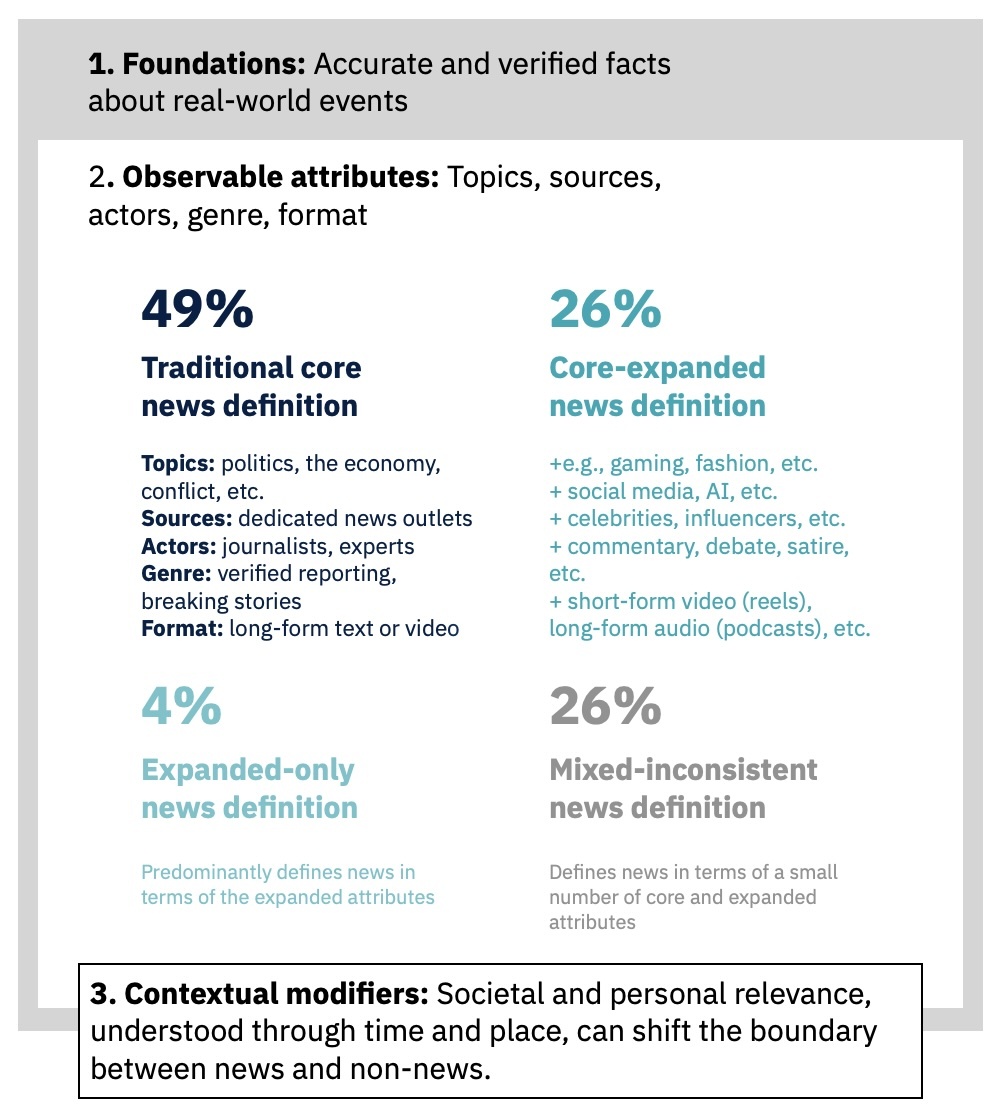
We first used our qualitative research to explore in an open-ended way what matters to people when defining news and in deciding whether information becomes news. Based on this, we designed a survey with a set of questions measuring around 40 different attributes (though some of these do not form part of the definitions discussed here). Questions were typically posed in the following form: ‘If you came across information about each of the following topics, to what extent, or not, would you consider it to be news?’, with the following response options: ‘Definitely news’, ‘Probably news’, ‘Probably not news’, ‘Definitely not news’, and ‘Don’t know’. For each attribute, if a respondent answered ‘Definitely news’ or ‘Probably news’, we coded them as having this attribute as part of their definition.
Based on the qualitative research (and past research from others), attributes were chosen as examples of either the traditional core definition or the expanded definition (see Table 2 for the full list). There were 17 core attributes and 18 expanded attributes. For each respondent, we then counted the number of traditional core and expanded attributes they had in their news definitions. If a respondent had three-quarters or more (at least 13 of 17) of the traditional core attributes we asked about in their definition, we classified them as having the traditional core definition. If they said at least half of the expanded attributes (at least 9 of 18) counted as news, we classified them as having an expanded definition.1
Of course, the expanded attributes and the core attributes are not mutually exclusive, allowing us to also see any overlap (or lack of) between the two. Traditional core respondents are those who embraced the traditional core attributes but mostly rejected the expanded attributes, whereas core-expanded respondents are those whose definition features both, according to the thresholds above.
Table 2.
As stated above, 49% have a traditional core definition, which means that they said three-quarters of the traditional core attributes are part of their definition of news, but their definition contains less than half of the expanded attributes. Around one in four (26%) have a definition that includes both three-quarters of the traditional core attributes and half or more of the expanded attributes. Just 4% have a definition that predominantly defines news in terms of the expanded attributes. This means that almost everyone who has an expanded definition still has the core attributes as part of their news definition – hence why we refer to this group as ‘core-expanded’. To use a more concrete example, among people who recognised gaming as news, around 90% also recognised politics, the economy, and military conflict as news topics.
This way of grouping respondents also leaves around one in five (21%) who do not meet either the traditional core or the expanded threshold, in part because they answered with ‘Don’t know’ to several of the questions. Though we do not discuss this group in detail, it is important to recognise that a substantial minority do not necessarily have, or are not necessarily able to articulate, a definition of news aligned with either the core or expanded attributes.
Finally, it is worth noting that, if we return to the data at the beginning of this chapter, we also see that the proportion who said they have a core-expanded news definition is larger among those who said their definition of news has changed in the past five years compared with those who said it has not – but there is no difference between these groups when it comes to the traditional core. This suggests that the expansion beyond the core is the change that people have experienced in recent years.
1.5 Variation by country, age group, and main source of news
The basic pattern we see on average – the shared traditional core definition with some expanding beyond this – can also be seen when we look at each country individually. The UK is the country with the largest traditional core group (68%), but in every country other than Argentina, this is larger than the core-expanded group. In every country apart from Japan, where the figure is 66% (primarily because there were more ‘Don’t know’ responses), at least three-quarters have a definition of news that includes the traditional core attributes.
Figure 3.
The distribution of people with core and core-expanded definitions also varies by age and people’s main source of news, which themselves are correlated. If we break down news definitions by age group we see that younger people are more likely to have a core-expanded definition of news, and older people are more likely to have a definition that is traditional core – but all ages are equally likely to have a definition that includes the core attributes. In other words, all ages are equally likely to adopt a definition of news that includes more traditional topics, sources, actors, genres, and formats, but younger people are more likely to have definitions of news that expand beyond this to include topics like fashion and gaming, sources like individual creators, and formats like podcasts.
Figure 4.
We see a slightly different pattern when we break the data down by people’s main source of news. People who primarily rely on platforms (defined here as social media, AI chatbots, and podcasts2) for news are more likely to have a core-expanded definition of news (38%) than people who are mainly reliant on more traditional sources (25%), including television, print, and radio, but also the websites and apps of traditional publishers. But interestingly, they are also a little less likely to retain the traditional core definitional attributes (71%) than traditional news users (80%).
This may suggest that platform use is eroding the importance of traditional news topics, actors, and genres. But we should be cautious here. The data cannot show whether the weaker traditional core among platform users is a result of sustained platform news use or whether people become reliant on platforms for news because their definitions are different for other reasons. More broadly, the data are cross-sectional, so it is not possible to confidently identify causation of any kind. Also, platform use (social media, AI, and podcasts) itself sits outside of the core definition which has a small effect on the estimates.
Figure 5.
In the rest of this report, we will go deeper into the five categories of attributes – sources, actors, topics, genres, and formats – to learn more about how people’s news definitions are composed. We will also introduce additional data from both the qualitative and quantitative phases to expand and nuance our understanding of how people define news today. But before doing that, the next chapter discusses the foundation that underlies all of these attributes: the belief that news should be based on accurate and verified facts about real-world events.
2. The foundation: accurate and verifiable facts about real-world events
In the next chapters of this report, we will discuss the five clearly observable attributes that determine whether people have what we call a traditional core news definition or a core-expanded definition. But before that, it is important to state that in the qualitative interviews, in line with previous research on journalism production and news audiences (Eddy et al. 2025; Galtung and Ruge 1965), participants consistently anchored their understanding of news in factual, verifiable accounts of real-world events. While there were differences in how people viewed commentary, satire, and other hybrid forms of information, these differences emerged largely at the boundaries of an otherwise remarkably stable understanding of what constitutes news.
When prompted to define news, there was widespread consensus among participants in our qualitative study that, at its most basic level, news is about real-world events or happenings. Although they sometimes conveyed this in different ways, people across all four countries shared this core understanding of news as ‘what’s going on in the world’ (Ole, Norway, 36). As Sofía (Argentina, 33) put it, news is ‘something has happened, whether it’s at a local level, at a global level, at a country level, or whatever’. Similarly, Claire (UK, 43) described news as informing people about ‘something that is happening, you know, a discovery, an event’.
Many underscored that news needed to be fundamentally grounded in ‘the facts, the actual facts’ (Denise, USA, 54). Kari (Norway, 57) agreed that beyond focusing on things that are happening in the world, ‘the most important thing is that there are facts’. Discussion about facts often came with a need for evidence or proof to support the accuracy of what was being reported. Tariq (UK, 57) suggested that news is ‘based on fact. It’s something that can be proven, whether it’s, you know, visual, you can see photos or video … it’s real data and it’s data-backed’. Federico (Argentina, 33) made a similar point, arguing that, for something to qualify as news, ‘it has to have some empirical fact that can also be demonstrated’. Factuality was therefore closely associated with accuracy, verification, and ultimately truth.
Because it tells a reality, something that actually happened, in a way that tries to be factual. There are images and video, and the journalist describes what happened. What I saw in the video matched what he was saying, so there’s a sense of truthfulness and actuality.
(Valentina, Argentina, 24)
Some interviewees contrasted facts directly with opinions, revealing one area of clear divergence. Those with more exclusionary views of news thought opinions undercut its news status or that the two were mutually exclusive. In Lauren’s (USA, 39) words, ‘what is not news would just be opinion’. Similarly, Matías (Argentina, 24) maintained that what stops something from being news is ‘if it has an opinion in the description … anything that is not objective’. For these participants, the introduction of subjectivity, whether through outright opinion or interpretation, occupied a grey zone that tarnished ‘unadultered [sic] facts’ (Lauren, USA, 39). Such concerns were typically connected to complaints about political biases, narratives, and manipulation permeating news coverage, which many saw as commonplace, even if they were opposed to it or saw it as poor-quality journalism.
They’re not actually presenting the news to me. I wanted them to present the facts. And they’re actually presenting opinions to me, and that is not news.
(Andre, UK, 42)
In our survey data, around two-thirds (65%) across six countries thought that it was essential for news to be based on accurate and verifiable information. This rises to 77% in the UK, but in all six countries it was considered essential by the majority. It is useful to keep in mind that asking whether something is ‘essential’ represents a higher bar than asking whether something is important or desirable. We can contrast this with personal viewpoints and interpretation, which just 10% on average thought were essential – and 18% thought this actually prevents something from being considered news.
Figure 6.
It is important to recognise, however, that not everyone feels that being based on accurate and verifiable information is an essential precondition for news. Some may consider it a marker of good-quality news, or may consider it highly desirable, but that does not mean that they consider it essential in every case, as will become clear in our discussion of different genres (e.g. commentary, debate, and satire) in Chapter 6.
In our qualitative research, some took a more pragmatic or nuanced approach to the fact versus viewpoint distinction, maintaining that biases were inevitable, but that it was sufficient for news to ‘aim, at least, for a certain neutrality’ (Valentina, Argentina, 24). Others did not regard opinions as inherently problematic and instead saw value in clearly distinguished interpretation. Paola (Argentina, 31), for instance, accepted more interpretive forms of journalism provided there was clear signposting demarcating where facts begin and end: ‘Someone can report the facts and then add their interpretation as long as they make it clear which part is which. That even helps people understand different perspectives. But the factual part has to be presented clearly and neutrally.’
Some went further, arguing that opinions could legitimately help audiences engage with current affairs. Imran (UK, 22) expressed this broader understanding of news as potentially including opinion, ‘I think anything that will bring your opinion out and make you have a view is classed as news.’ For these respondents, facts and opinions alike could help the public in forming their own understandings about current affairs.
3. Sources: where news is encountered
Sources lie at the heart of how audiences define news. Here we use sources to refer to the media through which information is encountered, such as television, newspapers, news websites, or social media. While, in the past, news available through legacy media necessarily came from a narrow set of actors, this no longer necessarily holds on digital platforms. This section foregrounds how different media environments shape the extent to which people recognise information as news. The following section then turns to the actors behind that information.
3.1 Traditional news sources at the core of news definitions, platforms at the periphery
Our qualitative research clearly shows that television broadcasts, newspapers, radio, and news websites – sources where news consumption tends to be more active, intentional, and historically rooted – were widely regarded as natural homes for news. These sources, in turn, often carried expectations of professional production, editorial oversight, and a primary focus on informing audiences. Television tended to be at the top of the news source hierarchy. Susan (UK, 56), for example, described TV news as being ‘a little bit more elaborated, a bit more in-depth’ than radio. Similarly, in defining news, David (UK, 40) described it as the ‘big stories’ or ‘things that you would see on TV’.
Some clearly drew a distinction between what they might find on traditional media and what they might find on digital platforms. Lars (Norway, 26), for example, reflected that while social media could sometimes contain new information, ‘if you take the word to its extremes, then a lot of the things you see on Instagram is news if it offers new information, but there is not much news there compared to everything else you might find in VG’ (the Norwegian tabloid newspaper). He added that if he was reading a newspaper, he would ‘think of 90% as news’. In other words, traditional media like newspapers were much more readily associated with news than digital platforms, where news formed only a small part of the information they encountered.
Importantly, these dedicated news environments carried expectations of depth, completeness, and professional reporting that participants did not automatically extend to digital platforms. Alexandra (Norway, 27), for example, argued that printed newspapers ‘often write more information, they have several sources, they dig deeper into the topics, because they have to compete with the articles that get pumped out all the time’. Jack (UK, 20) similarly compared traditional news sources with much of the content encountered elsewhere online, explaining that professional news ‘is normally long … it gives you the full story … here’s the whole story’, compared to the ‘snippets’ one might get on social media. Meanwhile, Henrik (Norway, 28) described TV2’s posts on TikTok as ‘a compromise’ because ‘they don’t always cover the news completely’. He added, ‘I’m thinking that if it’s supposed to be complete news coverage, it has to be a bit serious.’
I feel more comfortable with it [with radio broadcasting]. I think it’s more accountable. I don’t know if it is in today’s society, but I feel like it is more accountable, for what it puts out there. … I just feel like it’s been more vetted. Possibly because I’ve listened to the radio for so many years.
(Susan, 56, UK)
This distinction between traditional sources and platforms is also clearly reflected in the survey data we collected from nationally representative samples of the public. Consistent with the qualitative findings, Figure 7 shows a clear hierarchy in the sources respondents associate with news. Across all six countries, traditional sources remain overwhelmingly recognised as sources of news, with more than eight in ten respondents considering information from television bulletins (88%), radio bulletins (88%), news websites (87%), and newspapers (85%) to either ‘Definitely’ or ‘Probably’ be news. This may partly reflect the clearer boundaries between news and other types of content: television and radio, for example, typically have dedicated news sections, while newspapers and news websites are explicitly organised around news provision. By contrast, platform-based sources are considerably more contested. Social media platforms do not generally distinguish news as a defined content category, even though news is routinely encountered alongside entertainment, personal updates, and other forms of information. As a result, only around one third regarded information from social media (35%), podcasts (33%), or AI interfaces (26%) as news, while information received through interpersonal sources, such as people they know, was recognised as news by a similar proportion (33%). This runs counter to the idea that anything people see on, for example, social media can be considered a form of news because it constitutes new information for the user. In fact, relatively few people think this way about news.
Figure 7.
The same pattern is also evident in individual countries (Figure 8). Traditional news sources are consistently recognised as news by large majorities, while platform-based and interpersonal sources are considerably more contested. Cross-national differences are therefore largely a matter of degree rather than kind. Respondents in Argentina and Spain are comparatively more likely to regard information from people they know, social media, and podcasts as news than those in Norway, the UK, Japan, or the USA, but the overall ordering of sources remains remarkably consistent.
Figure 8.
Although patterns of news use vary considerably by age, with younger people much less likely to consume news from traditional media (Egan et al. 2026), both younger and older groups are highly likely to think that information from traditional news media counts as news. Figure 9 shows that, across different age groups, around eight in ten or more respondents consider information from television, radio, news websites, and print newspapers to constitute news – making them a core part of almost everyone’s news definitions. By contrast, all ages are less likely to consider platform-based sources as news. However, it is also true that young people (18–24s) are substantially more likely than the oldest group (55+) to regard social media (53% versus 23%), podcasts (40% versus 27%), information from people they know (39% versus 29%), and AI interfaces (30% versus 22%) as sources of news. This suggests that some younger people have expanded their definition of news beyond traditional sources to include podcasts, AI chatbots, and social media.
Figure 9.
3.2 The limits of source-based definitions
While there are clear differences in the quantitative data between traditional sources and platforms, the way people think about the difference between the two is often nuanced. Social media, video networks, and messaging apps served as places where participants first encountered stories, sometimes before seeking additional information or vetting them elsewhere. In other words, they often served as a gateway to news rather than a final destination.
Paola (Argentina, 31) described turning first to neighbourhood Facebook and Instagram pages when incidents of local insecurity occurred because they often shared ‘first-hand videos from neighbours’, before consulting established news organisations for further reporting. Denise (USA, 54) recounted a similar practice during severe weather affecting her mother, explaining that after seeing information on social media she would consult ‘two to three news sources’ such as Reuters and the Associated Press ‘to make sure a story is actual’. Others also described moving between platforms and news organisations’ websites or apps, using social media to discover stories and established dedicated news sources to confirm or expand upon them.
Our qualitative research also shows that some people make a distinction between social media and the news organisations that post there. Since news constitutes only a small subset of what people encounter on digital platforms, participants rarely treated the platform itself as the relevant source. Instead, they distinguished between the organisations and accounts operating within these environments. At the same time, they also recognised that identical pieces of content could carry different meanings depending on whether they were found on social media or via a news website. For instance, Sofía (Argentina, 33) distinguished between an unfamiliar TikTok creator and established news organisations, explaining that ‘whether it has a bit of credibility has to do with who is saying it and it has to do with … the medium’. These examples illustrate the limits of source-based judgements. While dedicated news environments predisposed participants to recognise information as news, more mixed source environments rarely settled the question on their own.
It is also important to recognise that social media is a very broad category that includes very different networks with very different affordances. As a result, some participants associated certain digital platforms more closely with news than others. For example, people often viewed X (formerly Twitter) as the social network most closely aligned with traditional core understandings of news because its speed and focus on topical events are central to many people’s definitions of news. Morten (Norway, 51) described X as ‘more news-like than TikTok’, and Sofía (Argentina, 33) agreed that ‘Twitter is the social network I use most for news’. By contrast, TikTok tended to be seen as the platform most distant from traditional news. Sofía added, ‘I would never go to a TikTok to find out about a news item … For me, TikTok was for uploading little videos, stupid things, singing, and all those things.’ Meanwhile, she took YouTube much more seriously as a source of news, reasoning that the news segments she saw there were essentially ‘filmed radio’. For Sofía, this association with radio aligned YouTube more closely with news while also allowing her to see the journalists behind it.
As is also true of all the individual attributes we discuss in this report, it is important to keep in mind that not all participants placed emphasis on the source itself. A smaller group of participants argued that whether something counted as news depended entirely on the quality of the information rather than where it was encountered. As Paola (Argentina, 31) argued, ‘The medium doesn’t matter to me. TikTok can have real news just like TV can. What matters is the content itself, the accuracy, and how it’s presented.’ For people like Paola, evaluations were more focused on what was being shared rather than where she was seeing it.
4. Actors: who can provide news
While central to definitions of news, audiences rarely judged newsworthiness based on sources alone. They also considered news ‘actors’ – that is, who created and/or delivered the news. In the past, journalists had a near monopoly over this role, but following the growth of social media and video networks, a much broader range of different actors, including individual creators, activists, celebrities, and even ordinary citizens, can in theory provide news.
4.1 Professional journalists and institutions at the core
Participants tended to regard professional journalists as the default providers of news. However, they rarely evaluated journalists independently of the organisations they represented, and in turn the professional and editorial standards they expected of them. Henrik (Norway, 28), for example, explained that ‘the sender is important’ because ‘if it’s an editorial staff at a magazine, more people are responsible for the content and the distribution’. Similarly, Katrine (Norway, 36) described established organisations such as NRK, Norway’s public broadcaster, and Aftenposten, a national daily newspaper, as ‘editor-controlled media’ because mistakes could be publicly challenged and corrected. As she explained, ‘if they’re wrong or convey things that are factually incorrect, it’s incredibly embarrassing’, meaning she ultimately placed trust in ‘that risk of embarrassment’. Henrik and Katrine saw journalists as representatives of organisations with routines and responsibilities that extended beyond any one reporter. Organisational affiliation therefore functioned as a powerful indicator for judging whether the person communicating the information was acting in a journalistic capacity.

From left to right: Hanne Skartveit by VG | Tucker Carlson by Richard Drew/AP | Dylan Page TikTok/@dylan.page
Some people articulated this distinction in terms of the journalistic practices they believed these organisations embodied. Alexandra (Norway, 27) contrasted large news organisations with influencers who might collect ‘bits and pieces’ without the competence or sense of obligation to check them. ‘If VG makes a mistake, they have to write an apology at the bottom of the article and refer to their mistakes and all of that’, she explained, whereas ‘an influencer does not have to tell you if they make a mistake. It just flies’. Here, the existence of identifiable standards and consequences made professional news organisations more readily recognisable as news.
As we and others have previously demonstrated, digital platforms have altered the relationship between news actors and audiences by allowing politicians, experts, creators, business leaders, eyewitnesses, and ordinary citizens to communicate directly with the public rather than primarily through journalism (Amit-Danhi et al. 2024; Newman et al. 2025). Rather than formal journalistic credentials, many focused on whether the person communicating the information demonstrated qualities they associated with institutions with epistemic authority, including accuracy, verification, and transparency. Participants therefore also identified other circumstances in which actors beyond journalism could legitimately provide news. Several viewed politicians’ own communications as news when they communicated matters of public consequence. Claire (UK, 43) explained that a politician’s post would count as news ‘if they are announcing something’. Marcelo (Argentina, 46) similarly considered a mayor’s video to be news because ‘he’s telling something that they decided from the executive branch’, while Ole (Norway, 36) suggested that similar communications would count as news ‘if he had been a president or a head of something’, because public office itself carried authority.
Similar considerations shaped how participants evaluated unfamiliar actors, who are often unaffiliated with institutions, communicating directly through platforms such as TikTok. Sofía (Argentina, 33) explained that she would hesitate to regard information as news if she did not know who the person was, whether ‘the account is verified or not’, or what motivations they might have. As she put it, ‘it could be me recording this TikTok’, which made it difficult to judge whether the information had ‘a bit of credibility’, something she associated with ‘who is saying it’ as well as the platform through which it was encountered. Institutional affiliation provided a powerful starting point for the assessment, even if it did not settle the question entirely. Alexandra (Norway, 27) expressed similar reservations, arguing that influencers lacked the competence and accountability she associated with professional news organisations, making them more prone to factual errors. Uncertainty about identity, expertise, motivation, and accountability made the boundary between news and other forms of information more difficult to draw.
In our survey, we asked respondents, ‘If you came across information from the following types of people, to what extent, or not, would you consider it to be news?’ The data show that actors associated with institutions, such as journalists, but also experts and politicians, were all ‘Probably’ or ‘Definitely’ considered news providers by 70% or more of respondents. While journalists remained the clearest benchmark for legitimate news production in the interviews, respondents were even more likely to recognise information from experts or scientists and politicians as news. This strong association with news could also partly reflect the long history of journalists relying heavily on experts and politicians as sources in their reporting, even if they were not themselves the authors.
Actors like celebrities, ordinary people, and individual creators, who are not typically associated with institutions with epistemic authority, were only considered news providers by around 20–30%. This is perhaps particularly surprising in the case of individual creators given that they now receive considerable attention for news and current affairs, particularly in Asia, Africa, and Latin America, where traditional media are often weaker and press freedom is contested (Newman et al. 2025). Business leaders and activists or advocacy groups sit somewhere in between those with and without institutional associations on average. This is partly because their legitimacy as news sources is partly conditional on politics, meaning they are not part of the shared traditional core news definition (see below).
Figure 10.
It may be tempting to think that the reason why information from celebrities and influencers is rarely considered news is because they rarely speak about newsworthy events. However, as Figure 23 in Chapter 8 shows, the newsworthiness of the information matters less than we might assume. Although 86% across countries think that information about a senior politician resigning is news, just 25% think that this information counts as news if it came from content creators or influencers.
However, this picture does change slightly if we compare people whose main source of news is platforms to those whose main source of news is traditional news media. While those reliant on traditional sources were a little more likely to say they consider journalists, politicians, and experts to be news sources, the differences are small (5pp or less). The differences are larger when it comes to ordinary people, celebrities, and content creators. Here, those reliant on platforms were more likely to say each is a source of news – especially so for content creators, where the difference is 10pp. This is perhaps unsurprising, given that platforms are how these newer sources reach people, but it nonetheless highlights how having a more expanded definition of news is associated with platform use.
Figure 11.
Figure 12 further explores how these perceptions vary across different groups of respondents. If we consider age, younger respondents are substantially more likely than older respondents to regard information from activists, celebrities, ordinary people, and especially content creators and digital influencers as news. For example, recognition of information from content creators and digital influencers falls from around one third among those aged 18–24 to around one sixth among those aged 55 and over, while recognition of information from celebrities declines from 43% to 25%. However, both young and old are roughly equally likely to regard journalists, politicians, and experts as news providers. This highlights how journalists, experts, and politicians are at the core of most people’s news definitions, and while influencers tend not to be, some especially younger users have expanded their definitions to include them.
It is worth noting that there are also some group differences that affect the view of specific actors. For example, respondents identifying with the political left are considerably more likely than those on the political right to recognise information from activists or advocacy groups as news (68% versus 42%), whereas recognition of core actors like journalists, politicians, and experts varies comparatively little across the political spectrum.
Figure 12.
4.2 The limits of institutional affiliation
Our qualitative research highlights where the distinction between actors with and without institutional affiliations, and the credibility that this affords, starts to blur. When discussing concrete examples, many participants hesitated, qualified, or revised their initial assessments, revealing uncertainty over whether legitimacy stemmed primarily from institutional affiliation, expertise, intention, or style. Some more engaged participants differentiated among individual journalists within the same organisation. Rosa (Argentina, 56) explained that ‘not all TN [Todo Noticias] journalists seem serious to me’ and that she instead followed particular reporters because ‘the more serious the trajectory, the more serious it seems to me’. A more widespread distinction was made between journalists as legitimate producers of news and the wider range of content produced by news organisations. Alexandra, cited earlier, observed that ‘NRK has a lot of content that is not news. They have a lot of entertainment.’ Something published or broadcast by NRK would not necessarily count as news unless it also took a recognisably journalistic form, such as ‘an article’ or Dagsrevyen (the evening news programme).
In fact, our survey data show that respondents often thought that much of what news outlets published as news did not actually count as news to them. Established news organisations with a strong public service or news identity, such as NRK News in Norway, NPR News in the US, and BBC News, Channel 4 News, and the Financial Times (FT) in the UK, were most likely to be regarded as producing predominantly news. By contrast, organisations with broader editorial profiles or stronger associations with entertainment and lifestyle content (such as tabloid newspapers in the UK) were less likely to have most or all of their output recognised as news. Although the rankings differ across countries, the overall pattern is remarkably consistent, with respondents recognising that even established news brands publish a broader mix of content.
Figure 13.
On the flip side, several participants argued that individual creators or influencers could legitimately produce news as long as they adopted journalistic standards, illustrating a more expanded understanding of who can make news. Imran (UK, 22), for example, described the TikTok creator Dylan Page as someone who ‘creates news off news’, noting that ‘he literally just posts updates’ without inserting his own opinions. Andre (UK, 42) similarly argued that influencers did not need a background in journalism ‘as long as they can ask the right question’ and ‘have the right sources’, because ‘verification of information … is as important’. For Imran and Andre, the boundary did not fall neatly between journalists and non-journalists. Occupational identity could be outweighed by practice: actors without formal journalistic credentials could still produce news when they sourced, verified, and communicated information in ways participants recognised as journalistic.
Some people also recognised that actors beyond journalism could sometimes contribute qualities that traditional news organisations struggled to provide, particularly relatability and accessibility. Adrian (USA, 33), for example, argued that younger audiences could relate more easily to creators who still had their ‘foot in the streets’ because ‘this person is presenting the news from my viewpoint’, whereas established television journalists had become ‘entertainers’ or ‘stars’. Meanwhile, Mariana (Argentina, 28) valued journalist Diego Leuco from the YouTube channel Luzu TV. She believed his communication style gave younger audiences ‘the opportunity to understand many more things’ than they might through a conventional news programme because ‘he’s not afraid to tell you what he thinks’. While she did see him as a journalist, it was precisely his non-journalistic approach that she found most valuable. Jack (UK, 20) expressed greater ambivalence, explaining that he both trusted and distrusted Dylan Page ‘because he’s a content creator not a big news page’, while also finding creator-led reporting more personal and authentic than institutional news.
Relatability is like talking about stuff that affects lots of people as well … I could relate to a certain person because they’re delivering the news [from] a regular apartment, you know, they have regular clothes … The expensive anchor that’s been there for 15 years, they want to seem relatable when they’re talking about the economy, but it’s just something cringey about watching a millionaire talk about the economy when there’s nothing to relate there.
(Adrian, USA, 33)
Others recognised legitimacy through first-hand knowledge or witnessing of significant events, rather than institutional authority. Marcelo (Argentina, 46), for example, argued that an ordinary passer-by filming an accident could be creating news because they were ‘reporting something that I don’t know about’. Here, the value of direct observation of a newsworthy event took precedence over formal occupational status. In these cases, legitimacy derived from witnessing and communicating information that audiences could not otherwise access.
At the same time, some interviewees identified limits to this expanded legitimacy. One key dividing line here was between reporting events and advancing personal, commercial, or political agendas. Communications perceived primarily as persuasion or political performance were much less readily accepted as news, echoing some of the earlier distinctions made around the content itself. Claire (UK, 43) excluded ‘political bickering’ and content that was ‘not providing anything new’, while Jack (UK, 20) argued that communications from political parties were often ‘too biased’ and amounted to ‘a small form of propaganda’ designed to influence rather than inform voters, echoing the distinction between fact and opinion.
Taken together, the findings suggest that audiences continue to recognise a relatively stable hierarchy of actors capable of providing news. Information from journalists, experts or scientists, and politicians was recognised as news by large majorities of respondents, with comparatively little variation across age or use of platforms. However, this core was based less on occupational identity and more on institutional affiliation, and it was evaluated in terms of whether actors communicated information in ways they associated with journalism, including verification, first-hand knowledge, expertise, authority, and public significance. Expansion beyond the core is possible, but usually when the communicative roles traditionally associated with journalism are replicated. As such, rather than replacing established understandings of who can provide news, digital platforms appear to have expanded the range of actors who can legitimately occupy that role.
5. Topics: what can news be about?
Topics are a key attribute for deciding whether or not something counts as news according to people’s definition. Topics are closely linked to thinking on the underlying expectation that news should be significant or societally relevant. Politics, crime, or the economy, for example, were generally assumed to matter because they affect society in clear or more obvious ways, whereas entertainment or celebrity stories were more readily associated with personal interest or curiosity. In this way, topics served as practical shorthand for broader judgements about significance.
5.1 The ‘hard’ core and the ‘softer’ periphery
Public affairs topics were treated as the clearest examples of news. For instance, Monique (USA, 44) was one of many participants who viewed politics as inherently newsworthy because ‘political things have ramifications that will last a lot longer’. Paola (Argentina, 31) described stories about ‘fires, crimes, verdicts’ as ‘things people need to know’, while Sophie (UK, 30) explained that government budgets, crime, or traffic disruptions were news because they ‘affect people personally’ and influence their daily lives. As we have written previously, these topics were central to participants’ core definitions of news (Aharoni et al. forthcoming) because they were widely understood to have consequences extending beyond particular individuals or communities.
There was less consensus about significance when it came to topics like celebrity news, sport, animals, and human interest stories, where different people sometimes reached different conclusions, usually based on their own personal interests. For Paola (Argentina, 31), celebrity gossip did not make the cut, ‘If something doesn’t affect society at all, or has no impact, I don’t see it as news. For example, celebrity gossip – that’s not news. It doesn’t add anything or affect anyone else’s life.’ Meanwhile, Megan (UK, 32) alluded to a hierarchy of news topics in describing a story about Kourtney Kardashian having a baby as ‘news, but it’s not important news’ and ‘bottom of the scale of news’ for her, while acknowledging that ‘for a lot of people, that probably is brilliant news’. Sport provided another illustration of these more contested boundaries. While Lars (Norway, 26) described Norway qualifying for the World Cup as an important piece of national and international news – ‘It is being mentioned all over the world, both on Instagram and in newspapers’ – Nina (Norway, 48) dismissed a TikTok about the World Cup as a news item, ‘It’s not news … it’s sport. I hate sport. So I don’t view sport as news.’
In line with the interview findings, the survey data also reveal a clear hierarchy in the topics people recognise as news. It is important to acknowledge up front that it was not practically possible to ask about a large range of topics in the survey. Therefore, we asked about a range of topics that, based on our qualitative work, were examples of (a) core topics that most people thought counted as news, (b) topics that could be news conditional on people’s interests, and (c) topics that few would consider news.
Figure 14 shows that across all six countries, information about military conflicts (91%), the economy (91%), politics (90%), and climate change (81%) are among the examples of topics that almost everyone considered to be news – and are thus core to how people define news. Sport occupies a more intermediate position (69%), suggesting that it was recognised as news by many people but that some respondents may not have considered it news, probably reflecting differences in personal interests. While entertainment and celebrities (38%), fashion (23%), and gaming (20%) are examples of topics that relatively few people considered to be news, they were nonetheless recognised by a minority, again perhaps based on interests. Overall, these findings suggest that audiences distinguish between a core set of public affairs topics that are almost universally recognised as news, topics that many but not all people recognise as news, and a more contested set of entertainment-oriented topics that lie closer to its boundaries.
Figure 14.
This hierarchy remains remarkably stable across demographic groups (Figure 15). Military conflicts, the economy, and politics were consistently recognised as news regardless of age, gender, or political leaning, with around nine in ten respondents in every group classifying these topics as news. Climate change also remains firmly within audiences’ definitions of news, although it exhibits greater political variation than the other public affairs topics, ranging from 91% among respondents on the political left to 71% among those on the political right. Differences are concentrated instead among the more peripheral topics. Younger respondents (18–24) are considerably more likely than those aged 55 and over to regard entertainment and celebrities (52% versus 31%), fashion (35% versus 20%), and especially gaming (32% versus 11%) as news, while differences by gender and political leaning are comparatively modest. Overall, disagreement about what counts as news appears to arise less over public affairs topics than over whether entertainment, fashion, and gaming-related content should also be included within the category of news – topics young people tend to be more interested in, and where there are also small differences between what men and women consider to be news (Robertson et al. 2026).
Figure 15.
The basic topic hierarchy also remains stable when we break the data down by main source of news. But again, we see that some of the more niche topics considered news by relatively few – namely entertainment and celebrity, fashion, and gaming – are more likely to be considered news by people whose main source of news is platforms. They are also slightly less likely to consider the core topics as news.
Figure 16.
5.2 Specific events matter more than the overarching topic
Despite quite clear differences between topics in the survey data, it is evident from the qualitative research that it was difficult for people to determine whether something was news just from the topic alone. Beyond simply identifying what they considered to be news, people often explained why particular events mattered, revealing how abstract ideas about societal and personal significance were applied in practice. For example, while politics emerged as a central news topic in our survey (90% said they would consider information about it as news), not every story involving politicians was seen as news in the qualitative interviews. Political bickering or content created by politicians about each other was often viewed as emotional rather than informative. Claire (UK, 43) said, ‘Any kind of political bickering … Or degrading … going into some kind of comparison with other parties’ is not news because it ‘is not providing anything new’. Similarly, Imran (UK, 22) criticised an X post by UK MP Robert Jenrick attacking Labour politician David Lammy, which included an AI-generated video depicting him as a clown: ‘put[ting] clown faces … It’s not really news, it’s just people making fun of him. However, it could be news if they say … what’s the reason for it, what’s up next?’ Similar reactions emerged in the US when California Governor Gavin Newsom posted on X targeting White House adviser Stephen Miller, likening him to Lord Voldemort from Harry Potter. Brandon (US, 31) said, ‘It doesn’t feel like a whole lot of news … It’s more to stir the pot … it’s divisive. The intent … is not to spread news, it’s to … make fun of other[s], I guess.’ These examples suggest that political content is not necessarily perceived as news based on its topic alone; its framing, tone, and informational value also matter.

It is worth reiterating that the same story could be interpreted very differently depending on not only how participants judged its significance but also the extent to which they found it personally interesting or compelling. In another example, Valentina (Argentina, 24) regarded a story from Todo Noticias (TN), an Argentine 24-hour news channel, about a dog reuniting with its owner as ‘a personal story’ rather than news because it affected only one individual. In contrast, Paola (Argentina, 31), who owned six dogs herself and therefore cared about them personally, considered it news because ‘it helps society appreciate animals as real companions’. These accounts help illustrate that the same type of story could be interpreted in very different ways depending on whether people cared about it themselves.
Across both our qualitative and quantitative studies, topics – and how they relate to the underlying expectation that news should be consequential and societally relevant – emerge as a central dimension through which people distinguished news from other forms of information. Yet, as some of these findings foreshadow, whether something felt sufficiently important to count as news was often shaped by the context in which it occurred – something we return to in Chapter 8. However, we first examine how the packaging of information, both in terms of genre and format, helps people identify and categorise news.
6. Genre: how news is presented
In our qualitative research, participants spoke about how they used the genre of the information as a way of recognising news. We use genre here to refer to the style in which the information is presented, with specific examples of genres being breaking or live updates, reporting, documentaries, debates, and satire. In our analysis, we treat genres as separate from formats like long-form text and short-form video, which are primarily about length and medium, though they clearly overlap conceptually with formats to some extent and in the way our interviewees talked about them.
6.1 Breaking stories, verified reporting, and investigations most closely associated with news
Participants often spoke in terms of specific programmes from specific outlets, which are closely associated with genres like breaking or live updates and verified reporting. Interviewees pointed to programmes such as the BBC’s News at Ten or NRK1’s Dagsrevyen as news in its purest form, while others identified breaking news as the gold standard of news-ness. Morten (Norway, 51), for example, referred to ‘hardcore news’, which he illustrated with the example of when ‘there’s an earthquake in Sumatra, which is classic news’.
The survey data also suggest that genres like breaking or live updates (‘Definitely’ or ‘Probably’ considered news by 87% of respondents), reporting based on verified or fact-checked information (80%), and documentaries or investigative content (77%) were widely regarded as news. Recognition fell, however, for genres that introduce greater interpretation or performance, with interviews (61%) and debates (55%) occupying a middle ground, while commentaries or opinion pieces (48%) and satire or humour (19%) were much less likely to be considered news. However, the dividing line between what people generally see as being at the core of news and what people see as being outside of that core is less clear-cut.
Figure 17.
Figure 18.
6.2 Some acceptance for interviews, debates, and commentary
That said, in the qualitative interviews some clearly had more expanded understandings of news that extended beyond conventional reporting to include genres blending information with entertainment, commentary, or alternative forms of presentation. This does not mean they entirely erased the distinction between conventional reporting and more hybrid genres. Instead, participants qualified their news status, describing them with terms like ‘news-adjacent’ or ‘entertainment news’. Imran (UK, 22), for example, differentiated between seeking out ‘comedy news’ and seeking out ‘news’, clarifying, ‘I will look for comedy news when I want comedy news, but if I want to actually look for news, I will look for news.’
Comedy and satire proved to be a clear area of disagreement. For Lars (Norway, 26), the satirical programme Desken Brenner was still recognisably news because it helped audiences engage with current affairs in a different way. As he explained, the hosts were ‘joking around and presenting it in ways that might make “adult cases” easier for younger people to listen to, so that they can know what is happening in the society … People are different, and some people want to get information in different ways.’ However, Tariq (UK, 57) drew more of a distinction between news and political satire, maintaining that it was not news per se but that it offered an ‘alternative view to what’s in the news, but making it in a way that’s easy to consume in a light-hearted way’. For him, satire performed an important informational function, offering an alternative perspective and making political issues more accessible, without becoming news in its own right.
Debates and interviews also occupied an ambiguous position. For some participants, whether these formats counted as news depended on whether they primarily reported events or discussed them. Claire (UK, 43), for example, distinguished between the two, arguing that ‘the debate in itself is not news … I suppose the news would be the outcome of the debate’. Likewise, Tariq (UK, 57), cited in the previous paragraph, described The Rest is Politics podcast as ‘commentary in relation to the news’ rather than news itself because it reflected ‘their own opinion’. Others, however, drew the boundary differently. Sophie (UK, 30) argued that ‘if there was any sort of political figure involved in it, it would be seen as political news’. For her, the discussion itself became newsworthy because it formed part of the political process rather than simply commenting on it.

From left to right: The Rest is Politics podcast | Oppdatert podcast by the Norwegian NRK | The Briefing with Jen Psaki.
Across both the qualitative and quantitative findings, audiences consistently anchored their understanding of news in factual, verifiable reporting of real-world events. Genres and formats mattered not because they defined news in themselves but because they acted as cues that helped audiences judge whether information possessed these underlying characteristics. While commentary, satire, debates, and newer digital formats were recognised as news under certain conditions, audiences evaluated these more ambiguous forms by assessing other features or cues, including how factual they thought it was and how it was presented.
7. Format: medium and length
The final attribute that emerged from the qualitative interviews is format, which also shapes whether information is recognised as news. However, this was spoken about less than most of the other attributes discussed in the previous chapters, in part because it is associated with specific genres and specific branded outputs.
7.1 The link between format and core news sources
In previous chapters we saw how some participants associated news with specific sources (e.g. television bulletins and newspapers) and specific genres (e.g. verified reporting), which themselves typically map onto formats like long-form video and long-form text. Conversely, information on social media, which many did not consider to be news, is associated with formats like short-form video and short-form text.
Another reason why specific formats were associated with news was because of their links to certain indicators of ‘quality’. Visual design, production quality, writing style, and presentation also served as potential indicators that something was news. Sofía (Argentina, 33) identified the inverted pyramid structure of a written article as a tell-tale sign, ‘that, to me, is news format’. Others pointed to a sober style, tone, or professional production. Jack (UK, 20), for example, contrasted professionally produced news with a blurry TikTok video that he dismissed as ‘very unprofessional’ and therefore not news. Meanwhile, Lauren (USA, 39) joked that ‘if I see an emoji, it’s probably not world-class news’, while also describing the BBC’s website as ‘pretty dry’ and unlikely to leave people ‘wowed’ by its design. As she put it, ‘It’s not like you have to fluff up news.’
In addition to indicators of professionalism or seriousness, participants sometimes distinguished news from other online formats based on how deep or comprehensive they were – again, something that is associated with specific genres like documentaries and investigations, but also formats like long-form text and long-form video. Overly condensed formats occupied a grey area because participants felt they offered headlines or isolated facts without the level of detail they expected from news. Susan (UK, 56), for example, described encountering content that felt like it was ‘almost like giving the news, but making it more headlines’. In her view, such formats tended towards sensationalism, ‘In the end, it just becomes a bit foggy, and all you’re catching are headlines.’ On a similar note, Jack (UK, 20) dismissed a brief Facebook post about a traffic accident because it lacked the depth and context he expected from a proper news article, ‘You can just kind of tell that isn’t what news is supposed to be. It’s one sentence about one tiny thing.’ By contrast, a proper ‘news article’, he reasoned, would give you ‘the full information’, such as details about road closures, the severity of the crash, and if the driver was okay. For Diego (USA, 23), some of these formats felt ‘more like content than news’ – interesting enough to consume, but lacking the event-based grounding or evidentiary structure he associated with journalism.
Figure 19 shows that the relationship between format and news recognition differs between written, video, and audio formats depending on length. On average across all six countries, long-form video and written text are more likely than their short-form equivalents to be regarded as news. For audio, however, the pattern is reversed: short audio is substantially more likely than long-form audio to be recognised as news in every country.
The preference for longer formats is particularly pronounced for written content, where between 70% (Japan) and 82% (the UK) of respondents considered long-form written articles to be news, compared with 37% (the UK) to 58% (Argentina) for short written formats. Video follows the same broad pattern, although the gap is noticeably smaller in Argentina, where a much larger proportion saw short-form video clips as news. In contrast, between 65% (Japan) and 80% (the UK) recognised short audio as news, compared with only 29% (Japan) to 46% (the US) for long-form audio. These findings suggest that audiences do not apply a single set of expectations across all formats. Instead, different formats appear to carry different expectations about what news looks like.
Figure 19.
It should be pointed out that in order to help respondents understand what we meant by terms like ‘long-form’ and ‘short-form’, we used examples like ‘Long-form video (e.g. television reports, extended online video)’, ‘Short-form video clips (e.g. social media videos or reels)’, and ‘Long-form audio (e.g. podcast episodes)’. This explicitly linked formats to specific sources, which is an important cue for audiences in deciding what counts as news. As such, this may partly explain the patterns we see.
7.2 Long-form audio is sometimes associated with news
As ever, the qualitative discussions complicated some of the clear distinctions implied by the survey data. Although participants rarely referred to specific formats as we describe them here, their discussions on sources were relevant. Podcasts, which are associated with long-form audio, were not considered news by most survey respondents, but for some interviewees this was not clear-cut. Several distinguished between podcasts that primarily discussed or analysed events and those they regarded as reporting news itself. Tariq (UK, 57), for example, argued that podcasts ‘can be about news because it would then be based on individuals having a conversation … dissecting it … giving a balanced view … But I don’t think podcasts can be news’. Alexandra (Norway, 27) drew a similar distinction, describing one example as ‘more of an analysis’ with ‘just opinions and discussion’ rather than ‘concrete facts’, comparing it to ‘a letter to the editor in podcast format’. Others, however, regarded podcasts produced by news organisations as legitimate sources of news. Kristian (Norway, 43), for example, valued podcasts precisely because they often provided ‘a longer format’ that ‘go[es] through things more thoroughly’ and avoided the ‘click hunting’ that he felt characterised much online information. Rather than rejecting the medium itself, such evaluations were based on whether they primarily reported events or analysed them.
8. How context shapes news judgements
Whether something is recognised as news also depends on the context in which it occurs. Context matters because it determines whether something is deemed either societally or personally relevant. This perceived relevance can be determined by a huge range of factors, but time and place emerged as two key factors in our qualitative research.
8.1 Societal significance and the limits of personal relevance
Across countries, societal significance emerged as an important feature of news: participants consistently referred to ideas such as importance, consequence, impact, and public interest when explaining why some events counted as news while others did not. By contrast, personal relevance was more negotiable.
While many agreed that news should matter, participants differed in what kind of significance they considered necessary. Many defined news primarily in terms of wider societal significance, whereas others argued that personally meaningful or directly consequential information could also qualify as news. This distinction was often expressed through ideas of news ‘for everyone’, ‘for me’, and ‘for others’. Content that lacked either wider societal or personal relevance was rarely regarded as news.
Valentina (Argentina, 24), for example, described news as ‘a piece of content, a fact, or event that happens in a certain context and has an impact or interest for society’. Likewise, Paola (Argentina, 31) argued, ‘If something doesn’t affect society at all, or has no impact, I don’t see it as news.’ However, we also heard similar views among people from other countries. For example, Morten (Norway, 51) explained that ‘the way I define it, it has to be relevant for enough people and there’s something new happening or a new twist that will affect many people’. And Nina (Norway, 48) described news as being ‘in the public’s interest’ and therefore ‘important for people to know about’.
The news has to be kind of relevant to lots of different people. It needs to have some sort of connection to something that may well be relevant and have that there to draw you in.
(Tariq, UK, 57)
Some people differentiated wider societal significance from personal relevance. Many argued that something could constitute news even if it had little direct bearing on their own lives, as long as it was important to others or to society at large. As Adrian (USA, 33) put it, news is ‘something that affects the … greater good of the community, the country … the population’. Tariq (UK, 57) articulated a similar point in discussing an example of a news story about farmer protests over inheritance tax, which he noted was ‘not relevant to me because I’m not a farmer, but it’s still news because it reminds us there are policies of this government that’s also having impact on other people’. Both Adrian and Tariq saw significance as something that was independent of their personal interests and needs as individuals.
Others, however, regarded narrower types of significance as a legitimate basis for recognising something as news. Mariana (Argentina, 28) argued that news could generate impact ‘whether at a personal level or at a population level’. In a similar vein, Sofía (Argentina, 33) suggested that even events affecting only part of a city remained news because ‘it is relevant information about an event that is happening in a place … which is what news is to me’. Others emphasised that significance depended on perspective. Sophie (UK, 30), for example, argued that celebrity stories could still constitute news because ‘what isn’t news to one person might be news to somebody else’. These participants expanded the boundaries of news by recognising that significance or interest could differ across individuals, communities, and audiences.
Every person defines [what is relevant]. You’re wearing glasses, and everyone’s got their own glasses through which they judge things.
(Kristian, Norway, 43)

From left to right: LBC Instagram post about David Beckham being knighted, 4 November 2025 Instagram/@LBC | VG article about Norwegian singer Carina Dahl, 15 September 2025 | AOL article about a fan attacking Ariana Grande, 14 November 2025.
At the same time, bringing personal significance into the news definition equation could also have the opposite effect: rather than expanding what counted as news, it sometimes narrowed participants’ understandings of news when widely recognised events felt distant from their own lives. Kari (Norway, 57), for example, reflected that something could be ‘important for someone else, or for society’, but added ‘not everything important feels relevant to me. And then it kind of slips out of the category of news in my head’. Andre (UK, 42) expressed a similar tension when reflecting on international developments, ‘I know it’s important, globally it’s important, but if it doesn’t affect my life in any way … I wonder, is this really news for me?’ In other words, although participants broadly agreed that news should matter, they differed in the threshold of significance they considered sufficient for something to count as news. Whereas some maintained a public-oriented understanding of significance, others defined news in relation to what mattered to them personally or to communities they identified with. This shifts significance from being a fixed attribute of events to a more relational judgement between audiences and information. Whether something mattered personally did not simply influence how valuable they found it but whether they regarded it as news in the first place.
These perceptions are reflected in the survey findings. Figure 20 shows that respondents across all six countries placed considerably greater emphasis on wider societal than personal impact when defining news. Just over one third (36%) said that it is essential for news to cover matters that have societal impact, compared with 22% who regard direct personal impact as essential. This gap is particularly pronounced in Japan (53% versus 20%), while even in countries where the difference is smaller, such as the UK (27% versus 16%) and Norway (27% versus 13%), wider societal impact remains more likely to be viewed as a defining characteristic of news.
Figure 20.
That just 36% said that it is essential for news to address issues with social impact may seem low, especially when compared with the qualitative findings. However, it is important to remember that many participants acknowledged that information had to be either societally relevant or personally relevant for them to consider it news, which is not captured when asking about the importance of each separately. In other words, respondents may not consider it essential for news to be societally relevant because it can still be news if it is personally relevant.
8.2 Novelty: Situating news in time
Participants consistently expected news to be timely in order to be relevant, but they differed over how recent an event needed to be, what counted as a meaningful update, and whether something could still be news if it was only new to them. They also differed over the role of place (discussed later in this chapter), weighing geographical proximity alongside the perceived significance of events rather than treating it as a defining characteristic in its own right.

From left to right: BBC NEWS | Dylan Page on TikTok, 15 October 2025. TikTok/@dylan.page
Consistent with the very notion of news, novelty and recency have long been regarded as core attributes of news (Galtung and Ruge 1965; Tenenboim-Weinblatt et al. 2026). Participants across all four countries echoed this view of novelty and recency as defining characteristics. Sofía (Argentina, 33), for example, argued that news ‘has to be narrating something that’s currently happening’, while Claire (UK, 43) remarked that ‘news, as the word indicates, is … providing new information upon a given subject’. Similarly, Paola (Argentina, 31) explained that if something ‘isn’t current, it’s more like background information or history’, and Lauren (USA, 39) described news simply as ‘time-specific’ and ‘time-sensitive’. Participants generally agreed that news should report recent events rather than information that had already become familiar or outdated.
This expectation shaped how participants distinguished news from other forms of information as well. Ole (Norway, 36) dismissed an investigative interview published in Aftenposten, a Norwegian newspaper, a week after the dismissal of Hans Christian Holte, a senior public-sector official, as news because ‘the thing has already happened. It’s not as current any more’. Meanwhile Alexandra (Norway, 27), drawing on the genres we discussed in a previous chapter, contrasted investigative newspaper articles with breaking news, explaining that although they often contained richer reporting, ‘they are not news when you think of them being current because 24 hours have already passed’. For these participants, news was defined not simply by the information it contained, but by its temporal relationship to the events reported.
Beyond this broad agreement, participants held somewhat variable opinions over what qualified as news. For some, simply reporting an existing story was not enough; news required a meaningful development. Morten (Norway, 51), for example, argued that news had to involve ‘a big enough change’ rather than ‘just that another thing has popped up in a story that was there from before’. While ongoing stories could remain newsworthy, they did so only when ‘something important has happened, something that changes the situation enough to call it news’. Conversely, stories that failed to develop or were repeatedly recycled gradually lost their sense of news-ness. Susan (UK, 56), for example, argued that ‘repetition, complete repetition, is not … news’. Mariana (Argentina, 28) expressed a similar frustration with recurring reports about holiday prices, explaining that ‘it’s not something new … it’s something that’s been happening a lot’. These participants judged novelty not just by the passage of time but also by whether a story represented a meaningful change. Significance therefore shaped the threshold for novelty: another update did not necessarily constitute news unless participants believed that something consequential had changed.
It’s news today, but tomorrow there will be something else, and this will already feel old.
(Mariana, Argentina, 28)
A smaller number of participants also suggested that novelty could be understood more personally. Rather than requiring information to be universally new, these interviewees suggested that something was news as long as it was new to them. Rosa (Argentina, 56), for example, described learning about a new type of wine-filled alfajor cookie as news because ‘it seemed new to me’, even while acknowledging that it ‘doesn’t change anyone’s life’. This parallels the earlier discussion of significance, suggesting that participants sometimes treated novelty as a relational rather than purely event-based characteristic. Here too, what counted as news depended not only on the event itself but on the individual’s relationship to it.
This concern with temporality also extended into the future. Several participants questioned whether information about proposed or anticipated events should be regarded as news before anything had actually happened. Susan (UK, 56), for example, believed news should focus more on ‘what was being done, not what’s proposed’, arguing that too much reporting concerned things that ‘might happen’ rather than events that had taken place. Similarly, Silvia (Argentina, 50) rejected a weather forecast as news because ‘it wouldn’t be news yet because it’s not something that’s happened yet’, despite acknowledging that she regularly followed this type of information. For these participants, predictions and speculation did not align well with their understanding of news because they referred to events that had not yet taken place.
To examine how widespread these understandings are among audiences, we presented survey respondents with four scenarios, each describing events occurring at different points in time. Figure 21 shows that timing is a powerful characteristic for determining whether information is recognised as news. Across all four scenarios, recognition peaks when events are happening now and declines as they move into either the past or the future. Although the overall levels differ substantially between scenarios, their trajectories are strikingly alike. Information about a politician resigning and a climate change-induced heatwave is consistently more likely to be recognised as news than information about a celebrity wedding or panda cubs playing in a zoo, but all four are judged through a similar temporal lens.
Figure 21.
It is also noticeable that in the case of the hard news stories about politics and climate change, information about future events is considered more newsworthy than events that happened in the past. Although they are less likely to be seen as news than information about events that are happening now, there is some acceptance for coverage about what might happen in the future.
8.3 Proximity: Situating news in place
In addition to temporality, participants also considered where events occurred, often treating place or geographical proximity as another characteristic that influenced whether information felt relevant enough to make it count as news. Being geographically closer typically strengthened perceptions of news-ness because it meant events connected more directly to participants’ lives, communities, and everyday experiences. That said, proximity was rarely treated as a defining criterion in itself and was instead weighed alongside the scale and significance of events.

From left to right: GlasgowWorld | Belfast Telegraph on X, 6 November 2025. X/@BelTel | The crown circuit on Instagram, 5 November 2025. Instagram/@thecrowncircuit
Interviewees frequently considered things happening nearby as especially newsworthy because they had immediate practical consequences or affected their daily lives. Claire (UK, 43), for example, described geographical location as one of the first things she considered when evaluating news, arguing that ‘location is the most important thing’ when deciding whether a story mattered. Lars (Norway, 26) explained that local news provided ‘important, little cases in my everyday life’ because ‘they affect me directly compared to bigger things that happen in all of Norway’. Likewise, David (UK, 40) described regularly receiving small-scale community news about roadworks, local services, and neighbourhood events, typically through word of mouth. While he described these as ‘silly things’, he also recognised that ‘conversations like that can be informative about what’s happening around the area’. In other words, proximity increased the perceived news value of a story by making its consequences feel more immediate and tangible, even if the significance was smaller.
Although proximity is relative to a person or group of people, it was another criterion used where participants expressed more relational understandings of news. For example, probed on whether a landslide on the other side of the world constituted news, Diego (USA, 23) reasoned that it could be if the story was connected to a globally relevant issue, ‘[If] changes caused this landslide to happen, and then we can start that conversation about global warming, I consider it news. But if it doesn’t have that relevance to me, it’s not news to me.’ But he also clarified that ‘in that area, it’s news’. Place, as a relative indicator of newsworthiness, could also matter in other ways. Henrik (Norway, 28), for example, argued that the opening of a new bar would be relatively unremarkable in Oslo but could constitute news in a small community with fewer bars because ‘it has an impact on society’. The exact same event might therefore count as news in one place and not in another.
We examined the relationship between proximity and significance in our survey using the same approach described above for temporality. Consistent with our qualitative findings, Figure 22 shows that geographical context influences whether information is recognised as news, although its effect differs across the four scenarios. Information about a climate change-induced heatwave (75–86%) and a politician resigning (74–84%) was widely recognised as news regardless of where the event occurs, with both scenarios receiving their highest levels of recognition when they take place within respondents’ own country. By contrast, proximity has a greater influence on the more marginal scenarios. Information about panda cubs playing in a zoo was regarded as news by 42% of respondents when the event occurs in another country, rising to 56% when it occurs nationally or locally, while recognition of a celebrity wedding varied more modestly (31–39%). These findings suggest that wider significance can outweigh geographical distance, while proximity exerts greater influence when an event’s newsworthiness is otherwise less clear cut.
Figure 22.
It is important to point out that in the interviews many participants articulated understandings of news that were more absolute, maintaining that the significance of an event outweighed their personal closeness or distance from it. Tariq (UK, 57) rejected geographical proximity as a defining feature of news, arguing that ‘news can be from anywhere around the world’ provided it was factual. Similarly, Matías (Argentina, 24) explained that ‘the location doesn’t affect me at all, but the gravity of the situation does’, while Jade (UK, 28) contrasted local political news, which she did not actively follow, with international events such as the leaking of negotiations over a Ukraine peace treaty, which she regarded as ‘a really big piece of news’ because of its global implications. These quotes illustrate how geographical proximity could be seen as secondary to other characteristics, including factuality or an event’s perceived significance for society at large.
Overall, proximity appeared to be an important contextual cue rather than a defining characteristic of news. Both strands of the research suggest that audiences rarely evaluated where an event occurred in isolation. Instead, geographical context shaped news judgements on the perceived significance of an event. Nearby events were more likely to be recognised as news when they felt directly relevant to people’s lives, while distant events readily crossed geographical boundaries when their wider consequences were considered sufficiently important.
8.4 Attributes can themselves be modifiers
Finally, it is worth pointing out that attributes like sources and actors can themselves be modifiers that can turn information into news and vice versa. We also used the four scenarios above to compare the baseline proportion who considered it news with a modified scenario where the information comes from, for example, specific actors.
Figure 23.
We found that attributes can have a dramatic effect on whether something is considered news. The proportion who consider information about a celebrity wedding or panda cubs playing in a zoo to be news can increase substantially if that information is from journalists or official sources that people associate with being at the core of news. Conversely, information clearly within core news topics like politics and climate change is less likely to be considered news if the information comes from influencers, celebrities, and ordinary people.
9. The complex relationship between news definitions and engagement
This final chapter shifts from examining how audiences define news to exploring how these understandings were reflected in the ways participants described engaging with news in everyday life. Here we show that while core understandings of news remained associated with authority, depth, and public significance, these same qualities made engagement emotionally taxing. Meanwhile, broader understandings often enabled participants to engage with news in ways that felt more accessible, relevant, and sustainable, while also introducing new compromises around credibility, depth, and understanding.
9.1 The authority and emotional demands of core news
Especially among those with a stronger interest in public affairs, the traditional characteristics that made something recognisable as professional journalism – institutional authority, verification, and reporting on matters of public significance – also provided the primary motivation for using it in the first place. Several participants explicitly rejected platform-driven news consumption because they felt news there lacked the credibility or seriousness associated with professional journalism. Susan (UK, 56), who dismissed influencers and what she described as ‘Tik-Toky rubbish’, also argued that if established organisations such as the BBC were to adopt similar styles, they would lose credibility and appear like ‘old fuddy-duddies’. Likewise, Lars (Norway, 26) expressed frustration with clickbait headlines designed to attract attention rather than accurately represent the story, explaining that he had become ‘fed up’ with articles about ‘meaningless stuff with the wrong headlines to get you to click it’. Rather than resisting digital platforms or new formats themselves, Susan and Lars questioned practices that they felt undermined the authority and reliability they associated with news.
For these participants, engaging with news remained closely tied to the enduring standards identified throughout the previous chapters. Institutional reputation, editorial oversight, and public significance were not simply characteristics that distinguished news from other forms of information; they were also reasons for choosing to engage with it. However, the very qualities that granted institutional news authority and importance also made it emotionally demanding to consume. Previous research has shown that the emotional toll of news is one of the key drivers of news avoidance (Newman et al. 2022), and our interviewees expressed similar sentiments. In our interviews, news with core attributes (highlighted in Chapter 1) was valued because it was perceived to provide accurate, authoritative reporting on matters of public importance, yet participants also associated it with a steady stream of conflict, crisis, and uncertainty. While acknowledging the value of this reporting and its news-ness, participants also frequently described the emotional effort involved in staying informed, particularly during periods of sustained coverage of wars, political turmoil, or other distressing events.
Jack (UK, 20) articulated this tension particularly clearly. Reflecting on the differences between traditional journalism and the news he encountered through social media, he explained that professional news remained his preferred source for understanding what was happening because it offered ‘the actual raw facts’. Yet he also recognised that this came at an emotional cost, ‘I think it’s probably more likely to have that depressing or concerning feeling afterwards because I feel like I engage a bit more, I read more into it.’ Jack’s account highlights an important tension in participants’ understandings of news. The emotional impact of professional journalism was not presented as evidence of its failure but as a consequence of engaging deeply with information they regarded as credible and important. Rather than simply consuming headlines, people described reading, reflecting, and dwelling on stories, making institutional news informative but also more emotionally taxing.
Jack was not alone in this experience. Lauren (USA, 39) explained that she often found herself reaching a limit in what she could absorb, reflecting, ‘I just don’t care. I don’t have room in my brain to care about some stuff… I just don’t like a lot of news in general. I just feel like most of it is negative. I don’t want it to kill my vibe.’ Susan (UK, 56) similarly questioned what audiences were expected to do with the relentless flow of distressing information, observing, ‘The world has gone mad… What are we supposed to do with the news? We want to hear it, we want to know what’s going on, but it’s not good.’ Even Scott (USA, 52), who described himself as a ‘news junkie’, acknowledged that there were periods when the volume and intensity of news became overwhelming, ‘There are definitely times of the year and news cycles where I just have to step away … I just want internal peace …’ Intense feelings of overwhelm, alongside limited feelings of efficacy – what they could do with such information – could therefore drive people away from news.
These feelings weren’t necessarily reasons to abandon news altogether, but they did often drive adaptation in how people engaged with it in order to make staying informed more sustainable (see Toff et al. 2023). Mariana (Argentina, 28), for example, explained that because she usually consumed news before going to bed, she consciously chose ‘what news I’m going to sleep with last’ because she felt ‘overwhelmed by all the situations, maybe bad situations of robbery, death’ and wanted to remain informed about ‘nice news’ as well. Rather than signalling a complete rejection of journalism or public affairs, these quotes highlight the negotiation of the emotional demands of staying informed. Their challenge was not deciding whether news mattered but how to engage with it in ways that remained manageable. As the following section explores, broader understandings of news often provided additional ways of maintaining that balance.
9.2 Broader forms of news expand engagement – but bring trade-offs
While some participants continued to rely on professional journalism to understand important public affairs, many also described engaging with news through a wider range of formats, platforms, topics, and actors. These broader understandings of news often seemed to make engagement easier to sustain, allowing participants to incorporate news into everyday routines in ways that felt more accessible, manageable, or personally meaningful.
Some people contrasted the effort involved in engaging with traditional core news with the ease of consuming news through social media and creator-led formats. Imran (UK, 22), for example, explained that ‘on social media, normally the content’s very fast and fast-paced, gets you interested quick, gets the news out there, videos done. Whereas BBC, Telegraph, you’ve got to read back’. Similarly, Henrik (Norway, 28) associated engagement with ease of consumption, explaining, ‘When you say engaging, I’m thinking what is the easiest to consume. That would be video … you don’t have to spend energy reading.’ Tariq (UK, 57) likewise described short-form creator content as making news ‘a little bit more digestible’, suggesting that these formats encourage engagement. Concise explainers could ‘entice you to go, okay, I need to understand this in a bit more detail’, even if questions about credibility remained.
Understandings anchored in personal relevance and proximity also encouraged engagement by connecting news more closely to participants’ everyday lives and experiences. Beyond reporting on national and international affairs, many valued information that helped them navigate daily routines, understand developments in their local communities, or respond to issues that affected them directly. Silvia (Argentina, 50), for example, explained that she was not a big news consumer and primarily followed ‘what has to do with the practical terms, the forecast, the traffic. Things that have a meaning for me in everyday life’. Lars (Norway, 26) described local news stories as the ‘most important’ to him because of the direct connection with them. He added that local stories ‘feel a bit more personal’ and ‘a bit more emotional’ because of their proximity. These quotes illustrate how participants valued forms of news that connected public information to the places, routines, and communities in which they lived – something that local journalism and community-based information often did particularly well.
Beyond practical relevance, many also valued news that fostered a sense of personal connection. Imran (UK, 22), for example, explained that he became more engaged when he encountered people sharing how policies would affect them because ‘I’m more focused on it, as I can relate to that person … I’m in the same boat as you’. For Imran, ‘anything that you can relate to and see … that’s what the news is to me.’ Similarly, Denise (USA, 54) appreciated ‘human interest’ stories, which she described as those that ‘talk about us as human beings’ and prompted compassion for others.
Broader understandings of news also helped some participants manage the emotional demands of staying informed. Alongside reporting on crisis and conflict, many valued stories that highlighted compassion, resilience, hope, or responses to public problems — and, importantly, recognised them as news. For Diego (USA, 23), this meant there was room for uplifting stories, where ‘you can share light-hearted news stories of acts of good faith, or stuff like that, of humanity … as long as the tonality matches, and it’s given to me in a professional way.’ Others argued that journalism could also offer value by showing how problems were being addressed. Reflecting on coverage of the prison system, Susan (UK, 56) questioned the value of ‘sensationally putting another headline’, arguing instead that journalists should be ‘asking [the] prison minister what they’re doing about it, and getting some positivity’. Likewise, Alexandra (Norway, 27) suggested that a story about a convicted doctor finding another job became more meaningful when it was reported that politicians had ‘found a solution to the problem’.
These quotes resonate with recent industry and scholarly interest in more constructive forms of journalism, including solutions journalism (e.g. Bro 2019; McIntyre 2019). They show that audiences also have an interest in journalism that makes ongoing engagement feel more hopeful, constructive, and emotionally manageable. More fundamentally, these perspectives also suggest that audiences may be less attached to negativity as a news value than journalists have traditionally been (e.g. Harcup and O’Neill 2017). Participants like Monique (USA, 44) explicitly articulated the belief that ‘positive things are news’. Others like Kari (Norway, 57) wanted good news that could provide ‘a kind of counterweight’ to bad news or was more balanced in its emotional valence. As Susan (UK, 56) put it, ‘the news needs to have some nice stuff … it needs to be a little bit more balanced.’
We saw some evidence of this in our survey. When we presented respondents with four example stories and asked them (a) whether they considered it news and (b) whether they would engage with it by reading, watching, or listening to it, we saw that regarding something as news was no guarantee that they would engage with it, and for examples of softer stories about a celebrity wedding and panda cubs playing in a zoo, many people who did not consider these to be news said they would nonetheless engage with them.
Figure 24.
In our interviews, some recognised that greater accessibility could come at the expense of deeper understanding. While short-form videos, headlines, and social media updates made it easier to stay informed, they were also seen as providing only a partial picture. Katrine (Norway, 36), for example, who reflected on the amount of ‘noise’ she encountered online, criticised the superficiality of much news there, which she described as just ‘floating on the surface’. She added that ‘you either have to have a lot of background knowledge yourself to understand what it’s all about, or you often end up not understanding’. Similarly, Jade (UK, 28) described news from an influencer on social media as ‘a summary for people who … don’t have time to read the actual news’, acknowledging that these formats rarely allowed audiences to engage ‘in that much detail’. For some at least, accessible forms of news were valuable entry points but not complete substitutes for more in-depth journalism.
Lastly, some described balancing the authenticity and convenience of creator-led news with the authority of professional journalism. Jack (UK, 20), for example, reflected on what he described as an ‘oxymoron’: he trusted content creators ‘less because it’s not a traditional news source’, yet he also trusted them ‘more because … they’ve got that authenticity’. Others described actively navigating this tension in their own practices. Brandon (USA, 31), for instance, explained that if a creator on TikTok said something ‘crazy’ he would immediately search on Google for ‘reputable news sources’ to verify the information. Rather than replacing professional journalism, these broader forms of engagement often worked alongside it, with participants drawing on different sources to balance accessibility, authenticity, and credibility.
The tension between the importance of news aligned with traditional core attributes and what people want to engage with is one faced by journalists and news organisations every day. Core news is often at the heart of their identity and the reason they are trusted by the public. In our survey, at the brand level there is a moderate correlation between the proportion of users who say they trust each brand as a source of news and the proportion of users who say ‘all’ or ‘most’ of the content that brand publishes is considered news by them. In other words, trust may be shaped by how closely brands are seen to stick to the core definition of news across their output.
Figure 25.
But as we have already seen, while the public certainly want and expect serious outlets to provide news aligned with the traditional core, this is not necessarily what they want to consume – creating unsustainable levels of engagement. The challenge, then, is how to provide the traditional core that’s there when people need it alongside content that can sustain a business without eroding the core.
Conclusion
This report explores how people in six countries (Argentina, Japan, Norway, Spain, the UK, and the USA) define news at a time when digital environments have expanded its availability, forms of engagement, and social and cultural meanings (Costera Meijer and Groot Kormelink 2015; Edgerly and Vraga 2020). We focus on the two most widespread audience definitions of news: a ‘traditional core’ and a ‘core-expanded’ definition. Both share a common expectation that news should provide accurate, verifiable information about real-world events. Five sets of attributes shape how people judge what counts as news: sources, actors, topics, genres, formats – the importance of which is shaped by perceived societal and personal relevance.
Around half (49%) of participants hold a traditional core definition of news, associating it primarily with journalists and experts at dedicated news outlets, covering topics such as politics and the economy through established formats like long-form text and video. A further 26% hold a core-expanded definition, recognising newer forms including individual creators, digital platforms, softer topics, commentary, podcasts, and short-form video. Almost nine in ten (88%) of those who recognise the expanded attributes also retain the core elements, showing that despite major changes in the information environment, audiences continue to share a stable core understanding of what news is. Across markets, people consistently expected news to be factual, relevant, timely, and grounded in core journalistic standards, with disagreement mainly over how these expectations apply to an increasingly diverse range of information, actors, and formats.
These layered definitions of news can also help explain declining news engagement in recent decades (Egan et al. 2026; Toff et al. 2023). Our study reminds us that people are quite happy to engage with news stories and information that do not meet their definition of news, and that stories right at the core of people’s news definitions are not necessarily the most engaging – in fact, they are often seen as something to be avoided. The traditional core confers authority and public significance, but it may also feel repetitive, negative, and emotionally demanding. Expanded forms can be more accessible and enjoyable, while not always being recognised as news and raising questions about credibility and depth. Our quantitative data show that ‘news-ness’ and engagement are related but distinct, while the qualitative data highlight tensions between accessibility, engagement, and professional journalism. Participants often conflate what news is with what they believe news should be, while also judging value by whether information is new, relevant, or consequential to them personally.
There are, however, important limitations to our findings. Perhaps the most important is that the traditional core (49%) and core-expanded (26%) groups account for around three quarters of respondents. While 4% have an expanded-only definition, that still leaves 21% that do not fit into any of these groups, either because people are uncertain about what they consider to be news or they have a mixed definition that does not align with these categories. This is a large minority of the public, and more should be done to understand how they think about news. The survey also relied on self-reported judgements and a limited set of attributes and scenarios, while the core and core-expanded thresholds are analytical choices, leaving some respondents in neither category. Finally, the cross-sectional design cannot establish causality, so we cannot determine whether news use shapes news definitions or whether existing definitions influence the type and amount of news people use.
For news organisations, one important implication is that the shared core definition of news remains a valuable anchor of legitimacy, but it must be visible. Our findings show that the public still value the qualities audiences most strongly associate with journalism: factual accuracy, verification, depth, transparency, and accountability. Yet, institutional reputation and familiar formats carry less weight when news circulates alongside a much wider range of information. Professional journalism remains the benchmark against which other sources are judged, but brand and platform alone do not determine whether audiences recognise content as news. Sourcing, transparent treatment of uncertainty, identifiable authorship, and clear distinctions between reporting, analysis, and opinion can help preserve journalistic authority when content travels through mixed feeds and unfamiliar formats.
Second, audiences’ expanded definitions of news could perhaps be seen as a route into, not a rival to, the journalistic core. Explanatory, conversational, creator-led, short-form, podcast, and curiosity-driven approaches can lower barriers to engagement and connect public issues with everyday experience, but they are most valuable when they lead audiences to fuller context, evidence, and reporting. As audiences increasingly evaluate content on its own merits rather than simply trusting a news organisation’s brand (Aharoni et al. 2024; Ross Arguedas et al. 2024), making journalistic processes, provenance, and standards more visible can help sustain trust across mixed digital environments. The challenge is to broaden journalism’s entry points without compromising the standards that distinguish it from other online content.
Third, the data suggest that news should be designed with audiences’ needs and perspectives in mind. The challenge is to maintain serious public interest journalism while reducing avoidable repetition, jargon, de-contextualisation, and emotional overload. Matching tone to the story and platform, providing recurring explainers, clarifying practical implications, and balancing negativity and positivity can make news more accessible and manageable without weakening core standards (see, for example, Kligler-Vilenchik and Literat 2024; Palmer and Paul 2025). Audiences value news not only as a record of what happened but as a way to orient themselves in the world – to understand context, consequences, and what matters now. Practically, this can mean embedding explainers, contextual updates, and possible responses to problems into everyday coverage, rather than reserving them for major breaking events.
The findings also matter for academic research. Leaving aside limitations associated with recall, researchers can be reasonably confident that generic questions about news use are likely to be interpreted by respondents as questions about the consumption of content aligned with the shared core, but for those primarily interested in content aligned with the expanded perimeter, a different approach may be needed. In these cases, surveys should, where possible, specify sources, actors, topics, genres, and formats; distinguish exposure, recognition, and engagement; and use concrete examples or scenarios alongside broad measures. Longitudinal and behavioural research is needed to track how definitions change and how they shape media use.
Debates over the boundaries of news are not new (see, for instance, Schudson 1976; Zelizer 2004), but digital environments have made them more complex. As actors, formats, and information sources have multiplied, characteristics once bundled together – such as professional journalism, editorial oversight, factual reporting, and dedicated news formats – have become increasingly separated. Recognising news has therefore become a more active and interpretive process, with audiences weighing cues that may point in different directions.
The central finding of this report is that audiences’ definitions of news are being layered, not replaced. Rather than abandoning established understandings of news, audiences are extending them to navigate an increasingly complex information environment. For journalism and scholarship alike, the challenge is therefore not simply to determine whether content belongs to a news brand or genre but to understand which cues make it recognisable as news, for whom, and under what conditions – and how these judgements shape engagement. The future of digital news will thus depend not on choosing between traditional core and its expanded forms but on understanding how they can work together to make journalism both recognisable and relevant to the audiences it seeks to serve.
References
- Aharoni, T. et al. Forthcoming. ‘Having Fun and Learning Something: How Users in Four Countries Define What News Is – and Is Not’, Digital Journalism.
- Aharoni, T. et al. 2024. ‘Trust-Oriented Affordances: A Five-Country Study of News Trustworthiness and its Socio-Technical Articulations’, New Media & Society 26(6), 3088–3106.
- Amit-Danhi, E. R., Aharoni, T., Overbeck, M., Baden, C., Tenenboim-Weinblatt, K. 2024. ‘An Ecosystem of Collective Futures: How Journalists and Experts Co-Construct Projections in Hybrid Media Environments’, Digital Journalism, 1–24.
- Bengtsson, S., Johansson, S. 2021. ‘A Phenomenology of News: Understanding News in Digital Culture’, Journalism 22(11), 2873–2889.
- Bro, P. 2019. ‘Constructive Journalism: Proponents, Precedents, and Principles’, Journalism, 20(4), 504-519.
- Caple, H., Bednarek, M. 2016. ‘Rethinking News Values: What a Discursive Approach Can Tell Us About the Construction of News Discourse and News Photography’, Journalism, 17(4), 435-455.
- Costera Meijer, I., Groot Kormelink, T. 2015. ‘Checking, Sharing, Clicking and Linking: Changing Patterns of News Use Between 2004 and 2014’, Digital Journalism 3(5), 664–679.
- Eddy, K. et al. 2025. ‘What Is News?’, Pew Research Center, 13 May 2025.
- Edgerly, S., Vraga, E. K. 2020. ‘Deciding What’s News: News-ness as an Audience Concept for the Hybrid Media Environment’, Journalism & Mass Communication Quarterly 97(2), 416–434.
- Egan, J. et al. 2026. Digital News Report 2026. Oxford: Reuters Institute for the Study of Journalism.
- Fletcher, R., Newman, N., Schulz, A. 2020. A Mile Wide, an Inch Deep: Online News and Media Use in the 2019 UK General Election. Oxford: Reuters Institute for the Study of Journalism.
- Galtung, J., Ruge, M. H. 1965. ‘The Structure of Foreign News: The Presentation of the Congo, Cuba and Cyprus Crises in Four Norwegian Newspapers’, Journal of Peace Research 2(1), 64–90.
- Harcup, T., O’Neill, D. 2001. ‘What is News? Galtung and Ruge Revisited’, Journalism Studies 2(2), 261–280.
- Harcup, T., O’Neill, D. 2017. ‘What is News? News Values Revisited (Again),’ Journalism Studies 18(12), 1470–1488.
- Kligler-Vilenchik, N., Literat, I. 2024. Not Your Parents’ Politics: Understanding Young People’s Political Expression on Social Media. Oxford University Press.
- Lazer, D. et al. 2026. ‘How Americans Spend their Time Online’, SSRN.
- McIntyre, K. 2019. ‘Solutions journalism: The Effects of Including Solution Information in News Stories About Social Problems’, Journalism Practice, 13(1), 16-34.
- Moe, H., Ytre-Arne, B. 2022. ‘The Democratic Significance of Everyday News Use: Using Diaries to Understand Public Connection Over Time and Beyond Journalism’, Digital Journalism 10(1), 43–61.
- Newman, N., Ross Arguedas, A., Mukherjee, M., Fletcher, R. 2025. Mapping News Creators and Influencers in Social and Video Networks. Oxford: Reuters Institute for the Study of Journalism.
- Newman, N., Fletcher, R., Robertson, C. T., Eddy, K., Nielsen, R. K. 2022. Digital News Report 2022. Oxford: Reuters Institute for the Study of Journalism.
- Palmer, R., Paul, S. 2025. ‘Is it Just Fluff? Topics, News Values, and Normative Democratic Implications of BBC’s The Happy Pod’, Journalism Studies 1–23.
- Robertson, C. T., Ross Arguedas, A., Mukherjee, M., Fletcher, R. 2026. Understanding Young News Audiences at a Time of Rapid Change. Oxford: Reuters Institute for the Study of Journalism.
- Ross Arguedas, A., Mont’Alverne, C., Toff, B., Fletcher, R., Nielsen, R. K. 2024. ‘Ritual Reinforcement: Habit, Emotion, and Identity as Attributes of Trust in News’, Journalism Studies 25(15), 1875–1892.
- Schneiders, P. 2024. ‘News from the User’s Perspective: With Naivety to Validity’, Digital Journalism 12(6), 808–829.
- Schudson, M. 1976. Discovering the News. Basic Books.
- Schultz, I. 2007. ‘The Journalistic Gut Feeling: Journalistic Doxa, News Habitus and Orthodox News Values’, Journalism Practice, 1(2), 190-207.
- Simon, F., Nielsen, R. K., Fletcher, R. 2025. Generative AI and News Report 2025: How People Think about AI’s Role in Journalism and Society. Oxford: Reuters Institute for the Study of Journalism.
- Temmerman, M., Mast, J. 2021. ‘Introduction: News Values from an Audience Perspective’. In: Temmerman, M., Mast, J. (eds), News Values from an Audience Perspective (pp. 1-13). Cham: Palgrave Macmillan.
- Tenenboim-Weinblatt, K., Aharoni, T., Baden, C. 2026. ‘Journalists as Reluctant Political Prophets’, Political Communication 43(3), 400–424.
- Toff, B., Palmer, R., Nielsen, R. K. 2023. Avoiding the News: Reluctant Audiences for Journalism. Columbia University Press.
- Zelizer, B. 2004. Taking Journalism Seriously: News and the Academy. SAGE Publications, Inc.
Footnotes
1 We use a higher threshold for the traditional core attributes because we wanted to capture strong retention of the core. The threshold for the expanded attributes is lower because we wanted to capture some recognition of a diverse and contested set of attributes. Of course, different thresholds produce different estimates for the size of each definitional group. However, different thresholds still produce the same traditional core and core-expanded patterns whereby almost everyone with an expanded definition retains the traditional core.
2 We recognise that some people would not classify podcasts as a platform. However, only 2% say podcasts are their main source of news, which means its inclusion in the platforms category does not meaningfully change the results.
About the authors
Dr Tali Aharoni is an Assistant Professor in the Department of Communication and Journalism at the Hebrew University of Jerusalem, and a former Postdoctoral Research Fellow at the Reuters Institute for the Study of Journalism. Her research interests include news audiences, journalistic production, and the various intersections of media and psychology.
Dr Waqas Ejaz is a Postdoctoral Research Fellow at the Reuters Institute for the Study of Journalism. His research interests include studying comparative journalism practices, climate change communication, and the use and effects of digital media.
Dr Amy Ross Arguedas is Senior Research Fellow at the Reuters Institute for the Study of Journalism. She has worked extensively on issues around trust in media and previously worked as a journalist for the Costa Rican newspaper La Nación.
Dr Richard Fletcher is Deputy Director and Director of Research at the Reuters Institute for the Study of Journalism. He is primarily interested in global trends in digital news consumption, the use of social media by journalists and news organisations, and, more broadly, the relationship between computer-based technologies and journalism.
Acknowledgements
We are grateful to the research team at the Reuters Institute for the Study of Journalism for their insightful comments and suggestions at various stages of this report. We extend our appreciation to Kate Hanneford-Smith, Alex Reid, and Rebecca Edwards for their efforts in advancing this project and ensuring its timely progress. We also thank Brita Ytre-Arne, Hallvard Moe, Eugenia Mitchelstein, and Pablo J. Boczkowski for their valuable comments on the data collection, sample, and cultural context in specific markets.
Finally, we thank Kate Knight, Louise Pasteur de Faria, Jessica Hamel-Akré, and the members of Lovebrands, as well as Caryhs Innes, Charlotte Clifford, Hannah Moores, David Eastbury, and the members of YouGov, for their thoughtful contributions to the project and their assistance with data collection.