



A human wrote this – believe me
Maybe you’ve seen this play out online. Maybe it’s even happened to you. You come across an article and something about the writing feels a bit off. You think, “Could this be AI-generated?” You copy and paste it into an AI detector, which returns a percentage. Now what?
Some people are posting the results of these checks on social media, naming and shaming writers, journalists, and even politicians they suspect rely on GenAI to do their writing for them. On the other side, some writers are looking for ways to pre-emptively certify their work as human-made, even introducing typos or mannerisms on purpose into articles, emails or cover letters.
But how accurate are AI detection tools? Can we really know for sure if a text was generated by AI? And why does it matter?
1. Many more questions than answers
Accusations of AI use in writing can grow beyond mere social media grumbling and have real impacts for the humans whose work is brought into question. This is often caused by secondary issues brought about by AI use, such as hallucinated quotes or plagiarism concerns.
Another argument is that AI is a mediocre writer, with annoying tics like a predilection for the “rule of three” and repetitive constructions such as “It’s not X, it’s Y.”
Beyond these issues, whether or not using GenAI for writing is acceptable or not is a thornier question and doesn’t fit neatly into existing journalistic ethical frameworks. Is using AI to generate text to be published under your byline wrong, even when it doesn’t break any other rules about the accuracy, originality, and quality of your writing?
Some journalists and writers are already using AI to organise their notes and to generate their drafts. What then dictates authorship? Is it doing the reporting? Is it editing the piece?
And is anyone objecting to these practices? Many journalists publicly criticise colleagues who use generative AI to write. But audiences seem split on the issue. According to our latest report on GenAI, one third of our respondents in six countries said they are comfortable with AI being used to write the text of an article.
Many newsrooms have rushed to introduce guidelines on AI use. But in an environment where both the technology and people’s use are changing quickly, grey areas abound. Even in a clear-cut case, such as a newsroom that explicitly bans all AI-generated text in articles, how can audiences and editors know that this standard is being adhered to?
The kinds of language, grammar and constructions seen as indicative of GenAI writing are not exclusive to it. If a writing quirk is overrepresented in AI-generated text, it’s because it was prevalent in the large language model’s training data, or encouraged by human reviewers when the model was refined.
In the absence of any certainty, different approaches are emerging to certifying text, visual art and other types of media as AI-generated or human-created. These range from AI detectors to voluntary declarations of human authorship to documentation tracking a digital artefact’s lifespan. In this piece, I look at an example of each of these three approaches and ask, can we ever really know for sure?
2. AI to detect AI: how detectors work
The popularity of AI detectors is growing, particularly Pangram, which proclaims it has 99.98% accuracy.
The way Pangram and similar detectors work is by using natural language processing and large datasets to predict if a section of text was authored by a human or an AI chatbot, a very similar process to how large language models generate text.
While analysed differently, the “tells” these tools use echo the ones eagle-eyed readers often call out: specific sentence structures, word choice and stylistic features that are more likely to crop up in AI-generated text than in human writing.
When fed passages, they return a percentage indicating the proportion of the text the tool evaluates to be AI-generated or AI-assisted.
Below are Pangram’s results for three short text snippets I submitted: the first is an entirely AI-generated response to one of ChatGPT’s suggested prompts, “Can you share fun science facts that will blow my mind?”; the second is the same text but manually edited; the third is the opening section of one of my recent articles. AI detectors tend to work better with longer texts, and in a piece where AI-generated passages are mixed with human-written ones, it will return mixed percentages.
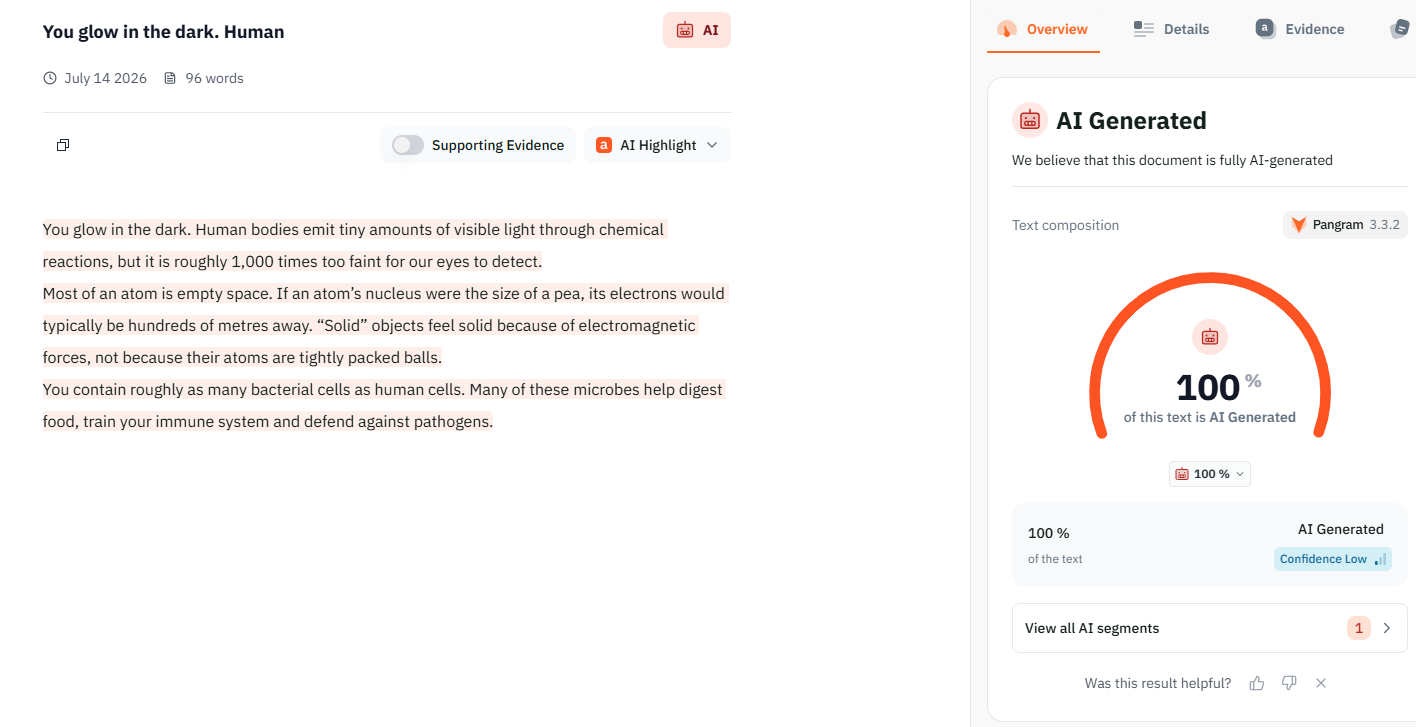
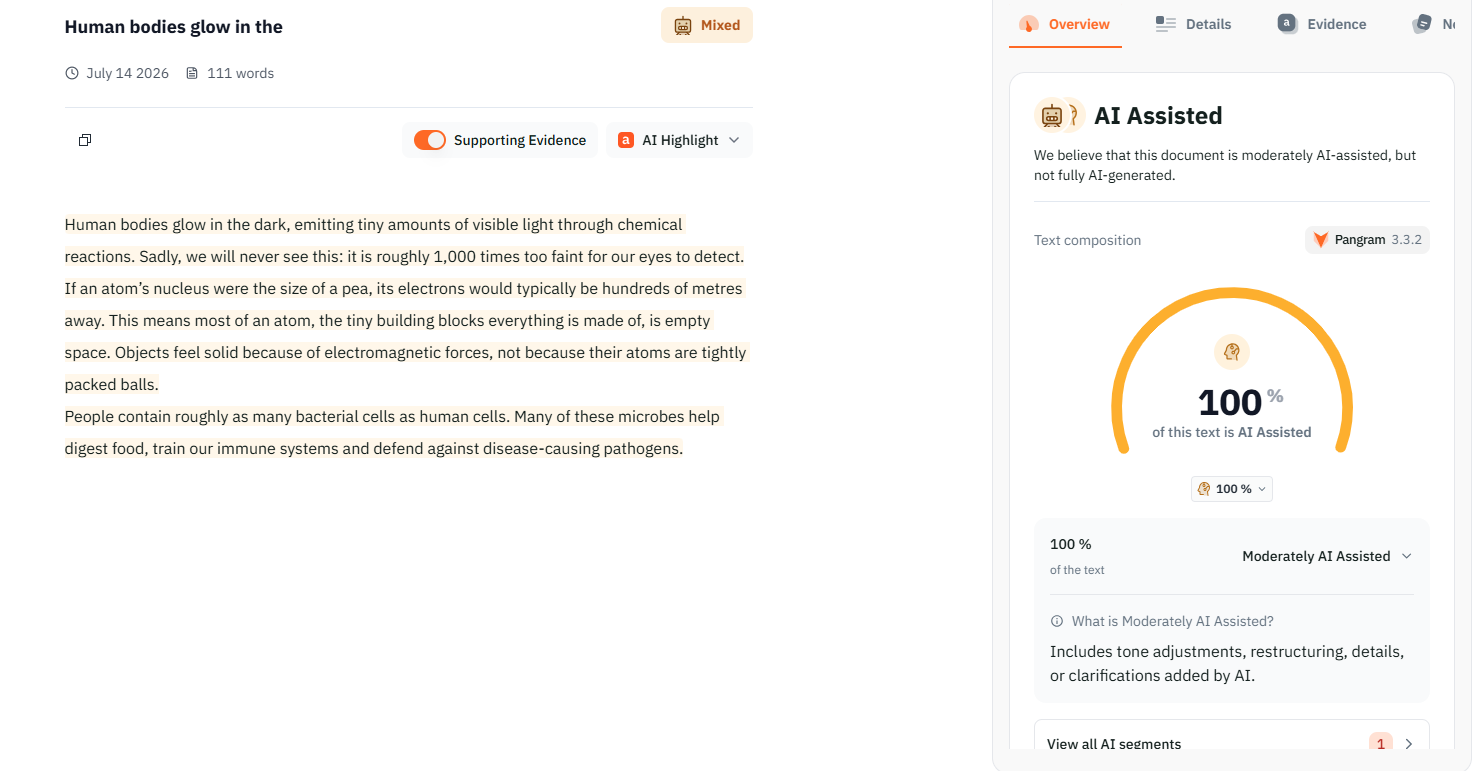

While Pangram tends to score very well in independent evaluations of its accuracy, and often better than other similar tools, it’s not fool-proof.
According to recent research, it can be tripped up by base models, meaning large language models trained on databases of text that haven’t gone through the usually human-supervised fine-tuning stage. Some researchers have suggested generative AI’s distinctive linguistic quirks could originate from the preferences of human annotators, which means they wouldn’t be present in base models.
Detectors can also be vulnerable to attempts to “humanise” AI-generated output, to new generation AI models, and to natural shifts in human language.
One of the people who recently tested Pangram is Alexios Mantzarlis, co-founder of Indicator, a digital outlet focused on tackling digital deception. Mantzarlis ran an adversarial test on the detector: he intentionally tried to get the tool to fail.
In preliminary testing, Mantzarlis found Pangram was more likely to misclassify AI-generated text as human-authored when it rhymed, repeated itself, and when it used archaic language. He then built an adversarial set of 588 AI-generated text samples tailored to these weaknesses. When he used Pangram to evaluate them, the tool falsely labelled AI text as human 86% of the time.
“I don't think that Pangram is bad,” Mantzarlis said. “I think actually Pangram at scale is probably a pretty solid tool. That said, I am extremely worried about it being used in individual cases.”
If used on a large corpus of text comprising thousands of articles, like an entire newsroom’s recent output, he explained, detector tools like Pangram could give a good overview of the proportion of these that are AI-generated. This could allow a publication or a university to develop policies and educational programs on AI use, for example.
But when used to determine if an individual text was AI-generated, even a very small error rate, like Pangram’s under normal circumstances, will mean some false positives. And when the stakes are as high as job terminations and public shaming, they could have disastrous consequences on individuals.
It’s also important for users to understand that AI detectors mostly work probabilistically, and that the most they can say is that there’s a high chance of a text being AI-generated, Mantzarlis said. They don’t actually know.
“I think we're in a bit of a pickle right now because the detector's business model relies on big institutional customers using it at scale to make important decisions and paying for it, and that's actually the worst use case for these tools,” Mantzarlis said.
What if an editor is worried about a specific reporter whose articles they suspect to be AI-generated? In that case, Mantzarlis thinks it can be helpful to use multiple AI detectors to check their work, but he also thinks this should only be one leg of the investigation.
Editors can go back to the reporter’s old articles and compare them to see if the writing style has substantially changed. They can also have a conversation with the reporter about their writing process, and potentially ask for proof of their work, such as a document history. In most cases, however, it will be impossible to know for sure.
3. Certifying that a piece of text was produced by humans
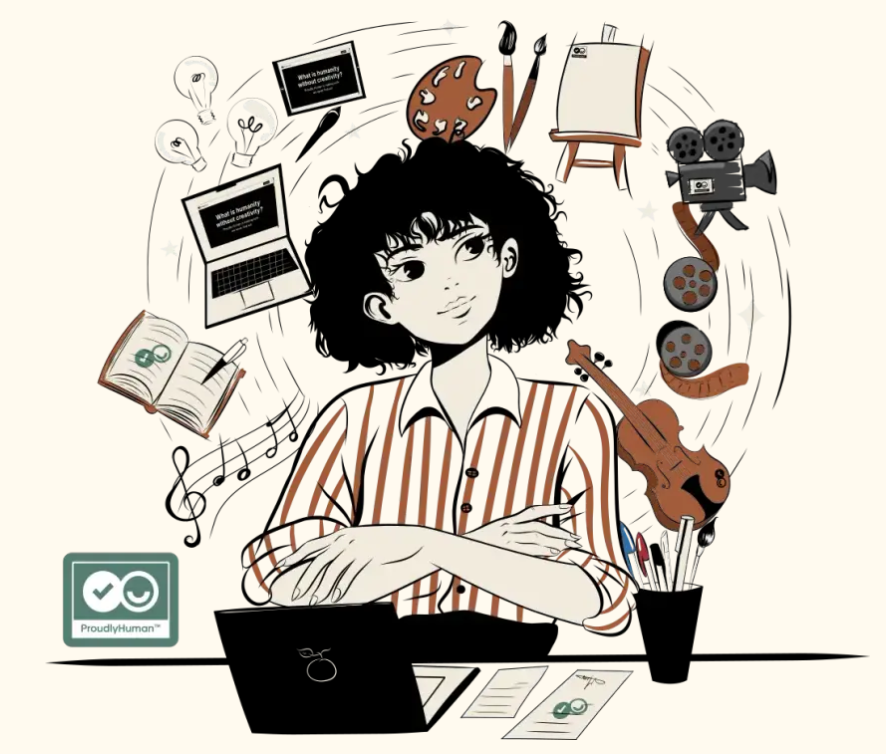
One way to circumvent the problem of false positives could be to invert AI detection, using similar techniques to instead detect human writing. This is ProudlyHuman’s pitch: a certification organisation that labels content as human-created.
ProudlyHuman started by analysing and certifying books and longer articles, and has since expanded to visual art, music and podcasts, as well as introducing dedicated services to certify students' essays and jobseekers' application materials. It’s a voluntary standard, inviting individual authors, artists or collectives to put their own work through the certification system and obtain a certificate signalling to their audiences that they have not used generative AI.
Recent ProudlyHuman certificate recipients include a book publisher, a columnist for Guardian Australia, and the design of a sapphire and diamond ring.
ProudlyHuman was founded by Dr. Alan Finkel, Australia’s former Chief Scientist and former chancellor of Monash University, with former university executive Trevor Woods. In 2023, just months after ChatGPT was released to the public, Finkel included a declaration of human authorship in his second book, asserting that he had not used AI to write.
By 2025, he was becoming concerned about the increasing prevalence of AI-generated images, music and video, he said, and teamed up with Woods to start ProudlyHuman. The core idea was: “Instead of trying to force the disclosure of AI, let's celebrate human authorship through a certification mark.”
ProudlyHuman’s certification process begins with an identity check, requiring applicants to register and verify an email account and a phone number, pass a reCAPTCHA and pay to use the service.
They are then required to declare that they have not used generative AI to produce the piece of work beyond a level inspired by the US copyright office’s standard for registering work. This is described as de minimis, meaning a minimal level of AI involvement.
The next stage varies according to the medium of the work submitted. For text, it is analysed by a combination of AI detection tools, the outputs of which are combined to obtain a percentage probability of a piece of work being AI-generated. If the percentage is above a certain threshold, the certification is not awarded. A human reviewer is involved if the case is less clear-cut. As the user, the only output received is the decision, which can be appealed.
What happens if a text, podcast or piece of art fails the certification process? “We say that we could not confirm that it was human-written,” Finkel explained to me. “We don't really want to be nasty because it could be a genuine situation where somebody just failed for the wrong reasons.”
ProudlyHuman has agreements with the companies whose detector tools it uses to ensure that the material submitted for review is kept strictly confidential and isn’t used as training data for AI systems. This is particularly important for authors and artists, given these groups’ work was used without their consent in the training of many large language models and image generators, and particularly if they submit their work to be certified pre-publication. The published version is then checked to make sure it’s the same as the one submitted for the label.
There’s also a possibility for consumers to lodge a concern if they have doubts about the certification of a piece of work. “[If that happens] we don't act on that instantly or automatically,” Finkel said. “We have a dialogue with the person making the complaint. We don't let scammers just destroy somebody's credibility. But [if someone had found out how to game the system] that's really the only way we would know.”
ProudlyHuman is not the only organisation to offer preemptive human certification to writers and artists. There’s also the No AI Movement, which offers two labels: a free No AI Declaration and a paid-for, audited No AI Certification. Books by People offers a membership to publishers to validate their titles. Until a single standard emerges, the coexistence of several labels all operating under their own rules may be confusing and struggle to break through.
4. Tracking the provenance of audiovisual files
Some voices think the solution to lingering doubts over the authorship of digital artefacts lies in a system akin to a nutrition label or a passport: metadata attached to an image, video, or audio file with details on who made it, when, and how it has changed. This is how Content Credentials work, an initiative by the Coalition for Content Provenance and Authenticity (C2PA). Members of the coalition include Adobe, Amazon, the BBC, Google, Meta, Microsoft and OpenAI.
It’s a different method of reaching some of the same aims of AI detectors or human-made certifications: to allow creators to be credited for their work, and as a measure against misinformation.
A content credential is “a cryptographic piece of data that's permanently attached to media,” explained Andy Parsons, global head of content authenticity at Adobe, a steering committee member of C2PA. This can include details such as the creator, the device used, the location and time of the recording, and any editing done on the file.
On some devices, such as recent versions of Google’s Pixel phone, content credentials are automatically attached to any photographs taken, although data that could be used to identify the creator is omitted.
“With the exclusion of GPS and [personal data], the Google Pixel phone will sign all those images and that says, simply but powerfully, ‘This was captured on a camera. This is an image that was captured on a device’,” Parsons told me. Camera manufacturers Canon, Sony and Leica also use content credentials.
These credentials can also be added at the editing stage. For example, when a project is saved in Adobe’s Photoshop, or as a kind of digital signature to prove they were published by a trusted outlet, such as the BBC.
Audiences are notified that an image or video has these content credentials by the presence of a small icon with the letters “CR”. There are various ways to check the information retained there. The content credentials website hosts a tool for users to check the metadata of any files they upload. Adobe also offers a browser extension so people can view content credentials on websites they visit.
Google has added a content credential verification capability to its Gemini chatbot, and announced the feature will be expanded to Google search and its Chrome browser in the coming months. The company also has its own digital watermark, SynthID, which is automatically added to media generated or edited by the tech giant’s Gen AI tool.
SynthID is embedded in the content itself and works differently for images, video, audio, and even text, with the aims of being undetectable, not affecting the quality of the output, and resisting attempts to remove it. For images, the watermark is located in the pixels rather than being overlaid on top. This means that, even if the image is screenshotted, the signature remains.
The clear limitation of both SynthID and content credentials is that they are only present in the output of specific companies. SynthID, although recently adopted for images by OpenAI, isn’t present in media generated by other Google AI competitors. Content credentials, although adopted by a number of well-known organisations, are still relatively uncommon when it comes to online images at the time of this writing.
There are also several ways metadata can be lost or removed when images are uploaded on online platforms. And if an image with content credentials is screenshotted, the original picture’s metadata won’t be transferred over to the screenshot, although the information can be recovered in some cases.
The Content Authenticity app, for example, embeds a watermark into the pixels of images. But someone could take a photograph of an AI-generated image with a device that uses content credentials, and the resulting image would be certified as having been taken with a camera.
Importantly, content credentials don’t analyse what the files purport to show and don’t certify that a piece of media is accurate. While providing more information about the provenance of the file can help journalists or audience members make a judgement on whether to trust it, these tools alone, like AI detectors, can’t provide a simple yes or no answer.
And there are many less technological ways for a piece of media to be misleading. In current conflicts, for example, real images from past clashes are often reposted accompanied by false claims misrepresenting what they show.
“[Content credentials are] not a way to detect the truth. No technology can accomplish that,” Parsons said.