

News
Inside the rise of AI-native newsrooms run by autonomous agents

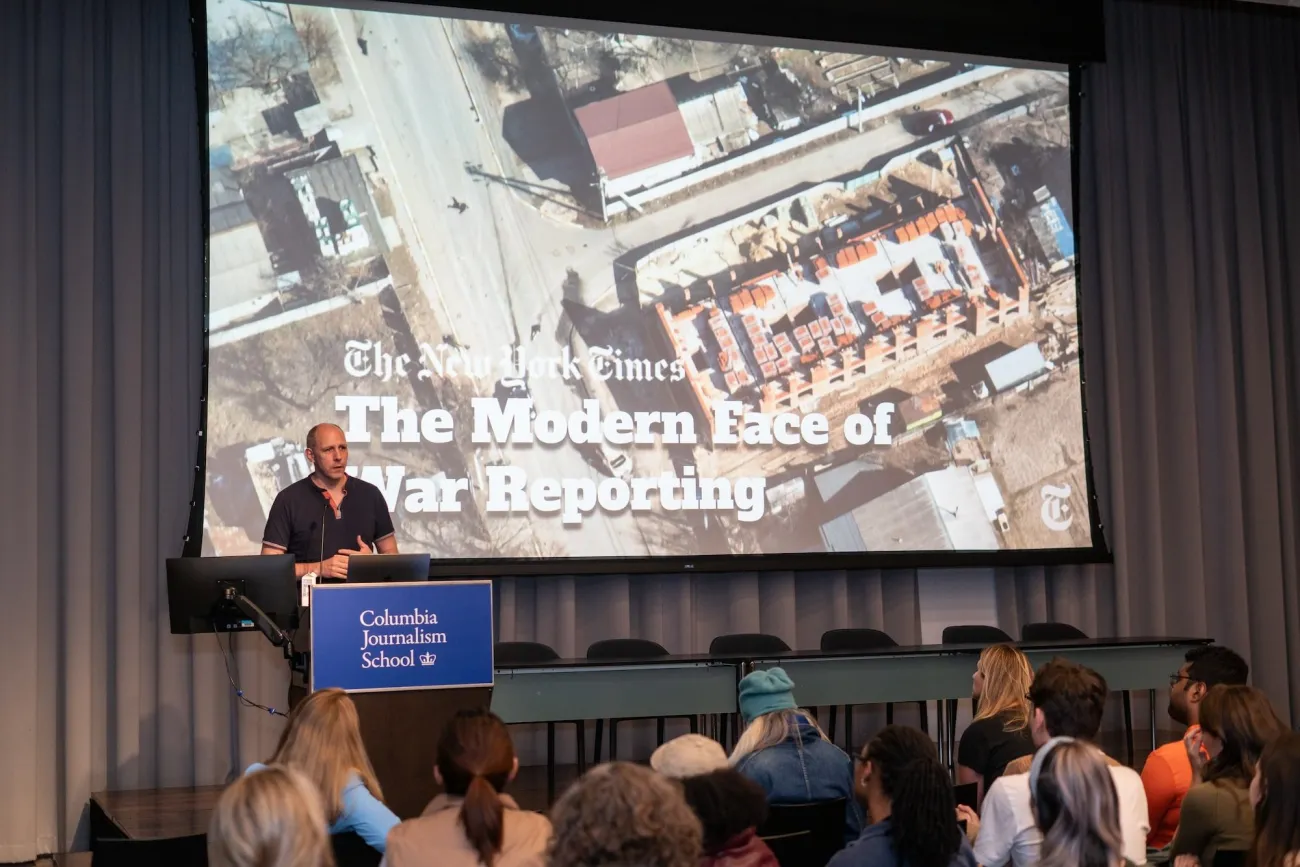
Malachy Browne presenting his work at the Columbia Journalism School in 2023.
When Malachy Browne started piecing together videos of the Arab Spring in early 2011, he wasn’t thinking about building a new kind of journalism. He was just trying to figure out what was real.
What began as the niche practice of verifying shaky mobile phone footage in an era of social media chaos has since become one of the most consequential developments in modern journalism.
As a co-founder of The New York Times’s visual investigations team, Browne helped pioneer a form of reporting that combines traditional investigative techniques with digital forensics. He uses satellite imagery, geolocation, and video analysis to uncover war crimes, expose abuses of power, and establish the facts of contested events.
The idea for the team emerged gradually. Browne credits early inspiration to groups such as Forensic Architecture, SITU Research, and Bellingcat. A turning point came at a gathering of investigators and technologists at Carnegie Mellon University, where researchers demonstrated new ways of documenting war crimes.
When he joined The New York Times in 2016, he saw an opportunity to bring open-source investigations into a mainstream newsroom with what he described as greater “reporting muscle and breadth.” Browne pitched then-executive director of video Nancy Gauss on creating a team of specialist reporters who would work alongside video and graphics journalists. Together with Gauss and his editor, Mark Scheffler, he took on a series of early visual investigations to demonstrate the approach’s potential. Then-executive editor Dean Baquet soon posed a question that would shape the team’s future: “How do we scale this?”
Today, Browne is a senior producer and enterprise director of the visual investigations team, whose work has helped turn open-source reporting from a niche verification practice into a major form of investigative journalism. In this conversation, he reflects on how the field developed, the challenges posed by artificial intelligence, and why establishing the historical record remains essential. Our conversation has been lightly edited for clarity and length.
Q. The field of visual investigations barely existed when you entered journalism. How did you find your way into this work?
A. We didn’t describe it as visual investigations when I started. It was described as open-source reporting. I started working at a company in Dublin called Storyful, which in late 2010, early 2011 was paying attention to conversations happening on social media to try to detect newsworthy events, report them out, and then visualise them. Eventually, as the company developed, we managed rights for content holders, and even earned money for them by licensing the content to news organisations.
That was really my first foray into open-source journalism and visual investigations. What we were doing back then was covering breaking news events. The Arab Spring had kicked off, and there was a huge amount of video coming out of Libya, Tunisia, Egypt, Yemen, and Syria as revolutions swept through those countries. Then there were unprecedented events like the Fukushima tsunami and a deadly terrorist attack in Norway. These were all high-profile visual stories, and the challenge for traditional newsrooms was: how do you trust this rich new source of information? That’s where Storyful came in. We developed verification practices that provided a layer of trust over the material being shared and emerging from these places.
Q. How does an investigation move from tip to publishable story?
A. It’s very much a team effort. We’re working with editors, as well as video and graphics specialists. How does a story come about? It could be a news event. Something happens -- the bombing of a school in Iran, for example -- and there are immediate questions about how that could happen. The first question is, did it happen? That’s the first verification challenge. You go through your open source reporting, your discovery processes, and collect and analyse as much information as you can, both visual and textual.
Then you start to piece the puzzle together and try to answer: what exactly happened? Who carried it out? By asking those questions, you end up with questions for the US administration for instance, because they’re the most likely culprit.
Another investigation might be thematic. I remember scanning Twitter [in 2019] and there was a post from the Red Crescent Society saying that in Syria a hospital, medical facility, or ambulance had been struck in an airstrike once every 29 hours over the past five weeks. That suggested a pattern of targeting rather than repeated mistakes, and so began a long investigation into the bombing of hospitals and medical facilities in Syria.
Then there are stories that become emblematic of a behaviour, abuse of power, or social malaise, such as the killings of Breonna Taylor, George Floyd, and Ahmaud Arbery in 2020. [Three Black Americans whose deaths became defining cases during the nationwide Black Lives Matter protests in 2020.] We recognised the importance of investigating those incidents, seeking answers, and potentially accountability.
Another example is Bucha in Ukraine, where the worst abuses of the Russian invasion took place. [Hundreds of civilians were found dead after Russian forces withdrew from the town in March 2022, prompting international investigations into possible war crimes.] We embarked on a complex investigation to figure out what happened there, which Russian unit was responsible, and whether the attacks were systematic or random.
Q. One of the things that stands out about the New York Times visual investigations team is how transparent you are about your methodology. Why do you choose to show your work?
A. We try to weave the story together with the evidence, the questions around it, the problems that evidence can solve, and the proof that supports our conclusions. We’re trying to show and not tell, and bring the viewer along on that journey of discovery.
I think it’s incredibly important now, because we’re in an environment of eroding trust in mainstream media, but also uncertainty about what is real, because of generative AI and how easy it is to create fake images or repurpose real images with a twist. That’s why it’s important to show our process. We want people to understand how we’re arriving at our conclusions.
There’s always a balance between storytelling and providing too much detail. Sometimes we’ll include a methodology section, publish a thread on X or Bluesky, or write a Times Insider article.
It’s also innate to the open source community. For most of us, it’s built into our DNA. I found that when we do that openly, it signals to people who might have more information, and can open us up to sources and avenues for further exploration.
Q. Much of this reporting involves graphic visual evidence. What have you learned about managing the emotional and psychological impact of this work?
A. Vicarious trauma is a studied phenomenon, and it does affect people. Repeated exposure to the worst of humanity has an impact. You may not always be on the front lines of a conflict, but you’re seeing the worst effects of it. Recognising that is the most important first step, and being open about it with colleagues. As managers, we keep an eye on who is being exposed, how people respond, and ensure we assign people in a balanced way.
Studies show that exposure to extremely graphic content becomes especially harmful when combined with other pressures, either at work or in life. That’s when trauma can become compounded and have an adverse effect.
For freelancers, it’s difficult because they still have to earn a living. At the Times, we have professional resources available. We provide counselling, and we’ve had group sessions where psychologists have educated us about the warning signs.
I am sometimes uncomfortable talking about this because doctors in emergency rooms, religious figures and firefighters are on the front lines of horror every day. For journalists, the important thing is recognising the impact and taking steps to make sure it’s not affecting us in unhealthy ways.
I have found material from some of our stories extremely upsetting, but it can also be motivating if you’re spotlighting an issue where people are on the wrong side of an imbalance of power.
Q. You’ve reported on some of the world’s most contested stories, from the January 6 US Capitol attack to the Bucha massacre. What have these investigations taught you about establishing facts where radically different narratives exist?
A. The radically different accounts are largely down to media environments and political leaders spinning a particular narrative or framing of events. Our job is to cut through that and find the truth. Bucha showed me that, perhaps for the first time, we were able to collect sufficient evidence within months of an event that could potentially be used in a war crimes tribunal. We don’t work directly with accountability mechanisms, but by collecting evidence, analysing it, and arriving at conclusions, we hope we’re showing how this material can be used. Organisations such as Human Rights Watch, Forensic Architecture, and Amnesty International have invested heavily in teams that do this kind of work, and they’re producing remarkable investigations.
I think the institutions responsible for prosecution and accountability still have some catching up to do in terms of deploying these skills and methods. More broadly, it has shown me that there is an abundance of evidence in the digital world. As reporters, we can collect it, synthesise it, and use it to answer important questions about what happened, whether in conflict zones or in situations where there are competing narratives about the same event.
Q. For journalists who want to get better at visual investigations, what are some tools or techniques they can start exploring?
A. For me, the process is very much about collecting information and mapping things out in space and time. I use tools like Google Earth to plot where things happened, key events, people, pieces of evidence, videos, and photographs, and then combine that with a chronology of events. Those two things repeatedly help me answer questions or reveal the story. Take the example of a recent strike in Iran. Videos emerged on social media within about 30 minutes of each other. Once I verified where they were taken, I could confirm that both a school and an Iranian military facility beside it had been struck in the same initial wave of attacks.
That immediately suggested certain possibilities about who was responsible, because those actors were already targeting military facilities in the area. Then, by comparing the videos with satellite imagery, you can determine that these were highly precise strikes, likely involving precision-guided munitions.
By mapping everything out and continually asking questions, you open up avenues for further investigation and eventually questions for the authorities involved. Going through that process allows you to build confidence in your conclusions.
More broadly, anyone who wants to get into this type of journalism should know that there is an abundance of resources available online. Bellingcat publishes a huge amount of material. There are communities on X and Bluesky. There are Discord groups, including Project Owl and Bellingcat’s own Discord channels. You can join those conversations, contribute, and learn on the job. That’s really the best way to learn.
Q. When you teach or mentor journalists who are new to open-source reporting, what are the most common mistakes you see?
A. I’ve seen people arrive at the wrong conclusions because they didn’t fully understand how to conduct this type of analysis and this is in major international newsrooms. You have to make sure you’re assuming nothing, and cross-checking your work with experienced colleagues. This type of reporting is highly collaborative and works best in a team environment. And don’t get caught out by AI.
Going back to your earlier question about graphic content, I’d also say that people should pay attention to how that material affects them. It affects different people in different ways. If it’s affecting you early on, recognise that and talk to your manager or colleagues about it.
Finally, I’d encourage anyone interested in this work to simply start doing it. Self-publish, contribute to collaborative investigations, or work with collectives like Bellingcat. There are endless opportunities and endless stories waiting to be told.
Q. What do you think the next major challenge for visual investigations and open-source reporting will be?
A. I think the rise of AI-generated content is probably the biggest challenge within our space. I also think diminishing newsroom resources are going to be a major challenge, especially for organisations that aren’t large newsrooms.
Investigative work requires time, skill, and patience. News organisations facing increasing budget constraints are going to find it difficult to support that kind of reporting. More broadly, journalism itself is becoming more expensive.
We’re no longer simply delivering a newspaper to someone’s doorstep. We have to produce video, graphics, and content for multiple platforms and audiences. At the same time, this is an enormous opportunity because digital platforms allow us to reach massive audiences.
The last thing I would say is that it’s incumbent on newsrooms to explain their reporting process and think seriously about how audiences can regain trust and engage more deeply with journalism.
Q. How do you see AI changing this field over the next few years?
A. I think visual verification, and particularly audio verification, is going to become extremely challenging. We interviewed Hany Farid, who is an expert in media manipulation and AI-generated content. He’s been at the forefront of this work for decades, and he warned that detection tools are struggling to keep pace with generation tools. It’s becoming an arms race. We’re going to see a lot more of it. It’s going to continue to erode trust, and when you have political leaders who deny what’s obvious to everybody, that only creates greater distrust.
That’s also where the value of rigorous methods, processes, and standards comes in. Teams like ours are trying to separate fact from fiction and arrive at the truth in highly contested environments. My hope is that audiences will increasingly recognise that value.
On the positive side, AI is also a fantastic tool that we’re only beginning to understand. As long as it’s used appropriately, it can be a tremendous aid to reporters. We’ve already used it to analyse imagery at scale. One example was during the early stages of the war in Gaza. Israel had designated parts of southern Gaza as safe zones for civilians fleeing from the north. We knew bombs were falling there, but we didn’t know how many. The largest bombs leave distinctive craters in sandy terrain. We obtained satellite imagery, and an AI model scanned before-and-after images of the area. It identified more than 500 craters consistent with 2,000-pound bombs in areas designated as safe. One of our reporters verified every single one of those strikes: confirmed it wasn’t an old crater, that it wasn’t a water tower mistaken for a crater. There were over 1,600 other craters as well, which shows the scale of bombardment, and this was only a month to a month and a half into the conflict.
It’s harder to use AI to detect more complex shapes with inconsistent features. The machines are learning, though. AI can also scan large volumes of video or imagery for objects or activity. If you have a week of CCTV footage, for example, you don’t necessarily need a reporter watching every second. An algorithm can identify moments when movement occurs or when a specific object appears in frame.
Another example was the Chinese surveillance balloon that crossed North America. We worked with a computer vision company and searched large amounts of satellite imagery for the distinctive characteristics of the balloon. We were able to track it from shortly after launch in China all the way across the Pacific and into North America.
Q. Investigative journalists often hope their work will lead to accountability, but that doesn’t always happen. How do you think about the value of investigative reporting when institutions fail to act on the evidence?
A. The impact of investigations can be hit or miss. Sometimes you see direct impact and sometimes you don’t. A lot depends on the authorities in power at the time and whether they’re willing to accept findings rather than immediately become defensive.
When you have an administration that repeatedly lies and obfuscates, it can be difficult to create impact from your work. The same is true when there is little accountability for repeated war crimes or other serious abuses. In those situations, it can sometimes be difficult to see the immediate value of the work. But I still think there is tremendous value in establishing the truth for the historical record. That record can later be used by accountability mechanisms, prosecutors, historians, or others seeking to understand what happened. So even when impact isn’t immediate, the work remains important.
In every email we send you'll find original reporting, evidence-based insights, online seminars and readings curated from 100s of sources - all in 5 minutes.