News
New York Times’s Malachy Browne on the future of visual investigations in the age of AI


An advert for an Israeli television channel that will broadcast Israel's election coverage features Israeli Prime Minister Benjamin Netanyahu and former Israeli military chief Gadi Eisenkot, leader of the Yashar party, ahead of Israel's national election, on a bridge in Tel Aviv, Israel, October 21, 2026. REUTERS/Ammar Awad
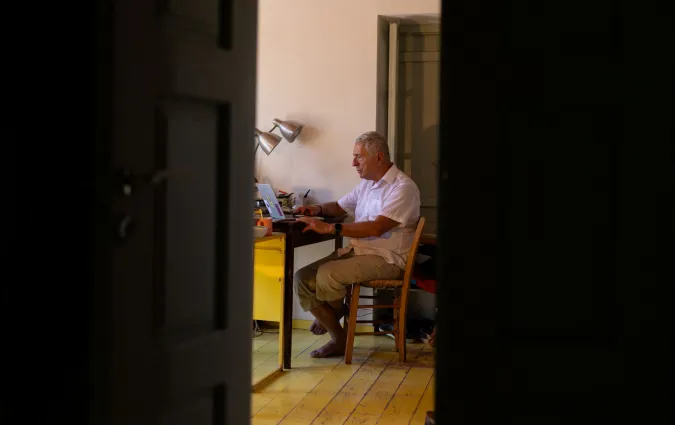
When 41-year-old Achiya Schatz pauses to think, he lifts his arms behind his head, revealing a tattoo on the inside of his upper arm. It reads be-emet: Hebrew for “in truth” or “really”.
Schatz says the tattoo has no connection to what he spends most of his days doing: tracking misinformation online. Yet the phrase seems apt for someone whose work over the past six years has revolved around separating fact from fiction in what is likely the most polarised time in his country’s history.
Schatz is one of the founders of FakeReporter, an Israeli non-profit watchdog that investigates malicious online activity. Nowadays, he spends a lot of his time in Barcelona, where he likes to blow off steam away from the charged atmosphere in the Middle East.
But as Israel braces for its first election cycle since 7 October, Schatz is back in his home country, and FakeReporter’s work in full swing. Many analysts have dubbed the upcoming 27 October vote as potentially the most pivotal in the country’s history, given the context of war, domestic infighting, and persistent divisions around the figure of Prime Minister Benjamin Netanyahu. This is also reflected in the scale of disinformation spreading online, Schatz says.
“There are three main conspiracy theories spreading in the online space. The first is the so-called treason from within, the one that claims that there were traitors inside the Israeli state apparatus that cooperated with Hamas on October 7”, he says.
Such a conspiracy theory has been subtly promoted by members of Netanyahu’s political and personal circles prior to and in the run-up to the third anniversary of 7 October, as a way to absolve him of responsibility for the security failures.
“There’s a lot of dog whistling around it”, says Schatz. “The idea of treason from within has a long history. It was always there in the background, with Netanyahu repeatedly claiming that a deep state was at work.”
Netanyahu has not explicitly endorsed these theories, but tacitly encouraged their promotion by his loyalists. For example, Netanyahu’s wife Sarah has suggested during a televised interview on the pro-government Channel 14 that left-wing leader Yair Golan knew of Hamas’ plans in advance.
Schatz says the second most common conspiracy theory is an evolution of this first one. “It says that the generals, the Shin Bet, and the Chief of Staff have been heavily poisoned by the protests against Netanyahu and therefore refused to let him know about the attacks of October 7, which led to such horrific results”, Schatz says. Establishing responsibilities for the October 7 security failure is a key battleground in the election campaigns, with the opposition calling for an independent state enquiry into the events.
At the height of the protests against the judicial reform in 2023, there was a call to stop reporting for duty within the Israeli military, in order to increase political pressure on the government to abandon it. After 7 October, however, the use of that political pressure was revisited and reframed as a deliberate act engineered to topple Netanyahu.
Finally, in the run-up to the vote, Schatz identifies a wave of fake news targeting the Arab minority of Israel, which numbers around 2 million — making up roughly 20% of the population. “Like always, there are many bogus stories on how Arab citizens of Israel cannot be trusted in the shared space, in the shared society”, he says.
Since its launch in 2020, FakeReporter has identified Iranian-linked networks using fake Israeli social media profiles to sow division, anonymous accounts used to harass journalists and activists, viral misinformation during the war in Gaza (including fabricated footage falsely claiming to show Israeli children held in Hamas cages) and coordinated campaigns aimed at influencing public debate.
With Israeli elections fast approaching, Schatz says FakeReporter’s team is grappling with a sharp increase in influence operations and coordinated online manipulation campaigns.
Most recently, FakeReporter uncovered a bot network operating through AI systems campaigning for far-right “Jewish Power” leader and Minister of National Security Itamar Ben Gvir against rivals within the Netanyahu camp. The organisation also identified an SMS campaign by Netanyahu’s Likud against right-wing opposition politician Avigdor Lieberman.
Schatz explains that FakeReporter’s election strategy is divided into three phases. The first focuses on “pre-bunking”: building public resilience against disinformation and influence campaigns. During the second phase, on election day, the organisation will operate a situation room to rapidly expose false claims and fact-check suspicious content. The third phase begins once polls close, when the priority shifts to combating disinformation at a critical moment, “when people need to accept the results”.
“The town square is now digital,” he recently told me. “It’s where people are speaking, convincing one another. So, of course, it’s also where people try to manipulate and gain power – especially political power. The new town square is a place where you can be attacked, lied to or robbed, and there are no consequences. Someone has to help protect it.”
The organisation’s work is not limited to investigations, however. Education is another major pillar of FakeReporter’s work, aimed at helping people navigate the digital sphere more safely. Its members regularly give talks on media and digital literacy in Israeli schools, local communities and other organisations.
Unlike civil society organisations associated with the left by pro-government circles – such as Breaking the Silence, an NGO in which former soldiers speak out about wrongdoing during their military service, and which has been barred from giving talks in schools – FakeReporter is considered “a very mainstream organisation,” says Schatz. Its work is widely accepted in Israel, including in schools. “I think a healthy public digital sphere is not really a matter of politics,” he adds.
FakeReporter also provides immediate support to people targeted by online shaming, doxxing or disinformation, offering what Schatz describes as “a kind of first aid” to help victims respond. The aim, he explains, is to prevent the chilling effect of digital attacks from shrinking the space for democratic debate online.
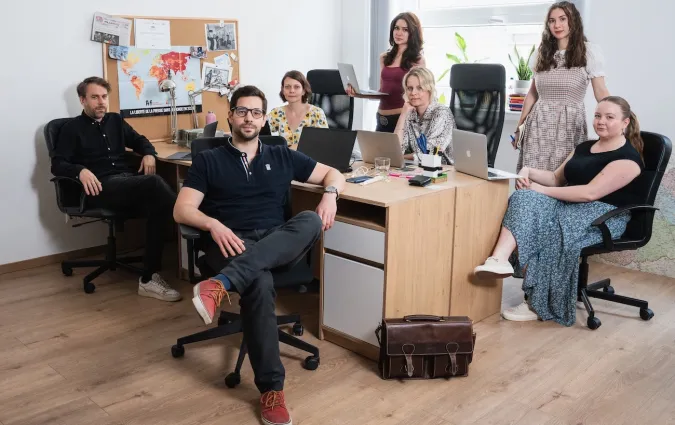
The organisation is formed of a core body of around 15 full-time staffers but also relies on dozens of volunteers and a wider community that helps flag suspicious content for investigation. “Most of the reports or the claims we dive into come from the public,” Schatz says. There is an office in Tel Aviv but coordination between staffers mainly takes place remotely.
Schatz said the New Israel Fund, an NGO that supports mainly left-wing civil society organisations, is the main donor. But FakeReporter’s work is also funded by hundreds of monthly donors, known as “Friends of Truth” (Haverei Emet), alongside private donors, family foundations, Jewish philanthropic funds such as The Jewish Federations of North America (JFNA), a body representing Jewish communities across America, and, lately, a small EU grant.
Schatz said the organisation’s work peaked during the Gaza war. “We were working around the clock and were able to become fact checkers for the biggest outlets around the world”, he said. This, however, is not the work he is most proud of. “Fact checking in general is not something that I see as the most important, usually. It’s important as a tool to teach and to show broader trends. But I am not a big fan of fact-checking on its own, without showing propagation patterns and the bad faith actors behind it”.
In the complex and tragic context of Gaza, Schatz admits fact-finding was not without its challenges. “At the beginning of the war, we were heavily focused on disinformation and traditional fact-checking. We wanted to establish the facts, but getting reliable information about what was happening in Gaza was extremely difficult. Even traditional open-source intelligence (OSINT) methods proved challenging,” he said.
FakeReporter was born during one of the most turbulent periods in Israeli politics. The organisation was founded in 2020, as Israel found itself trapped in an unprecedented political gridlock, with four parliamentary elections held in less than two years.
Prime Minister Benjamin Netanyahu had become too polarising a figure to assemble a governing coalition, but he refused to step aside and corruption charges against him fuelled a growing protest movement.
“Hundreds of thousands of people were joining the demonstrations,” Schatz told me. “Small groups would gather in strategic locations across Israel, coordinating through WhatsApp groups.”
Those activists soon found themselves targeted online. “They were being attacked,” he said. “Their photos were being taken. People were doing Facebook Live videos against them. We wanted to understand who was behind it and how it was being done.”
What began as an informal network of volunteers quickly evolved into FakeReporter. “We were a small guerrilla group of researchers who really love and enjoy quests online,” Schatz said. “Geolocation, open-source intelligence, social media investigations.”
At the time, he argued, there was little institutional capacity to respond to coordinated online abuse: “You could spread private information, conspiracy theories or lies about people, organise attacks against them, and nobody would do anything. Authorities were not always up to speed with these threats. So we started doing it ourselves.”
As the organisation grew, so did the scope of its investigations into online harassment.
One expression has come to symbolise that phenomenon in Israel: Mechonat ha-ra'al – literally, “the poison machine”. The term, now widely used across the political spectrum, describes coordinated online campaigns that combine personal attacks, conspiracy theories, hate speech and disinformation to discredit political opponents, most often targeting Netanyahu rivals.
“Every politician strives for a machine that helps push their messaging,” Schatz said. “The problem arises when this is done through violence, racism, hate speech, lies and conspiracies. That’s what we call poison.”
Schatz believes these influence campaigns often leave a deeper mark on Israeli public life. But this doesn’t mean FakeReporter ignores foreign interference. Ahead of elections, he said, “Iranians are always top players in the disinformation field”, adding that some operations appear connected to Russia and other campaigns seem to be linked to the Arab world.
Their aim is generally twofold: first, to deepen social polarisation by inflaming divisive issues within Israeli society; and second, to recruit Israelis. “Many of these campaigns are designed to build relationships with Israelis and eventually persuade them to carry out actions on Iran’s behalf,” says Schatz.
Schatz recounts a recent case in which an Iranian-linked account posing as an Israeli posted inflammatory messages, including incitement against Netanyahu. The posts were then amplified by Netanyahu supporters as evidence of the extremism of his political opponents. The same account later created a Facebook group purporting to support Naama Lazimi, a lawmaker from the Democrats party, inviting Israelis to join. Once members had been drawn in, the group could be exploited for other purposes.
“Ultimately, it’s about gaining trust, gaining control and gaining access,” Schatz explains, “and then using that access to pursue different goals.”
Artificial intelligence is now making the challenge more complex. The war between Israel and Iran in June 2025 offered an early glimpse of how this emerging technology is reshaping psychological warfare.
The New York Times reported that AI-generated images and videos about the conflict circulated widely online, including fabricated scenes of attacks and destruction.
Schatz argued that the real challenge goes beyond spectacular fakes: “AI is increasingly being used to power micro-campaigns targeting specific audiences, and you can scale that easily because you don’t need a person to write all those messages. It’s not just about deepfakes.”
Do people at FakeReporter see themselves as journalists? Schatz gives a nuanced answer. “There are journalistic features to what we do,” he says, particularly the work of “exposing what is not exposed to the public” and promoting fact-based debate. He describes much of it as “meta-journalism”, supporting a profession increasingly under attack.
But, “at the end of the day we work for civil society, we are not journalists,” Schatz says. “It’s not exactly journalism, but we can call it being good neighbours.”
Schatz’s interest in disinformation is rooted in an unlikely place: his military service.
Coming from a family marked both by the Holocaust and Israel’s wars, he grew up hoping to serve in one of the army’s elite units and then work for the foreign ministry. He eventually joined Duvdevan, a special forces unit which is mainly responsible for operations in the occupied West Bank.
Over time, however, he began questioning the effectiveness of many of those missions. “In every operation where you take over one house, you also take over five surrounding houses belonging to innocent families,” he told me. “You raid them in the middle of the night, scaring innocent people to death. I often discovered the threat we were acting against amounted to almost nothing. I could not stop thinking what we were doing was counterproductive.”
Those doubts eventually brought him to Breaking the Silence, the group of former Israeli soldiers that documents unethical military practices in the occupied territories. As its spokesperson, Schatz witnessed first-hand how sharply polarised Israeli public discourse had become.
Following a TV investigation into the organisation in 2016, ministers from across Netanyahu’s government publicly denounced the group and introduced measures restricting its activities.
“Minister after minister came out against us,” Schatz said. “The defence minister called us traitors. The education minister said we were no longer allowed into schools. The culture minister barred us from public institutions. Less than an hour after this TV report, Netanyahu said the security services were looking into us.”
In the following ten years, polarisation in Israel’s public discourse started to become more extreme, and an increasingly flawed online information environment tore society apart even more.
FakeReporter’s work is no longer confined to mainstream social media platforms. Much of the political conversation now unfolds in messaging apps and alternative news channels, operating outside the norms of traditional journalism.
“A lot of what we see is actually happening not only on Facebook, Instagram, TikTok or X, but under the radar in messaging apps – in what we call alternative news channels on Telegram and WhatsApp,” he said. “Nowadays they are very impactful in Israel, and this changes the field and influences elections.”
Schatz traces the first major shift to the May 2021 conflict between Israel and Hamas, when unrest spread to mixed Jewish-Arab cities inside Israel. Telegram groups proliferated, as activists used them to coordinate attacks and mobilise supporters.
“Back then, we documented about 100 groups that appeared in just a few days in order to organise people to go out and carry out attacks in the streets,” he said.
A second, even larger transformation followed the Hamas attacks of 7 October 2023. People turned to large Telegram groups for urgent news. “You had a 50% rise in Telegram use after the attacks,” he said. “Everyone was consuming news mainly from those channels, and that became a serious new realm in the media field.”
The demand for immediate security updates often outpaced the ability of traditional Israeli media, bound by military censorship and verification standards. This gap was filled by Telegram groups, some of which today count hundreds of thousands of members.
“It’s not just about spreading fake news,” Schatz said. “It’s a question of what is being shown to you. If all you get is press releases from the government and other entities, without investigations or questioning of sources, then you don’t get news. You get PR.”
Alongside Telegram, a new generation of digital-first outlets has rapidly expanded its audience. Schatz points to Push.il, an Instagram-based news aggregator that has become one of Israel’s largest news brands online, predominantly espousing a right-wing perspective.
Schatz believes traditional Israeli media largely failed in its mission to convey to Israelis the full picture of what has been happening in the Gaza war and elsewhere in the region over the last few years. Mainstream channels, like Channel 12, have been criticised for their lack of coverage of Gaza’s civilian casualties. Research by media scholar Dr Ayala Panievsky found that, of more than 700 prime-time news items aired during the first six months of the war, only four mentioned civilian deaths in Gaza.
“The Israeli media didn’t do its job,” Schatz argues. “It is partly responsible for the cognitive dissonance among Israelis regarding the war, leaving them with little understanding of what it actually looked like and what its consequences are.”
Schatz thinks media outlets initially felt the need to support their country in a moment of need. “I think the Israeli media were more sort of enlisted in the war effort, and I understand the emotions behind that. But the media have a different job: to communicate reality, even when it is harsh. The Israeli public showed little interest in or empathy for what was happening in Gaza, but that is not a good enough excuse. Israeli media need to reflect on their role during the war and where they failed to fulfil it.”
Schatz emphasises that information disorder and false narratives are not unique to Israel. But he argues the country’s intense political tensions, repeated election cycles and permanent security crises have turned it into an unusually revealing case study.
“Misinformation happens all around the world,” he says. “But in Israel, many times, things are on steroids.”
Looking ahead to Israel’s 27 October election, Schatz says he’s cautiously optimistic they may lead to some improvement and to a less toxic public debate. “But I think it’s not going to be enough for substantial change,” he says.
In every email we send you'll find original reporting, evidence-based insights, online seminars and readings curated from 100s of sources - all in 5 minutes.