




News
This journalist built a database tracking thousands of cases of AI adoption in news organisations. Here’s what she’s learnt

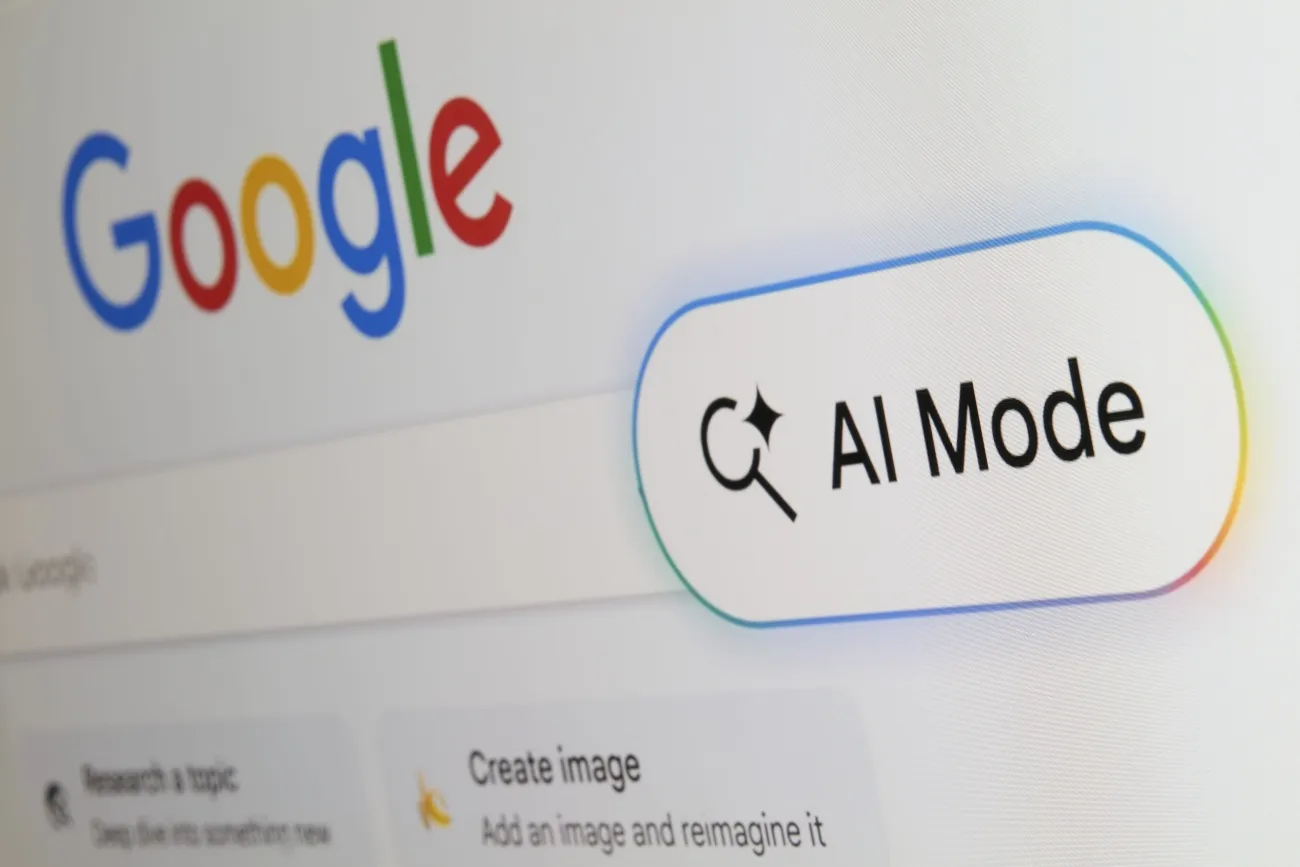
Google's AI Mode feature is displayed on the Google Search homepage in this illustration photo taken on September 9, 2026. (Photo by Matteo Della Torre/NurPhoto)
Traffic from search to publishers has plummeted in the past year. According to Chartbeat’s annual publisher playbook, referrals from Google Search to hundreds of publishers declined by 40% from July 2025 to July 2026, twice as much as in the previous 12 months. In this context, many media managers are concerned about so-called “Google Zero”: the idea that Google will stop functioning primarily as a gateway to the web and will become an answer engine instead.
In the past two decades, newsrooms learned how to make journalism visible to Google. They built SEO teams, trained their journalists to rewrite headlines and structured articles around search queries. Now, audiences are increasingly getting some of their answers directly from Google’s AI Overviews or from their favourite AI chatbot, rather than clicking through search results to a publisher’s website.
At the time of this writing, Google doesn’t include AI Overviews in news queries. But you can get similar summaries from Gemini and other chatbots, and news-adjacent queries such as historical context on Iran or biographical information on leading politicians do include AI Overviews, competing with output produced by professional journalists.
As search, discovery and traffic become increasingly fractured, publishers are reckoning with how to remain visible in the era of generative AI. Many are focusing on building stronger and more direct relationships with audiences. But others are beginning to pay attention to their AI visibility: how often and how prominently they are cited in AI search tools and assistants such as ChatGPT, Perplexity and Google AI Overviews.
I spoke with five newsroom experts experimenting with this nascent practice to learn whether it is possible to optimise a news site for AI discovery, which kinds of actions are counterproductive, and which experiments are working to gain visibility in this new world.
Unlike traditional search engines that deliver a list of links, AI platforms retrieve information across sources and synthesise it directly into summaries, with a selected number of sources being featured in those answers. How can publishers maximise their chances of getting featured in those AI answers?
With SEO and social platforms, you have metrics and analytics dashboards that tell you what sort of content is performing well: what keywords to use, what article structures are the most SEO-friendly, and what topics are the most sticky. AI search, however, is a black box: you can see what comes in and what comes out; but what happens in the middle is a mystery.
“I’ve seen countless playbooks, many with contradictory advice,” said Ezra Eeman, Director of AI in Media at WAN-IFRA. “If you monitor which sources rank highly in citations, you’ll see that it fluctuates a lot. At one point it was Wikipedia, then it was Reddit, then YouTube. Every month there seems to be a new favourite, and it’s not the same across different platforms.”
Eeman told me that different AI platforms prioritise different sources because they use different search and retrieval systems. What we do know, he said, is that across LLMs, citations tend to be highly concentrated among a small number of dominant sources, making it difficult for smaller publishers to break through.
“We have such little data across the industry that it’s actually annoying,” said Shelby Blackley, Director of Global SEO & AI Search at New York Times-owned The Athletic and co-founder of the WTF is SEO? Newsletter. “It’s such a black box of what works, what doesn’t. It changes so consistently.”
Clara Soteras, an SEO and audience consultant, admitted there is not a magic formula but argued that so-called GEO (generative engine optimisation) is not entirely a black box: publishers can learn through trial and error and use tools to monitor prompts, brand mentions and formats that perform well.
Research into what gets cited by AI engines does suggest there is no single GEO formula. Studies find that relevance, recency and extractable evidence such as statistics and quotations can improve citation visibility, while formatting changes have less consistent effects. Citation patterns also vary considerably between ChatGPT, Gemini and Perplexity, with each favouring different sources.
All of this suggests that, while GEO isn’t a complete black box, it has nothing yet resembling SEO’s mature playbook.
“No one has a magic wand, but various tools allow you to monitor your brand,” said Soteras, who stressed news organisations should change their mindsets in this new world: “KPIs need to change. Many [newsrooms] are still based on unique users and page views, while mentions in AI Overviews, for example, don’t generate clicks. Therefore, those metrics need to change.”
The use of generative AI is exploding. According to our own survey data across six countries, weekly use nearly doubled from 2024 to 2025 (18% to 34%) and has likely kept growing substantially ever since. The use of chatbots for news remains much lower. According to the Digital News Report 2026, only 10% of our global sample use them for this purpose. But the percentage is much higher within the youngest age groups.
In light of these figures and despite the absence of a clear playbook, some publishers have started taking GEO seriously and peeking inside the black box to understand what, if anything, they can do to become more visible.
Ben Berkowitz, who oversees newsroom AI operations at Axios, said that they are preparing for a GEO world by building up their reputation as an authoritative brand. “We spend an extraordinary amount of time thinking about all the ways that we interact with AI, how AI interacts with us, and how we feed and structure our content,” he said.
Berkowitz says they’ve tested likely user queries and track how often they appear in AI citations. But this process remains highly experimental because LLMs can produce different answers and citations even when given the same question several times.
“To some degree, you have to lean into authority and do structural things that make your authority clear: depth of expertise, depth of information, clarity of information,” said Berkowitz. “One thing we’ve found is that a huge advantage for Axios is that our Smart Brevity format [with articles often presented in short paragraphs and bullet points] is incredibly LLM-friendly. It is atomic, to a degree, in the way that LLMs prefer.”
That could also appear to create a vulnerability: if an AI Overview can extract and reproduce the essential information in an Axios story, why will the reader need to visit Axios?
Berkowitz’s answer was that Axios is betting on something harder to replicate than format alone: its authority, subject expertise and relationship with readers. Even when an AI answer produces no immediate click, he argued that having Axios prominently cited still strengthens the brand.
“It’s not just traffic; it’s brand as well,” he said. “We want to show up in citations. We want to be an authority on the things where we have cultivated more than a decade of expertise.”
Their value proposition is the relationship they have with their audiences, not necessarily their Smart Brevity format. Their newsletters, events and recurring relationships with audiences, he argued, are the reason why readers will stay with Axios even when search or social traffic declines.
Jessie Willms, SEO Editor at the Guardian and also co-founder of WTF is SEO? Newsletter, told me that publishers should treat GEO as an additional layer on top of strong SEO fundamentals, not a replacement for them. Once the technical and content basics are in place, they can experiment with optimising for generative search while continually monitoring how AI is changing discovery.
“I don’t think it’s necessarily priority number one if you haven’t already done all the basics,” Willms said. “But because generative search is changing what readers see, it’s something we should be looking at consistently to understand how the experience is changing, where it creates headwinds for our ability to reach readers, and where there are opportunities for our journalism to show up.”
There is an enduring dilemma sitting at the heart of investing in AI search: visibility does not necessarily translate into traffic. A study from Pew Research Center based on over 68,000 searches by 900 US Google users in March 2025 found that only 1% ended up with a click on a source cited in a Google AI Overview.
The experts I spoke to argued that GEO needs to be understood in broader terms. Eeman said appearing prominently in AI answers can build brand recognition, attract subscribers, strengthen the case for licensing deals, and even give publishers leverage in negotiations with AI companies.
“If you see that you’re always the answer to a question, that you’re a top authority, that gives you negotiating power to go to the LLMs and say, ‘We are in 80% of answers. We’re always there. You need us,’” he said.
There is some evidence that this visibility is already concentrated. For example, research into AI citations has found that a relatively small group of news organisations receive a large share of citations. There is no universal ranking of AI’s favourite publishers: the outlets cited most frequently vary between ChatGPT, Google, Perplexity and other systems. But established brands such as Reuters, the BBC, the New York Times and the Guardian frequently feature prominently.
So where does that leave smaller publishers?
Eeman told me that they may have an advantage when producing specialised or local information that larger organisations cannot create. Instead of competing on stories covered by hundreds of outlets, the opportunity might lie in answering questions for which they are one of only a handful of authoritative sources.
“For smaller publishers, it’s about the questions they can uniquely answer,” he said. “If you’re the only source in the world that has an answer about something very local, there are only a few sources that have that information and then you will be found and cited.”
The editors I spoke to agree that even when AI search does not drive traffic, publishers still need to be visible where audiences are searching. Blackley, from The Athletic, said that, for her publication, being absent from AI-generated answers about sports would represent a missed opportunity, regardless of immediate clicks. Appearing in AI summaries can build brand awareness and familiarity, potentially encouraging users to return directly later.
“Do I think it’s right? Absolutely not,” said Blackley. “But search is changing as a behaviour. People are using AI summaries to orient themselves, and the sources being surfaced create a psychological connection: ‘Oh yeah, I remember that brand,’ or ‘I read this there.’ That can create a relationship that leads to a return visit or direct navigation.”
As news organisations prepare their websites for GEO, they are facing a separate dilemma: whether or not to block AI crawlers. These are bots that companies such as Google or OpenAI use to scrape data from websites to train their large language models.
According to our own research, 48% of major news sites across ten countries were blocking OpenAI’s crawlers by the end of 2023. The concerns were fairly straightforward. Publishers did not want journalism used to train commercial models without compensation; they worried AI answers would substitute for visits to their sites; and they had concerns about inaccurate information being attributed to their brands.
Three years later, however, the blocking strategy is becoming more complicated. If a publisher blocks the crawlers responsible for retrieval, it can reduce the chances of its journalism appearing when somebody asks a relevant question to an AI system.
Eeman says publishers should think selectively about what they make available to AI. Premium journalism might remain protected while free content is opened to crawlers as a way of introducing people to the brand. The calculation can also depend on what their journalism offers: a generic summary may be easily substituted by an AI answer, while live updates, archives or hyperlocal reporting can give readers a reason to seek out the publisher itself.
“The whole strategy around bots, which ones you allow and which ones you don’t, is not black and white,” said Eeman. “The more mature publishers are connecting their strategic goals to their bot strategy and to how they measure and understand these environments. That gives you a strong triangle.”
Blocking AI crawlers is an option, as is licensing content to AI companies, though licensing may provide only short-term or uncertain revenue, argues Willms from the Guardian. The crawler decision ultimately depends on a publisher’s broader audience strategy.
“If you are covering politics and people are using Gemini to get a summary of politics every single day and you’re not there, that’s a big missed opportunity,” said Willms. “If AI becomes the default experience for getting information on the internet and your brand isn’t there, people will never get that introduction to your brand.”
Ultimately, Willms argued that publishers should think about AI visibility as the beginning of a relationship, rather than necessarily its point of conversion. The goal is not simply to maximise traffic, but to be visible to the right audiences and ultimately turn some of them into people who return directly, subscribe to a newsletter or podcast, or become paying supporters.
For the past two decades, audience strategy meant mastering SEO: figuring out how to get your journalism to the top of Google Search. A decade ago came the rise of social media, with publishers chasing audiences and advertising dollars on platforms like Facebook and YouTube. More recently, newsrooms have followed audiences to TikTok, Instagram and short-form video.
As AI search emerges as yet another route to audiences, how can publishers avoid repeating the same cycle, this time producing journalism for LLMs rather than for search algorithms or social platforms?
“Chasing an algorithm or a platform is not a long-term strategy,” said Willms from the Guardian. “It might work [for a while], but it works until it doesn’t. The strategy, as we’ve seen time and again, is to build meaningful relationships with your audience around topics they care about and are willing to convert for.”
Berkowitz from Axios, who’s seen this cycle play out over the past 25 years, thinks that the best strategy going forward is to focus on your journalism and build the most direct relationship with your audience.
“We’ve always believed that if we have a direct relationship with our audience, if we know them and they know us, and we interact directly through things like newsletters and events, they will stay with us in a way they may not stay with other publishers when SEO or social traffic falls off,” he said.
Soteras, the SEO consultant, believes we are at a critical point, as AI is shaking up publishers’ reliance on search. The goal now, she stresses, should not be to become dependent on another algorithm, but to use search and other platforms to reach audiences and then build lasting relationships with them.
“We shouldn’t become slaves to the algorithm, but build loyalty within our audience,” she said. “Not all publications can operate in the same way. Some media outlets will have their main audience on Instagram and will need to focus on video, while others will be on YouTube with longer stories or will focus on podcasts. All of them will pursue the same goal: building a loyal audience.”
In every email we send you'll find original reporting, evidence-based insights, online seminars and readings curated from 100s of sources - all in 5 minutes.