


News
As Serbia heads to the polls, independent media faces the fiercest pressure in decades

Credit: Dosain
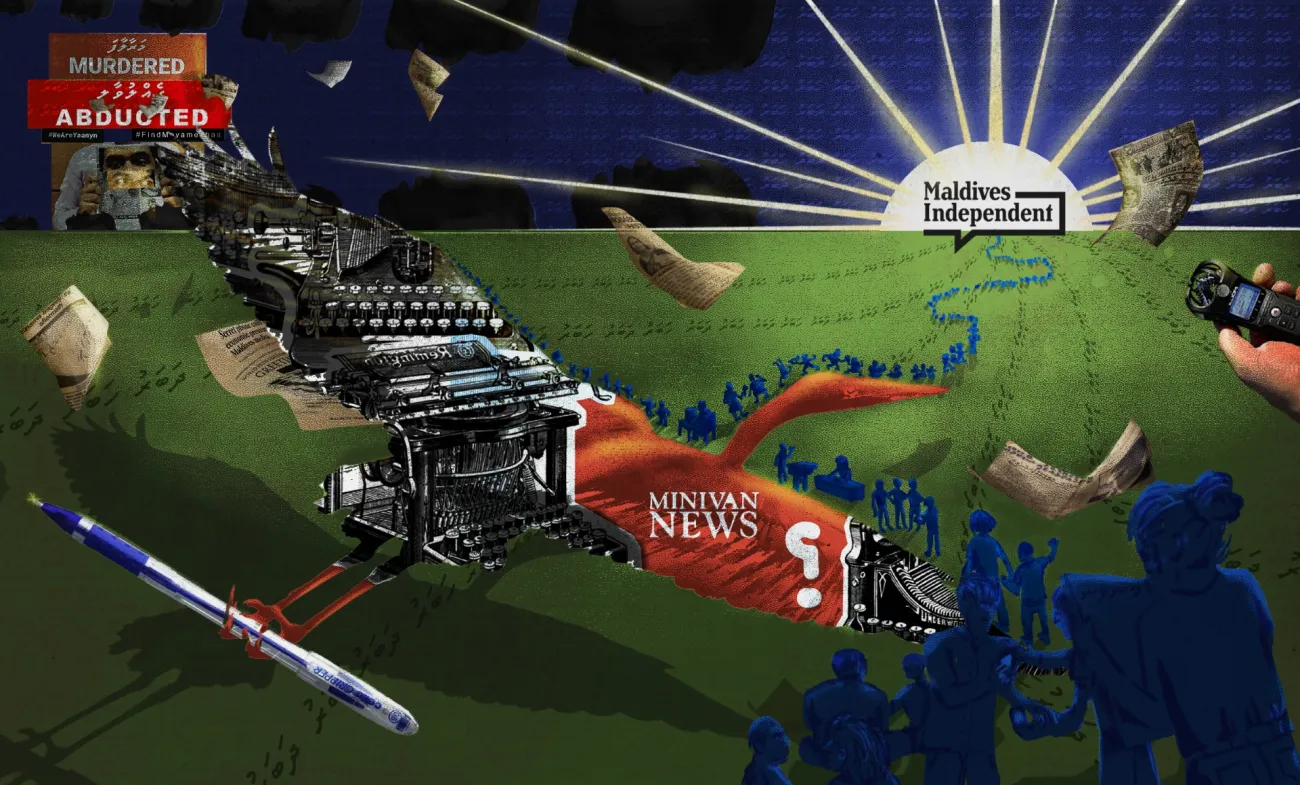
Minivan News, founded in 2004, was one of the first online newspapers in the Maldives, building a reputation for award-winning public-interest reporting. More than 20 years later, the newsroom has relaunched as the Maldives Independent, with a renewed commitment to groundbreaking journalism and a focus on reaching online audiences.
The lean, full-time editorial team comprises editor-in-chief Ahmed Naish and two senior journalists, alongside CEO Nur Thoufeeq. Working with a network of freelancers, a CTO and a contracted design team, the newsroom has big ambitions: it launched a membership programme in November 2025, aims to grow its core funding, and is working to rebuild its reputation and reach in a shrinking independent media space.
Since its relaunch, the newsroom has covered a pivotal legal case in which Battered Woman Syndrome was recognised as a valid partial defence for the first time. It has also worked with OCCRP to investigate an island investment deal proposed by a former president of the Maldives and revealed in the Epstein Files.
In this Q&A, co-founders Nur Thoufeeq, CEO; Ahmed Naish, editor-in-chief; and columnist Mohamed Saif Fathih discuss their plans for the newsroom, how reporting from the Maldives has changed, and the challenges of relaunching a news brand.
Q. Minivan News, which later became the Maldives Independent in 2015, ran until 2020. Why did the newsroom suspend operations?
Mohamed Saif Fathih (MSF): Part of the reason was that we were tired. One of our journalists [Ahmed Rilwan] was disappeared and one of our contributors [Yameen Rasheed] was killed, so our mind was not really there. We didn't know where to get funding and were fed up with the system. There was a presidential commission to investigate the murders and the enforced disappearance, but it didn't work. We didn't close down because we wanted to quit writing, but because we had to.
Q. What prompted the relaunch?
MSF: We couldn't just abandon the Maldives Independent. It's part of our lives. I started translating for the paper when I was 16; I’m now 33. The name was important because it comes with a reputation and integrity attached. We were known to do quality reporting. We were known to talk to people, have different perspectives, write about hard things.
We got together and thought: this cannot go on, we have to start writing. We have to start communicating with the younger generation. They're not interested in legacy media. There's no confidence there and the news cycle just seemed repetitive. We realised that the biggest chunk of people who wanted change, but didn't come out and vote were the younger people. If we can't talk to them, we can't protect the values that we [as the Maldives Independent] stood for. It was the right moment to start anew.
Ahmed Naish (AN): It was always meant to be temporary, it just took five years.
Q. You’ve told me that support from newsrooms and colleagues outside of the Maldives was crucial to the reboot, in particular help from Premesh Chandran, co-founder and CEO of Malaysiakini and its model; Roman Gautam, editor of Himal Southasian; and JJ Robinson, former managing editor of Minivan News and formerly of Open Society Foundations. What has changed and what has stayed the same?
Nur Thoufeeq (NT): A large percentage of our audience thought we were brand new to the market. We highlighted the history of the Maldives Independent during the relaunch in newsletters, social media posts and articles. We didn't want to relaunch something without speaking about the history.
On the editorial side, we shifted from daily news to more feature-style articles. Now we do a daily news-in-brief summary of everything that happened the day before and one article per day. We publish every day, except on Fridays, when we have our newsletter.
Ahead of the relaunch we asked: how can we set ourselves apart? How do we reach the audience? This has led to a few different things, including getting designers to create artwork for each article – this helps communicate with Gen Z on Instagram, for example – and longer-read articles. We knew that we would relaunch the Dhivehi [the national language of the Maldives] edition to reach the older audience.
In the beginning, people were confused about the ownership. In the Maldives, it’s common that even if you own a newsroom on paper, you're actually not the owner. People who fund it will have a hand in editorial guidelines and policies and what is published. But it is now fully owned by the team and we make [those] decisions. The proof of this is in the consistency and credibility of the editorial – all the articles, the planning, the balance. Comments about the ownership died down. People could see we were reporting fully on both sides.
Q. What’s it like to work as a journalist in the Maldives right now?
AN: There are two different threats. One is from the state as there's a new media law and a new regulator. We personally haven't faced any investigations yet, but other outlets are coming under pressure. The Media Control Act significantly expands the state's role in regulating journalism. It establishes a new regulator, the Maldives Media Council, with broad powers to investigate complaints, compel journalists and media organisations to provide information, issue orders, levy fines and require the publication or removal of content.
One of the most concerning aspects for journalists is the law's broad and sometimes vague provisions. The Act prohibits content deemed contrary to Islam, national security, public order, social norms or public morality, among other categories. It also grants the regulator authority to determine whether media content is “ethical” and to impose penalties for breaches.
The law creates a complaints-based mechanism through which public officials or private individuals can seek regulatory action against journalists and media outlets. While supporters argue that it promotes accountability, many journalists and press freedom advocates worry that the breadth of the provisions could encourage self-censorship, particularly when reporting on politically sensitive issues.
In recent months, journalists at Adhadhu were imprisoned for contempt of court in secret proceedings, editors have faced Qazf accusations linked to their reporting, reporters have been barred from presidential press conferences, and police have seized newsroom equipment as part of investigations. These actions did not arise directly from the Media Control Act itself, but they contribute to a wider environment in which journalists perceive increasing legal and regulatory pressure.
In the early days, under the first democratic administration, we merely pushed the envelope, and that's part of why we were targeted [In 2006, for example, a religious NGO organised protests against the newsroom and called for the deportation of its editor at the time. In addition, to the disappearance of Ahmed Rilwan and killing of contributor Yameen Rasheed, the Maldives Independent’s offices were raided by police in 2016 and its former editor forced into exile].
This wasn't by design, we just covered subjects that other media didn't want to touch. Coming back to the present day, we consciously decided that we would be more careful when doing these kinds of stories. It's a calculation driven by the legal and security environment in which we operate. The breadth of interpretation of Article 27 is the problem. It creates both legal exposure and the conditions for physical violence, and we have experienced both.
We now take a step back before instinctively reporting on otherwise newsworthy subjects if they appear to carry a strong religio-cultural dimension. This includes issues such as flogging, which remains prescribed under the penal code for certain offences, as well as stories relating to radicalisation, including the return of detained jihadist families from Syria or gang-linked radicalisation.
We have also consciously reduced our public profile and visibility. That includes being more restrained in interviews, reassessing how we approach sources, exercising greater caution regarding our personal online presence, and generally adopting a more security-conscious editorial culture when dealing with sensitive investigations. In some sensitive pieces, we have all together abandoned bylines, instead choosing to write Maldives Independent as the author.
The presidential commission that investigated both cases [Rilwan’s disappearance and Rasheed’s killing] was dissolved in 2024. The only two convictions in Yameen's case were overturned by the High Court in December 2025. Nobody has ever been convicted in Rilwan's case. The people who organised and financed these killings remain free. That legacy of impunity is the backdrop against which we make editorial decisions.
So when people ask whether our approach to stories involving religion is self-censorship or a necessary compromise, the honest answer is: both. We do not avoid difficult stories, but we are acutely aware of the lines that can get people killed in this country, and we navigate around them deliberately.
Q. Tell us about the audience of the Maldives Independence and your plans to grow a membership programme.
NT: As of last month, we have around 110,000 monthly active users on the English-language site and our monthly Dhivehi readers average 12,000. Our reach across all social channels in February was 1.7 million, which is larger than our population. We reach an international audience, plus a lot of our environmental stories, in particular, are shared on Instagram and Facebook.
We launched membership in November 2025 and currently have 21 paid members and 553 registered non-paying members – and one institutional membership that’s being processed now. We’re taking a mixed approach to growth. On the institutional side, we’ve been reaching out directly to embassies and high commissions; on the audience side, we’ve tested paid social, including a sponsored Instagram reel to introduce our membership model and a separate campaign promoting Fili, our daily Dhivehi word game, as a way to bring new users into the ecosystem
With membership, I don't believe in putting content behind a paywall and, with a small editorial team, we thought instead of doing editorial deliverables, why not deliver members additional features on the website as perks? For non-paid members, you can switch the website between dark and light mode, you can comment on articles. You can access the archives. These are small perks just for this iteration of the membership.
We are also pushing the narrative of supporting the mission and some people have sent money directly. Some people from the diaspora have signed up. We're hoping to cover some of the website costs.
MSF: Subscriptions are really new to the Maldives. This culture of supporting a cause, supporting journalism, and the sort of journalism that you want to see, is not common here. The total membership figure is currently low, but we want people to get used to the idea that journalism can be supported through their own means, and that newspapers or journalists don't necessarily have to obey an overlord and protect their business interests.
Q. What are your editorial and product priorities?
AN: One of the first things we decided was not to do daily news anymore. As the old Maldives Independent, we were always chasing the news cycle with a small team and we could never do any in-depth reporting.
Maybe it’s a bit of a cliche to say we want to do underreported subjects, but in our case, it happens to be true. Even in our previous iteration, we covered all these stories that never appeared anywhere else. We knew that if we came back and focused this time on more long-form, in-depth features, we could operate more sustainably this time.
NT: Before we launched, we discussed editorial policies and said “We don't work for anyone, we can do what we want.” Two things we said were: let's try not to get anyone killed and let's make sure that we survive long-term.
In every email we send you'll find original reporting, evidence-based insights, online seminars and readings curated from 100s of sources - all in 5 minutes.