

News
The market is failing public interest journalism. This policy framework can help save it

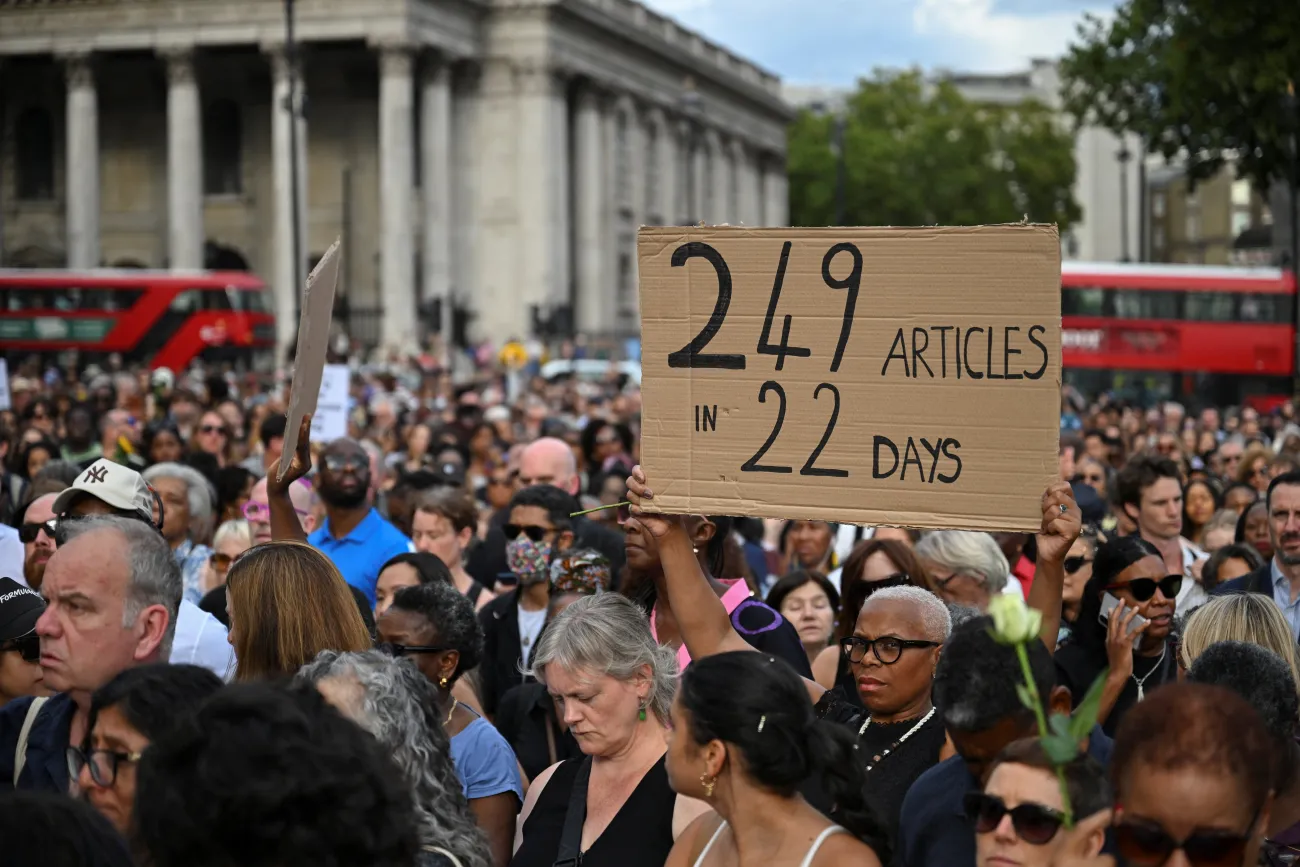
A person holds up a sign at a vigil by Stand Up To Racism to remember former Cambridge professor Jason Arday, who died aged 41 after resigning amid plagirism allegations he denied, at Trafalgar Square in London, Britain, August 17, 2026. REUTERS/Chris J. Ratcliffe
In mid-October an investigation by scientific publisher Taylor & Francis failed to substantiate plagiarism allegations raised against Jason Arday, the professor of Sociology of Education at the University of Cambridge who took his own life in August after facing intense media scrutiny over allegations concerning his academic credentials and research.
The Taylor & Francis findings follow an earlier investigation by Liverpool John Moores University, which concluded that attribution errors in Arday’s doctoral thesis were consistent with honest mistakes rather than deliberate plagiarism. The latest decision does not resolve every question raised about his academic record or appointment, but it adds another dimension to the debate surrounding his treatment by the British press.
There were several calls for investigations into British media coverage of Jason Arday’s story following his death. These tragic events raise questions about the role of journalism as a watchdog but also about what constitutes public-interest journalism.
In October, a man died after entering a tiger enclosure at Yorkshire Wildlife Park. His identity was subsequently published by news organisations, despite reports that his family had initially asked police not to name him. In a statement released through South Yorkshire Police, his family criticised the circulation of distressing material relating to his death and asked journalists not to approach them or obtain further content from their social media accounts.
Most recently, a ‘famous’ public figure is seeking a permanent injunction against the Guardian and ITN to prevent publication of allegations concerning his conduct towards girls and young women. The barrister for the unnamed man has argued that publication of his identity “would have a potentially fatal impact” as he has attempted suicide twice because of “the fear of trial by media.” The news organisations maintain that their investigation concerns matters of significant public interest.
Although the circumstances differ considerably, the three cases expose a recurring dilemma for journalists: when does the public’s right to know outweigh an individual’s right to privacy? And who decides how far reporting should go?
For Gia Thom, of press regulator Impress, the central issue is not whether journalists should investigate matters of public concern, but how they justify the extent of their reporting. “Public interest can open the door, but proportionality dictates how far that is opened,” she told me.
Roger Mosey, former BBC editorial director, agreed that while scrutiny can become excessive, he questioned whether regulation can provide a workable answer to where the boundary lies. “It’s very hard to say you’ve written three articles [and] you must not write a fourth,” he told me.
This disagreement points to a wider question for journalism in the UK and elsewhere: not simply what constitutes the public interest, but how it should be applied once a story has become news.
The allegations against Arday prompted questions about his research, his qualifications and the procedures through which one of Britain’s most prestigious universities appointed senior academics. Cambridge announced an investigation into the circumstances surrounding his appointment and has since commissioned an independent review following his death.
For Mosey, the broader institutional significance of the story made scrutiny legitimate. “The Arday case was actually about an institution. It was about Cambridge University. It was about public policy. It was about equality, diversity, and inclusion,” he said. “It wasn’t simply an individual or a famous person being randomly attacked.”
Arday’s public profile also mattered. Beyond his academic position, he had appeared on programmes including BBC Question Time and Sunday with Laura Kuenssberg and had guest-edited BBC Radio 4’s Today programme. Those roles, Mosey suggested, reasonably attracted a degree of public scrutiny.
Thom similarly acknowledged that questions about plagiarism allegations and Cambridge’s appointments process justified an investigation, particularly where they might reveal institutional failures. But she argued that establishing a legitimate public interest at the outset should not give journalists unlimited scope to pursue a subject.
“The right to investigate is not a right to intrude,” she said.
Under Impress’s standards, she explained, publishers should consider whether publication is necessary, whether less intrusive alternatives are available, and whether the scope and persistence of coverage remain proportional to the public interest being served. Crucially, she argued, those considerations should apply to each article rather than simply to the original investigation. That distinction becomes especially important when a story generates sustained coverage across multiple news organisations.
“There’s often incentives for cumulative media scrutiny into a specific individual,” said Thom. “However, those incentives are much more around audience demand which is not the same as public interest.”
The volume and intensity of reporting about Arday became a source of controversy following his death, with critics questioning whether the scale of the coverage was proportionate to the allegations.
His family said he had experienced sustained abuse during his time at Cambridge and a petition calling for an inquiry into the reporting of his case subsequently attracted tens of thousands of signatures.
But the existence of distress, even severe distress, does not by itself establish that reporting was unjustified. Nor has a causal relationship between press coverage and Arday’s death been established.
For Mosey, journalists must distinguish between the legitimacy of an investigation and the proportionality of individual stories.
“I think it’s sometimes difficult for people to hold two ideas in their head,” he said, explaining that the first idea is recognising that public scrutiny of individuals is necessary and justified, while the second is questioning the overall proportion and nature of that coverage.
For Mosey, these decisions require qualitative editorial judgment rather than a numerical limit on coverage. Mosey notes that coverage can become disproportionate when journalists stray from substantive institutional issues into minor side-stories or private life details that lack real weight.
On the other hand, Thom sees a greater role for independent oversight. While Impress requires its member publishers to demonstrate the necessity and proportionality of their reporting, most national newspapers in the UK operate outside its regulatory framework. For Thom, this fragmented system weakens accountability, particularly when sustained coverage across multiple outlets causes cumulative harm.
“We are not lacking in definitions. We are not lacking really in the codes. The issue is the consistent application of it,” she said.
The death of the man entering a tiger enclosure at Yorkshire Wildlife Park illustrates how questions of proportionality can arise even when the newsworthiness of an event is not in doubt.
The circumstances of his death attracted national attention. But the decision to identify him, and the subsequent circulation of material relating to the incident, raised separate questions about the public-interest value of publishing personal information.
His family’s initial request was reported specifically as a request that police withhold his identity. It does not necessarily follow that news organisations had received a direct request not to identify him. The family later released a public tribute naming him, while criticising the circulation of distressing material and asking for privacy.
Reporting a fatal incident, identifying the person involved and reproducing graphic or personal material are separate editorial decisions, each with different implications for privacy and potential harm. But restrictions on publication can create problems of their own.
In proceedings currently before the High Court, a well-known man is seeking to prevent the Guardian and ITN from publishing allegations of inappropriate and exploitative sexual activity involving girls and young women. The man denies the allegations and his lawyers argue that publication would create serious risks to his life and well-being, alluding to suicidal ideation.
The two news organisations argue that the allegations, which they say are supported by extensive reporting and first-hand accounts, concern matters of substantial public interest.
The case poses some allusions to the Arday controversy. If the potential consequences for an individual are severe, should that justify preventing the publication of otherwise lawful, public-interest reporting?
The disagreement over where to set that boundary reflects a longstanding divide in British press regulation.
More than a decade after the Leveson Inquiry, set up after the phone hacking scandal, the UK’s regulatory landscape remains fragmented. Impress, for example, operates under a framework recognised by the Press Recognition Panel, while most major national newspapers belong to the Independent Press Standards Organisation (IPSO) or operate outside those arrangements.
Thom argues that the failure to proceed with the second part of the Leveson Inquiry left important questions about press culture, institutional relationships and accountability unresolved.
She believes broader adoption of independently recognised regulatory standards would strengthen the application of public-interest tests and provide more meaningful remedies for people affected by intrusive reporting. For her, the issue is not preventing investigations but requiring publishers to demonstrate why potentially harmful reporting was necessary.
“Editors need to be able to avoid things like gratuitous intrusion, repeated publication of the same allegations when there isn’t any new evidence, and I would say the kind of tactics that really amount to harassment at the end of the day,” she said.
Mosey is more sceptical about extending regulatory intervention. He warned that demands for greater press restrictions can sometimes be driven by opposition to particular stories rather than concerns about journalistic conduct. The danger, in his view, is that restrictions intended to protect individuals could also discourage scrutiny of institutions and public figures.
Yet he does not suggest that editorial freedom removes the obligation to exercise care. Mosey argued that journalists must recognise the human consequences of putting individuals under sustained scrutiny, including where mental health vulnerabilities are involved.
“You’ve got to make sure your coverage has both rigour and sensitivity,” he said. “You have to be fair to everybody and recognise that these individuals are real people at the heart of them.”
However, the question of how to achieve that balance between sensitivity and rigour remains unresolved. The Arday case has already prompted institutional reflection. Cambridge’s independent review will examine the support available to him before his death, alongside broader questions about its decision-making and appointment processes.
For the press, however, the challenge is less easily confined to a single institution or inquiry.
The latest findings concerning Arday’s academic work underline the importance of continuing to report accurately as evidence develops. They do not, on their own, establish that the original investigations were illegitimate. But they raise questions about whether allegations and subsequent findings receive comparable scrutiny and prominence.
The case of the man who died after entering a tiger enclosure and the injunction against the Guardian and ITN reveal different sides of the same tension. In one, the question is whether identifying a private individual and circulating personal material added enough public value to justify the intrusion. In the other, it is whether the risk of harm should prevent journalists from publishing serious allegations they believe the public ought to know.
Both involve judgments that are difficult to reduce to a single rule.
Thom and Mosey both agree that the public interest is not necessarily a fixed threshold that, once crossed, justifies everything that follows. It is a continued judgment about the necessity, significance and consequences of publication.
Whether that judgment should ultimately rest with editors, regulators or courts remains contested. But the question for news organisations is perhaps more immediate: once the public interest in a story has been established, what justifies the next article?
In every email we send you'll find original reporting, evidence-based insights, online seminars and readings curated from 100s of sources - all in 5 minutes.